Disclosure: Some links in this guide are affiliate links. If you book or buy through them, we may earn a small commission at no extra cost to you — it helps keep our guides free.
Siem Reap is safe for most travellers, and Cambodia sits at level 2 of Smartraveller’s 4 advice levels overall, “exercise a high degree of caution,” with the only area under the highest level 4, “do not travel,” is land within 50km of the Thailand-Cambodia border, well over 100km from Angkor and Siem Reap town.
The real risks here are petty theft, tuk-tuk scams and getting your Angkor ticket from the right place, not armed conflict.
| Risk | How likely | How serious | What actually prevents it |
|---|---|---|---|
| Bag-snatching, pickpocketing | Occasional around Pub Street after dark | Financial, rarely violent | Crossbody bag worn in front, phone zipped away once the sun goes down |
| Tuk-tuk and “temple closed” scams | Common with street-hailed or unlicensed drivers | Wasted time, inflated fares | Book through your hotel or an app, agree the fare before you get in |
| Angkor ticket scams | Occasional near park entrances and online | Financial, invalid ticket | Buy only from the official Angkor Enterprise office or its site |
| Landmines in remote rural areas | Rare, confined to unmarked land far outside Angkor | Severe if it happens | Stay on marked paths; the Angkor complex itself is fully cleared |
| Armed conflict at the Thai border | Not present in Siem Reap or Angkor | N/A, a different zone entirely | Siem Reap sits well south of the do-not-travel line |
Siem Reap and Angkor sit outside the Thailand border warning
Cambodia’s overall Smartraveller rating is level 2 of 4, “exercise a high degree of caution,” the same tier as much of Southeast Asia.
A separate, more serious warning applies only to a narrow strip of the country: on 20 February 2026, Smartraveller raised land within 50km of the Thailand-Cambodia border to level 4, “do not travel,” across the provinces of Banteay Meanchey, Oddar Meanchey, Preah Vihear, Battambang, Pailin, Pursat and Koh Kong, citing armed clashes between Cambodian and Thai forces and the ongoing presence of landmines and other explosive remnants of war along that frontier. Land border crossings between the two countries remain closed.
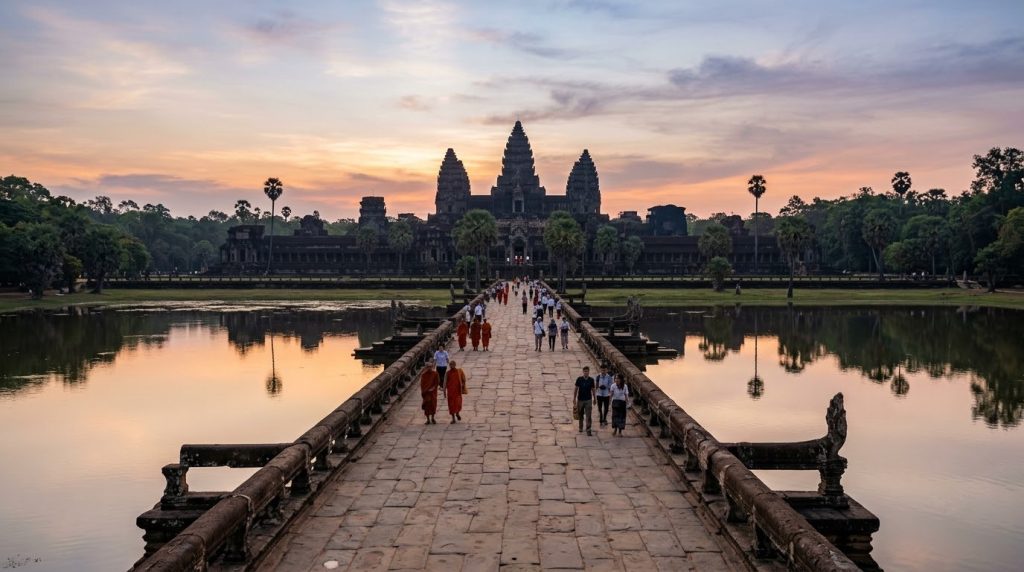
The flashpoint sits around the disputed Preah Vihear temple area, northeast of Siem Reap, not around Siem Reap itself. Angkor and Siem Reap town lie well over 100km south of that 50km border strip, an entirely different part of the country with a different, much lower risk profile.
It’s an easy mix-up for anyone skimming border-tension headlines, so worth stating plainly: Siem Reap and the Angkor temples are not inside the do-not-travel zone, and both have stayed open, busy and calm for tourism through 2026.
For the fuller national picture, including what the border tension does and doesn’t change for a Cambodia trip more broadly, see this Cambodia safety guide.
Petty theft around Pub Street
Petty theft, not violent crime, is the most likely problem in Siem Reap, and it clusters around Pub Street and the Old Market night scene rather than the temples.
Bag-snatching from passing motos and opportunistic pickpocketing in the crowded, poorly lit lanes off Pub Street tend to pick up after dark, when tourists are relaxed, drinks are flowing and bags are hanging loosely off one shoulder or a chair back.
It’s a lower-intensity version of the same risk you’d meet in Bangkok or Phnom Penh, not a spike unique to Siem Reap, and it rarely escalates beyond a stolen phone or wallet.
Wear a bag crossbody and in front rather than over one shoulder when walking Pub Street at night, keep your phone zipped away instead of on the table at a streetside bar, and skip the side alleys that peel off the main strip after midnight. During the day, around the Angkor temples and Old Market, the same precautions matter less; theft here is overwhelmingly a night-and-nightlife pattern.
Tuk-tuk scams and the Angkor ticket office
Tuk-tuks are the default way to cover Angkor’s spread-out temples, and most rides are straightforward if you settle the price first. The scam to watch for is the “your guesthouse is closed” or “that temple is shut today” line, usually followed by a suggestion to visit a commission-paying shop, restaurant or “better” temple instead.
A related trick near Pub Street and the temple gates is the photo prop, where a vendor hands you a basket or conical hat for a free photo, then demands a tip once you’re holding it. Neither is dangerous, just an annoyance and a few dollars if you fall for it.
Book your driver through your hotel or an app, agree the day rate upfront, typically AUD 25 · USD 18 for a full day covering the main temple circuit, and decline unsolicited offers outright rather than negotiating them down.
Angkor tickets are the other scam point worth knowing before you land. Buy only from the official Angkor Enterprise ticket office at the main checkpoint or through its own site; third-party sellers and street touts near the park entrances have sold invalid or overpriced passes to visitors who then get turned away at the gate.
Official 2026 pricing runs AUD 51 · USD 37 for a one-day pass, AUD 86 · USD 62 for three days usable across a 10-day window, and AUD 100 · USD 72 for seven days usable across 30 days; children under 12 enter free.
A Siem Reap travel budget guide is worth checking before you go, since the ticket and driver together are usually the single biggest line item on a temple day.
Landmines, traffic and getting sick
Landmines are the most alarming word associated with Cambodia, and the most misunderstood in a Siem Reap context.
The Angkor Archaeological Park itself is fully cleared and has been safely walked by millions of visitors; the residual landmine and unexploded-ordnance risk that Smartraveller flags sits in unmarked rural and forested land, overwhelmingly near the Thailand border zone described above, not inside the park or on any route a standard itinerary follows.
The rule that actually matters: stay on marked paths and established trails on any day trip that heads further out from Siem Reap, and never cut across open fields or forest edges to save time.
A day trips from Siem Reap guide is the right place to check which routes are well-travelled before adding a more remote temple to your plan.
Traffic is a steadier, more mundane risk than either scams or landmines. Siem Reap’s roads mix tuk-tuks, motos, bicycles and cars at modest speed, and the main danger is a moto or bicycle collision rather than anything more severe; wear a helmet if you rent your own scooter, and expect chaotic but slow-moving traffic near the Old Market at peak hours.
Food and water hygiene is a mild, ordinary travel risk: stick to bottled or filtered water and busy, high-turnover food stalls, and a mild stomach upset is more likely than anything serious. Dengue is the one health risk worth real attention in wet season.
Cambodia recorded 28,074 dengue cases and 38 deaths nationwide by 12 July 2026, a 58.1% rise on the same period in 2025, with Siem Reap consistently among the provinces reporting the highest case counts alongside Phnom Penh, Kandal and Battambang.
Pack repellent, cover up around dawn and dusk, and check a best time to visit Siem Reap guide before booking a wet-season trip, since the May-to-October rains are exactly when dengue transmission peaks.
Who should think twice about Siem Reap
Siem Reap suits nearly every kind of traveller, including solo and female travellers, who generally get around with normal city-level caution and no particular trouble. The exceptions are specific, not general.
Anyone planning to cross overland into Thailand or explore near the disputed Preah Vihear frontier should reconsider that leg entirely, since it sits inside Smartraveller’s level 4 do-not-travel zone regardless of how calm Siem Reap itself feels, and the land border crossings there are closed in any case.
Travellers tempted to wander off marked paths at a remote, little-visited temple or rural site to get a better photo are taking on the one real landmine risk in the region, one the fully cleared Angkor park does not carry.
Night owls who plan to walk Pub Street’s side alleys alone after midnight with a phone in an open bag are adding avoidable risk to an otherwise low-key trip.
Choosing a safer base
Where you stay changes your daily exposure to Siem Reap’s two real risks, night theft and tuk-tuk hassle, more than any other single choice.
A hotel or guesthouse within a short, well-lit walk of Pub Street and the Old Market keeps late-night journeys short and puts you close to drivers your accommodation already knows and trusts, while a budget stay further out means more unfamiliar tuk-tuk rides after dark to get home. Compare neighbourhoods and book through the map below before locking in dates.
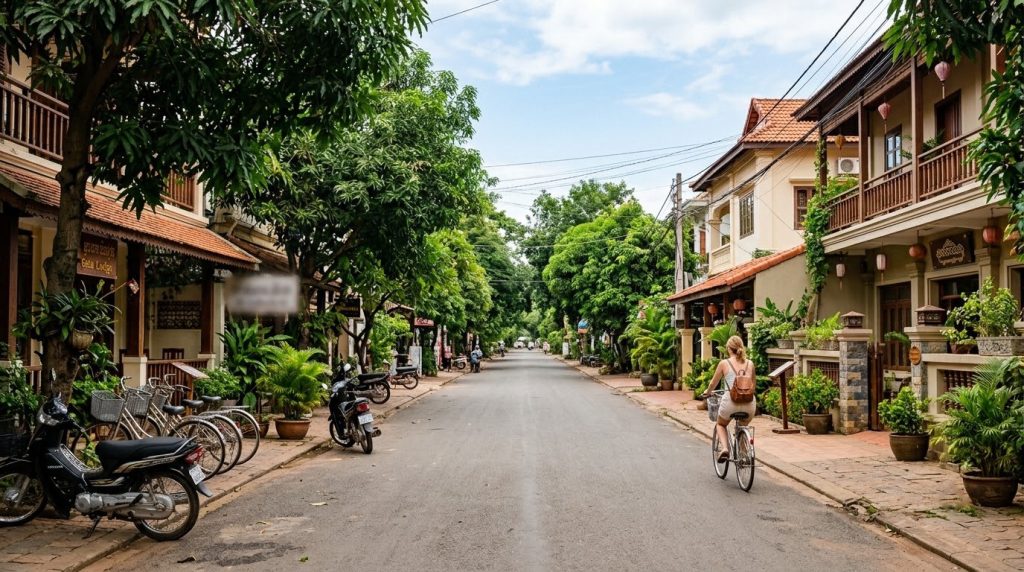
Find your Siem Reap hotel on the map
Live prices from Booking, Airbnb and more — move the map or change dates to compare stays across Siem Reap.