Vietnam Itinerary 7 Days: Hanoi, Ha Long Bay and Hoi An Without the Rush (2026)
By TravelguidestipUpdated 13 min readHow we earn
Hotel buttons open Stay22 (Booking.com, Agoda and others) and tour buttons open GetYourGuide. We may earn a commission at no extra cost to you.

Seven days in Vietnam works best as a north-plus-centre trip: three nights in Hanoi with a Ninh Binh day trip, one night on a Ha Long Bay cruise, then a 1 hour 20 minute flight to Da Nang for two nights in Hoi An. Do not try to cover Hanoi to Ho Chi Minh City in a week.
The country is 1,726 km long by rail, and every extra base costs you half a day in transit.
| Day | Sleep in | Highlights |
|---|---|---|
| 1 | Hanoi (Old Quarter) | Arrive, street food, Hoan Kiem Lake |
| 2 | Hanoi | Temple of Literature, Ho Chi Minh Mausoleum, egg coffee |
| 3 | Hanoi | Day trip to Ninh Binh: Trang An boat ride |
| 4 | Ha Long Bay cruise | Expressway transfer, kayaking, cave visit |
| 5 | Hoi An | Cruise back to Hanoi, evening flight to Da Nang |
| 6 | Hoi An | Old Town heritage sites, lanterns at dusk |
| 7 | Flight home | Morning bike ride, fly out via Ho Chi Minh City or Hanoi |
Why you should skip the north-to-south run in 7 days
The Reunification Express takes 32 to 36 hours from Hanoi to Saigon, and even Hanoi to Da Nang is 15.5 to 17 hours by train. Flying the full length takes only about 2 hours 10 minutes in the air. Add the airport runs and check-in, though, and each flight eats most of a day. A north-to-south week loses roughly two days to transit. If a week feels too tight, our guide to how many days in Vietnam you really need shows what three weeks adds: mountains, the Mekong or an island.
So pick two regions and fly once. North plus centre is the strongest first-timer combination: limestone karsts, Hanoi’s food and Hoi An’s old town. If you can stretch the trip, our 10-day Vietnam itinerary with a third region is the next step up. The two-week Vietnam route from Hanoi to the Mekong does the full length without wrecking you.
Days 1–2Hanoi’s Old Quarter on foot
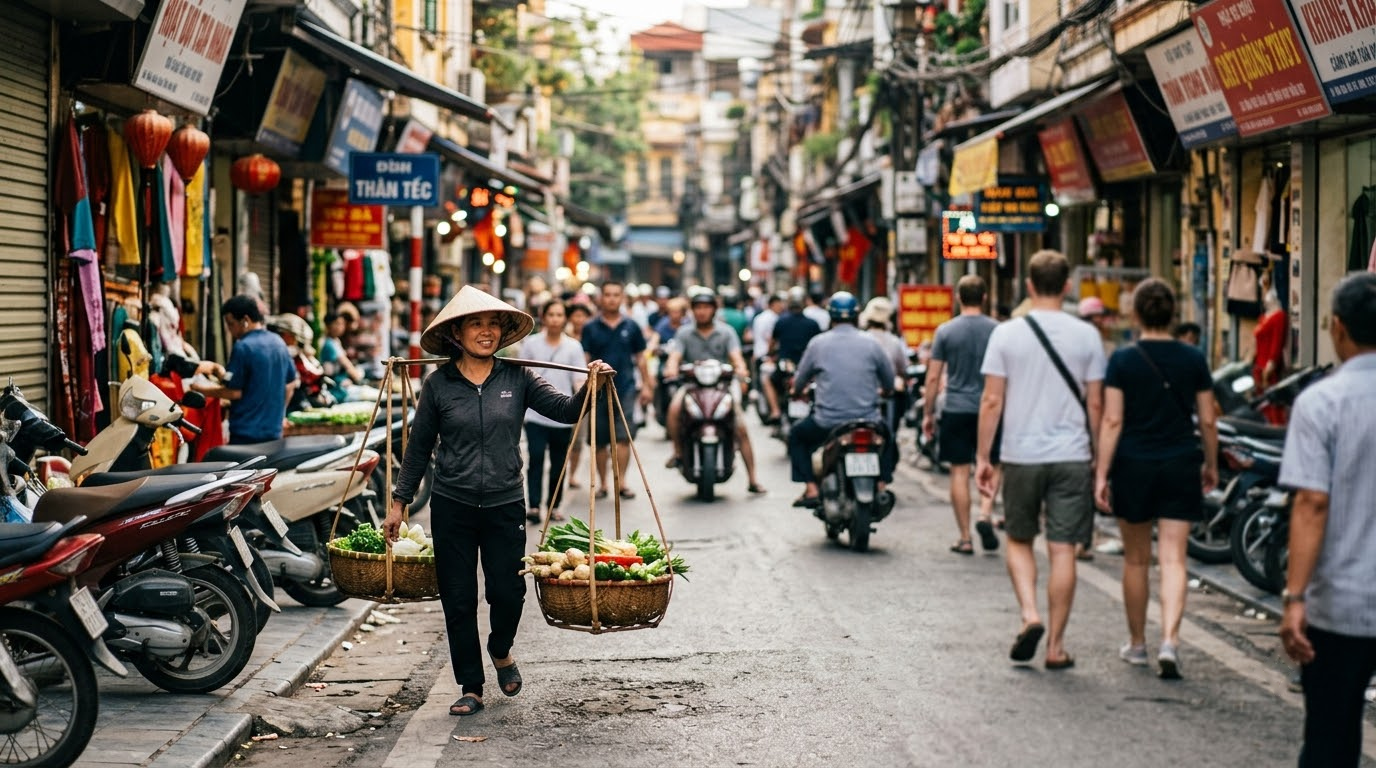
From Sydney, Vietnam Airlines runs the only non-stop to Hanoi. It takes about 10 hours 5 minutes, with fares from around AUD 733 · USD 528 one way. Melbourne’s direct flights land in Ho Chi Minh City instead, after 8 hours 25 to 8 hours 40 minutes on Jetstar, VietJet or Vietnam Airlines. If you are flying from Melbourne, either connect north or run this route in reverse.
Get your e-visa on the official evisa.gov.vn portal at least a week out. It costs AUD 35 · USD 25 for a single entry, is valid for up to 90 days and takes 3 to 5 Vietnamese business days. Our Vietnam eSIM guide compares data plans for Grab-heavy weeks.
Spend day 1 recovering: pho, a lap of Hoan Kiem Lake, an early night. On day 2, do the Temple of Literature and the Ho Chi Minh Mausoleum complex (check the hours, because it closes early), then go on a street-food crawl after dark.
Day 3Ninh Binh day trip from Hanoi

Ninh Binh is about 93 km south of Hanoi, 1.5 to 2 hours by car or tour bus. The highlight is the Trang An boat ride: 2 to 3 hours rowed through caves and past temples. The ticket rose on 1 January 2026 and now costs AUD 16 · USD 11.50 (VND 300,000) per adult, with up to four passengers per boat.
Sleep in Hanoi again. Your Ha Long shuttle collects from the Old Quarter tomorrow, so moving hotels for one night in Ninh Binh gains nothing.
If you are short on time: drop Ninh Binh. The cruise gives you similar scenery, and you get a slower Hanoi day back.
Ninh Binh beyond the Trang An boat ride
If you have energy after the boat, a few more stops fit into the same day without extra transfers.
- Hang Mua viewpoint: A climb of about 500 steps rewards you with views over the rice paddies and river bends. Go early or late to avoid the heat, and wear shoes with grip.
- Tam Coc: A boat ride past rice paddies, best around the harvest season in May and June, when the fields turn gold.
- Bai Dinh Pagoda: Vietnam’s largest Buddhist complex, with a giant gold Buddha. It suits a short stop if the weather turns.
You will not fit all three plus Trang An in one day trip. Choose Trang An plus one other stop, and ask your driver to sequence them so the hot middle of the day is spent on the water rather than on stairs.
The Ha Long shuttle collects from the Old Quarter the next morning, so book a driver who promises a return to Hanoi by early evening.
Day 4one night on Ha Long Bay

Cruise shuttles pick up around the Old Quarter and Hoan Kiem Lake. The expressway run takes 2.5 to 3 hours with a rest stop. Go overnight. A day trip means 5 to 6 hours on a bus for a few hours on the water, and you miss sunset and early morning on the bay.
What a two-day, one-night cruise costs in 2026:
| Tier | Price per person | What you get |
|---|---|---|
| Budget | from AUD 125–146 · USD 90–105 | Older boats, shared shuttle, basic cabins |
| Mid-range (4-star) | AUD 180–347 · USD 130–250 | Better food and cabins |
| Luxury | from AUD 347–417 · USD 250–300 | Top-end boats, more inclusions |
Fares normally cover the cabin, meals on board, a guide, kayaking, the bay entry fee and the shuttle from Hanoi. Solo travellers pay a single supplement of 30 to 70 per cent. Ask which bay the boat sails. To see how a cruise fits around AUD 35-70 backpacker days, read our breakdown of what Vietnam really costs Australians.
Day 5back to Hanoi, fly to Da Nang
One-night cruises finish with lunch on board and then the drive back, so plan on reaching Hanoi in the late afternoon. Book an evening flight to Da Nang and leave at least three hours between the expected drop-off and departure, because shuttles run late. The flight takes 1 hour 20 minutes.
Fares run AUD 56–139 · USD 40–100 return. Hoi An is about 30 km from Da Nang airport, 40 to 50 minutes by Grab or taxi, or up to 90 minutes in peak traffic.
If you are short on time: skip Hoi An and do Hanoi, Ninh Binh and Ha Long only. That gives you a relaxed northern week with no internal flight.
Days 6–7Hoi An, then home
Buy the Old Town ticket, which costs AUD 7 · USD 5 (VND 120,000) and covers five heritage sites. Walk the river at dusk when the lanterns come on. On day 7, cycle out to the rice fields or An Bang beach before an afternoon flight.
We could not confirm a non-stop flight from Da Nang to Sydney or Melbourne for 2026, and VietJet’s own route page lists only Ho Chi Minh City to Melbourne. Connect through Saigon or Hanoi on a single ticket.
Timing warning: central Vietnam’s rainy season runs September to December and peaks in October and November, when Hoi An’s Old Town often floods. The north is best October to April and the centre February to May, so February to April suits both halves. See Rough Guides’ month-by-month breakdown, and for daily costs, read our Vietnam travel budget for Australians.
Hanoi sights: opening days, fees and rules
Hanoi’s big historic sights run on tighter schedules than most tourist attractions, so check before you build a morning around them.
Ho Chi Minh Mausoleum
Admission is free, but visits are limited to mornings and the building closes for periodic restoration, typically two to three months a year. In 2026 it was closed from 4 September to 2 November and reopened on 3 November.
Morning entry starts from 7:30am between April and October and from 8am between November and March. Reports name Monday and Friday as non-visiting days, so confirm the current schedule. Remove your hat, keep your voice down, and cover shoulders and knees.
Temple of Literature
Adult tickets are VND 70,000 (AUD 3.90 · USD 2.80), paid in cash. The site is open daily from 8:00 to 17:00, with last entry at 16:30, and it closes for several days around Tet and some public holidays. Allow 45-60 minutes, or about 90 minutes if you add the Giam Garden at the back.
Staff turn away tank tops, crop tops and very short shorts or skirts. Bring a light shirt or scarf rather than buying one at the gate.
Water puppet theatre
The Thang Long Water Puppet Theatre sells standard, deluxe and VIP seats, and a show runs for about 50 minutes. Third-party sites list different showtimes, so buy from the theatre’s own site or box office.
Food to try in Hanoi and Hoi An
Hanoi’s street food is built around a handful of dishes locals eat daily. Pho, the beef noodle soup, is the obvious starting point and best at breakfast from a stall with plastic stools rather than a sit-down restaurant.
Bun cha, grilled pork served over rice noodles with a sweet-and-sour dipping sauce, is the dish many Hanoians rank above pho. Cha ca la vong, turmeric-and-dill grilled fish cooked tableside, is a Hanoi specialty tied to one street of restaurants that have served it for generations.
Bun dau mam tom pairs fried tofu and rice noodles with fermented shrimp sauce. The sauce is strong, so order it alongside something milder on a first try.
Egg coffee, whipped egg yolk and condensed milk poured over strong coffee, started in Hanoi and is worth one cup even if the idea sounds strange. Vietnamese iced coffee and coconut coffee are easier, more familiar options if egg coffee is not for you.
Hoi An’s Old Town night market is a better food plan than chasing one named dish: stalls rotate by season, and walking the market after dark covers more ground than any single restaurant booking. Banh mi, the French-influenced baguette sandwich, is sold across Vietnam and makes a fast lunch between sightseeing stops in either city.
Street stalls are cash-only, so keep small VND notes on hand rather than large bills that vendors may not be able to change.
What to pack for North Vietnam
North Vietnam runs cooler and drier than the south, and the right kit depends on when you travel. October to April is the main dry season for Hanoi and Ha Long Bay, with cooler mornings and evenings, especially December to February.
Pack a light rain jacket or a compact umbrella regardless of season, since short downpours happen even outside the wet months. Breathable, light-coloured clothing works for daytime walking in Hanoi’s Old Quarter and Hoi An’s Old Town.
Bring at least one warmer layer if travelling December to February, since Hanoi mornings can feel genuinely cold despite Vietnam’s tropical reputation. A light jumper or jacket covers early starts for the Ninh Binh day trip and the Ha Long Bay cruise.
Comfortable walking shoes matter more than sandals here. The Old Quarter’s pavements are uneven, and the Trang An boat dock and Ha Long cave visits both involve some walking and steps.
Modest clothing, shoulders and knees covered, is expected at the Temple of Literature, the Ho Chi Minh Mausoleum complex and Hoi An’s heritage sites, so pack at least one outfit that covers both.
Insect repellent and sunscreen cover the cave visits and boat days. A dry bag is useful for the Ha Long Bay kayaking stop, where phones and cameras get wet easily. A universal power adapter is worth packing too, since Vietnam uses a mix of plug types and hotel reception desks do not always have a spare.
Getting around: Grab, taxis and trains
Grab, Vietnam’s ride-hailing app, covers Hanoi, Da Nang and Hoi An and is the simplest way to move around each city. Fares show upfront in the app, which avoids the negotiation that unmetered taxis sometimes require.
Hanoi’s Noi Bai International Airport sits roughly 40 minutes from the Old Quarter by car. Book an airport transfer in advance or use Grab from the arrivals hall rather than an unmetered taxi tout inside the terminal.
In the Old Quarter itself, walking covers most sightseeing since the historic streets sit close together. Use Grab for longer hops, such as to the Ho Chi Minh Mausoleum complex or back from dinner late at night.
Metered taxis are a reasonable backup where Grab coverage is thin, but confirm the meter is running rather than agreeing a flat fare with an unmetered driver.
Vietnam’s rail network connects Hanoi to the rest of the country, including overnight sleeper services, but this itinerary’s two side trips, to Ninh Binh and to Ha Long Bay, run faster by road than by rail, since neither town sits on the main line out of Hanoi.
In Hoi An, a rented bicycle is the easiest way to reach An Bang beach or the rice fields outside the Old Town, and most hotels either lend or rent one. Grab also operates in Hoi An for anything beyond cycling range.
Renting a scooter without prior experience on Vietnamese roads is the single most common way first-time visitors get hurt. A Grab car or a hired driver is the safer call for anyone not already comfortable riding in Southeast Asian traffic.
Safety and first-time mistakes to avoid
Vietnam is a safe country for most travellers, and the biggest practical risk on this itinerary is road traffic rather than crime. Crossing the street in Hanoi’s Old Quarter follows one rule: walk at a steady, predictable pace and let motorbikes flow around you, since stopping suddenly causes near-misses.
Keep bags across the body rather than on one shoulder in crowded tourist areas, and avoid holding a phone out near passing traffic. Bag and phone snatching by motorbike is the most common petty theft reported by visitors.
Agree a taxi fare or confirm the meter is running before the car moves. Book the Ha Long Bay cruise and the Ninh Binh day trip through an operator with reviews rather than a stranger who approaches you on the street.
A common first-time mistake is under-booking time at the Ho Chi Minh Mausoleum complex and Temple of Literature. Both close earlier than most sightseeing hours and enforce stricter entry rules than other attractions, so check opening hours and dress codes before turning up.
Another mistake is skipping travel insurance that covers the Ha Long Bay boat and the Trang An rowboat specifically, since not every general policy covers water transport. Check the policy wording before booking either trip.
Carry a printed or saved copy of the e-visa approval alongside your passport, since some land and air checkpoints still ask for a paper copy rather than a phone screen. Use only the official evisa.gov.vn portal; agencies charging well above the official fee for “guaranteed” approval are unnecessary for most nationalities.
Swap Hoi An for Sapa, or choose another route
Some travellers prefer to stay north and trade the internal flight for mountains. The trade-off is that you drop Hoi An and cut about a day from the bay.
North-only with Sapa
Sapa is a long haul from Hanoi, so it only works with at least two nights. Road transfers by bus or limousine take roughly 5.5-7 hours, and fares are about VND 450,000-750,000 (AUD 25-42 · USD 18-30).
The overnight train takes 8-9 hours to Lao Cai, then about 35 km by bus or taxi to Sapa. The Fansipan cable car costs roughly VND 550,000-750,000 per person (AUD 29-40 · USD 21-29), and the station is about 9 km from Sapa town.
A workable plan is Hanoi (two nights), Sapa (two nights), Ha Long Bay (one night) and a final Hanoi night. You skip Ninh Binh or squeeze it into a half day.
Other 7-day routes
If the north does not suit your dates, two southern alternatives exist.
- South: Two days in Ho Chi Minh City, a day for the Cu Chi tunnels and the Mekong Delta (these tours last around 10 hours, with about 2 hours at Cu Chi), then Mui Ne for beach time.
- South and centre: Ho Chi Minh City, a flight of roughly 1.5 hours to Da Nang, Hoi An, and a Hue day trip for the Imperial City.
Domestic flights between the main cities take around two hours and have been quoted at about AUD 69 · USD 50 when booked ahead. Melbourne travellers land in Ho Chi Minh City on direct flights, which suits either southern route.
Where to stay in Hanoi, Ha Long Bay and Hoi An
– Hanoi Old Quarter (3 nights): walkable, full of food and inside nearly every Ha Long and Ninh Binh pick-up zone.
Noisy, so ask for a back room. – Hoan Kiem Lake edge: quieter, still near pick-ups, and better for couples and light sleepers. – Hoi An Old Town edge or An Bang beach (2 nights): the Old Town edge means you can walk in for the evenings, while An Bang has sand and quiet and suits families.
Find your Hanoi hotel on the map
Live prices from Booking, Airbnb and more — move the map or change dates to compare stays across Hanoi.
Related guides: Mekong Delta tours.
Frequently Asked Questions
Is 7 days enough for Vietnam?
Seven days is enough for two regions, not the whole country. Hanoi, Ha Long Bay and Hoi An fit comfortably with one internal flight. Adding Ho Chi Minh City or the Mekong Delta means extra flights and roughly two days lost to transit, so save the south for a trip of 10 days or more.
Should I do north or south Vietnam in a week?
For a first visit, do north plus centre. Ha Long Bay, Ninh Binh and Hoi An are the most distinctive sights and sit one short flight apart. The south suits a beach-and-city break, and Melburnians may prefer it, because direct flights from Melbourne land in Ho Chi Minh City.
Do Australians need a visa for Vietnam?
Yes. Australians need a visa, and the official e-visa from evisa.gov.vn costs AUD 35 · USD 25 for a single entry, valid for up to 90 days. Processing usually takes 3 to 5 Vietnamese business days. Apply at least a week before you fly and use the government portal, not an agency site.
Is a Ha Long Bay day trip worth it on a 7-day trip?
Usually not. The transfer from Hanoi is 2.5 to 3 hours each way, so a day trip means 5 to 6 hours on a bus for a few hours on the water. An overnight cruise costs more, but you get sunset, sunrise and kayaking after the day boats leave.