Disclosure: Some links in this guide are affiliate links. If you book or buy through them, we may earn a small commission at no extra cost to you — it helps keep our guides free.
Tuscany Itinerary 2026: 7-Day Road Trip Guide
The best Tuscany itinerary for 2026 uses Florence as an arrival hub but sleeps in the countryside, because a rental car is the only practical way to reach the hill towns and vineyards that trains skip. A five-to-seven-day loop covers Chianti, Siena, San Gimignano and the Val d’Orcia comfortably, with driving legs rarely longer than 90 minutes. From Florence, the Val d’Orcia sits roughly 1.5 hours south by car, and the towns inside it are only 10 to 18 miles apart (Rome2Rio, 2026), so you spend more time in villages than behind the wheel.
This guide lays out a day-by-day route, tells you exactly where the ZTL camera traps are, and lists the real 2026 costs for fuel, tolls and parking. We drove this loop over seven days last spring in a small hatchback, and the single most useful decision was picking the car up on the morning we left Florence, not the day we arrived. Everything below is built around that principle.
Key Takeaways
– Rent a small car, not a large one: a small car in Tuscany averages about $60 per day in 2026, a medium car about $67, and a compact roughly $79 (multiple rental aggregators, 2026); narrow hill-town lanes make the smaller class genuinely easier.
– The ZTL fine is the trip’s biggest risk: base fines run €95 to €120, dropping to about €70 to €80 if paid within five days, and cameras generate the ticket instantly with no warning (Visit Florence, 2026).
– Fuel and tolls add up: petrol runs €1.70 to €1.90 per litre, and autostrada tolls average about €9 per 100 km (Tolls.eu; Untold Italy, 2026).
– Distances are short: the Chiantigiana (SR222) from Florence to Siena is only about 70 km / 43 miles but deserves a full day; Pienza to San Quirico is 16 minutes, Montepulciano to Pienza just 9 miles.
– Park outside, walk in: San Gimignano’s P1 Giubileo lot caps at €7.00 per day and Siena, Pienza and Montepulciano all bar cars from their centres.**** We based two nights in a farmhouse outside Panzano and two more near San Quirico d’Orcia, and that split cut our daily driving in half compared with day-tripping from Florence. On our last visit we mistimed a Siena arrival and circled the ZTL edge for twenty minutes before finding the Santa Caterina escalator lot, which is the mistake this itinerary is designed to help you avoid.
What Is the Best Tuscany Itinerary Route?
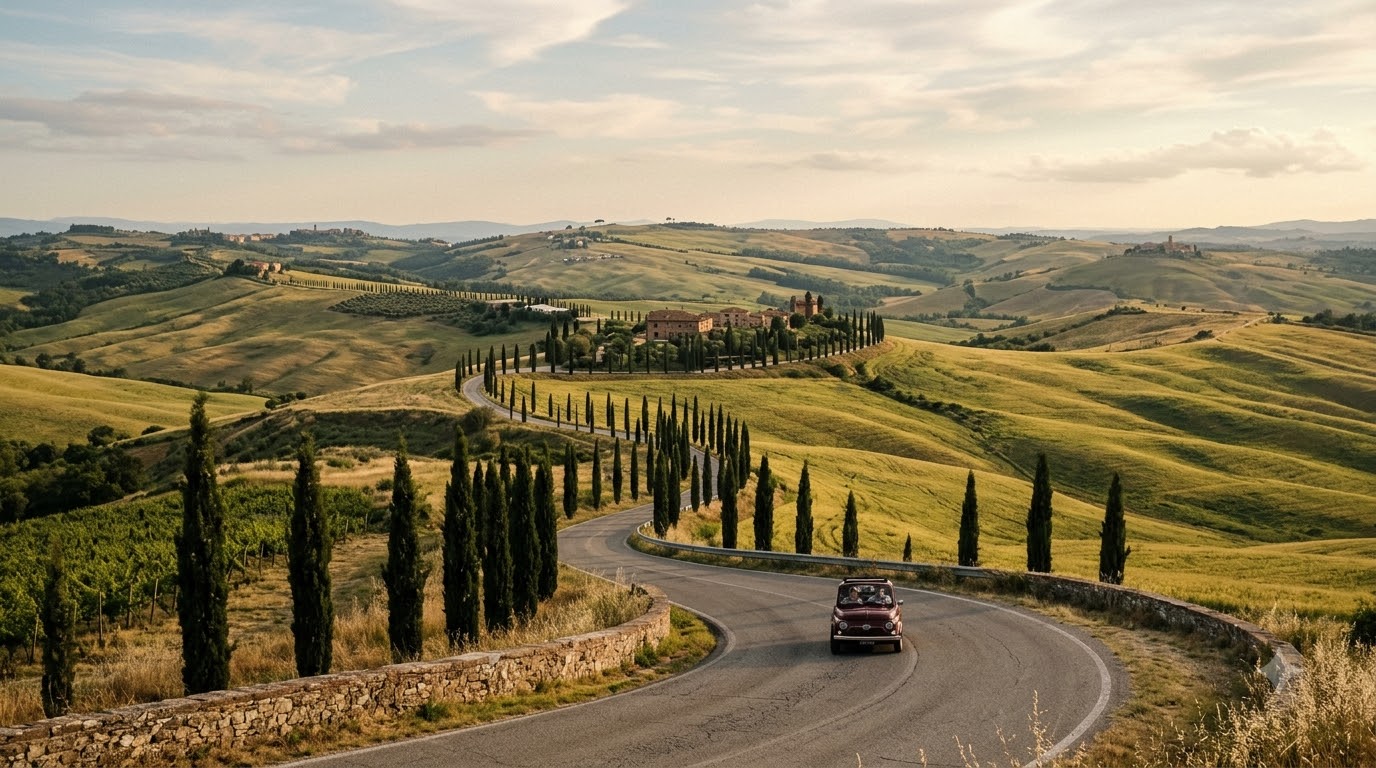
The best route is a clockwise loop south from Florence through Chianti, down to the Val d’Orcia, then back up through Siena and San Gimignano. This keeps the scenic SR222 wine road early, saves the postcard cypress hills of the Val d’Orcia for the middle, and returns you toward Pisa or Florence airport at the end without backtracking. Trains connect Florence, Siena and Pisa, but they do not reach Chianti villages, the Val d’Orcia hill towns, or the vineyards, which is why the car matters.
Here is the seven-day shape at a glance:
- Day 1 (Florence): Arrive, drop luggage, explore on foot. Do not collect the car yet.
- Day 2 (Florence to Chianti): Pick up the car mid-morning, drive the SR222 to Greve and Panzano, sleep in Chianti.
- Day 3 (Chianti): Radda, Castellina and a winery visit; short driving day.
- Day 4 (Chianti to Val d’Orcia): Drive south via Siena’s outskirts to San Quirico d’Orcia.
- Day 5 (Val d’Orcia): Pienza and Montepulciano, cypress-lined photo roads.
- Day 6 (Siena): Half-day in Siena, park at the escalators.
- Day 7 (San Gimignano to airport): Towers in the morning, return the car by evening.
To go deeper on individual stops, our Tuscany travel guide covers seasons, budgets and regional context, while the best hill towns in Tuscany breakdown ranks which villages are worth an overnight versus a quick photo stop.
The 7-Day Tuscany Itinerary
The plan we use ourselves — sent straight to your inbox.
- Day-by-day route
- Where to stay
- Real 2026 costs
Free · No spam · Unsubscribe anytime
Day 1 to 2: Florence Base and the Chianti Wine Road
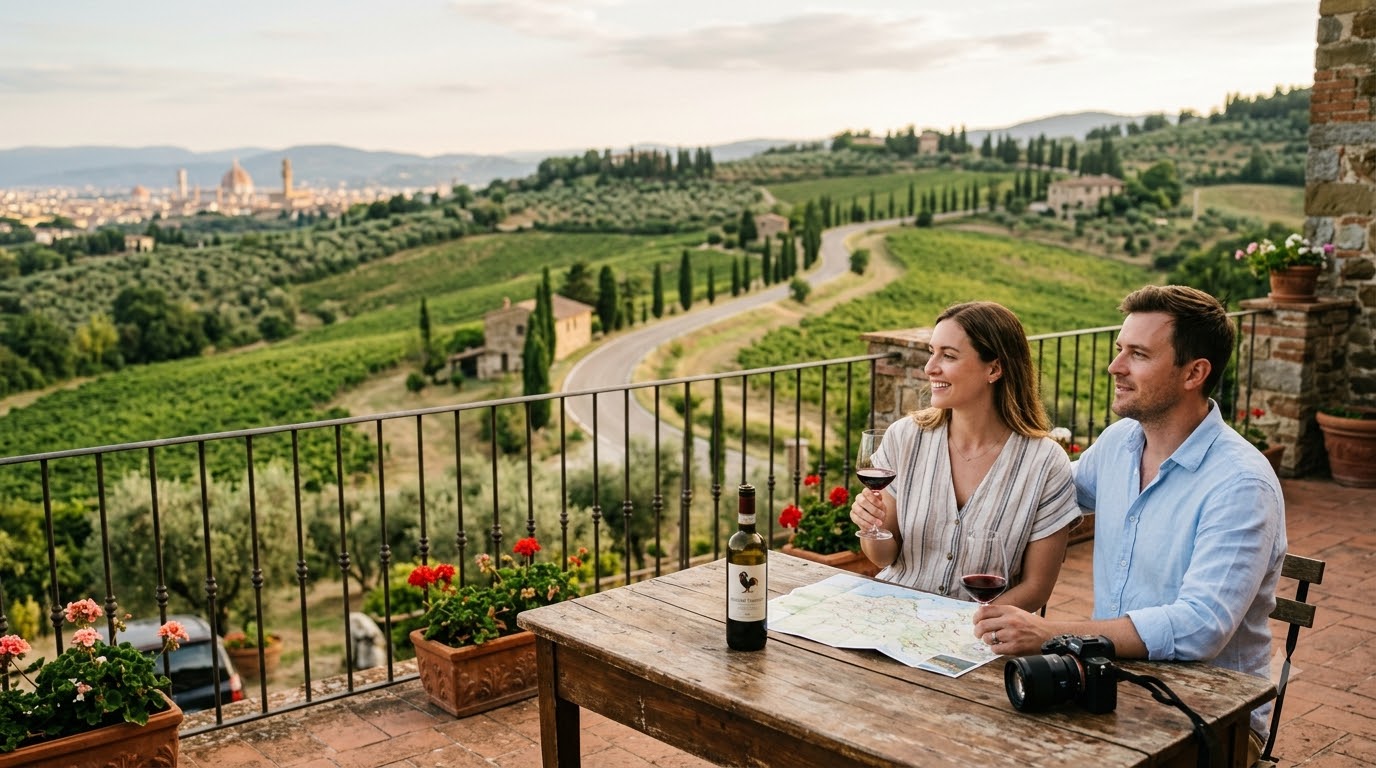
Start in Florence without a car, then head into Chianti on the morning of Day 2. Florence’s historic centre is a strict ZTL, and rental cars are actively discouraged inside major Italian cities, so a car parked here on Day 1 only invites fines and garage fees. Spend the first day walking, then collect your rental near the edge of town or at the airport on Day 2.
The drive that opens the countryside is the Chiantigiana, officially the SR222. It runs roughly 70 km (43 miles) from Florence to Siena and can be done in 1.5 to 2 hours without stopping, but the whole point is to stop (Tours of Tuscany, 2026). We spent an entire morning covering barely 40 km because the vineyard pull-offs are that good.
Worth building into Days 2 and 3:
- Greve in Chianti: the main market town, with a triangular piazza and easy roadside parking; a natural first coffee stop.
- Montefioralle: a tiny walled hamlet a short climb above Greve, quiet even in high season.
- Panzano in Chianti: home to the famous Dario Cecchini butcher; book ahead if you want the lunch.
- Radda in Chianti: medieval lanes and the Belvedere viewpoint, best in golden-hour light.
- Castellina in Chianti: its covered Via delle Volte walkway is unusual and worth the ten-minute detour.
For a wider list of experiences beyond the wine road, our roundup of the best things to do in Tuscany pairs well with these first two driving days.
Day 4 to 5: Val d’Orcia, Pienza and Montepulciano
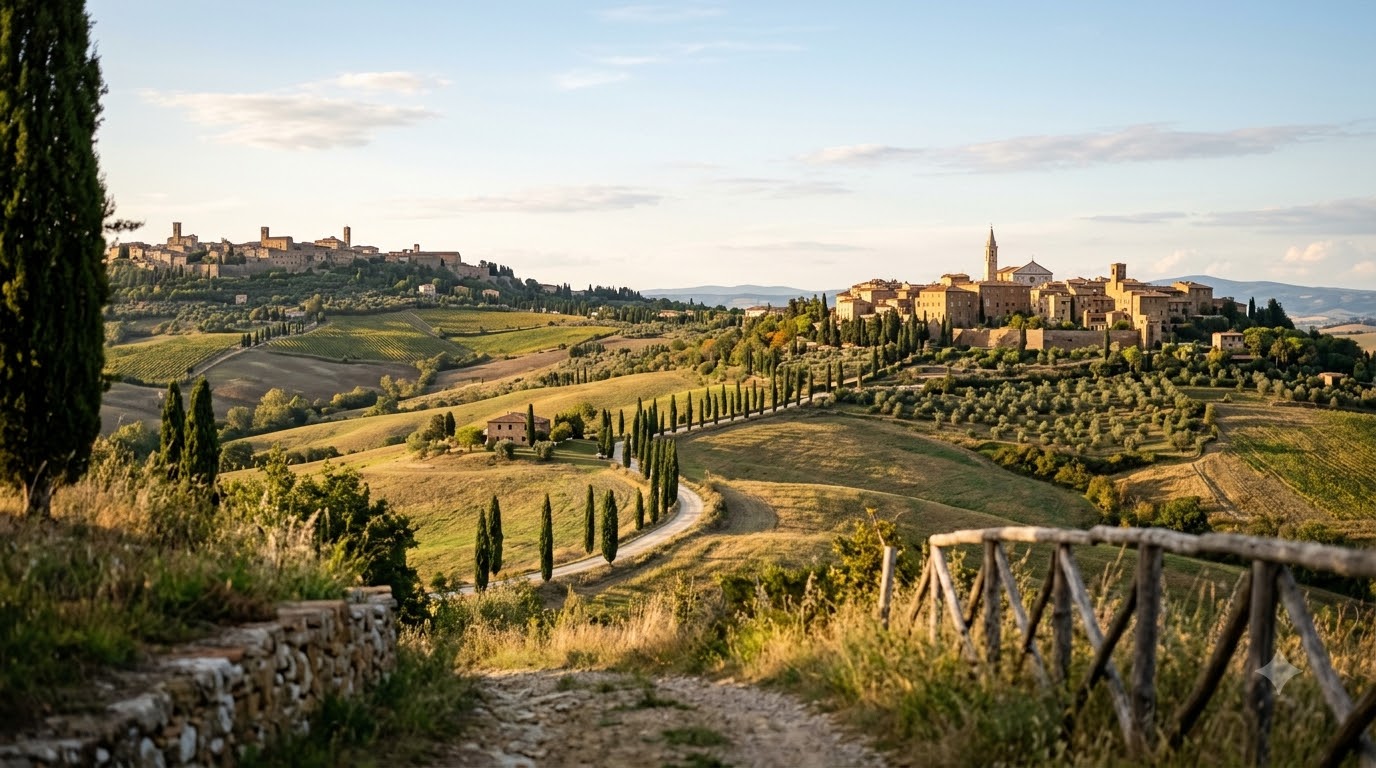
The Val d’Orcia is the classic Tuscan landscape of solitary cypress rows and golden wheat hills, and it sits about 1.5 hours south of Florence by car. The UNESCO-listed valley is compact: from a base in San Quirico d’Orcia you can reach Pienza in about 16 minutes, and Montepulciano lies only 9 miles (14.5 km) east of Pienza (Rome2Rio; Earth Trekkers, 2026). We based here two nights and never drove more than half an hour to anything.
The distances between the marquee stops are genuinely small:
- San Quirico d’Orcia to Pienza: about 10 miles, roughly 16 minutes.
- Pienza to Montepulciano: about 9 miles east, under 25 minutes.
- Montepulciano to the wider Val d’Orcia loop: about 17.4 miles of road.
- The Gladiator cypress cluster and San Quirico: a five-minute hop apart on the SP146.
Both Pienza and Montepulciano rank among the best hill towns in Tuscany for good reason. Pienza is a pocket-sized Renaissance town you can cross in ten minutes, famous for pecorino cheese sold straight from the shop counters along Corso Il Rossellino. Montepulciano climbs a steep ridge and is known for Vino Nobile; its main street is a long, calf-testing uphill from the lower car parks. Both towns bar cars from their centres, so you park below and walk up. We found early morning, before the tour coaches, was the only time the Piazza Pio II in Pienza felt empty.
The 7-Day Tuscany Itinerary
Hour-by-hour plan, where to stay and what it really costs — free PDF.
Free · No spam · Unsubscribe anytime
How Much Does a Tuscany Road Trip Cost in 2026?
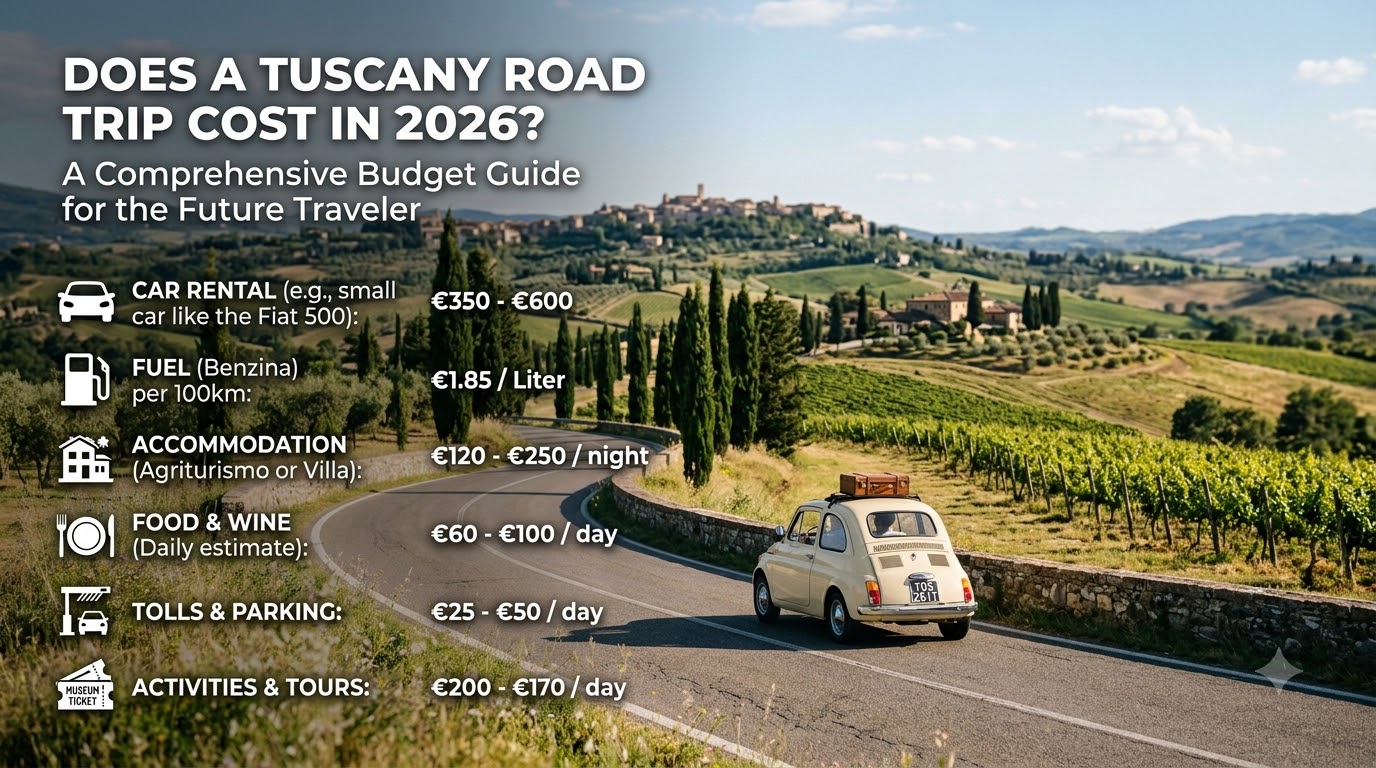
Budget roughly €70 to €110 per day for the car itself once fuel, tolls and parking are added on top of the rental rate. The rental is only part of the picture; the running costs below are what surprise first-timers. Prices reflect 2026 rates from rental aggregators, Tolls.eu and regional parking authorities.
| Cost item | 2026 price | Notes |
|---|---|---|
| Small car rental | ~$60 / day | Medium ~$67, compact ~$79 |
| Petrol (benzina) | €1.70 to €1.90 / litre | Diesel similar range |
| Autostrada toll | ~€9 per 100 km | Closed ticket system; pay at exit |
| San Gimignano P1 Giubileo | €2/hr first 2 hrs, €7 daily cap | 315 spaces, walk in |
| San Gimignano P2 Montemaggio | €3 first hr, €15 per 24 hrs cap | Higher tier lot |
| ZTL fine | €95 to €120 base | ~€70 to €80 if paid within 5 days |
For a fuller breakdown of seasonal pricing and daily budgets, see our Tuscany travel guide. A few line items that trip people up:
- Rental month matters: June averages about $38 per day and August about $50, the two cheapest months in Tuscany in 2026, while spring and autumn peaks cost more.
- Fuel is self-serve or served: “fai da te” pumps are cheaper than the attended “servito” lane at the same station.
- Tolls are unavoidable on the A1: the Florence-to-Chianti back roads are free, but any autostrada leg adds up fast.
- Parking caps are your friend: always check for a 24-hour cap sign rather than paying hourly for a full-day visit.
Where Should You Stay on a Tuscany Itinerary?
Split your nights between one Chianti base and one Val d’Orcia base rather than sleeping in Florence the whole time. Staying central in Florence means either paying for a ZTL-permitted garage or leaving the car far out; staying in the countryside puts you inside the scenery and cuts daily driving. Most Tuscan hotels in 2026 register your license plate through a digital portal for a temporary ZTL access window covering only your arrival and departure (Renting A Car In Europe 101, 2026).
| Base area | Best for | Driving to next region |
|---|---|---|
| Florence (nights 1) | Museums, arrival, no car needed | 45 min to Chianti |
| Chianti (Panzano/Greve) | Wine road, sunset hills | ~1 hr to Val d’Orcia |
| San Quirico d’Orcia | Cypress roads, Pienza, Montepulciano | ~45 min to Siena |
| San Gimignano area | Towers, last night before Pisa | ~1 hr to Pisa airport |
Practical stay tips we relied on:
- Ask for the ZTL permit by email before arrival so your plate is registered the moment you reach town.
- Confirm free on-site parking at farmhouse agriturismi; most include it, but not all.
- Pick a base with an easy road, since some agriturismo driveways are steep gravel tracks best avoided after dark.
- Book Val d’Orcia stays early for April to June and September, the peak photography months.
Day 6 to 7: Siena, San Gimignano and Driving Warnings
End the loop with Siena and San Gimignano, and treat both as park-and-walk towns. Siena’s shell-shaped Piazza del Campo and its Gothic cathedral are the highlight of Day 6, but the medieval centre is closed to non-resident traffic. Use the perimeter garages linked by escalators, such as Santa Caterina, then walk up. San Gimignano, famous for its surviving stone towers, runs a strict ZTL and starts fines at €90 for cars entering without a permit (ItiMaker, 2026).
The driving rules that keep this trip fine-free:
- Never cross a “varco attivo” sign: that is a live ZTL camera, and the ticket is automatic.
- Watch for ZTL time windows: some zones are restricted only during certain hours, but assume enforcement unless a sign says otherwise.
- Park at numbered lots, not curbs: San Gimignano’s P1 through P5 are outside the walls; P1 Giubileo caps at €7.00 per day.
- Blue lines mean paid, white lines mean free, yellow lines mean residents only across Italian towns.
- Keep the rental paperwork handy: if a ZTL ticket arrives months later, the agency will bill your card plus an admin fee.
With more time, you could stretch this into a longer trip using our list of the best things to do in Tuscany to fill extra days. We finished by returning the car near Pisa airport the evening of Day 7, which avoids re-entering Florence’s ZTL entirely. If you fly out of Florence instead, drop the car at the airport rather than driving into the centre.
Frequently Asked Questions
Do I need a car for a Tuscany itinerary?
You need a car for the countryside but not for the cities. Trains link Florence, Siena and Pisa, but no train reaches Chianti’s villages or the Val d’Orcia hill towns. Rent the car for the rural middle of your trip and skip it for city days, since cars are discouraged inside Florence, Siena and other historic centres.
What is a ZTL and how do I avoid the fine?
A ZTL (Zona a Traffico Limitato) is a restricted-traffic zone covering most Tuscan historic centres, enforced by cameras. In 2026 the base fine runs €95 to €120, falling to roughly €70 to €80 if paid within five days. Avoid it by parking in lots outside the walls and walking in, and by asking your hotel to register your plate for a temporary access permit.
How many days do you need in Tuscany?
Five to seven days is the sweet spot for a road trip covering Florence, Chianti, the Val d’Orcia, Siena and San Gimignano. Five days works if you move quickly; seven lets you slow down for winery visits and unhurried mornings in the hill towns before the tour buses arrive.
When is the best time to drive Tuscany?
Late April to June and September offer warm days, green-to-golden hills and manageable crowds. June is also one of the cheapest months to rent a car, averaging about $38 per day in 2026. July and August are hot and busy, while winter is quiet but many rural restaurants and wineries close.
Is it hard to drive in Tuscany?
The open roads are easy and scenic, but hill-town centres and ZTL zones are the stressful part. Stick to a small car, park outside historic centres, and never drive past a ZTL camera. The autostrada uses a closed toll system where you take a ticket on entry and pay by distance at the exit, using cash, card or Telepass.
Tuscany rewards a slow loop more than a packed checklist. Sleeping in the countryside, keeping driving legs short, and respecting the ZTL cameras turns a potentially stressful self-drive into the calmest way to see the region. Use Florence as a doorway, point the car south, and let the SR222 and the Val d’Orcia do the rest.