Disclosure: Some links in this guide are affiliate links. If you book or buy through them, we may earn a small commission at no extra cost to you — it helps keep our guides free.
Best Ribe Travel Guide 2026: Denmark’s Oldest Fairytale Town
Quick answer: Ribe is Denmark’s oldest town, founded around 710 AD, and its tiny cobbled medieval centre of leaning half-timbered houses around a 12th-century cathedral makes an easy half-day to full-day trip. Reach it by train via Bramming or Esbjerg, and time your visit to catch the free evening Night Watchman walk, the town’s signature experience from May through late October.
Ribe was founded around 710 AD as a Viking trading post on the North Sea coast, and it has been accumulating layers of history ever since. The cathedral was begun in 1150. The cobblestones were laid in the 13th century. The half-timbered houses leaning over the narrow streets have survived fires, floods, and the Reformation, and they look exactly as Hans Christian Andersen would have drawn them if he had been born 200 kilometers west.
Denmark’s oldest town receives roughly 350,000 visitors annually (Visit Ribe, 2026), a fraction of what Copenhagen absorbs in a weekend. This Ribe travel guide covers why this town deserves a spot on your Denmark itinerary, the best things to do, the Viking history that defines it, the most charming photo spots, and how to visit in a day.
Key Takeaways
– Ribe Cathedral (Domkirke) dominates the skyline and is the oldest cathedral in Denmark, begun in 1150. Climb the 248-step Commoner’s Tower (20 DKK, roughly 3 EUR) for a view across the marshlands to the Wadden Sea.
– The Ribe VikingeCenter is a living-history museum where costumed interpreters forge iron, bake bread, and sail a reconstructed longship. Entry is 140 DKK (19 EUR). Open April through October.
– The night watchman tour has walked the same route every evening from May through September since 1935. The watchman sings, tells stories, and carries a lantern. Free. Departs at 8:00 PM from the main square.
– The Wadden Sea National Park, a UNESCO World Heritage site, begins at Ribe’s doorstep. Guided mudflat walks depart at low tide to walk the seabed among migrating birds and seals on distant sandbanks.
– Ribe works as a day trip from Aarhus (1.5 hours) or Esbjerg (30 minutes). The town center is walkable in 15 minutes end-to-end. Two hours covers the sights. A full day allows the VikingeCenter and a Wadden Sea walk.We only recommend services we genuinely trust. Learn more.
**** We spent a long weekend in Ribe during the autumn equinox, when the light slanted low across the marshlands and the town smelled of woodsmoke and baking. The night watchman sang in Danish under a three-quarter moon while forty strangers followed his lantern through streets that have not changed their course in 1,300 years.
Why Ribe Should Be on Your Denmark List
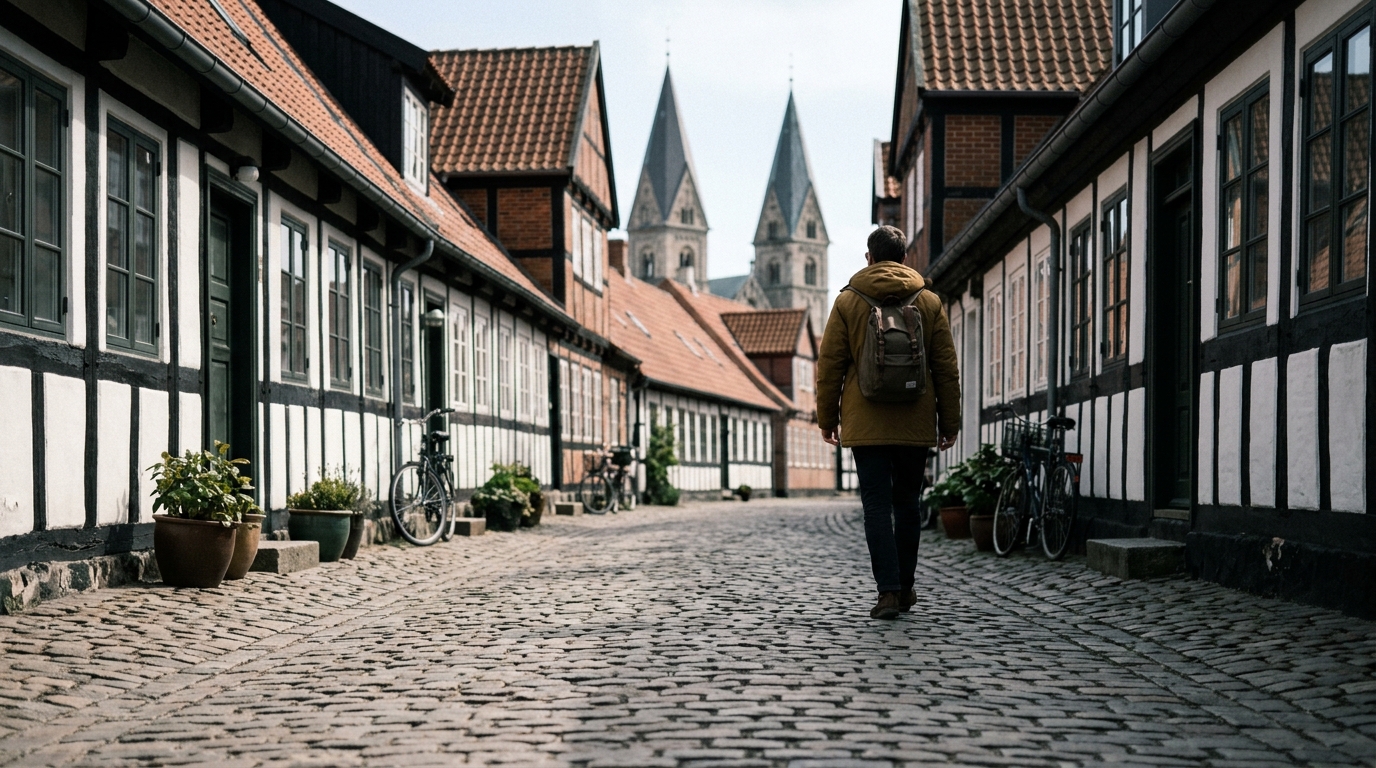
Ribe is not on the way to anything. It sits in southwestern Jutland, 30 kilometers from the German border, surrounded by marshland that the Wadden Sea floods twice daily. This isolation preserved it. While Copenhagen modernized and Aarhus expanded, Ribe stayed exactly where it was, a medieval townscape so intact that you can photograph any street corner and the result looks like a 16th-century painting.
The town’s layout has not meaningfully changed since the Middle Ages. The cathedral marks the center. The river loops around the old town in a defensive semicircle. The cobblestone streets radiate outward in a pattern that predates urban planning. More than 100 buildings in the town center are listed as protected monuments (Danish Cultural Heritage Agency, 2026).
Denmark’s oldest town hall (1496) still functions at the intersection of Overdammen and Nederdammen, the two main streets. The St. Catherine’s Church and monastery (1228) became a hospital after the Reformation and today houses Ribe’s art museum. The layers of adaptive reuse — Viking to Catholic to Lutheran to modern — are written into the buildings themselves.
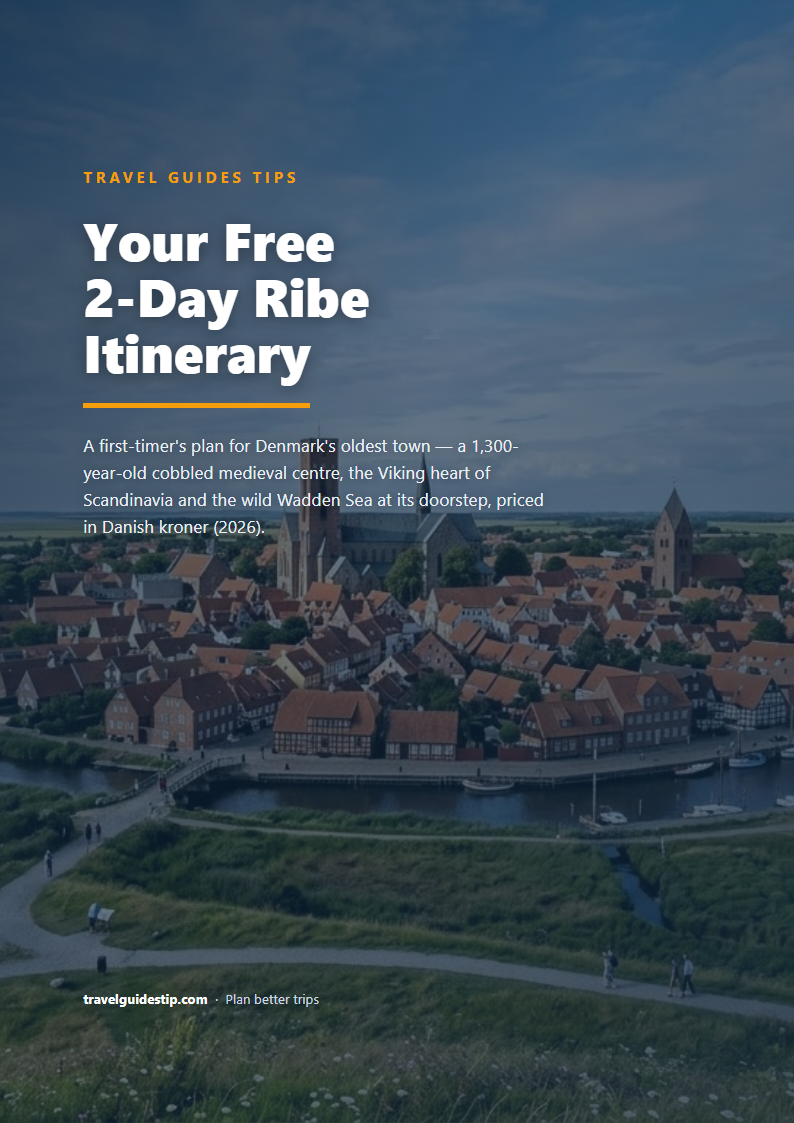
The 2-Day Ribe Itinerary
The plan we use ourselves — sent straight to your inbox.
- Day-by-day route
- Where to stay
- Real 2026 costs
Free · No spam · Unsubscribe anytime
Best Things to Do in Ribe

Ribe Cathedral (Domkirke)
The Cathedral of Our Lady dominates the flat Jutland landscape from every approach to Ribe. Construction began in 1150 on the site of an earlier wooden church built by the missionary Ansgar in 860 AD. The resulting building is a hybrid of Romanesque and Gothic styles, with a brick tower added in the 14th century and a bronze door cast in 1973 depicting the life of Christ.
The interior holds the tomb of King Christopher I (died 1259), a 16th-century pulpit carved by Jens Asmussen, and modern mosaics by Carl-Henning Pedersen that shocked the congregation when installed in the 1980s. The 248-step climb up the Commoner’s Tower (Borgertarnet, 20 DKK) delivers a flatland panorama: red-tiled rooftops, the winding Ribe River, and the green-brown expanse of the Wadden Sea marsh stretching to the horizon.
Entry: Cathedral is free. Tower climb 20 DKK (3 EUR). Open daily, Sunday services at 10:00 AM.
Ribe VikingeCenter
The Viking Center, 2 kilometers south of the old town, is a living-history museum spread across 15 hectares where costumed interpreters live and work in reconstructed Viking-era buildings. The centerpiece is a full-scale reconstruction of a Viking longship, built on-site using period tools and techniques. Blacksmiths forge iron. Bakers bake flatbread. A falconer flies birds of prey twice daily in summer.
The market square reconstruction is based on archaeological evidence from Ribe’s own 8th-century trading post, one of the earliest urban settlements in Scandinavia (Ribe VikingeCenter, 2026). Children can mint their own coins, shoot a longbow, and grind flour on a quern stone.
Entry: 140 DKK (19 EUR) adults, 70 DKK children. Open late April through late October. Allow 2-3 hours. The on-site cafe serves Viking-inspired food including smoked fish, flatbread, and mead (non-alcoholic version available).
The Night Watchman
Every evening from May 1 through September 15, a man in a black cloak and tricorn hat carrying a lantern and a morning star (the weapon, not the flower) walks a route through the old town, stopping at intersections to sing traditional watchman songs and tell stories of Ribe’s fires, floods, and executions.
The tradition dates to the medieval period when watchmen patrolled the streets calling the hours and watching for fire, the constant terror of wooden towns. The modern watchman tour began in 1935 and has run every summer since, interrupted only by World War II and the 2020 pandemic.
The tour is free and departs at 8:00 PM from the main square (Torvet) in front of the Weis Stue hotel. It lasts 45 minutes. The stories are in Danish and English, alternating. No booking required. Tip the watchman at the end if you enjoyed it, as the locals do.
The Viking Heart of Denmark

Ribe was Scandinavia’s first proper town, established around 710 AD when Norse traders recognized that the bend in the Ribe River where it met the North Sea made an ideal harbor. Archaeological excavations in the 1970s revealed layers of Viking-era workshops, market stalls, and homes beneath the modern town, preserved in the waterlogged soil.
The Museet Ribes Vikinger (Ribe Viking Museum, 75 DKK/10 EUR) in the old town center displays artifacts from these excavations: amber beads, glass drinking horns, bone ice skates, and the Ribe skull fragment, a human cranium drilled with a small hole, possibly the earliest evidence of trepanation in Scandinavia. The museum’s centerpiece is a reconstructed Viking market stall built directly on top of the 8th-century original, which remains visible through a glass floor.
The story the museum tells is not just of Viking raids but of Viking commerce. Ribe was a trading hub connecting Scandinavia to the Frankish Empire, Byzantium, and the Arab caliphates via a network of rivers, portages, and sea routes. A dirham coin minted in Baghdad in 782 AD was found in a Ribe excavation, having traveled 4,000 kilometers to reach a Jutland market stall.
The 2-Day Ribe Itinerary
Hour-by-hour plan, where to stay and what it really costs — free PDF.
Free · No spam · Unsubscribe anytime
Most Charming Photo Spots in Ribe
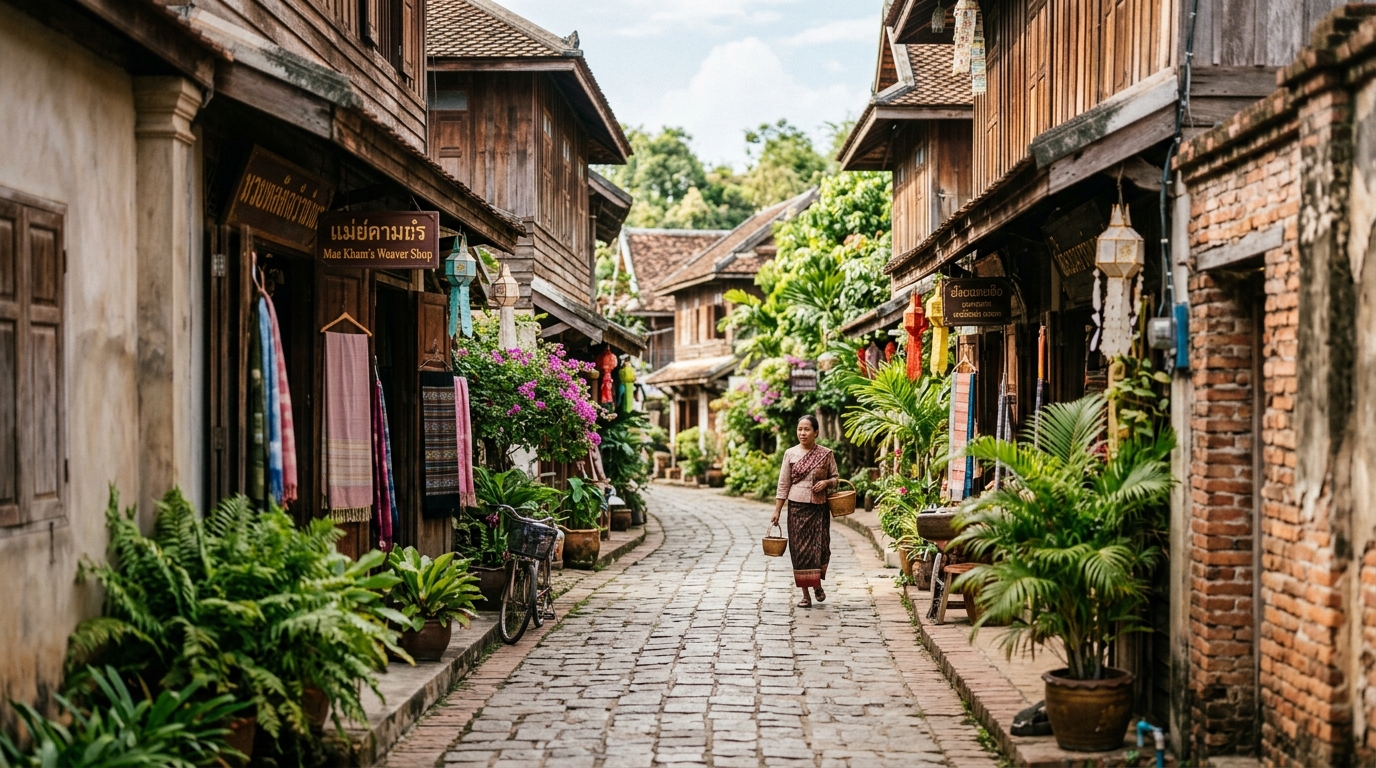
Overdammen Street
The main street of Ribe’s old town, lined with half-timbered houses in ochre, white, and brick red. The street curves gently, which means every few steps reveals a new composition. The best angle is looking north toward the cathedral from the intersection with Sct. Nicolaj Gade, where the tower fills the frame above the gabled rooftops.
Early morning (before 9:00 AM) and late afternoon (after 4:00 PM) deliver the best light. The cobblestones pick up a golden sheen in the last hour before sunset. A 35mm or 50mm lens works best for street-level compositions. The street is pedestrianized, so no cars will ruin your frame.
Ribe Cathedral from Puggaardsgade
Puggaardsgade is a narrow alley that dead-ends directly facing the cathedral’s west front. The street is barely three meters wide, and the cathedral tower fills the entire frame from this angle, appearing to rise out of the cobblestones. Photograph from the far end of the alley with a 24mm wide-angle to capture the tower, the cobblestones, and the half-timbered walls on either side.
The Harbor (Skibbroen)
Ribe’s small harbor on the river, lined with wooden boats and a few restaurants, reflects the town’s quiet relationship with the water. The best time is dusk, when the boat masts silhouette against the fading sky and the cathedral tower catches the last light. The harbor is small, intimate, and rarely photographed compared to Nyhavn in Copenhagen. That is the point.
The Mill (Ribe Molle)
The town windmill, built in 1844, sits on a small hill just outside the old town gates. The whitewashed mill with its four sails against the flat Jutland sky makes for a composition that feels more Dutch than Danish. The surrounding garden is free to enter. Photograph from below looking up at the sails, ideally with a dramatic sky.
How to Visit Ribe in a Day
Getting There
Ribe is 30 minutes by train from Esbjerg (48 DKK/6.50 EUR), 1.5 hours from Aarhus (168 DKK/23 EUR), and 2.5 hours from Copenhagen (268 DKK/36 EUR). Trains depart roughly hourly on the Esbjerg-Bramming-Ribe line. The station is a 10-minute walk from the old town center. Driving from Copenhagen takes 3 hours via the E20 motorway. Parking near the old town is free at the Skibbroen lot.
The Perfect Day Timeline
9:30 AM: Arrive at Ribe station. Walk to the cathedral. Climb the Commoner’s Tower while you have the energy and the morning light is on the tower face.
10:30 AM: Ribe Viking Museum (75 DKK). Spend 1 hour with the artifacts and the reconstructed market stall.
11:30 AM: Walk Overdammen and Puggaardsgade for the cathedral photo. Stop at the Weis Stue hotel courtyard for coffee (25 DKK).
12:30 PM: Lunch at Restaurant Saelhunden on Skibbroen harbor. The fish of the day (120-150 DKK/16-20 EUR) comes directly from the North Sea. Sit on the terrace if weather permits.
2:00 PM: Ribe VikingeCenter (140 DKK). A 25-minute walk or 5-minute taxi from the old town. Spend 2-3 hours in the reconstructed village. Watch the falconry display at 2:30 PM.
5:00 PM: Walk back to town along the river path. Photograph the cathedral from the meadows on the south side of the river, where cows graze in the foreground and the tower rises behind.
7:00 PM: Dinner at Kolvig (3-course set menu, 325 DKK/44 EUR), Ribe’s best restaurant, housed in a 16th-century merchant’s house on the main square.
8:00 PM: The night watchman tour from the main square (May-September). The lantern, the songs, the 1,300-year-old streets.
9:00 PM: Last train to Esbjerg or Aarhus, or check into a room at Hotel Dagmar (built 1581, oldest hotel in Denmark, from 995 DKK/134 EUR).
Where to Stay
Hotel Dagmar: Denmark’s oldest hotel, facing the cathedral on the main square. From 995 DKK (134 EUR). Half-timbered, crooked floors, genuinely historic. Book via Booking.com.
Danhostel Ribe: Budget option in a converted 19th-century warehouse by the harbor. From 450 DKK (60 EUR) for a private room. Clean, modern, friendly.
Find your Ribe hotel on the map
Live prices from Booking, Airbnb and more — move the map or change dates to compare stays around Ribe.
Frequently Asked Questions
Is Ribe worth visiting?
Yes. Ribe is one of the most intact medieval townscapes in Scandinavia and Denmark’s oldest continuously inhabited settlement. The combination of Viking history, the cathedral, the night watchman, and the Wadden Sea access creates an experience that no other Danish town replicates. Over 350,000 annual visitors (Visit Ribe, 2026) confirms its appeal.
How many days do I need in Ribe?
One full day covers the old town plus the VikingeCenter. Two days allows a Wadden Sea mudflat walk (3 hours, tide-dependent), a visit to the Ribe Art Museum, and a relaxed pace. Ribe works as a day trip from Aarhus or a weekend destination in its own right.
What is the best time to visit Ribe?
May through September for the night watchman tour, the VikingeCenter, and outdoor dining on the harbor. June has the longest daylight (sunset after 10:00 PM). September brings golden marshland light and fewer visitors. December has the Christmas market in the old town square.
How much does it cost to visit Ribe?
Budget 400-600 DKK (54-80 EUR) per person per day including meals, museum entries, and transport. The VikingeCenter (140 DKK) and Ribe Viking Museum (75 DKK) are the main expenses. The cathedral, the night watchman tour, and the old town streets are free.
Is Ribe good for families?
Excellent. The VikingeCenter is designed specifically for families, with hands-on activities for children of all ages. The Wadden Sea mudflat walks introduce kids to marine ecology. The town is flat, compact, and entirely walkable with a stroller.
Can I visit Ribe in winter?
Yes, though with reduced offerings. The VikingeCenter closes in late October. The night watchman runs only May through September. But the cathedral is open year-round, the old town is beautiful in winter fog, and the Christmas market (late November through December) fills the main square with stalls selling glogg (mulled wine, 35 DKK) and aebleskiver (pancake puffs).
Ribe does not shout. It has no world-famous painting, no Michelin-starred dining scene, no Instagram-geotagged hotspot that draws millions. What it has is 1,300 years of continuous habitation written into cobblestones and half-timbered walls, a cathedral that catches the last light of every Jutland sunset, and a night watchman who still sings the old songs because someone should.
The train from Esbjerg takes 30 minutes. The train back can wait until tomorrow.
Continue your Danish journey with our guides to Copenhagen, Aarhus, and more Nordic destinations. For more European small-town inspiration, explore our guides to Annecy in the French Alps and Hallstatt in Austria.
Sources: Visit Ribe (2025-2026), Ribe VikingeCenter (2026), Danish Cultural Heritage Agency (2026), DSB train schedules (2026). Book: GetYourGuide for Denmark tours, Booking.com for hotels, Airalo for Denmark eSIM from $6.