Disclosure: Some links in this guide are affiliate links. If you book or buy through them, we may earn a small commission at no extra cost to you — it helps keep our guides free.
Singapore is expensive for anyone who books a hotel room or orders a beer, with mid-range hotel rooms running AUD 142-219 · USD 102-158 (SGD 130-200) a night and a single beer at a bar costing AUD 11-16 · USD 8-12 (SGD 10-15).
Everywhere else the bill drops fast, since a hawker-centre meal, an MRT ride and several of the best sights cost only a few dollars, so the real question is not whether Singapore is expensive but where.
| Travel style | Per day (AUD · USD) | What it covers |
|---|---|---|
| Budget | AUD 110-139 · USD 80-100 | Hostel dorm, hawker meals, MRT, free sights |
| Mid-range | AUD 180-278 · USD 130-200 | 3-star hotel, mixed hawker and restaurant meals, MRT plus occasional Grab, 1-2 paid attractions |
| Comfortable | AUD 333-500 · USD 240-360 | 4-star hotel, restaurant dining most nights, Grab over MRT, 2+ paid attractions, evening drinks |
Figures reused and converted from our Singapore travel cost breakdown (Numbeo, 2026). AUD and SGD converted at USD 1 = AUD 1.388 and USD 1 = SGD 1.27, September 2026.
Where Singapore genuinely stings
Singapore’s highest costs cluster into four categories, hotels, alcohol, taxis and Sentosa’s paid attractions. A mid-range 3-star hotel room near the CBD or Orchard Road runs AUD 142-219 · USD 102-158 (SGD 130-200) a night. Rooms stay small even at that price, since land is scarce and hotel supply has not kept pace with demand.
Alcohol carries a heavy tax, so a beer at an ordinary bar costs AUD 11-16 · USD 8-12 (SGD 10-15), and a round of cocktails at a rooftop bar in Clarke Quay can run well past that.
Grab from Changi Airport to the CBD costs AUD 20-33 · USD 14-24 (SGD 18-30), and street taxis start at AUD 4 · USD 3 (SGD 3.90) before distance charges stack on top.
Sentosa’s paid attractions add up quickly too, since Universal Studios Singapore alone costs AUD 91 · USD 65 (SGD 83) per adult, and a family of four can clear AUD 350 before lunch.
Surge pricing makes Grab worse at peak times, so a ride that costs AUD 20 at midday can climb past AUD 40 during evening rain, which is common in Singapore’s tropical climate. Each of these costs has a cheaper workaround, covered below.
Where it is a bargain
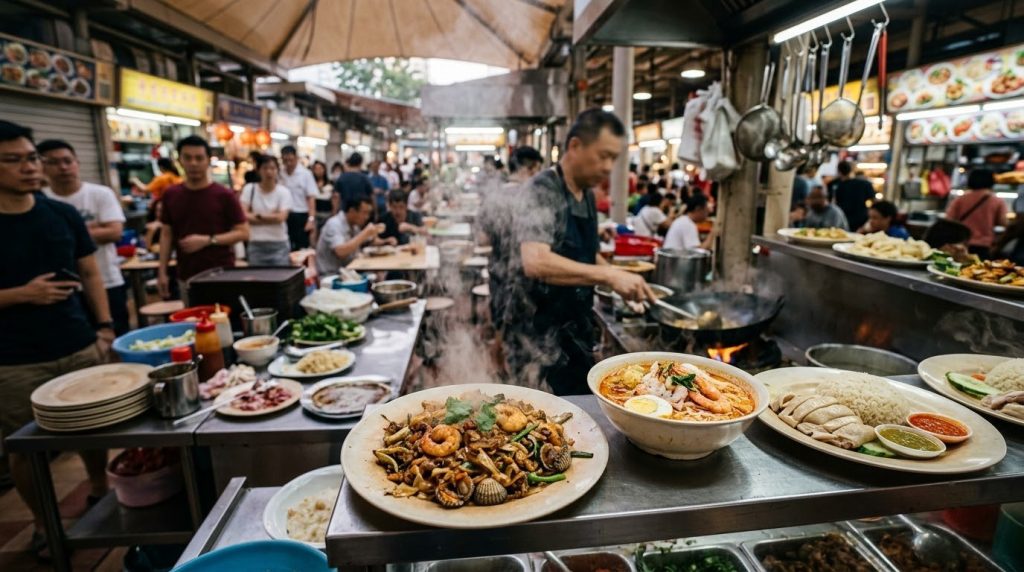
Singapore is genuinely cheap in the three categories that shape how good a day actually feels, food, transport and sightseeing. A hawker-centre meal costs AUD 3-7 · USD 2-5 (SGD 3-6), and a plate of chicken rice at a well-known stall runs about AUD 6 · USD 4 (SGD 5.50). Three hawker meals a day cost less than one restaurant dinner.
A single MRT or bus ride costs AUD 2-3 · USD 1-2 (SGD 1.40-2.50), and the network reaches almost every attraction tourists actually visit. Several of Singapore’s best-known sights cost nothing at all, including the Supertree Grove at Gardens by the Bay, the nightly Marina Bay light show, Merlion Park and the free Sentosa beaches.
Even the paid version of Gardens by the Bay, the Cloud Forest and Flower Dome conservatories, costs only AUD 31-58 · USD 22-42 (SGD 28-53). The pattern holds across the best things to do in Singapore, where the highest-rated experiences are frequently the cheapest ones.
What a day actually costs
A realistic Singapore day falls into one of three bands. The gap between the bands is almost entirely accommodation and alcohol rather than food or transport. Budget travellers staying in a hostel dorm, eating hawker food and sticking to the MRT spend AUD 110-139 · USD 80-100 a day.
Mid-range travellers in a 3-star hotel, mixing hawker meals with the occasional restaurant and using Grab once or twice, spend AUD 180-278 · USD 130-200 a day. Travellers who want a 4-star hotel, restaurant dinners most nights, Grab over the MRT and an evening drink most nights should budget AUD 333-500 · USD 240-360 a day.
Our full Singapore travel cost breakdown walks through every category in this table line by line, including sample 5-day and 7-day totals.
How to do Singapore cheaply
The two changes that matter most are where you sleep and where you eat. Together they can cut a week-long trip by hundreds of dollars with almost no drop in experience quality.
Swap a 3-star hotel for a hostel private room and eat two hawker meals a day instead of restaurant meals, and a mid-range AUD 180-278 · USD 130-200 day drops toward the budget band without feeling like a downgrade.
Book activities through Klook rather than paying gate price, since Klook consistently runs 10-20% cheaper on attractions such as the Night Safari and Gardens by the Bay. Take the MRT everywhere instead of Grab, and save ride-hailing for late nights or airport runs with heavy luggage.
Top up an EZ-Link card rather than buying the Tourist Pass unless the plan involves 10 or more rides in a day. Skip the paid Sentosa attractions in favour of the free beaches and Merlion Park, and visit the national museums on Friday evenings when entry is free after 6pm.
Timing matters too, since hotel rates spike 200-300% during the Singapore Grand Prix in September and drop to their lowest in February and early March. Carry an EZ-Link card and a printed hawker-centre map instead of defaulting to mall food courts, since mall food courts routinely charge 30-50% more for the same dishes served a few blocks away.
Splitting one restaurant dinner between two people and eating hawker food for the other two meals is often enough to move an entire trip down a full budget tier without cutting out restaurants altogether.
When Singapore is not worth the money
Singapore is not worth the money for travellers chasing a big nightlife budget or a Southeast Asia bargain trip, since both goals collide directly with what makes Singapore expensive.
A traveller who wants several drinks a night at bars and clubs will spend more on alcohol alone in Singapore than an entire day’s budget in Bangkok or Bali, given beer at AUD 11-16 · USD 8-12 and cocktails running well past that.
A traveller comparing Singapore to Kuala Lumpur or Hanoi on a strict backpacker budget will also come away disappointed, since even Singapore’s cheapest hostel beds and hawker meals sit above what covers a full day in most of the region.
Singapore also rewards a longer stopover more than a rushed one-night layover, because the free and cheap experiences, such as the light show and the hawker centres, take a full evening to enjoy properly rather than a couple of daylight hours.
If the goal is stretching a tight budget across many days, Singapore works better as a 2-3 day add-on to a longer Southeast Asia trip than as the whole trip, which is how our Singapore itinerary frames a first visit.
Families travelling on a strict per-person daily cap should also think twice, since Singapore’s paid attractions are priced for individual adult tickets rather than family bundles, and a single Sentosa day for four people can rival two full days of food and transport for the same group.
Tipping, service charges and GST
Tipping is not expected anywhere in Singapore, including restaurants, taxis, hotels and bars, and leaving one will not get you better service next time since there is no cultural expectation of it.
Most sit-down restaurants already add a 10% service charge to the bill, on top of 9% GST, so a menu price of SGD 20 effectively becomes close to SGD 24 once both are added, commonly shown on menus as “++” after the listed price.
Hawker centres are the exception: prices at hawker stalls are final and already include everything, with no service charge and no tipping culture at all, which is part of why hawker food represents such good value against restaurant dining.
Taxi and Grab fares are also all-inclusive, so rounding up is a courtesy rather than an expectation, and hotel porters and housekeeping do not rely on tips the way they might in the US or parts of Europe.
Some diners note the mandatory service charge does not always reach frontline staff directly, which is one more reason extra tipping on top adds nothing rather than being appreciated.
If you want to reward genuinely good service beyond what is built into the bill, a small discretionary tip for a private tour guide or driver is fine, but it stays optional and nobody will chase you for more at the end of a meal or a ride.
When checking a bill, look for “+” or “++” next to the price to know whether service charge and GST are already included or still coming.
Currency, cash and getting the best exchange rate
The Singapore dollar (SGD) is the only currency accepted outright at most shops and hawker stalls, and while cards and contactless payment are widely accepted at malls, restaurants and on the MRT via tap-in-tap-out, plenty of hawker stalls and small shops are cash-only or add a small surcharge for card payments under a minimum spend.
Carrying SGD 50-100 in small notes covers a typical day of hawker meals, transport top-ups and incidentals without needing to break a large note constantly.
For exchanging cash, independent money changers beat banks and the airport consistently, by roughly 1 to 3%; The Arcade at Raffles Place is the city’s best-known cluster of licensed money changers and is routinely cited as offering the most competitive rates, with Chinatown and Lucky Plaza on Orchard Road as reliable alternatives.
Airport money changers and bank counters are the most convenient but also the weakest rates, so exchanging only enough for the first day or two at the airport and doing the rest in town saves a noticeable amount over a week-long trip.
ATMs are widely available and generally reliable, though your home bank’s foreign transaction fee usually outweighs any savings versus a money changer for cash withdrawals, so check that fee before relying on ATMs for your main cash supply. Avoid exchanging money at hotel front desks, where rates are typically the weakest of all.
Converting leftover Singapore dollars back to your home currency before leaving is also worth doing at the same money changers, since SGD gets a poor rate almost everywhere outside Singapore and Malaysia.
Shopping and souvenirs: what things actually cost
Budget souvenir shopping in Singapore centres on Bugis Street Market and Chinatown’s street stalls, where printed T-shirts run about 4 for SGD 10, cheap tote bags, keychains and magnets sit in the SGD 2-8 range, and scarves or shawls can go for as little as SGD 2 each once you bargain.
Bargaining is expected and normal at these street-stall markets, unlike in malls or department stores where prices are fixed. Haji Lane and the Kampong Glam area suit mid-range shopping for independent fashion and design pieces, typically priced well above Bugis Street but below Orchard Road’s flagship malls.
Orchard Road itself is where Singapore’s shopping costs climb fastest, home to international luxury brands and multi-level malls where a casual browse can turn into a high spend quickly; it is the right stop for electronics, branded fashion and department-store shopping rather than souvenirs.
Local food souvenirs, such as packaged bak kwa (dried meat), pineapple tarts or kaya jam, travel well and make a cheaper, more distinctive alternative to printed T-shirts for most travellers.
On any single purchase of SGD 100 or more at a participating retailer, tourists can claim back the 9% GST through the Electronic Tourist Refund Scheme (eTRS), either as an immediate deduction in-store or as a refund processed at Changi Airport before departure, so it is worth asking at checkout whether a shop participates before paying full price on a larger item.
Keep receipts and the eTRS ticket together, since the airport refund kiosks require them to process the claim, and leave extra time before your flight if you plan to use them.
Miscellaneous costs to budget for
A handful of smaller costs do not fit neatly into hotels, food or transport but add up over a trip.
A prepaid tourist SIM card at Changi Airport typically costs SGD 12-30 depending on the data allowance and provider, with M1, Singtel and StarHub all running airport counters; an eSIM bought online before you travel is often cheaper and skips the airport queue entirely, provided your phone supports it, and it is worth comparing that cost against your home carrier’s travel roaming add-on before you leave.
Bottled water costs very little by Singapore’s overall standards, generally SGD 1-2 from a convenience store, and tap water is safe to drink throughout the city, so there is little reason to buy it constantly instead of refilling a bottle.
Laundry is one of the few genuinely expensive incidentals: a hotel’s in-house laundry service can run SGD 5-10 per item, while a self-service launderette a short walk from most hotel districts charges a flat machine fee of roughly SGD 4-8 per load, a far cheaper option on a longer stay.
Public toilets in malls and MRT stations are free and plentiful, which is not true everywhere in the region and is worth knowing if you are coming from a country where paid toilets are common.
Museum and gallery entry for Singapore residents is sometimes discounted or free, but tourists should expect the standard adult rate everywhere except the free Friday evening slots already mentioned above, so timing a museum visit around that window is a small but easy saving.
Plan an affordable Singapore trip
Booking early and choosing the right neighbourhood does more for a Singapore budget than any single money-saving trick. Areas like Lavender, Little India and Bugis sit on or near the MRT and run cheaper than Orchard Road or Marina Bay. Our where to stay in Singapore guide breaks down which neighbourhoods suit which budget.
Compare live rates below and book 3-4 weeks ahead where possible, since last-minute Singapore hotel rates rarely drop.
Find your Singapore hotel on the map
Live prices from Booking, Airbnb and more — move the map or change dates to compare stays across Singapore.