Disclosure: Some links in this guide are affiliate links. If you book or buy through them, we may earn a small commission at no extra cost to you — it helps keep our guides free.
Krabi is worth visiting: yes, decisively, home to more than 150 limestone islands, over 700 established rock-climbing routes at Railay alone, and a beach-to-jungle mix that beats Phuket on scenery without Phuket’s traffic or bar-strip density. Three to five days is enough to cover the karst coastline, at least one island-hopping day and a temple climb, and almost nobody leaves saying the detour south from Phuket wasn’t worth it.
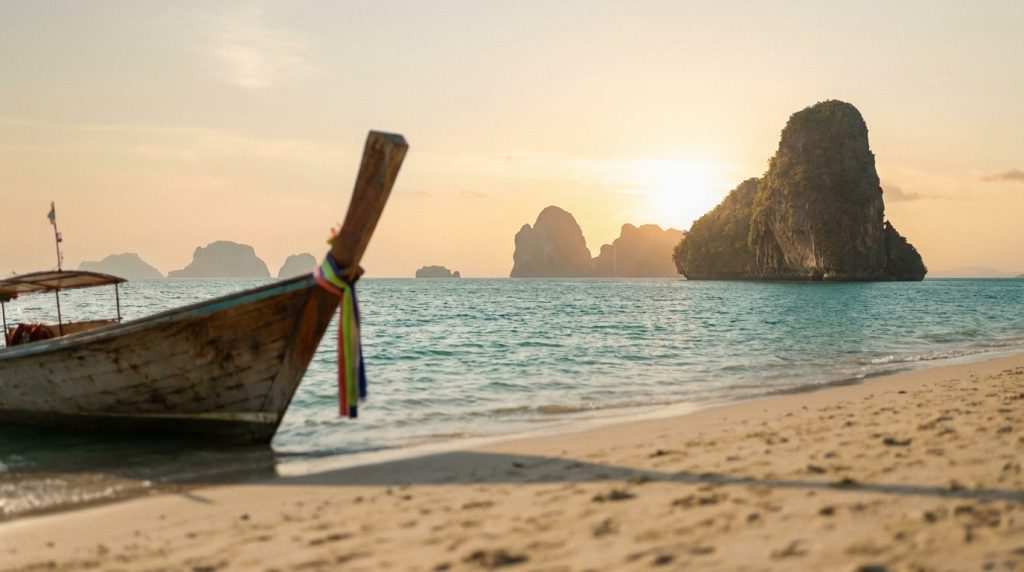
What makes Krabi different from most of coastal Thailand is that its best beach isn’t reachable by road at all. Railay and neighbouring Tonsai sit on a peninsula boxed in by limestone cliffs, so every visitor, hotel guest or day-tripper, arrives the same way: by longtail boat.
That single fact shapes the whole destination, keeping Railay free of the tour-bus crush that reaches Ao Nang’s beachfront by mid-morning, and it’s the main reason repeat visitors rate Krabi above Phuket for atmosphere.
| Highlight | Why it’s worth it | Cost or time |
|---|---|---|
| Railay Beach + Tonsai | Boat-only access keeps crowds down; sport climbing on-site | Longtail from Ao Nang, AUD 4 · USD 3 (THB 99) each way |
| 4-Islands / Hong Islands day trip | Snorkelling, lagoon, Phra Nang Cave Beach in one day | AUD 42 · USD 30 (THB 988) to AUD 49 · USD 35 (THB 1,153) |
| Rock climbing at Railay | SE Asia’s premier climbing destination, beginner-friendly | Half-day intro AUD 69 · USD 50 (THB 1,647) |
| Tiger Cave Temple | 1,237 steps to a hilltop Buddha and 360-degree views | 30-50 min climb, free entry |
| Emerald Pool + hot springs | Jungle-interior counterpoint to the beach circuit | Entry around AUD 8 · USD 6 (THB 200) |
| Best season | Dry, calm seas, minimal rain | November to March |
Railay Beach and Tonsai: the payoff of boat-only access
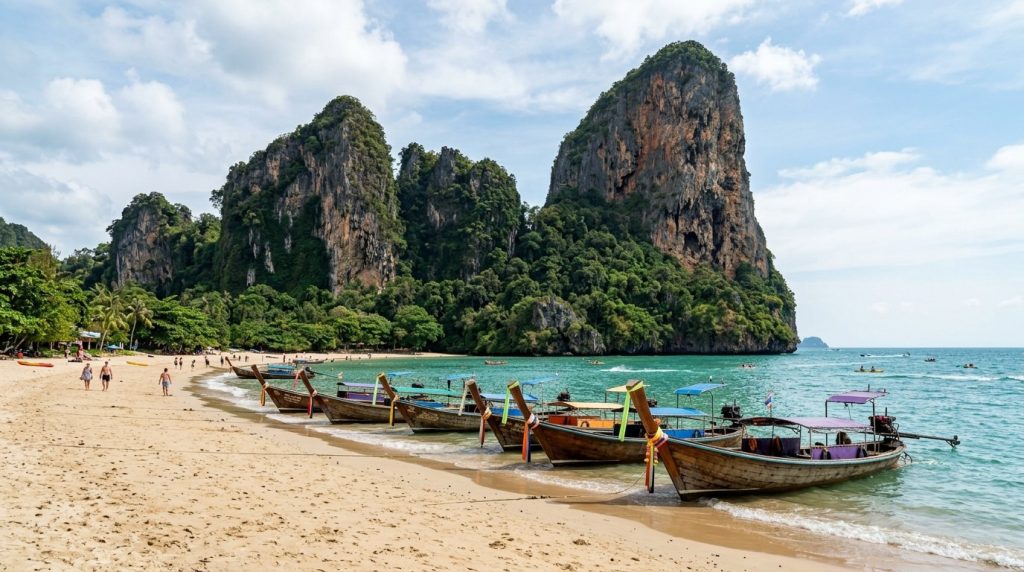
Railay’s limestone walls rise straight out of turquoise water, and because no road reaches the peninsula, the beach never fills up the way a car-accessible stretch would. Tonsai, on the northern side, draws the climbing crowd and stays scruffier and cheaper; Railay West and East carry the resorts and the sunset bars.
Phra Nang Cave Beach, technically the peninsula’s southern tip, is the single most photographed stretch of sand in the province, walled in by cliffs on three sides, and it’s worth timing your visit before 10am or after 3pm to beat the day-trip boats that pile in from Ao Nang.
Ao Nang: the base that makes everything else easy
Ao Nang is where most visitors sleep, not because it’s the prettiest beach in Krabi but because it’s the transport hub everything else radiates from: longtail piers, tour desks, restaurants and a walkable strip that Railay simply doesn’t have room for.
If you’re deciding where to stay, compare options across the Krabi hotels range before booking, since a room a few streets back from the beachfront can cost half as much with a five-minute walk added.
Krabi Town and its night market
Krabi Town, the provincial capital on the Krabi River, is easy to skip entirely if you base yourself in Ao Nang or Railay, and most visitors do. That is a reasonable call for a short trip, but it is worth at least one evening if the schedule has a spare half-day.
The riverside path along Utarakit Road passes the town’s black crab statue and gives a clear view of the Khao Kanab Nam limestone outcrops rising straight out of the water, with longtail boats running upriver to stalactite caves for travellers who want a cheaper, shorter alternative to a full island-hopping day.
A short mangrove boardwalk, the urban forest walkway near the Riverfront Hotel, adds a quiet half-hour stop that does not appear on most Krabi checklists. The main draw is the weekend walking-street night market, running Friday through Sunday evenings, with food stalls, live music and a noticeably more local crowd than anything in Ao Nang.
Accommodation in Krabi Town itself runs cheaper than beachfront Ao Nang or boat-access Railay, which makes it a workable, if beach-less, base for travellers prioritising budget and bus or van connections over sea views.
The 4-Islands and Hong Islands day trips
Two boat trips cover most of what makes Krabi’s coastline worth photographing. The 4-Islands tour strings together Koh Mor, Koh Tub, Chicken Island and Phra Nang Cave Beach in a single day, with snorkelling stops and lunch included, typically for AUD 42 · USD 30 (THB 988) per person.
Hong Island, a lagoon enclosed by karst walls with an entrance so narrow it’s only passable at the right tide, runs slightly higher at around AUD 49 · USD 35 (THB 1,153) on a speedboat, less on a slower longtail.
Book either through a platform with fixed pricing and cancellation cover rather than a beach tout, particularly in December-February when both trips sell out two to three days ahead.
Rock climbing at Railay: the angle most guides underweight
Most “is Krabi worth it” write-ups mention the beaches and skip what actually sets the destination apart internationally: Railay is one of the most established sport-climbing destinations in Asia, with well over 700 bolted routes across limestone walls that rise directly from the sand. You don’t need experience to try it.
Half-day introductory courses, run by long-standing outfits like King Climbers and Wee’s Climbing School, include all gear and a certified instructor for around AUD 69 · USD 50 (THB 1,647), and plenty of first-timers who came for the beach end up booking a second session.
For climbers who already have the skill, Railay and Tonsai between them offer route density that few coastal destinations anywhere match.
Tiger Cave Temple’s 1,237 steps
Wat Tham Sua, better known as Tiger Cave Temple, sits about 8km outside Krabi Town and asks for the one genuinely strenuous thing on a Krabi itinerary: 1,237 steps up a limestone karst to a hilltop Buddha statue and a 360-degree view over the province’s islands and jungle.
The climb takes 30 to 50 minutes each way and is best started before 9am, both for the heat and for having the summit closer to yourself. Entry is free, though modest dress (covered shoulders and knees) is expected since it’s an active temple, not a viewpoint.
Emerald Pool and Krabi’s jungle interior
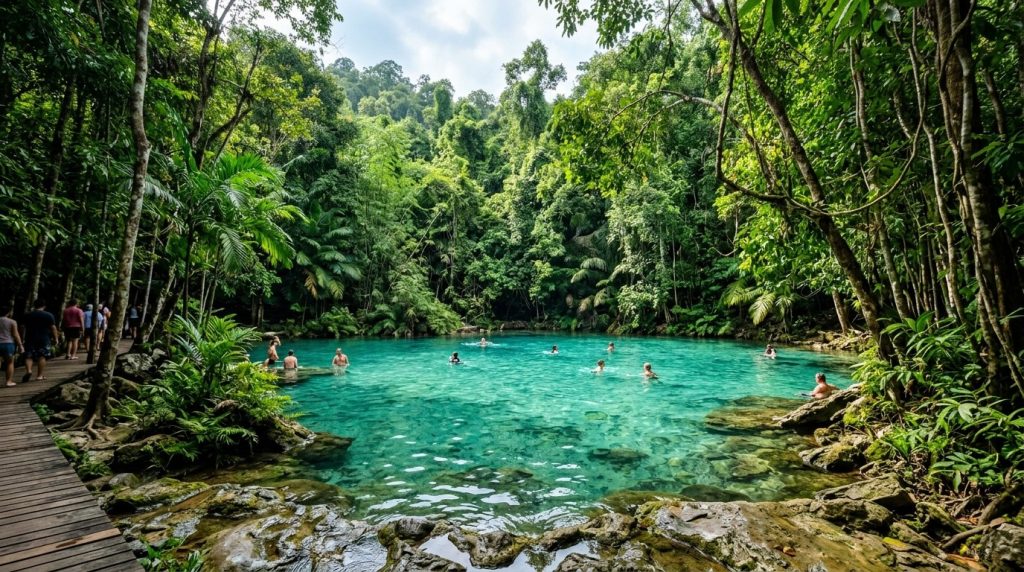
Krabi isn’t only a beach and boat destination. Inland, the Emerald Pool (Sa Morakot) and a cluster of nearby hot springs sit inside a wildlife sanctuary roughly an hour from Ao Nang, offering a genuinely different kind of morning: freshwater jungle pools instead of salt water and limestone cliffs.
Entrance runs around AUD 8 · USD 6 (THB 200), and pairing it with the hot springs makes a reasonable half-day break from the coast, particularly useful if you’re in Krabi long enough to want variety beyond a third day of island-hopping.
Diving and kayaking beyond the day-trip boats
Not every Krabi activity involves a crowded day-trip boat. Scuba diving is a genuine alternative for travellers who want time in the water without the 4-Islands crowd: a no-experience-needed discover-scuba trial dive runs around AUD 125-210 · USD 90-150 (THB 2,900-4,900) depending on whether the dive site is a local reef or a boat transfer out to Phi Phi, and a two-dive trip for certified divers costs roughly AUD 125-165 · USD 90-120 (THB 2,900-3,900).
Travellers chasing a full certification can book a three-day PADI Open Water course for about AUD 610-695 · USD 440-500 (THB 14,500-16,500), with the Phi Phi-based option pricier than diving locally out of Ao Nang.
Kayaking is the calmer option: Klong Root, a freshwater clear-water canal through limestone cliffs and mangroves near Nong Thale, runs guided two-hour tours, often paired with a swimming stop or an add-on Thai massage; prices vary noticeably between operators and booking platforms, so it is worth comparing a couple of listings rather than booking the first one that appears.
It is a reasonable half-day booking for families or non-divers who still want to be on the water without the crowds of the island-hopping boats, and it runs year-round since it does not depend on open-sea conditions the way the island day trips do.
Krabi vs Phuket: calmer, more scenic, less nightlife
Krabi and Phuket sit close enough to compare directly, and the comparison usually favours Krabi for anyone not chasing nightlife.
Phuket has more flights, more resorts and a bigger party scene concentrated around Patong; Krabi has fewer crowds, a shorter drive between highlights and scenery that most visitors rate higher, largely because of Railay’s cliffs and the karst-dotted bay you don’t get on Phuket’s west coast.
For a full side-by-side on transport links, costs and which suits which traveller, the Phuket vs Krabi comparison breaks down the trade-offs in more depth than a single paragraph can.
How many days do you need in Krabi
Three to five days covers Krabi’s core without feeling rushed, and that range shows up consistently across independent itinerary guides covering the province. Two days works only as a boat-only stop bolted onto a longer Thailand trip: enough time for one day trip (4-Islands or Hong Islands) and a half-day at Railay or Tiger Cave Temple, but not both.
Three days adds room for Ao Nang, one island-hopping day and either the temple climb or the Emerald Pool, which is the minimum most return visitors suggest.
Five days lets a rock-climbing session, a second island or lagoon trip and an evening in Krabi Town all fit without double-booking a single day, and is the sweet spot for travellers who want more than a highlights reel.
Beyond five or six days, Krabi’s compact geography starts working against a longer stay unless Phuket, Koh Lanta or Koh Phi Phi are added to the itinerary, since the core sights here are genuinely covered inside a week.
Shoulder-season travellers in late October or April can lean toward the shorter end, since smaller crowds mean less time lost queueing for boats; peak dry-season visitors from December to February should budget an extra half-day buffer for sold-out tours and busier piers.
Best time to visit
Krabi’s dry season, November through March, is when the case for visiting is strongest: calm seas make the island-hopping boats reliable, rainfall drops off, and Railay’s climbing routes stay dry.
April and May turn hot and humid before the wet season sets in from June to October, when short afternoon downpours are common and some boat operators pause departures during storms. A full month-by-month breakdown, including which weeks inside the dry season are quietest, is in the best time to visit Krabi guide.
Who should skip Krabi
Krabi is not the right call for everyone. Travellers who want nonstop nightlife, a dense strip of bars and clubs within walking distance, or big-box shopping malls should skip Krabi and look at Phuket’s Patong or Bangkok instead; Ao Nang has restaurants and a modest bar scene, but nothing like Phuket’s nightlife density.
Anyone who gets seasick easily and dislikes boats should also think twice, since most of Krabi’s signature experiences, Railay itself included, involve a longtail or speedboat at some point.
And travellers with only a day or two in Thailand are usually better off skipping Krabi altogether rather than rushing it, since the flight or transfer time from Bangkok eats a disproportionate share of a very short trip.
Choosing where to stay
Where you base yourself changes how much of this list is a short boat ride away versus a half-day excursion. Ao Nang keeps you closest to tour departures and restaurants; Railay puts you inside the climbing and cliff scenery but limits you to boat transfers for everything else, including groceries and ATMs after dark.
A full breakdown of neighbourhoods, price bands and which suits families versus climbers is in the where to stay in Krabi guide.
Find your Krabi hotel on the map
Live prices from Booking, Airbnb and more — move the map or change dates to compare stays across Krabi.