Ao Nang or Railay: Which Krabi Base Suits You? (2026)
By TravelguidestipUpdated 10 min readHow we earn
Hotel buttons open Stay22 (Booking.com, Agoda and others) and tour buttons open GetYourGuide. We may earn a commission at no extra cost to you.
Pick this if
Ao Nang
You want cheaper rooms, plenty of restaurants and island tours leaving from the beach.
See hotels in Ao Nang →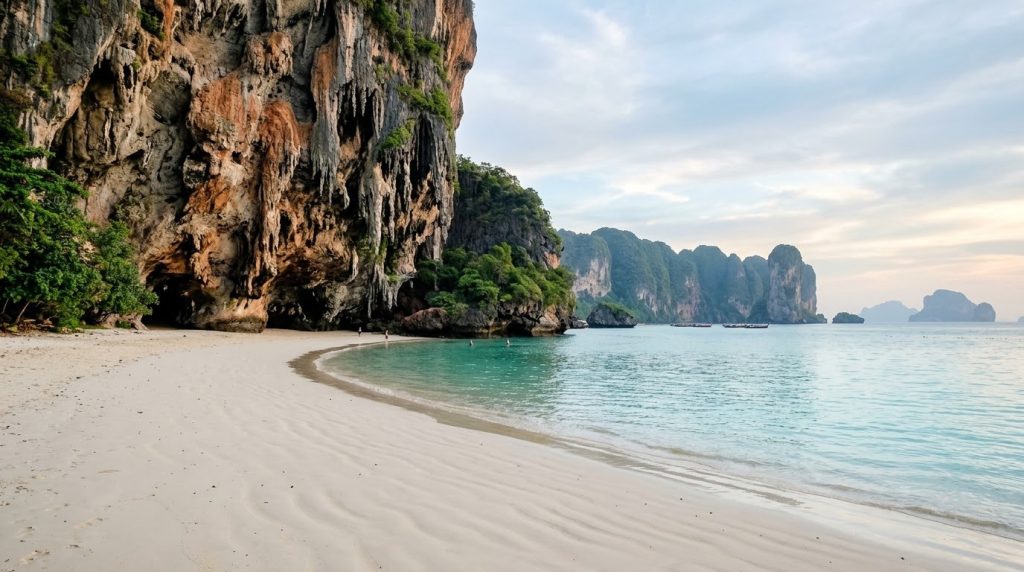
Book Ao Nang for cheaper rooms, plenty of restaurants and island tours leaving from the beach, and Railay for car-free limestone cliffs and Krabi’s best sand, knowing the two are only 10–15 minutes apart by a 100-baht longtail. For most Australians stopping in Krabi the best answer is both: 3 nights in Ao Nang, then 2 on Railay.
| Factor | Ao Nang | Railay |
|---|---|---|
| Access | Road from Krabi airport, airport shuttle THB 150 | Longtail only, no road, wet landing on Railay West |
| Beaches | Busy town beach, fine for a dip | Railay West and Phra Nang are the region’s best |
| Rooms | Mid-range average around AUD 46 · USD 33 | Railay East AC rooms AUD 63–126 · USD 45–91 |
| Food and nightlife | Huge choice, bars open late | Limited, pricier, quiet after dark |
| Island tours | Hotel pick-up included | Pick-up usually excluded |
| Climbing | Day trips to Railay | World-class crags on your doorstep |
| Best for | Families, budget travellers, first-timers | Couples, climbers, slow travellers |
Getting between them: the longtail, the tide and your suitcase
From the Ao Nang Longtail Boat Service Club on the beach, a one-way ride to Railay West is THB 100 (AUD 4 · USD 3) and takes 10–15 minutes, per WeSeekTravel’s August 2026 transport update. Boats run roughly 8am to 6pm and leave once eight or nine passengers board. After about 6pm a THB 50 (AUD 2 · USD 1.50) night surcharge applies.
There’s no jetty on Railay West. You’ll wade to your knees getting on and off, sometimes further at low tide, and you lift your own bag over the side. One suitcase is manageable; with heavy luggage, take the longtail from Ao Nam Mao pier to Railay East instead (also THB 100), which has a walkway, then walk 5–10 minutes across the peninsula to the west side.
In the monsoon months the Ao Nang side gets rough, and on choppy days or very low tides boats may leave from Nopparat Thara pier instead, with a tuk-tuk transfer included. Check our guide to Krabi’s dry and wet seasons before you lock in dates.
Beaches: Railay wins, and it isn’t close
Ao Nang’s main beach is a busy town beach lined with parked longtails. Railay West is a proper postcard: a curve of pale sand framed by sheer limestone walls. A 10–15 minute walk south brings you to Phra Nang Cave Beach, with a cave shrine full of fishermen’s carved wooden offerings.
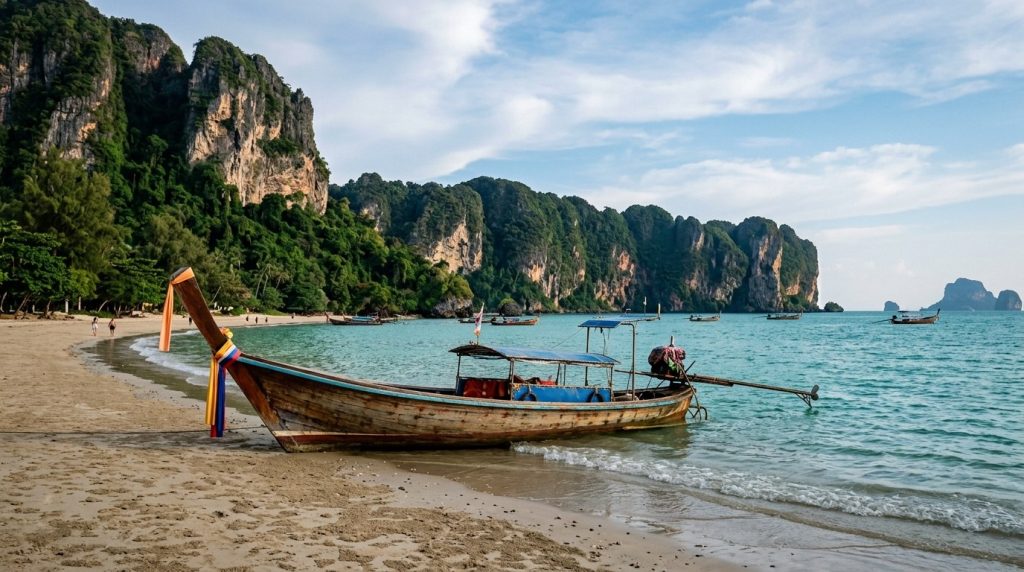
Railay East is not a swimming beach. It’s a mangrove mudflat that is mostly exposed mud at low tide, and it’s where the cheaper guesthouses are.
The catch is day-trippers, who pack Railay West and Phra Nang from late morning. Sleep there and you get early mornings and sunset with far fewer people, which is the real reason to stay.
Noppharat Thara and Tub Kaek: the quieter beach options
Ao Nang’s main beach is not the only option nearby, and the better pick for a quiet morning is a short walk rather than a boat ride away. Noppharat Thara starts 10–15 minutes on foot northwest of Ao Nang’s main strip, part of the same national park as the Phi Phi islands, and runs roughly 3 km of casuarina-shaded sand.
At low tide the sea pulls back far enough to expose a wide sandbar you can walk out on toward the offshore islets, so check tide times first if that is the draw.
Unlike Ao Nang’s beach, there are no jet skis or beach clubs here, the crowd skews toward Thai families rather than tourists, and parking along the beach road is free. Street-food stalls sell at local prices, and a cluster of seafood restaurants sits near the park headquarters.
Tub Kaek, further round the bay, is quieter again: a handful of resorts and little in the way of restaurants or nightlife, with road access so you are not relying on longtails. It suits couples who want some of Railay’s calm without the wet landing, though you will drive or taxi everywhere rather than walk.
Neither beach replaces Railay’s limestone backdrop or Phra Nang’s postcard curve, so treat them as a calmer alternative for a slow morning rather than a reason to skip Railay altogether.
What Railay’s island premium actually costs
Everything arrives by boat, and prices show it. Railay East air-conditioned rooms run THB 1,500–3,000 (AUD 63–126 · USD 45–91), basic fan bungalows on neighbouring Tonsai are THB 500–900 (AUD 21–38 · USD 15–27), and Railay West’s top resorts start around THB 8,000 and pass THB 15,000 (AUD 335–630 · USD 240–455).
In Ao Nang the average mid-range room is around AUD 46 · USD 33, rising to about AUD 85 · USD 61 in high season.
Food follows the same pattern. Expect beachside dishes on Railay at THB 180–280 (AUD 8–12 · USD 5.50–8.50) and cocktails at a similar THB 200–280. Ao Nang has far more competition, so eating cheaply is easy; our Ao Nang travel guide covers the town in detail.
Railay’s practical quirks: power, cash and after-dark options
Railay generates its own electricity. Some areas cut power between roughly midnight and 6am, and the cheapest Tonsai huts may only have power in the evening. Need all-night air conditioning? Ask before booking.
There’s no reliable ATM on the peninsula, so bring plenty of cash from Ao Nang; a return boat just to withdraw money costs THB 200.
Railay goes quiet after dark. Ao Nang has beach bars, fire shows and clubs open into the early hours, so parts of it are loud at night.
Island hopping and climbing: which base does what better
Ao Nang is Krabi’s tour hub. A 4 Islands longtail tour costs about THB 599–1,199 for adults (AUD 25–50 · USD 18–36), plus a national park fee that operators currently list at THB 200 (AUD 8 · USD 6). Hotel pick-up is included from Ao Nang but often excluded from Railay. If you want Phi Phi as well, our Krabi vs Phi Phi comparison covers whether to day-trip or stay.
Railay is the opposite. It’s a world-famous climbing area, and the crags start a few minutes from your room. A half-day beginner course with gear and instructor costs THB 2,500–3,300 (AUD 105–140 · USD 75–100). The Railay viewpoint hike takes about 25 minutes and is a steep, muddy scramble; wear closed shoes and think twice after rain.
Krabi Town: the budget, authentic base
Krabi Town is the third option most comparisons skip, and it deserves a mention for travellers who find Ao Nang too touristy and Railay too remote.
It sits inland on the Krabi River, roughly 18–25 km from Ao Nang, with transfer options running from a private car or van at around 30–40 minutes, to a shared minivan from the bus terminal at 40–60 minutes, to a songthaew (a shared pickup-truck taxi) as the cheapest option at 45–60 minutes, paid in cash and not much fun with heavy luggage.
What you get for the longer commute is a working Thai town rather than a resort strip. The Krabi Town Night Market and the older Maharaj Market both run into the evening with street food, handicrafts and the kind of prices that come without a beach-town markup.
There is no beach in town itself, so day trips to Ao Nang, Railay or the islands mean building in that 30-to-60-minute transfer each way, which adds up over a week-long stay.
Who it suits: budget travellers happy to trade beachfront convenience for cheaper rooms and food, and anyone flying in or out of Krabi Airport who wants one night in a proper town before or after the beach days, since the airport sits closer to Krabi Town than to Ao Nang or Railay.
Who should skip it: first-timers who want to walk to the sand, and anyone with only two or three nights, since the extra transfer time eats into a short trip fast.
The verdict for each type of traveller
– Families with young kids: Ao Nang. No wet landings with toddlers, tour pick-ups and endless food.
Day-trip to Railay; for a calmer beach, try Nopparat Thara next door. – Couples: Railay, at least for two nights. Car-free evenings and quiet sunsets on Railay West are the payoff. – Climbers: Railay or Tonsai, full stop. Commuting daily from Ao Nang wastes time and fares. – Budget travellers: Ao Nang. Rooms, food and tours are cheaper; Railay is THB 200 return. – First-timers in Thailand: Ao Nang first. There are no direct flights from Australia to Krabi, so after connecting via Kuala Lumpur, Singapore or Bangkok, a road transfer beats a wet landing.
Best time to visit Ao Nang and Railay
November through April is the dry season across Krabi, and it is the easiest window for both bases: days run about 24°C to 33°C, the sea sits around 28°C to 30°C, and island-hopping boats run on schedule.
February through April is the driest stretch of all, with low humidity and the best underwater visibility of the year, which matters if snorkelling or diving off Ao Nang is part of the plan.
December and January are the most reliable months for predictable weather, which is also why they are the most crowded and most expensive for rooms on both sides.
May through October is the southwest monsoon. Rain can pass through in twenty minutes or settle in for most of a day, and June in particular brings strong winds and rough seas that can make the outer islands hard to reach by longtail. September and October carry the heaviest rainfall of the year.
None of this rules out a wet-season trip, since rates drop and crowds thin on both Ao Nang and Railay, but it does make island-hopping and the Railay crossing itself less predictable, since rough seas can delay the short longtail ride between the two. May and October sit in between, with temperatures similar to the dry season but rising humidity.
If your trip is fixed to one of the wetter months, build a spare day into your plan rather than a tight boat-tour schedule, and check sea conditions before committing to a Railay crossing with luggage.
How to split your nights
For a 5-night Krabi stop, do 3 nights in Ao Nang for tours, eating out and getting over the flight, then 2 on Railay. Cross in the morning with a light bag. With 7 nights, go 4 and 3. With only 3 nights, pick one base: Ao Nang if island tours are the priority, Railay if beaches and quiet are.

A day in Railay: a sample itinerary
If you are staying in Railay for a night or two rather than just passing through on a longtail, here is how a full day on the peninsula typically breaks down. Start early on Railay West before the day-trip boats arrive from Ao Nang; the beach is at its calmest before mid-morning.
Rent a kayak from one of the stands on the sand for an hour on the water around the headland toward Phra Nang, a flatter and easier way to see the cliffs than walking.
Midday, head into the limestone itself: Diamond Cave and the Bat Cave, both a short walk inland from Railay East, have boardwalks through stalactite chambers and make a shaded break from the sun during the hottest hours.
Grab lunch at one of the simple beachside stalls rather than a resort restaurant, since prices run noticeably lower away from the hotel grounds.
Afternoon is for Phra Nang Cave Beach itself, reached on the walking path south of Railay West: swim, look at the shrine’s carved wooden offerings, and expect the crowd to thin out as day-trippers head back to their boats in the late afternoon.
End the day at one of the beachside bars on Railay West for sunset over the water, then a simple dinner before the peninsula goes quiet. Without late-night transport back to Ao Nang, Railay’s evenings are slow by design, which is exactly the trade-off you are making by staying over rather than day-tripping.
This plan skips the climbing routes and the viewpoint hike covered earlier; add either in if a full day of cliffs and views suits your fitness better than a swim-and-paddle day.
Where to stay in Ao Nang or Railay
– Ao Nang central: families and first-timers, walking distance to the longtail club and restaurants. – Railay West: couples wanting the famous view; priciest. – Railay East or Tonsai: climbers and budget travellers happy with mangroves or basic rooms.
Our full guide to where to stay in Krabi covers the other areas.
Find your Ao Nang hotel on the map
Live prices from Booking, Airbnb and more — move the map or change dates to compare stays across Ao Nang.
Frequently Asked Questions
Is it better to stay in Ao Nang or Railay?
Ao Nang is better for families, budget travellers and anyone who wants island tours with hotel pick-up and lots of restaurants. Railay is better for couples and climbers who want the best beaches, no traffic and quiet evenings. Since the longtail between them is only 10–15 minutes, splitting your stay gives you both.
How much is the longtail from Ao Nang to Railay?
A one-way longtail from Ao Nang beach to Railay West costs THB 100 (AUD 4 · USD 3) and takes 10–15 minutes. Boats run about 8am to 6pm, with a THB 50 surcharge after that. The Ao Nam Mao pier to Railay East fare is also THB 100, according to OutThailand’s Railay guide.
Is Railay worth a day trip from Ao Nang?
Yes. A return longtail costs THB 200, and you can see Railay West, Phra Nang Cave Beach and the viewpoint in one day. Go early, before the crowds, and note the last regular boats back leave around 6pm. Bring cash, as there’s no reliable ATM on the peninsula.
Does Railay have electricity all night?
Not everywhere. Railay produces its own power, and some areas cut it between roughly midnight and 6am, while the cheapest bungalows on Tonsai may only have power in the evenings. If air conditioning matters, confirm 24-hour power with the property before booking, and pack a torch for evening walks between beaches.