Is Chiang Rai Worth Visiting? An Honest Verdict (2026)
By TravelguidestipUpdated 10 min readHow we earn
Hotel buttons open Stay22 (Booking.com, Agoda and others) and tour buttons open GetYourGuide. We may earn a commission at no extra cost to you.
Yes, Chiang Rai is worth visiting if you give it 1 night and 2 half-days, because its 3 headline sights (the White Temple, Blue Temple and Black House) sit within about 15 km of town and are best seen early or late, outside tour-bus hours.
It is not worth a rushed 12-hour day trip from Chiang Mai, and it is not worth it at all in March, when burning-season smoke can turn the views grey.
| Question | Reality | What to do |
|---|---|---|
| White Temple cost | THB 200 for foreigners since 1 January 2026 | Budget AUD 8.60 · USD 6.20 (THB 200) and arrive at the 8am opening |
| Day trip from Chiang Mai | Around 7 of 12 hours spent in a van | Stay 1 night instead |
| Golden Triangle | A river viewpoint, not a wilderness | Go for the Hall of Opium museum, keep expectations modest |
| Burning season | Builds from December, worst February–March | Avoid March, check AQI daily in February and April |
| Getting there | Greenbus 3h20–3h45 from Chiang Mai | AUD 11–17 · USD 8–12 (THB 260–400) one way |
The honest answer: one night beats one day
Chiang Rai’s problem is not quality, it is logistics. A group day tour from Chiang Mai costs AUD 56–76 · USD 40–55 with lunch and pick-up, leaves around 7am and gets back near 7pm, and a 2026 route guide from Visit Thailand Today estimates that seven of those twelve hours are spent in transit. Worse, every tour reaches the White Temple at the same mid-morning peak.
Sleep one night in town and the maths flips: Blue Temple in late-afternoon light, night bazaar dinner, then the White Temple gate at 8am before the vans arrive. If you are still deciding which city deserves your base, our Chiang Mai vs Chiang Rai comparison covers that question; this page is only about whether Chiang Rai earns a spot at all.
The sights, rated honestly
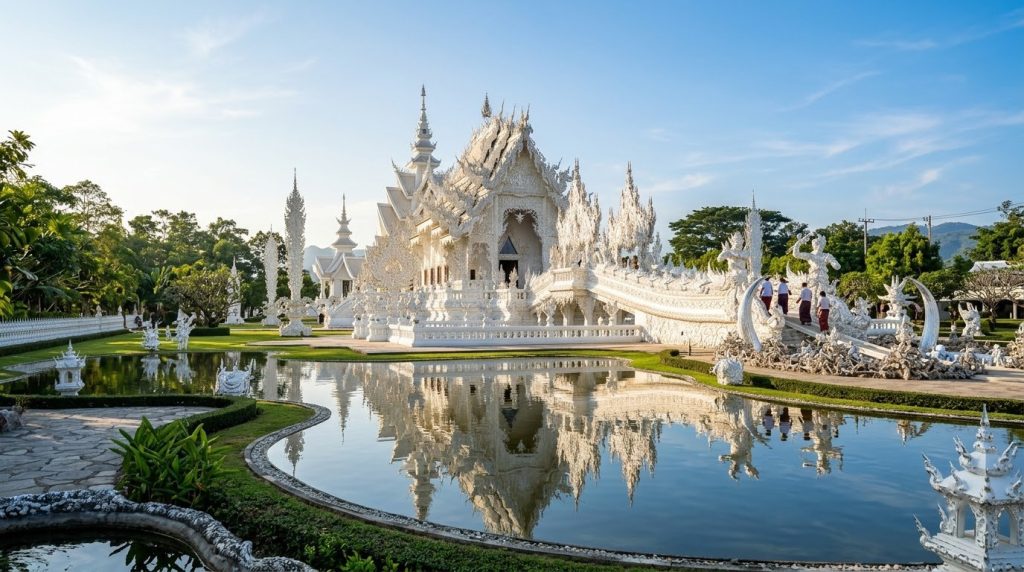
White Temple (Wat Rong Khun): worth it, at the right hour. The mirror-studded white hall really is as striking as the photos. The fee doubled to THB 200 for foreigners on 1 January 2026; children under 120 cm and visitors 70 and over enter free, according to the Chiang Rai Times visitor guide.
It opens 8am to 5.30pm, 13–15 km south of town. Cover shoulders and knees. Before 9.30am it is calm; by 11am it is a queue.
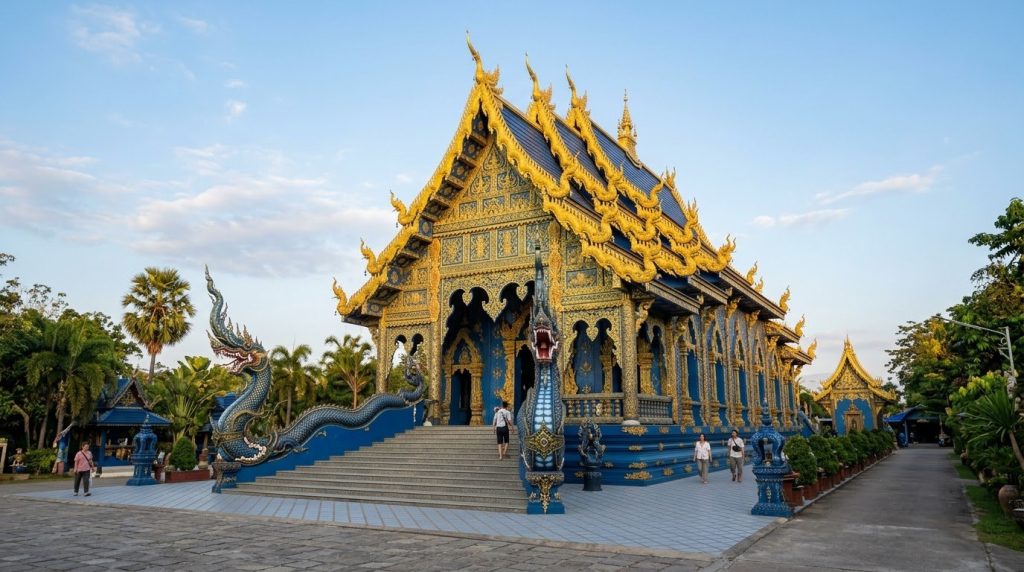
Blue Temple (Wat Rong Suea Ten): free and underrated. Sapphire walls, gold trim and a big white Buddha. Entry is free, it stays open until 8pm and it is about 10 minutes from the centre, so it suits your arrival afternoon.
Black House (Baan Dam): the one people argue about. Not a temple but a private art complex of roughly 40 dark timber buildings by the late artist Thawan Duchanee, full of horns, skins and skulls. Entry is AUD 3.40 · USD 2.50 (THB 80), it is 10–11 km north of town, and it closes for lunch from noon to 1pm, which catches a lot of people out.
Golden Triangle: modest, but the museum saves it. Sop Ruak, where the Ruak River meets the Mekong and Thailand, Laos and Myanmar converge, is about 60 km north of the city, roughly 1.5 hours by car. The viewpoint is a riverbank with a golden Buddha and souvenir stalls. The real reason to go is the Hall of Opium, a royal-foundation museum about 1 km up the road.
Tea plantations at Singha Park: the easy win. A working estate 10–12 km southwest of the centre with tea rows and flower fields. Walking in is free; the tram loop costs AUD 6.40 · USD 4.60 (THB 150) and runs 9am to 4pm. Pair it with the White Temple, roughly 6 km away.
Night bazaar: pleasant, not a destination. The Night Bazaar runs nightly from about 5pm beside Bus Terminal 1 and is smaller than Chiang Mai’s. On a Saturday, the Walking Street on Thanalai Road (about 4pm to 10pm) is the better evening.
More sights worth the extra half-day
Add a half-day to the one-night plan above and a few more Chiang Rai sights earn their place without needing a third night in town.
Wat Huay Pla Kang, the Big Buddha: free, and good at two times of day. A short ride north-west of the centre, this hillside temple mixes Thai Lanna and Chinese styles around a roughly 25-metre statue of Guanyin, the Goddess of Mercy, plus a nine-tiered pagoda.
Entry to the grounds is free; a lift inside the statue costs about AUD 1.70 · USD 1.20 (THB 40) if you want the view from the top.
It works well either as a quick stop on the way to the White Temple in daylight, or after dark, when the statue and pagoda are lit up and the daytime crowds have thinned out.
Wat Phra Kaew: the temple with the real history, and almost no queue. This modest in-town temple is where Thailand’s most sacred Buddha image, the Emerald Buddha now in Bangkok’s Grand Palace, was reportedly discovered after lightning cracked open an old stupa in 1434.
Entry is free, it sits a short walk from the clock tower, and because it lacks the White Temple’s photo fame, you can usually walk straight in.
Khun Korn Waterfall: the easy nature fix. About 30 km south-east of the city, Khun Korn is reached by a flat, shaded 1.4 km forest trail to a roughly 70-metre waterfall, open from around 8.30am to 4.30pm.
Entry is free or a small forest-park fee, and swimming at the base is popular in the cooler months when the flow is gentler. It needs a scooter or a car with a driver, so it suits the second day of a one-night stay rather than a packed first afternoon.
Doi Tung and Phu Chi Fa: for a third night, not a rushed add-on. Doi Tung, around 60–70 km north near the Myanmar border, pairs the former royal residence gardens with a coffee and macadamia project that replaced the area’s old opium fields; allow at least half a day once the drive is added in.
Phu Chi Fa, a sunrise viewpoint over a sea of cloud on the Laos border, sits roughly 2 to 2.5 hours further again and realistically needs an overnight near the mountain rather than a day return.
Both are genuine highlights, but neither fits inside the one-night plan above without cutting something else, so treat them as a reason to come back rather than something to squeeze in.
A one-night plan that actually works
Day 1. Take a 7am or 7.30am Greenbus from Chiang Mai Bus Terminal 3; you arrive downtown around 10.50am. Drop bags, lunch, then the Black House after its 1pm reopening. Blue Temple around 4pm, night bazaar for dinner.
Day 2. Grab to the White Temple for the 8am opening, then Singha Park for the tea fields until late morning. Afternoon bus back to Chiang Mai, or a late flight to Bangkok.
Add a second night only for the Golden Triangle, a half-day on its own. Slot this trip into the middle of our 4-day Chiang Mai itinerary rather than the end, so a delayed bus never threatens your flight home. Our breakdown of how many nights Chiang Rai needs shows what that second night adds, including Doi Tung and the tea hills of Choui Fong or Mae Salong.
What to eat in Chiang Rai
Northern Thai food, known locally as Lanna cuisine, is milder and herbier than the central Thai dishes most visitors already know, and Chiang Rai is a good place to try it away from Chiang Mai’s bigger crowds.
Sai ua: a grilled herb sausage packed with lemongrass, kaffir lime leaf and galangal, sold at night-market stalls and almost every local restaurant. Gaeng hang lay (also called gaeng ho): a slow-cooked pork curry with ginger and tamarind, Burmese in origin and a Chiang Rai menu staple.
Larb: minced meat tossed with toasted rice powder, lime and chilli, served warm rather than the cold salad version found further south. Khao soi: the curried-noodle soup more associated with Chiang Mai, but widely available here too and worth comparing between the two cities.
For where to eat it, the Night Bazaar’s food stalls near Bus Terminal 1 are the easiest first stop, with plastic-table seating and dishes costing only a few dollars each. Sit-down Northern Thai restaurants clustered around the Clock Tower serve the same dishes in a calmer setting for a little more.
A kantoke dinner, a low-table set meal traditionally eaten on the floor with several small dishes shared between diners, is worth booking if a hotel or tour operator offers one, since it is the clearest introduction to how a full Lanna meal is put together.
Budget AUD 3–6 · USD 2–4 (THB 70–140) for a market meal and AUD 7–13 · USD 5–9 (THB 170–300) for a sit-down restaurant dish with a drink, broadly in line with the rest of northern Thailand.
Chiang Rai is also one of Thailand’s main coffee-growing provinces. Highland areas such as Doi Chang, Doi Tung and Doi Mae Salong grow Arabica beans that supply both export roasters and a growing run of mountain cafes, several with views over the surrounding hills.
A coffee stop at one of these cafes, or at a roastery closer to town, pairs naturally with the Big Buddha or Singha Park loop described above, since most sit along the same roads.
Expect to pay AUD 2–4 · USD 1.50–3 (THB 50–90) for a basic espresso drink, similar to city-centre prices in Bangkok, a little more at the view cafes on Doi Chang itself.
Who should skip Chiang Rai
– Travellers with 3 nights or fewer in the north. Spend them in Chiang Mai.
Doi Suthep, the old city and an ethical elephant sanctuary will give you more than a rushed temple dash; our list of the best things to do in Chiang Mai shows how much fits in. – Anyone visiting in March. Chiang Rai’s burning season builds from December, peaks in February and March and usually eases in late April or May once rain arrives.
Chiang Rai Times recorded district readings above 250 micrograms per cubic metre of PM2.5 in its burning season report, against a Thai red-alert threshold of 75.1.
Asthmatics and families with young kids should not plan around this window. – People who dislike temples. Strip out the three art-temples and Chiang Rai is a quiet provincial town. – Families with under-10s on a day tour. A 12-hour van day is brutal for small children.
What a day in Chiang Rai actually costs
Outside the big-ticket sights already covered, these are the smaller costs that add up across a one or two-night stay.
| Item | Typical cost | Notes |
|---|---|---|
| Scooter rental | AUD 6–9 · USD 4–6 (THB 150–200) per day | An international licence is recommended; helmets are compulsory |
| Grab ride across town | AUD 2–4 · USD 1.50–3 (THB 50–90) | Cheaper and more reliable than flagging a tuk-tuk |
| Songthaew (shared pickup-truck taxi) | AUD 0.85–1.70 · USD 0.60–1.20 (THB 20–40) | Flat in-town fares; agree the price first for longer trips |
| Bottled water, 1.5L | AUD 0.40–0.65 · USD 0.30–0.45 (THB 10–15) | From 7-Eleven or minimarts, widely available |
| Local SIM or eSIM, about 8 days | AUD 8–13 · USD 6–9 (THB 190–300) | Buy at the airport counter or a 7-Eleven; useful for maps between sights |
A realistic daily budget outside accommodation, covering a scooter or a few Grab rides, two meals and water, lands around AUD 13–21 · USD 9–15 (THB 300–500) per person, less if you walk the in-town sights and eat mostly from market stalls.
Cash still runs most of daily life outside hotels and larger restaurants: market stalls, songthaews and small cafes rarely take cards. ATMs charge a flat foreign-card fee, around THB 220 per withdrawal at most Thai banks, so it is cheaper to withdraw a larger amount less often than to make several small trips.
Tipping is not expected but is appreciated for a good guide or driver; rounding up a restaurant bill or leaving small change from a meal is the norm rather than a fixed percentage.
Getting there from Australia
There are no direct flights from Australia. Fly Sydney, Melbourne or Perth to Bangkok, then take the 1h20 domestic hop from Don Mueang on Thai AirAsia, Nok Air or Thai Lion Air. From Chiang Mai, the Greenbus runs 13 departures a day between 7am and 6pm; buy at the Terminal 3 counter for the lowest fare.
If Chiang Mai itself is still a question mark, read whether Chiang Mai is worth visiting first, because Chiang Rai works best as an add-on to it.
Where to stay in Chiang Rai
– Around the Night Bazaar and Clock Tower: walkable to dinner, markets and Bus Terminal 1. Best for a one-night stay and anyone without a scooter. – Kok River (Mae Kok) riverside: a few minutes north of the centre, quieter, with more resort-style hotels and pools.
Suits couples and families staying two nights. – Near the White Temple and Singha Park: only with a car; closest to an 8am temple start.
Find your Chiang Rai hotel on the map
Live prices from Booking, Airbnb and more — move the map or change dates to compare stays across Chiang Rai.
Frequently Asked Questions
Is the White Temple worth THB 200?
Yes, if you arrive early. At AUD 8.60 · USD 6.20 it is still cheap for a headline sight, and the ticket includes the on-site art gallery. Arrive at the 8am opening, because tour groups from Chiang Mai pour in from mid-morning and the bridge into the main hall becomes a slow queue.
Can you see Chiang Rai in one day?
You can see the White Temple, Blue Temple and Black House in one day, since all three sit within about 15 km of town. What you cannot do comfortably is add the Golden Triangle, which is 60 km north. If you are coming from Chiang Mai, one day means around seven hours of transit, so stay at least one night.
Is the Golden Triangle worth the trip?
Only if you go to the Hall of Opium museum. The viewpoint at Sop Ruak is a riverbank with a golden Buddha and souvenir stalls, and most people are done in 20 minutes. The museum explains the region’s opium history properly and justifies the roughly 1.5-hour drive each way from Chiang Rai.
When is the best time to visit Chiang Rai?
November to January is cool, dry and clear, which makes it the best window, though also the busiest. Avoid February to April if air quality matters to you, with March usually the worst month for smoke. The wet season brings fewer crowds but afternoon downpours.