How Many Days in Langkawi? 3–4 Nights Is the Sweet Spot
By TravelguidestipUpdated 10 min readHow we earn
Hotel buttons open Stay22 (Booking.com, Agoda and others) and tour buttons open GetYourGuide. We may earn a commission at no extra cost to you.
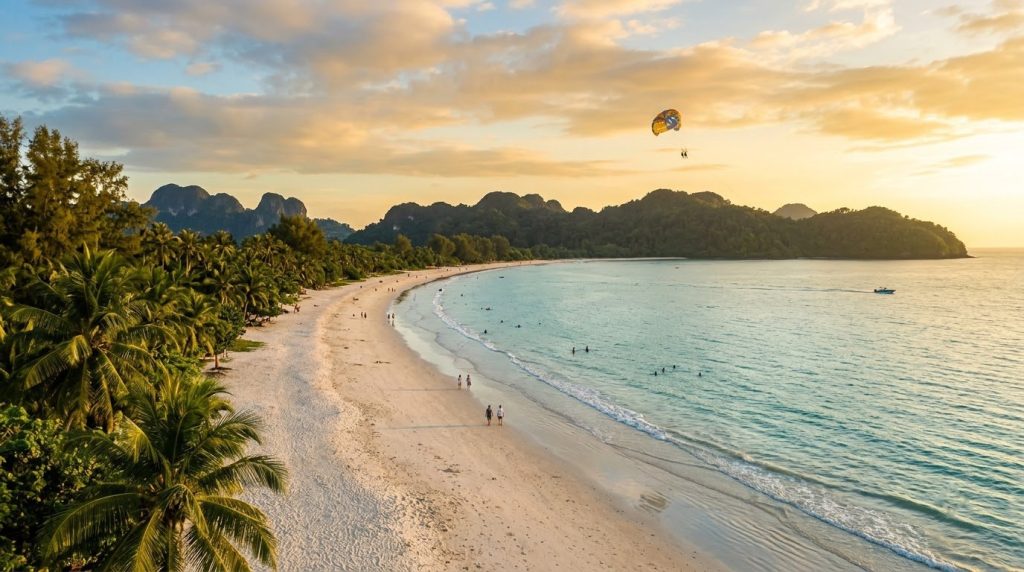
The short answer
Book 3 to 4 nights in Langkawi. 2 nights works only if you skip either the mangroves or the islands; 5 or more nights suits families and resort lovers.
| Trip length | What you fit in | Who it suits | Approx. cost / person |
|---|---|---|---|
| 2 nights | SkyCab + SkyBridge, one boat trip, one Cenang sunset | ||
| 3–4 nights | SkyCab, Kilim, island hopping, beach days, duty-free shopping | ||
| 5–7 nights | All of the above plus waterfalls, a quiet north-coast resort, rain buffer days |
Book 3 to 4 nights in Langkawi: that covers the SkyCab and SkyBridge, a Kilim mangrove tour, a 3–4 hour island-hopping trip and 2 slow afternoons on Pantai Cenang without a single rushed morning. Two nights works only if you skip either the mangroves or the islands.
Five or more nights suits families, resort lovers and anyone visiting in the wet season. Langkawi is a beach-and-nature stop, not a sightseeing marathon, so extra days mostly buy you rest rather than new attractions.
| Trip length | What it realistically covers | What you give up |
|---|---|---|
| 2 nights | SkyCab + SkyBridge, one boat trip, one Cenang sunset | Either Kilim or island hopping; no rain buffer |
| 3–4 nights | SkyCab, Kilim, island hopping, beach days, duty-free shopping | Very little for a first visit |
| 5–7 nights | All of the above plus waterfalls, a quiet north-coast resort, rain buffer days | Time you could spend in Penang or KL |
What 2 nights in Langkawi gets you (and what it costs you)
Two nights is the minimum that makes the flight worthwhile, and it lines up with a customs rule too: you must stay at least 48 hours on the island before you can carry duty-free goods off it, including the 1 litre alcohol allowance.
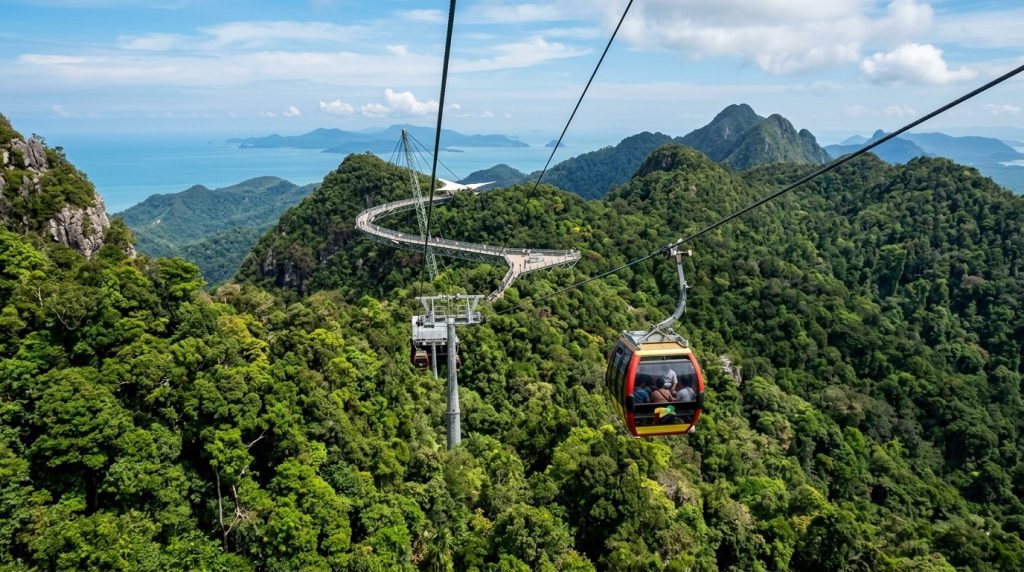
On a 2-night stay, spend your one full day at Oriental Village. The 4-in-1 SkyCab ticket for international visitors costs AUD 27 · USD 20 (MYR 80) per adult, and the standard package does not automatically include the SkyBridge, so check what you are buying on the official SkyCab ticket listing. Go early.
The cable car opens at 9:30am, but on Wednesdays it starts at 12pm for maintenance, and weather closures are not refunded.
That leaves half a day for one boat trip and no spare day if a storm rolls in. For Australians flying in via Kuala Lumpur, 2 nights is a stopover, not a holiday.
Why 3–4 nights is the right number for most Australians
Three to four nights lets each of the big four experiences have its own morning, which matters because boat trips run best before the afternoon storms build.
– Kilim Geoforest Park. The official park manager lists private boats at AUD 136 · USD 98 (MYR 400) for 2 hours and AUD 187 · USD 135 (MYR 550) for 4 hours, up to 10 people per boat, per the Kilim mangrove tour rates.
The 2-hour route covers the river cruise, a floating fish farm, eagle watching and the bat cave. Split between four friends it is good value. – Island hopping. Sharing boats run around AUD 10–17 · USD 7–12 (MYR 30–50) per person, or about AUD 119 · USD 86 (MYR 350) for a private 8-seat boat.
The trip takes 3–4 hours and stops at Dayang Bunting’s freshwater lake (entry AUD 2 · USD 1.50 (MYR 6)), Pulau Singa Besar for eagle feeding and Beras Basah for a swim. – Pantai Cenang and Pantai Tengah. Cenang is about 10–15 minutes by taxi from the airport, and Tengah is the quieter continuation of the same shoreline.
Budget at least two late afternoons here for swimming and sunset. – Duty-free. Langkawi has been a duty-free island since 1 January 1987. A 400g Toblerone runs AUD 5–7 · USD 3.70–4.90 (MYR 15–20), roughly half the mainland price, and beer and spirits are the bigger savings.
Want those four slotted into actual days? Our day-by-day Langkawi itinerary does the sequencing. This page only answers how long to stay.
When 5–7 nights makes sense
Stretch to 5 nights or more if you are travelling with young kids who need pool time between outings, if you are visiting in September or October and want buffer days for rain, or if you have booked one of the secluded north-coast or Datai-side resorts where the resort itself is the point. A week also suits Australians escaping winter who want one unhurried stop rather than a multi-city lap.
Who should think twice about more than 4 nights
Skip a long stay if you want nightlife, street food variety or culture. Langkawi’s dining is centred on the Cenang strip, and after three evenings it starts to feel like the same street, because it is. Penang beats it for food and heritage, and KL beats it for shopping beyond chocolate and alcohol.
There is also no useful public transport for visitors, so every outing means a Grab, taxi or hire car. Cut your stay to 3 nights if you are on a tight two-week Malaysia loop.
How wet season changes the answer
The driest stretch is January to March, when rain is minimal. April to August brings intermittent showers, and September and October are the wettest months at around 339mm and 344mm of rain respectively, according to Langkawi Insight’s climate guide.
The good news: even in the wet, rain usually falls for about two hours a day, often later in the afternoon. That means mornings are generally clear enough for the cable car and boat tours. The bad news: lightning stops SkyCab and can cancel boats, so in September and October add 1 night to whatever you planned. Four nights becomes 5. That spare day is what saves the trip.
Getting around Langkawi once you land
Langkawi has no public bus or rail network for visitors, so however many nights you book, your transport plan is Grab, taxi or a rental car.
Grab operates across the island and is usually the cheapest option for short hops around Pantai Cenang and Kuah, though drivers can be reluctant to take jobs out to the quieter Datai Bay side, so check availability before you book a resort there without a car.
Taxis run on a fixed-fare system rather than a meter, with set prices between common points such as the airport, Cenang and Kuah; agree the fare before you get in if a driver quotes verbally rather than pointing to a posted rate card.
Hiring a car makes sense from about three nights onward, when you are covering the SkyCab, Kilim and the duty-free shops in Kuah on different days, since it removes the wait time for a Grab to arrive and lets you detour to a waterfall or viewpoint on a whim.
Whichever you choose, fill up on fuel in town rather than waiting until you are near the airport, and keep a little cash on hand, since Grab in Langkawi still sometimes defaults to cash payment outside the app’s card option.
Roads on the island are generally in good condition and signposted in English as well as Malay, so self-driving is straightforward for visitors used to driving on the left, which matches Australian road rules.
The main thing to plan around is distance rather than traffic: resorts near Datai Bay or the north coast sit 30–45 minutes from Pantai Cenang and the airport, so factor that drive into your first and last day rather than booking a tight flight connection.
Motorbike and scooter hire is widely advertised around Cenang, but Malaysian law requires a valid motorcycle licence, and travel insurance policies often exclude scooter-related injuries if you do not hold one, so check your cover before you consider it as a cheaper alternative to a car.
Fitting Langkawi into a Malaysia route
Most Australians will connect through Kuala Lumpur, as Malaysia Airlines, AirAsia and Batik Air fly KL to Langkawi in about 1 hour 10 minutes. From Penang the flight is about 30 minutes.
The direct Penang to Langkawi ferry has not run since it was suspended in March 2020 and has not resumed. The overland option is a ferry from Kuala Kedah (about 1 hour 45 minutes, AUD 15 · USD 11 (MYR 45) for international adults) or Kuala Perlis (about 1 hour 15 minutes, AUD 12 · USD 9 (MYR 35)).
Flying is faster from Penang; the Kuala Kedah ferry only makes sense if you are already travelling up the mainland coast. Our guide on getting to Langkawi by air or sea compares the routes in full.
A balanced 10-day Malaysia trip looks like 3 nights KL, 3 nights Penang and 4 nights Langkawi, finishing on the island so you can fly home via KL relaxed.
What to pack for Langkawi
Langkawi is casual by Malaysian standards, but you will want at least one modest outfit, covered shoulders and knees, for visiting a mosque or temple on the island, plus a sarong or light scarf that doubles as sun cover on the boat trips.
Reef shoes or sturdy sandals earn their place on the packing list for Pulau Beras Basah’s swim stop and the jetty scrambles on island-hopping trips, where bare feet meet sharp coral rubble and hot concrete in the same five minutes.
Reef-safe sunscreen matters more here than in a lot of destinations, because so much of a Langkawi trip happens on or over water: the SkyCab, the mangrove cruise and the island-hopping boats all put you under direct sun with very little shade.
Pack a light rain jacket rather than relying on umbrellas, especially if you are travelling in the wetter months of April to August or September and October, since sudden squalls can catch a boat trip mid-crossing.
A dry bag, or simply a zip-lock bag for your phone, is worth the small effort on any of the boat trips, where spray and the occasional wave over the side are normal rather than a sign something has gone wrong.
Insect repellent earns its place too, especially around the Kilim mangroves and anywhere near standing water at dusk. Lightweight, breathable layers work better than heavy cotton in Langkawi’s humidity, and a change of clothes packed separately from your main bag is useful on an island-hopping day, since swimwear and a sarong can see you through most of it without needing a full outfit change back at the hotel.
Bring a universal travel adapter rather than assuming your hotel will have spares, and pack any specific medication you need in carry-on rather than checked luggage, since pharmacies on the island stock the basics but not every prescription brand.
Langkawi with young kids: what changes
Families travelling with young children generally need more nights than the 3–4 that suit most couples, because toddlers and preschoolers do not move at a sightseeing pace.
Build in pool time between outings rather than stacking the SkyCab, a boat trip and the beach into one day, and expect the Kilim mangrove tour and island hopping to feel long for anyone under about six, since both involve sitting on open boats for hours at a time.
Family-oriented resorts clustered on Pantai Cenang tend to have kids’ pools, shallow sections of beach and sometimes a kids’ club, which takes pressure off parents on the inevitable rest day. Wildlife-focused attractions, such as the island’s bird park, are an easier win with young children than a half-day boat trip, since they run on a child’s attention span rather than a tour schedule.
Car seats are not standard in Grab or taxi vehicles on Langkawi, so families who want one should either bring a portable seat or book a private transfer company in advance that can supply one, rather than assuming the airport taxi rank will have it covered.
Life jackets sized for children are not always stocked by every island-hopping operator, so ask specifically when booking rather than assuming one will be handed over at the jetty. The same goes for shade on board: most boats have a small canopy, but it rarely covers everyone, so a wide-brimmed hat and a long-sleeved rash top protect a child far better than sunscreen alone over a 3–4 hour trip.
Families stretching to five or more nights often split the stay between a beach-focused resort near Cenang for the first half and a quieter north-coast property for the second, which breaks up the drive times and gives young kids a change of pool and scenery partway through without changing islands.
Where to stay in Langkawi
Your base matters more than the number of nights, because Langkawi is spread out.
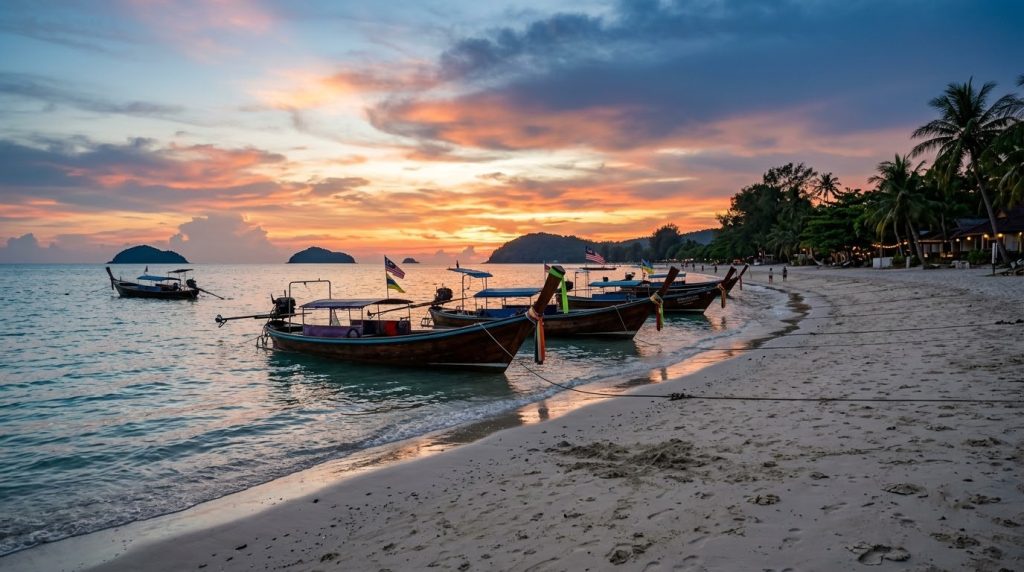
– Pantai Cenang: best for first-timers and short stays. Restaurants, duty-free shops and the beach are walkable, and it is 10–15 minutes from the airport. – Pantai Tengah: best for couples. Same coastline, fewer crowds, an easy taxi back to Cenang for dinner. – North coast and Datai Bay: best for 5+ nights when the resort is the holiday. Expect longer drives to Kilim and the jetties.
For a deeper breakdown, read our guide to the best areas to stay in Langkawi or browse our shortlist of Langkawi hotels by budget.
Find your Langkawi hotel on the map
Live prices from Booking, Airbnb and more — move the map or change dates to compare stays across Langkawi.
Frequently Asked Questions
Is 2 days enough for Langkawi?
Two nights is enough for the SkyCab and one boat trip, but you must choose between the Kilim mangroves and island hopping. It also meets the 48-hour minimum stay for taking duty-free goods off the island. If the weather turns, you have no spare day, so treat 2 nights as a stopover rather than a beach holiday.
Is 3 days in Langkawi too short?
Three nights is enough for a first visit. You can ride the SkyCab, take a Kilim mangrove tour, go island hopping and still have two afternoons on Pantai Cenang. It feels tight only in September and October, when afternoon storms can cancel boats, so add a fourth night in the wet season.
Can I take the ferry from Penang to Langkawi?
No. The direct Penang to Langkawi ferry was suspended in March 2020 and has not resumed. Fly from Penang in about 30 minutes, or travel overland to Kuala Kedah or Kuala Perlis and take a ferry from there. Kuala Kedah ferries take about 1 hour 45 minutes.
What is the best month to visit Langkawi?
January to March is the driest period and the best for boat trips and beaches. April to August has intermittent showers. September and October are the wettest months, although rain typically lasts only about two hours a day, so mornings are usually usable for tours.