Disclosure: Some links in this guide are affiliate links. If you book or buy through them, we may earn a small commission at no extra cost to you — it helps keep our guides free.
The best time to visit Indonesia is the dry season between April and October, when Bali and Java hold daytime temperatures of 27°C to 31°C and Komodo’s dive visibility peaks near 35 meters. Indonesia spans more than 5,000 km across the equator, so this dry-season answer only covers the western and central islands, and a traveller heading to Raja Ampat in the far east needs the opposite months.
| Month | Bali/Java | Gili/Lombok | Komodo | Raja Ampat |
|---|---|---|---|---|
| January | Wet | Wet | Wet, manta season begins in the south | Dry, peak season |
| February | Wet | Wet | Wet, manta season | Dry, peak season |
| March | Wet, drying out | Wet, drying out | Transitional | Dry |
| April | Dry season starts | Dry season starts | Dry season starts | Dry, season winds down |
| May | Dry | Dry | Dry, north sites open | Off-season starts |
| June | Dry | Dry | Dry | Off-season |
| July | Dry, peak crowds | Dry, peak crowds | Dry, peak visibility | Off-season |
| August | Dry, peak crowds | Dry, peak crowds | Dry, peak visibility | Off-season |
| September | Dry, shoulder | Dry, shoulder | Dry | Off-season |
| October | Dry season ends | Dry season ends | Dry season ends | Dry season starts |
| November | Wet season starts | Wet season starts | Wetter, north sites still diveable | Dry |
| December | Wet | Wet | Wet, manta season begins in the south | Dry, peak season |
The dry season (April to October) – the answer for Bali, Java and Lombok
April to October is the dry season across Bali, Java and Lombok, and it is the most reliable window for sunshine, calm seas and low humidity on these three islands. Java’s dry season runs narrower, from May to September, while Bali and Lombok stay dry from April through to October.
Daytime temperatures in Bali hold between 27°C and 31°C through the period, with cooler, drier evenings than the wet months bring. July and August have the clearest skies but also the largest crowds and the highest hotel rates, since they overlap with school holidays in Australia, Europe and Indonesia at the same time.
May, June and September are the shoulder months, and accommodation in these weeks can run 30-40% cheaper than the July-August peak while keeping a similar chance of dry weather. Lombok and the Gili Islands are quieter than Bali even during the July-August peak, which matters for anyone choosing between the two for the same dry-season trip.
For a full month-by-month breakdown of Bali’s rain and crowd patterns, see Bali’s seasonal guide; Lombok and the Gili Islands follow a near-identical dry-season pattern, covered in Lombok’s seasonal guide.
Why one national best time is misleading
A single “best time to visit Indonesia” answer breaks down once the trip crosses into the eastern archipelago.
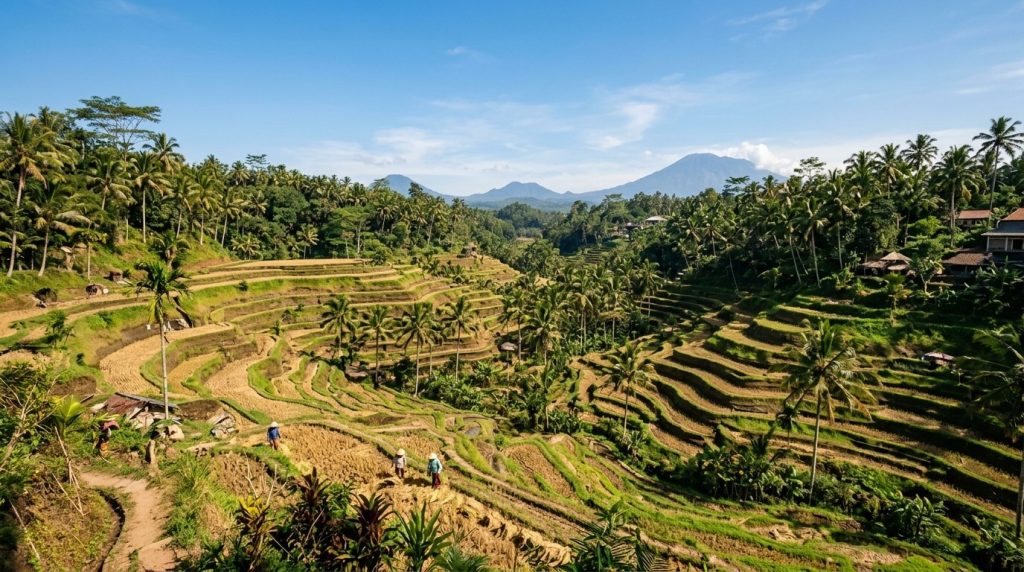
Indonesia straddles the equator across more than 5,000 km, from Sumatra in the west to Papua in the east, so the country has no shared summer or winter, only a wet and dry season that arrives in different months depending on which sea surrounds each island group.
Bali, Java, Lombok and the western dive sites in Komodo follow the April-to-October dry season described above.
Raja Ampat, off the coast of Papua in Indonesia’s far east, runs the opposite calendar: its liveaboard dive season is October to April, when seas are calmest and visibility exceeds 25 meters, and it slows through the northern-hemisphere summer while Bali is at its driest.
A traveller who times a trip around Bali’s July dry season would arrive in Raja Ampat during its quietest, roughest months, and a diver booking a Raja Ampat liveaboard for January would land in Bali during its wettest weeks.
The archipelago needs two separate calendars, not one national verdict, and any itinerary that spans both ends should plan the flights around the dive season rather than the beach season.
Komodo and the diving calendar
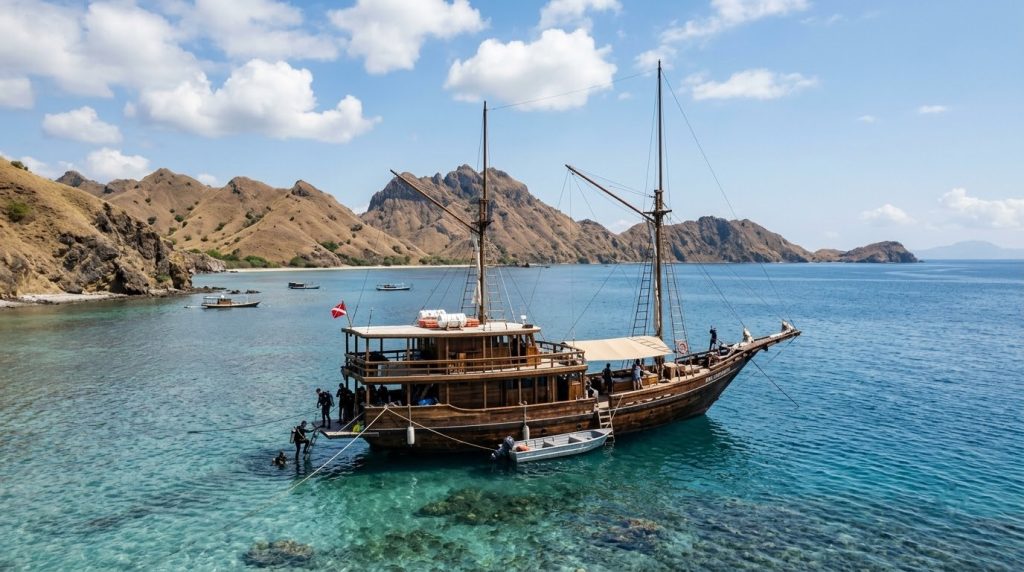
Komodo’s dry season runs April to November, but the best window shifts within the park depending on which dive sites are on the itinerary. Visibility peaks in July and August, reaching 25-35 meters at most dive sites, and this is also when currents settle into their most predictable patterns.
The northern sites, including Crystal Rock and Gili Lawa, dive best from May to October, inside the main dry season.
The southern sites, including Manta Point and The Cauldron, run on a different clock: they are strongest from December to April, and Manta Alley sees its largest manta ray numbers from January to March, when cooler water pushes plankton into the southern channels.
A trip built only around the July-August visibility peak can miss the manta season, while a trip timed for January mantas has to accept rougher conditions on the northern sites. Most liveaboards departing from Labuan Bajo in Flores plan their routes around this north-south split rather than treating Komodo as a single season.
The wet season (November to March) – what it ruins and what it does not
The wet season does not cancel a Bali, Java or Lombok trip; it mostly shortens the sunny hours across the middle of most days. Rain in these months typically falls as afternoon downpours rather than continuous rain, and mornings are often clear enough for beach time or temple visits before clouds build.
Humidity rises, surf breaks lose their consistency, and some hillside roads and hiking trails become harder to manage, but flights, ferries and most tours continue to run on schedule. The wet season is also when hotel rates drop furthest below the July-August peak, which suits travellers who prioritise budget over guaranteed sun.
Crucially, the same months that bring rain to Bali and Java are the peak dry season for Raja Ampat, where January and February are the calmest, clearest months of the year for a liveaboard trip.
A traveller who checks only the west-Indonesia forecast and assumes the whole country is wet from November to March would skip the best window for the country’s most remote dive region.
When NOT to visit Indonesia
Avoid Bali and Java in January and February if calm, dry weather matters more than low prices, since these are the wettest months of the year with the heaviest rainfall and the highest humidity.
Avoid the last week of December and the first week of January across Bali and Lombok, when Christmas and New Year school holidays push hotel rates to their highest point and popular beaches and restaurants fill up well ahead of the dates.
In March, Bali observes Nyepi, the Day of Silence, when the entire island, including the airport, closes for 24 hours; arriving or departing on that date is not possible, so the exact date needs checking before flights are booked.
Avoid planning a Raja Ampat liveaboard between May and September, when most operators suspend trips or reposition their boats toward Komodo and other regions for the calmer Bali-Java dry season, leaving fewer departures and rougher seas for anyone who books during that window regardless.
Festivals and events that affect timing
Nyepi, Bali’s Day of Silence, falls on 19 March 2026 and is worth building a trip around rather than running into by accident. The entire island, airport included, shuts down for 24 hours, so flights neither land nor depart, taxis and shops close, and even tourists are expected to stay off the streets and keep noise and lights down.
Travellers flying in or out of Bali around this date need to check the exact dates each year, since Nyepi follows the Balinese Saka lunar calendar and shifts annually.
Galungan and Kuningan, the twin festivals marking the victory of good over evil in Balinese Hinduism, recur every 210 days on the Pawukon calendar rather than on a fixed date, and they bring penjor, tall bamboo poles decorated with offerings, lining streets across the island along with busier temples and more traffic than a typical week.
These festivals do not close the island the way Nyepi does, but they add a genuine cultural layer worth timing a trip around if the dates line up, and a quick date check closer to travel is the only reliable way to catch one.
Ramadan, observed by Indonesia’s Muslim-majority population across Java, Sumatra and Lombok, falls in mid-to-late February 2026 depending on moon sighting, and it changes daytime rhythms more than it closes anything to tourists.
Expect some restaurants in Muslim-majority areas to adjust hours around fasting, and Idul Fitri at Ramadan’s end brings a major domestic travel surge, Indonesia’s busiest and most expensive week for flights and ferries, that is worth avoiding for anyone trying to keep transport costs down.
Best time to visit Indonesia FAQs
Do I need to avoid Indonesia entirely during the wet season? No. As covered above, the wet season mostly shortens sunny hours with afternoon downpours rather than cancelling a trip outright, and it is also the best window for Raja Ampat diving, so “wet season” is not a single verdict for the whole country.
Which islands are least affected by the dry/wet season split? Islands near the equator, including parts of Sulawesi and Kalimantan, see less seasonal swing in rainfall than Bali, Java or the Nusa Tenggara chain, though humidity stays high year-round regardless of season.
How far ahead should I book around Nyepi or Idul Fitri? Several months ahead for flights touching Bali around Nyepi or anywhere in Indonesia around Idul Fitri, since both periods compress either flight availability (Nyepi’s airport closure) or push domestic demand to its yearly peak (Idul Fitri).
Is there a single best month to see all of Indonesia? No, as covered above, the country’s geography rules out one answer: July and August suit Bali, Java and the northern Komodo dive sites, while that same window is Raja Ampat’s off-season, so the right month depends entirely on which part of the archipelago is the priority.
Should I avoid Bali entirely on Nyepi day if I’m already there? No, staying is fine and many travellers find it a genuinely memorable experience, since the enforced quiet brings out clear night skies rarely seen the rest of the year. The restriction is on movement and noise, not presence, so a trip already in progress simply pauses for a day rather than needing to end early.
Plan your Indonesia trip
Once the season is set, the next decision is where to base the trip: Bali’s south coast, Ubud’s rice terraces, the Gili Islands, or Labuan Bajo for Komodo. A 7-day Bali route built around the dry season is mapped out in Bali’s 7-day itinerary, and a Lombok-focused route, including the Gili Islands, is covered in the Lombok itinerary.
The map below shows live hotel availability across the archipelago for the dates already chosen.
Find your Indonesia hotel on the map
Live prices from Booking, Airbnb and more — move the map or change dates to compare stays across Indonesia.