Disclosure: Some links in this guide are affiliate links. If you book or buy through them, we may earn a small commission at no extra cost to you — it helps keep our guides free.
The best time to visit Boracay is during the Amihan season, which runs roughly November to May, when the northeast monsoon shelters White Beach from the 15 to 25 knot winds that hit the other side of the island.
This window narrows further to December through February for the driest, calmest days, while the Habagat season from June to October reverses the wind and sends rain and swell onto White Beach instead.
| Month | Weather | Sea and wind | Crowds | Verdict |
|---|---|---|---|---|
| November | Dry season begins, occasional late showers | Amihan sets in, White Beach flattens | Rising | Good, fewer crowds than December |
| December | Dry, warm days, cooler nights | Amihan strong, Bulabog wind builds toward 15-25 knots | Peak, holiday surge | Best for calm swimming, book early |
| January | Dry, sunny | Amihan strongest, White Beach glassy | Peak | Best overall month |
| February | Dry, warming | Amihan holds, occasional early algae patches reported locally | Peak into high | Excellent, watch beach flags |
| March | Dry, hot | Amihan easing, seas still calm | High | Great value versus January |
| April | Hot, dry | Amihan tail end, warm calm water | Moderate | Hot but reliable, good value |
| May | Humid, transitional | Amihan fading, first Habagat swells possible late month | Lower | Shoulder season, watch forecasts |
| June | Wet season starts | Habagat begins, swell and seaweed can reach White Beach | Low | Skip if you need calm swimming |
| July | Wet, frequent rain | Habagat active, White Beach roughest | Low | Avoid for beach days |
| August | Wet, heaviest rain | Habagat peak, poorest visibility | Lowest | Cheapest, worst weather |
| September | Wet, rain easing late month | Habagat continues, typhoon risk | Low | Still risky, track storms |
| October | Transitional, drying out | Habagat fading, Amihan returning by month end | Rising | Improving fast, good value |
Amihan season (November to May) – the main window
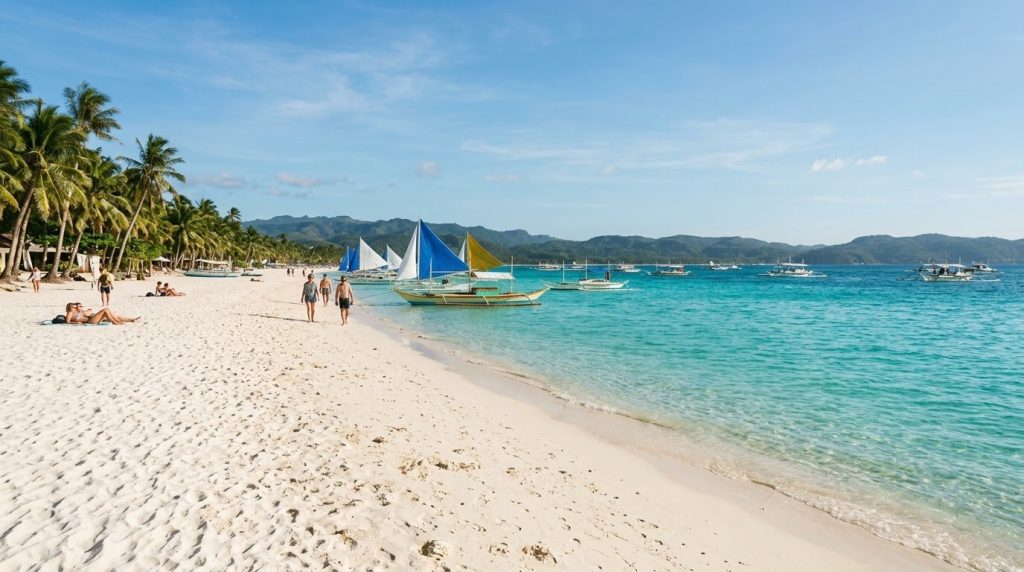
Amihan is the season to book if calm water and dry skies matter more than anything else, because the northeast monsoon pins White Beach on the sheltered side of the island for six straight months.
The wind comes from the northeast, crosses the island, and exits over Bulabog Beach on the east coast, which is why White Beach stays glassy while Bulabog gets the breeze. December through February is the driest, most reliable stretch inside this window, and it is also when hotel rates run highest across the island.
Amihan governs the same northeast-to-southwest swing across the central Philippines, so the timing lines up closely with the seasonal pattern covered in our guide to the best time to visit Cebu.
Travelers who want Amihan conditions without the peak-season room rates should target April or the first half of May, when the wind is still calm but hotel demand has eased.
Habagat season (June to October)
Habagat is the season to avoid if a calm White Beach is the priority, because the southwest monsoon reverses the wind and drives swell and rain directly onto it. Rainfall is heaviest in July and August, and swimming conditions on White Beach turn choppy with a higher chance of seaweed washing in during these onshore weeks.
Establishments on the island stay open through Habagat, and there is no island-wide closure in effect as of this writing, so the season is better described as wetter and rougher rather than shut down.
Bulabog Beach on the opposite coast becomes the calmer option during Habagat, since the same wind that roughs up White Beach now shelters the east side instead.
Budget-focused travelers weighing a wetter Boracay date against a different Philippine base can compare daily costs in the Cebu travel budget breakdown, since the same rainy months bring lower rates across the region.
Why the wind decides which beach you use
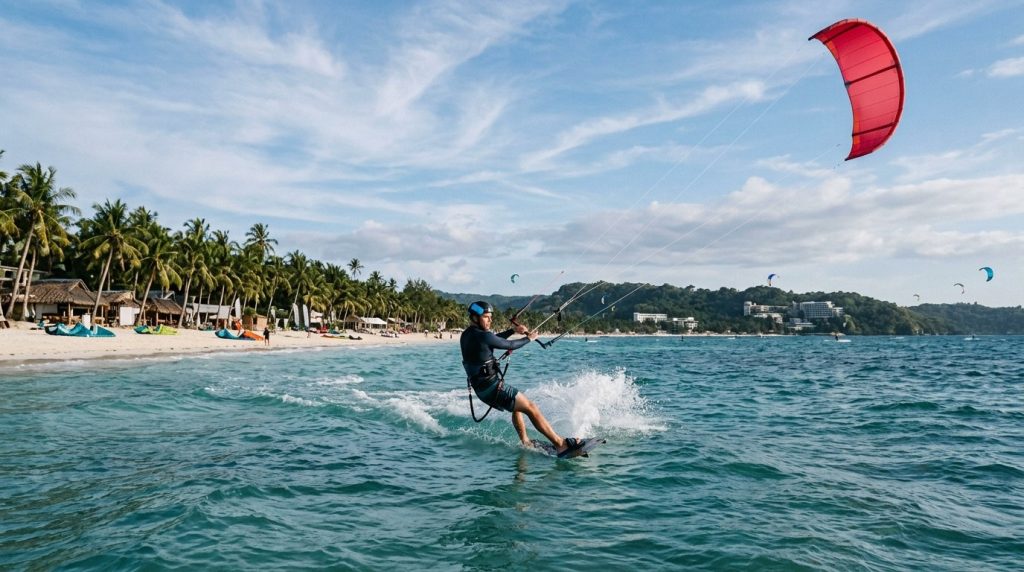
The wind, not the calendar, decides which beach on Boracay actually works on any given day. During Amihan, the northeast wind travels the short width of the island and blows out over Bulabog, so White Beach sits in the lee and stays flat while Bulabog gets steady 15 to 25 knot wind that builds through the day.
That handoff is why Bulabog functions as the island’s wind-sports beach for exactly the months White Beach is calmest, roughly November through April. When Habagat takes over from June to October, the wind flips to the southwest and blows straight onto White Beach, pushing swell and stray seaweed onto the sand that postcards show as flat and clear.
Bulabog becomes the sheltered side during Habagat, and kitesurfers who stay on the island through the wet season relocate there or to White Beach depending on which way that week’s wind is blowing, since Habagat wind is more variable than the steady Amihan flow.
Best months for kitesurfing and diving
December through March is the best window for kitesurfing at Bulabog Beach, when the Amihan delivers its most consistent 15 to 25 knot wind and the strongest days cluster in December and January.
The wind season extends a little further, from late October through April and sometimes into early May, but October, March and April tend to run lighter and more moderate than the December to January peak.
Diving and snorkeling conditions follow the same Amihan calendar, since flat seas and clearer water from November to May make for more consistent boat schedules than the swell and runoff of Habagat months.
Divers chasing similarly calm, dry-season conditions elsewhere in the Philippines can cross-check timing against island hotel availability using the Palawan hotel guide, since Palawan runs on a comparable Amihan-Habagat split.
What to pack for Amihan versus Habagat
Amihan-season packing is straightforward: light cotton or linen layers for hot, dry days, a light jacket or long sleeves for the cooler Bulabog evenings in December and January, and reef shoes or sandals for walking the sand at midday when it heats up under a cloudless sky.
A wide-brim hat and strong sun protection matter more during Amihan than any other season, since clear skies offer no cloud cover from the sun for days at a stretch.
Habagat-season packing needs an extra layer of weatherproofing: a compact rain jacket or poncho, a dry bag or waterproof phone pouch for boat transfers and sudden downpours, and quick-dry clothing that handles repeated wet-and-dry cycles better than cotton.
Pack a spare pair of shoes as well, since the paths between Station 1 and Station 3 can turn muddy after a heavy afternoon shower, even though the beach itself stays usable between showers.
Both seasons call for the same baseline beach kit, sunscreen, a reusable water bottle, and insect repellent for the evenings, but travelers visiting in the August to September window should weight the rain gear over the beachwear, since that stretch produces the island’s wettest, roughest conditions of the year.
Anyone booking a kitesurfing or windsurfing lesson at Bulabog during the Amihan months should also pack closed-toe water shoes, since the gear rental shops supply boards and harnesses but rarely footwear suited to the coral-flecked shallows at low tide.
When NOT to visit Boracay
August is the single month to avoid, since it combines the heaviest Habagat rainfall with the roughest seas and the lowest odds of a dry beach day.
The last two weeks of December through New Year, plus the Holy Week dates around Easter, are the other dates to skip if crowds bother you, because hotel rates island-wide climb 40 to 80 percent above shoulder-season pricing during these peaks.
Boracay’s daily visitor numbers are also managed against a standing carrying-capacity limit of 19,215 people at any one time, and that ceiling is most likely to be tested during the same Christmas, New Year and Holy Week dates.
Late February through May can also bring short-lived patches of green algae, locally called lumot, in some Bulabog coves and back-beach areas, though municipal cleanup crews typically clear it within days rather than closing the beach.
Getting to Boracay and when boat crossings get disrupted
Boracay has no airport of its own; travelers fly into either Caticlan’s Godofredo P. Ramos Airport, a short drive of well under 10 minutes from the jetty port, or the larger Kalibo International Airport, roughly 60 to 70 kilometers and a 1.5 to 2.5 hour drive from the same jetty.
From either port, a short outrigger boat crossing of around 10 to 15 minutes covers the final stretch to Boracay’s shore.
Caticlan is the faster, more convenient option for most travelers despite usually costing more for the flight itself, while Kalibo tends to run cheaper airfares at the cost of a much longer road transfer. Both routes funnel through the same short boat crossing, which is the one link in the journey most exposed to weather.
During Habagat season, and especially when a typhoon or tropical depression is active nearby, port authorities can suspend boat crossings between the jetty and Boracay for safety, stranding arriving and departing travelers on either side until seas calm down.
This risk is close to zero during the Amihan months but worth building a buffer day around for any Habagat-season trip, particularly one timed around a flight connection that cannot easily be rebooked.
Travelers connecting through Kalibo already carry a longer road transfer into the itinerary, so a weather-related boat suspension hits that routing harder than a Caticlan connection, where the gap between flight and departing boat is naturally shorter.
Building in a one-night buffer at either end of a Habagat-season trip, rather than a same-day connection straight to or from the airport, removes most of the risk that a delayed crossing causes a missed flight.
Entry fees and environmental rules on arrival
Boracay charges a terminal fee and a separate environmental fee on arrival, with reported rates in the rough range of PHP 150 to 300 depending on fee type and traveler category; expect to pay again, in a smaller amount, on departure.
Converted at the same rate used elsewhere in this guide, that lands around AUD 4 to 7 · USD 3 to 5 each way, and fees are commonly collected or pre-paid through the government’s E-Boracay digital system rather than only in cash at the port.
Beach rules apply island-wide regardless of season: smoking and drinking alcohol directly on the sand are banned, with fines possible for both, and single-use plastics are restricted in favor of refill stations and reusable containers.
These rules trace back to the six-month closure the Philippine government ordered from April 26 to October 26, 2018, when Boracay shut to all tourists for an environmental rehabilitation, and they apply the same way whether the trip falls in the calm Amihan months or the wetter Habagat stretch.
Carry a mix of small-denomination cash and a card for the arrival fees, since port-side payment counters can run slower on peak Amihan weekends when every incoming boat unloads a queue at once. Filing the E-Boracay registration ahead of departure, where the option is available, saves time at the counter compared with filling in the same details on paper after a long flight or a rough Habagat-season crossing.
Plan your Boracay trip
Book Amihan-season dates outside the December-to-February peak, such as April or the first half of May, for the best balance of calm water and lower rates.
A budget double room near Station 2 runs close to AUD 60 · USD 43 (PHP 2,500) per night, based on current listings in the full where-to-stay guide for Boracay, which breaks down every station and Bulabog Beach by price band.
The same guide is the fastest way to check which stations sit closest to White Beach versus Bulabog before locking in dates that match the wind season you want.
Find your Boracay hotel on the map
Live prices from Booking, Airbnb and more — move the map or change dates to compare stays around Boracay.