Disclosure: Some links in this guide are affiliate links. If you book or buy through them, we may earn a small commission at no extra cost to you — it helps keep our guides free.
Best Food in Hoi An: Top Dishes and Restaurants 2026
Hoi An is one of the most rewarding eating destinations in Southeast Asia, where street-side stalls, UNESCO-listed lanes, and family-run kitchens all compete for your attention within a few walkable blocks. This guide covers the top dishes, the best restaurants for each, realistic prices in USD, and the local tricks that make the difference between a good meal and a great one.
Quick answer: Hoi An food centers on four signatures you should prioritize: cao lau (a chewy pork-and-noodle bowl unique to the town), delicate white rose dumplings, the crackly banh mi made famous by Banh Mi Phuong, and Hoi An chicken rice (com ga). Eat these at family stalls and the night market rather than tourist-facing restaurants, and you can cover all four for under .
Key Takeaways
– Hoi An’s Ancient Town has over 200 registered street food vendors, making it one of the densest food streets in central Vietnam. (Vietnam National Administration of Tourism, 2025)
– A full street food meal — Cao Lau, White Rose Dumplings, and Banh Mi — costs under $5 USD per person at local stalls. (Hoi An Tourism Office, 2025)
– Banh Mi Phuong has served over 1 million banh mi since 2000 and was featured by Anthony Bourdain in 2009, cementing Hoi An as Vietnam’s banh mi capital. (CNN Travel, 2024)
– Hoi An’s White Rose Dumplings are produced exclusively by one family supplier, the Truong Ba family, and distributed to all restaurants legally licensed to serve them. (Vietnam Heritage Magazine, 2024)
– Food tours by local guides average $28-$45 USD per person and cover 6-10 stops in 3 hours. (Klook, 2026)
Affiliate Disclosure: We include affiliate links at no extra cost to you.
Why Hoi An Has Its Own Food Identity
Related: things to do in Hoi An.
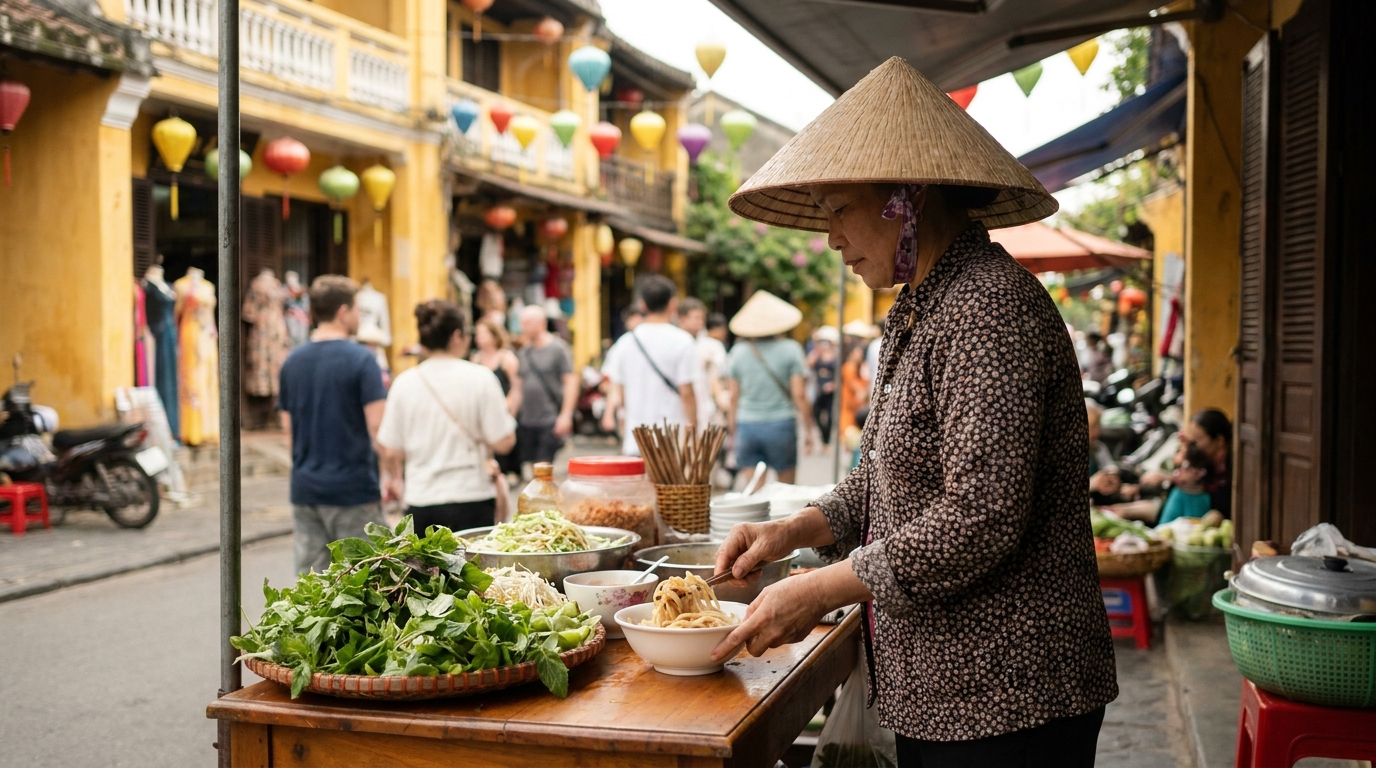
Central Vietnamese cuisine in Hoi An is distinct from both Hanoi and Saigon because the city developed as a major trading port between the 15th and 19th centuries. Merchants from Japan, China, and the Dutch East Indies all influenced the local kitchen, layering flavors that do not exist elsewhere in Vietnam.
The result is a tight canon of dishes — Cao Lau, White Rose Dumplings, and Banh Mi among them — that locals take seriously enough to have trademarked some ingredients. Most restaurants in the Ancient Town stay open from 07:00 to 22:00 year-round, with the wettest and coolest months running October through December.
The 3-Day Hoi An Itinerary
The plan we use ourselves — sent straight to your inbox.
- Day-by-day route
- Where to stay
- Real 2026 costs
Free · No spam · Unsubscribe anytime
Cao Lau: The Signature Bowl You Cannot Miss
Related: best day trips from Hoi An.
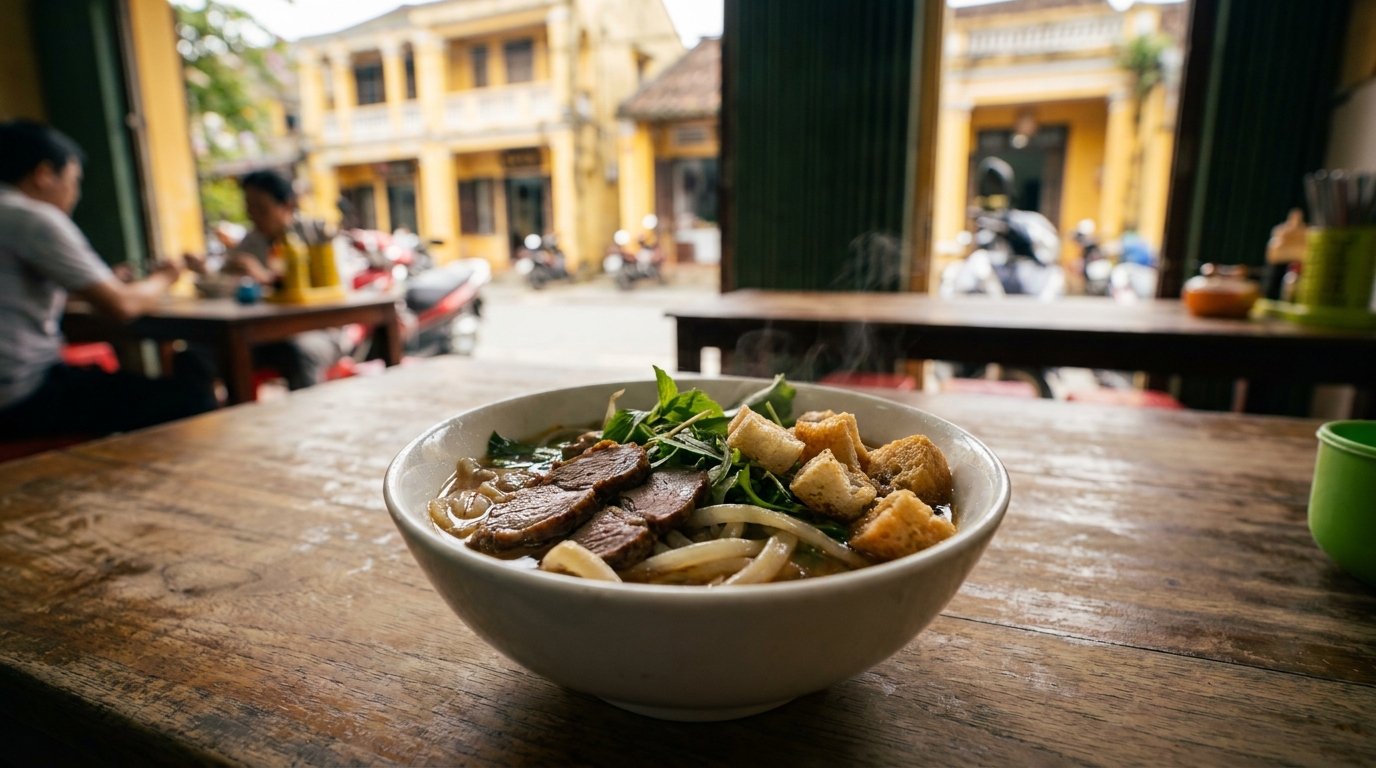
Cao Lau is the single dish that defines Hoi An cooking, and no other city in Vietnam can authentically replicate it.
The thick, slightly chewy noodles are made with water drawn exclusively from an ancient Cham well called Ba Le Well and wood ash lye from trees grown on Cham Island, which gives them a pale yellow-gray color and a texture closer to Japanese udon than Chinese rice noodles.
Each bowl is served with sliced char-siu-style pork, crispy croutons fried in pork fat, fresh bean sprouts, mint, and a ladle of concentrated broth that is more sauce than soup.
A standard bowl at a street stall costs 35,000-50,000 VND ($1.40-$2.00 USD). Sit-down restaurants charge 60,000-90,000 VND ($2.40-$3.60 USD). The best version we have tested is at Cao Lau Thanh (26 Thai Phien Street), a stall open since 1975 that still uses hand-cut noodles. Cargo Club (107-109 Nguyen Thai Hoc Street) serves a reliable tourist-friendly version with English menus at $4.50 USD. (Hoi An Tourism Office, 2025)
White Rose Dumplings: One Family, Every Restaurant
Related: Bali travel guide.
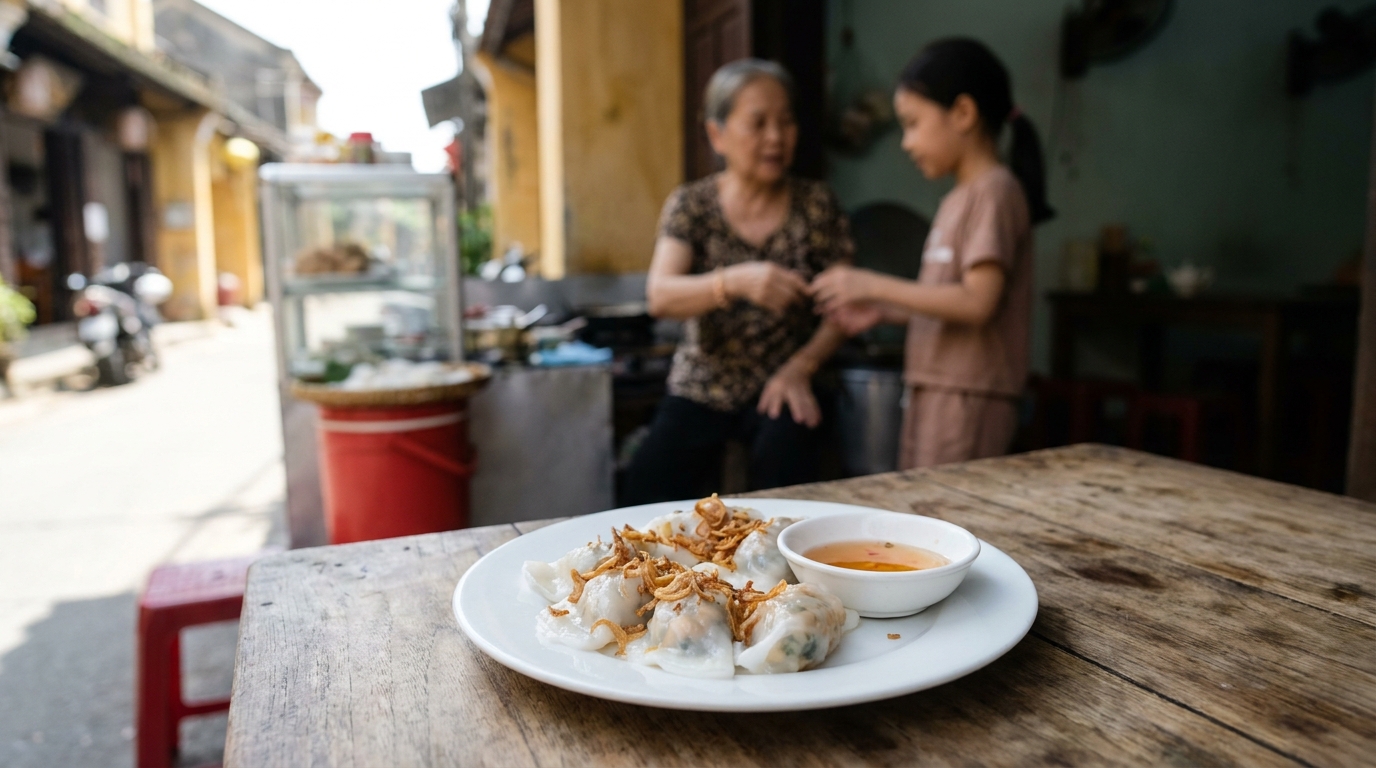
White Rose Dumplings (Banh Vac) are translucent rice-paper parcels shaped into a loose rose and filled with shrimp or pork, then steamed and topped with fried shallots and a light fish-sauce dipping broth.
The monopoly arrangement is real: the Truong family at White Rose Restaurant (533 Hai Ba Trung Street) is the sole licensed producer, and every restaurant serving Banh Vac in Hoi An buys from them each morning. (Vietnam Heritage Magazine, 2024)
The best place to eat them is at the source. A plate of ten dumplings at White Rose Restaurant costs 65,000 VND ($2.60 USD). The dumplings also appear as a starter at most Ancient Town restaurants priced at 70,000-90,000 VND ($2.80-$3.60 USD).
Book a table — it is always busy by 12:00 and 19:00. If you want a structured tasting route that includes White Rose, Klook’s Hoi An Street Food Walking Tour covers this stop plus five others for around $28 USD per person.
The 3-Day Hoi An Itinerary
Hour-by-hour plan, where to stay and what it really costs — free PDF.
Free · No spam · Unsubscribe anytime
Banh Mi Phuong: The Most Famous Sandwich in Vietnam
Related: Da Nang travel guide.
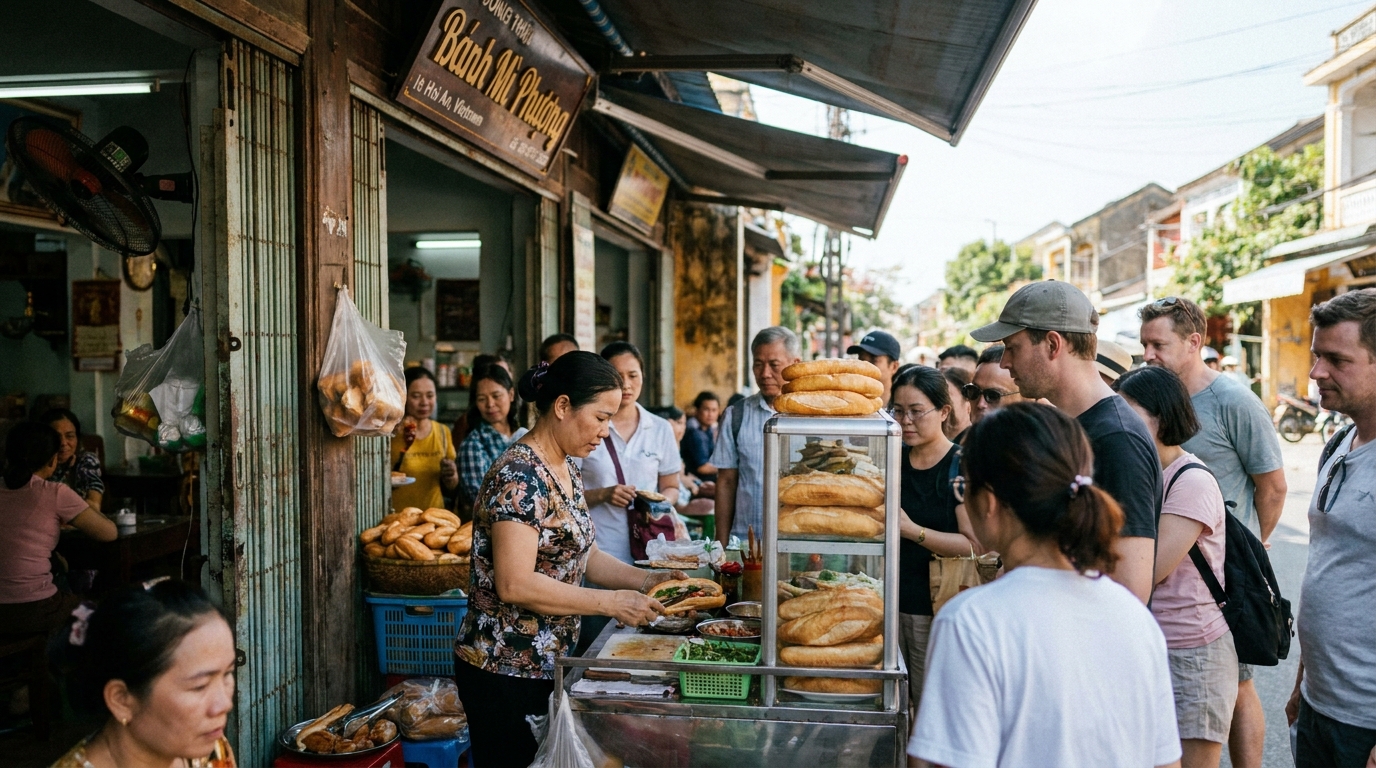
Hoi An’s version of banh mi is heavier and more ingredient-forward than the Saigon version. A full-loaded Hoi An banh mi contains char-siu pork, Vietnamese cold cuts, pate, cucumber, pickled daikon and carrot, fresh coriander, chili, and a smear of hoisin — all packed into a light, airy baguette baked in wood-fired ovens that produce a shatter-crisp crust.
Banh Mi Phuong (2B Phan Chau Trinh Street) is the benchmark. Anthony Bourdain called it “the best banh mi in the world” in 2009, and the line is still 20-30 people deep at peak hours (07:00-09:00 and 11:30-13:30). (CNN Travel, 2024)
Price: 35,000-45,000 VND ($1.40-$1.80 USD). The queue moves fast — average wait 8 minutes. Banh Mi Madam Khanh (115 Tran Cao Van Street) is a worthy alternative, open since 1968, priced the same, and far less crowded.
Hoi An Chicken Rice: The Comfort Bowl
Related: Hoi An itinerary.
Com Ga Hoi An (Hoi An Chicken Rice) is a local variation of Vietnamese chicken rice that swaps plain steamed rice for turmeric-tinted rice cooked in chicken stock and topped with hand-shredded poached chicken, fresh herbs, pickled papaya, and a house chili-ginger sauce. The result is more fragrant and complex than the Hainanese versions common in Singapore and Malaysia. (Vietnam Culinary Institute, 2024)
The street stall standard is 45,000-60,000 VND ($1.80-$2.40 USD). Com Ga Ba Buoi (22 Phan Chau Trinh Street) is widely considered the best, run by the same family since 1950. Arrive before 13:00 — the pot sells out. For hotel-standard comfort and air conditioning, Streets Restaurant Cafe (17 Le Loi Street) charges $6.50 USD for the same dish with a salad starter, and profits fund vocational training for at-risk youth.
Banh Xeo: Crispy Crepes Worth the Mess
Banh Xeo are large sizzling crepes made from rice-flour batter poured over a hot pan with coconut milk, turmeric, shrimp, pork, and bean sprouts. The name translates to “sizzling cake,” a reference to the sound the batter makes hitting the oiled pan.
The standard eating method is to tear off a piece, wrap it in mustard leaf or rice paper with fresh herbs, and dip it in nuoc cham (fish sauce, lime, sugar, chili). It is messy, delicious, and one of the most interactive meals you can have at a table for two. A plate serving two people costs 70,000-100,000 VND ($2.80-$4.00 USD).
Banh Xeo Ba Le (45/51 Tran Hung Dao Street) is the local favorite, open 09:00-21:00, cash only. For travelers who want to learn the technique, Klook lists several hands-on cooking classes in Hoi An starting at $22 USD that include banh xeo as one of the dishes. hoi an cooking class guide
Find your Hoi An hotel on the map
Live prices from Booking & Airbnb — tap a pin to compare stays around the Ancient Town and An Bang Beach and beyond.
Where to Eat: Restaurant Picks by Budget
Related: Hoi An travel cost.
| Budget | Restaurant | Best Dish | Avg. Spend/Person | Book |
|---|---|---|---|---|
| Street (under $3) | Cao Lau Thanh, 26 Thai Phien St | Cao Lau | $1.50-$2.00 | Walk-in |
| Street (under $3) | Banh Mi Phuong, 2B Phan Chau Trinh | Banh Mi | $1.50-$2.00 | Walk-in |
| Mid ($5-$12) | White Rose Restaurant, 533 Hai Ba Trung | White Rose Dumplings | $6-$10 | Walk-in / call ahead |
| Mid ($5-$12) | Cargo Club, 107-109 Nguyen Thai Hoc | Cao Lau, River views | $8-$12 | Booking.com |
| Mid ($5-$12) | Streets Restaurant Cafe, 17 Le Loi | Com Ga, Western options | $7-$11 | Walk-in |
| Upscale ($15+) | The Field Restaurant, Hoi An Farm Resort | Tasting menus, farm-to-table | $20-$35 | Agoda |
For travelers staying in the An Bang Beach area, hoi an beach guide has hotel recommendations near the best seafood strip. Visitors planning a full day in the Ancient Town can combine meals with the lantern market — see hoi an ancient town walking guide for a route that passes five of the stalls above.
Night Market and Street Food After Dark
The Hoi An Night Market runs nightly 18:00-23:00 along Nguyen Hoang Street on the island between the two branches of the Thu Bon River. Approximately 60 food stalls line the street, selling grilled corn, fried quail eggs, fresh spring rolls, che (sweet dessert soups), and fruit smoothies.
Prices are tourist-facing — expect 20-50% higher than daytime stalls — but the atmosphere and the density of options justify the markup for most visitors. Budget $4-$6 USD for a thorough tasting sweep.
The best dessert in Hoi An is Banh Dap (crispy rice crackers with wet rice paper, shrimp paste, and sesame), available from carts along Bach Dang riverside for 15,000 VND ($0.60 USD). Wash it down with Che Ba Mau (three-color dessert of red beans, mung beans, and pandan jelly in coconut milk) sold at most dessert stalls for 20,000 VND ($0.80 USD). (Vietnam Street Food Network, 2025)
If you prefer a guided evening with a local, Klook’s Hoi An Night Food Tour covers 8-10 stalls for $32 USD per person and includes a lantern boat ride. hoi an night market guide
Staying Connected and Getting Around
Hoi An’s Ancient Town is compact — most restaurants in this guide are within a 1 km radius — but An Bang Beach and the Cham Island ferry terminal are 4 km and 10 km out respectively. Grab (ride-hail) fares from the Ancient Town to An Bang Beach run $1.50-$2.50 USD.
For reliable data to pull up maps and menus on the go, we use Airalo Vietnam eSIM — the “Vietnamobile” 3 GB plan costs $5.50 USD and activates in minutes. vietnam esim guide
For accommodation within walking distance of all the stalls above, Agoda lists 40+ hotels inside or adjacent to the Ancient Town buffer zone starting at $28 USD/night. Search Hoi An hotels on Agoda. where to stay hoi an
Frequently Asked Questions
What is the most famous dish in Hoi An?
Cao Lau is Hoi An’s signature dish and the one most food writers cite as the single best reason to visit. The noodles are made with water from an ancient Cham well and wood ash lye from Cham Island, so they cannot be authentically reproduced anywhere else. A bowl costs $1.40-$2.00 USD at a local stall.
How much does food cost per day in Hoi An?
Eating entirely at street stalls and local restaurants, a full day of food — breakfast banh mi, lunch cao lau, afternoon snack, dinner — costs $6-$10 USD per person. Mixing in one mid-range restaurant per day raises the budget to $15-$20 USD. Upscale dining adds $30-$50 USD for a single meal.
Is Hoi An food spicy?
Central Vietnamese food is the spiciest of Vietnam’s three regional cuisines, but most restaurants in Hoi An moderate the heat for international visitors. Fresh chili is always served on the side, so you control the level. If you have a low spice tolerance, simply ask for “khong cay” (no chili) when ordering.
Where is the best banh mi in Hoi An?
Banh Mi Phuong (2B Phan Chau Trinh Street) is the benchmark, made famous by Anthony Bourdain and consistently rated the best by food critics. Banh Mi Madam Khanh (115 Tran Cao Van Street) is the best alternative if you want to avoid the tourist queue. Both charge under $2 USD.
Can I take a food tour in Hoi An?
Yes. Klook and GetYourGuide both list multiple Hoi An food tours starting at $22-$45 USD per person. A 3-hour walking tour typically covers 6-10 stops including Cao Lau, White Rose Dumplings, Banh Mi, and dessert. Evening tours (18:00-21:00) add the Night Market and a lantern boat ride.
Are there vegetarian options in Hoi An?
Hoi An has a strong vegetarian tradition tied to Buddhist observance days (the 1st and 15th of each lunar month). On these days, many stalls switch to fully vegetarian menus. Year-round, Minh Hien Vegetarian (9A Tran Phu Street) and Nhu Y (2 Tran Quoc Toan Street) serve reliable vegetarian Central Vietnamese food for $2-$5 USD per dish.
When is the best time to eat street food in Hoi An?
Breakfast stalls are most active 07:00-10:00. Lunch peaks 11:30-13:30. Evening street food starts at 17:30 and the Night Market runs until 23:00. Midday in July-August is very hot (35-38C); eating early morning and after 17:00 is significantly more comfortable.
Conclusion: Build Your Hoi An Food Itinerary
Hoi An rewards a slow, food-first approach. Start with Banh Mi Phuong before 09:00 to beat the line, walk to Cao Lau Thanh for a mid-morning bowl, and time your lunch at White Rose Restaurant by 12:30.
The afternoon is best spent at a cooking class or exploring the Ba Le Well neighborhood where most of the Ancient Town’s family kitchen restaurants cluster. End at the Night Market with Banh Dap and Che Ba Mau.
For a structured culinary experience, book the Hoi An Street Food Walking Tour on Klook — it covers the main dishes in one evening and local guides share sourcing stories you will not read anywhere else.
Combine with an Airalo Vietnam eSIM so you can navigate the lanes without hunting for Wi-Fi, and check Agoda for hotels near the Ancient Town core to keep every stall in this guide within a 10-minute walk. hoi an travel guide vietnam travel tips