Best Food in Penang: 15 Must-Try Dishes & Where to Eat
By TravelguidestipUpdated 10 min readHow we earn
Hotel buttons open Stay22 (Booking.com, Agoda and others) and tour buttons open GetYourGuide. We may earn a commission at no extra cost to you.
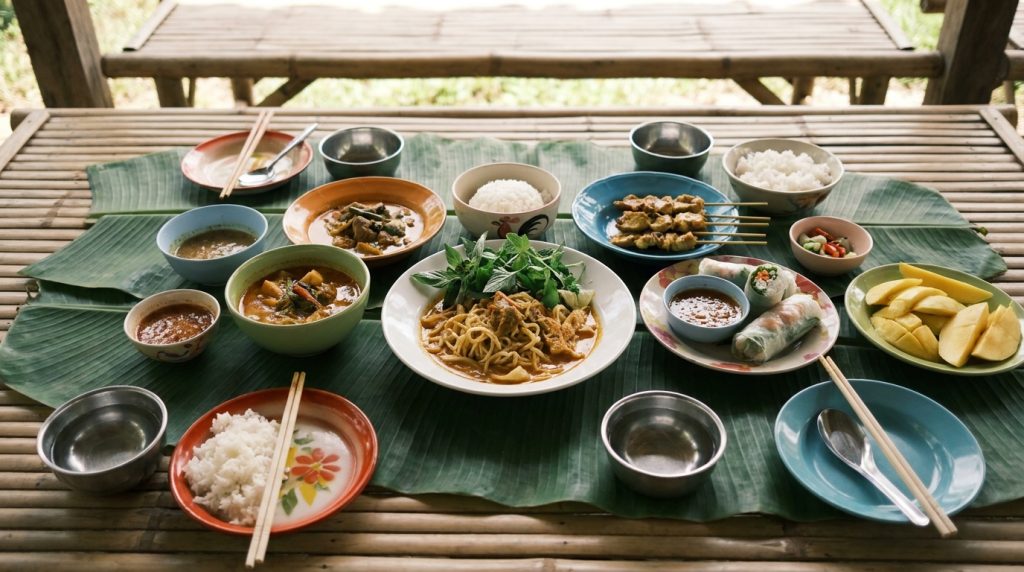
Quick answer
Order char kway teow, assam laksa and nasi kandar.
Most dishes cost 5-15 MYR ($1-3.20) at hawker stalls. The freshest bowls appear at breakfast (7-10am) and dinner (6-9pm).
8 dishes to try
- Char Kway TeowWok-fried flat noodles with prawns and cockles7-12 MYR
- Assam LaksaSour-spicy tamarind fish broth with thick rice noodles6-10 MYR
- Nasi KandarRice with a ladle of mixed curry sauces10-20 MYR
- Penang Hokkien MeeYellow noodles in rich prawn and pork bone broth8-14 MYR
- CendolShaved ice, green jellies, palm sugar, coconut milk3-6 MYR
- PasemburFritters, potatoes and egg in sweet-spicy peanut sauce6-10 MYR
- Roti CanaiFlaky flatbread with dhal curry and sambal1.50-4 MYR
- Teh TarikFrothy pulled milk tea, Malaysia’s national drink1.50-3 MYR
Best Food in Penang 2026: 15 Must-Try Dishes & Where to Eat
Key Takeaways: Penang is widely regarded as the street food capital of Southeast Asia. The best food in Penang costs 5-15 MYR ($1-3.20) at hawker stalls and food courts. Char kway teow, assam laksa, nasi kandar, and cendol are non-negotiable.
Gurney Drive Hawker Centre and New Lane Hawker Centre are the two best all-in-one food hubs. Eat breakfast between 7-10am and dinner from 6-9pm — the best hawker stalls have the freshest food and shortest queues in these windows.
Penang’s hawker food culture is protected under Malaysia’s National Heritage Act. George Town has over 180 registered hawker stalls and food courts in its 2.6 sq km heritage zone. A typical Penang hawker meal costs 8-15 MYR ($1.70-3.20) — roughly 70% less than equivalent dishes in Singapore and 40% less than in Kuala Lumpur.
Penang’s multicultural heritage created a cuisine that blends Hokkien Chinese, Malay, and South Indian flavors in ways found nowhere else. This guide covers what to order, where to order it, and how much to pay. For trip planning, see our Penang Travel Guide and 4-Day Penang Itinerary.
Best Food in Penang: The Essential Dishes
Quick answer: Penang’s signature hawker dishes are char kway teow (smoky wok-fried flat noodles with prawns and cockles), assam laksa (tamarind-sour mackerel noodle soup), and nasi kandar (rice with layered curries), rounded out by Hokkien prawn mee, cendol, and roti canai. Most cost just 5-15 MYR ($1-3.20) at hawker stalls, and the freshest bowls appear at breakfast (7-10am) and dinner (6-9pm).
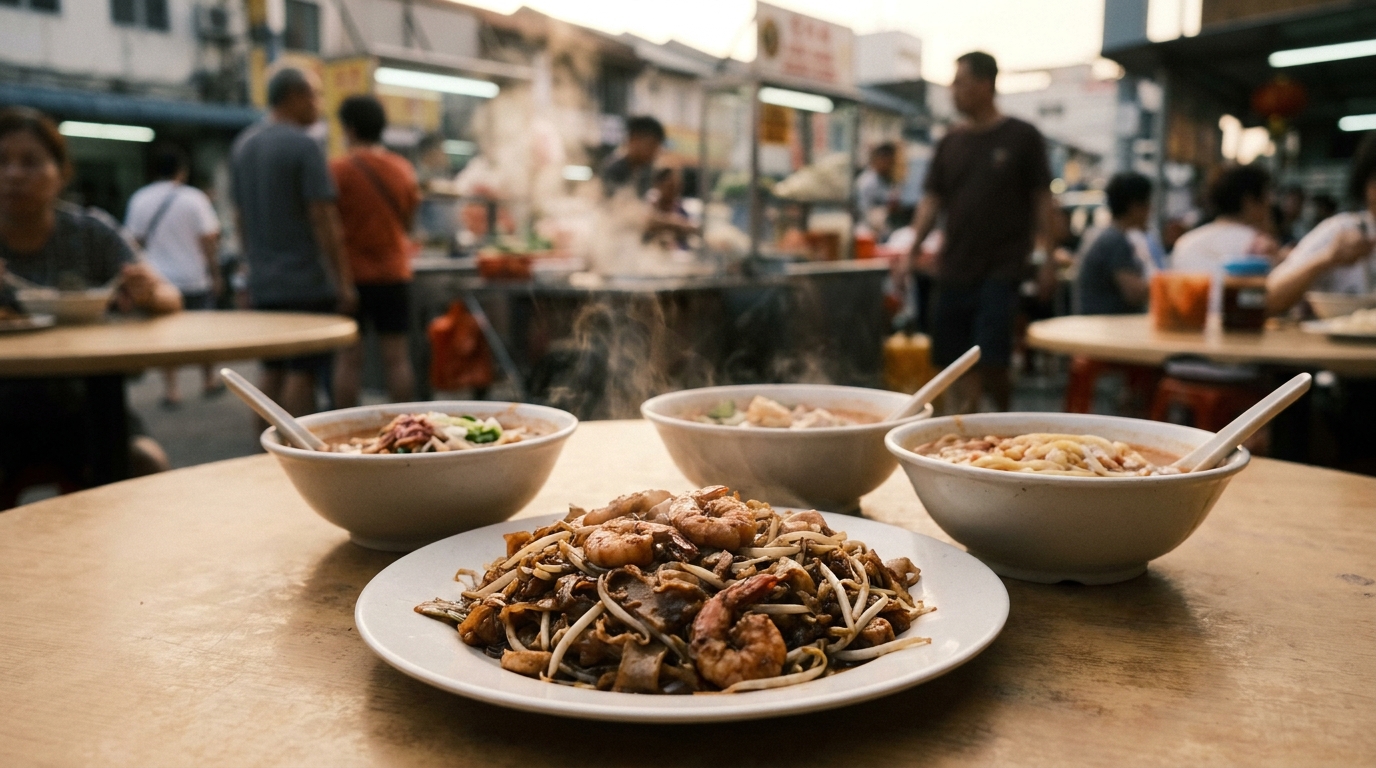
1. Char Kway Teow (炒粿條)
Price: 7-12 MYR | Where: Any hawker center
Flat rice noodles stir-fried over extreme heat with egg, bean sprouts, prawns, cockles, and Chinese sausage. The wok hei (breath of the wok) — the smoky char from high-heat cooking — is what separates great char kway teow from mediocre. Penang’s version uses lard, which is non-negotiable for authentic flavor.
Best stall: Ah Leng Char Kway Teow (Lebuh Presgrave, George Town) — widely regarded as the island’s best. Queue of 20-30 people is normal; still worth it.
2. Assam Laksa
Price: 6-10 MYR | Where: Food courts, hawker centers
Penang assam laksa is a completely different dish from Singapore’s curry laksa — it’s a sour-spicy fish broth with tamarind (assam), lemongrass, torch ginger flower, and thick rice noodles, topped with prawn paste and pineapple. CNN Travel ranked it among the world’s top 50 foods. The version at Joo Hooi Café in Air Itam market is the gold standard — but the stall only opens until sold out (~noon).
Best stall: Joo Hooi Café (Air Itam Market) — arrive before 10am or it’s gone.
3. Nasi Kandar
Price: 10-20 MYR | Where: Indian-Muslim restaurants
A Penang-specific dish: plain rice served with a ladle of mixed curry sauces (the “kandar” — from the shoulder pole street hawkers once used). You choose your curry (fish, chicken, mutton, prawn) and the server ladles everything over the rice. The sauce combination is called “banjir” (flood). Hameediyah on Lebuh Campbell is the most famous, serving nasi kandar since 1907.
4. Penang Hokkien Mee (Prawn Mee)
Price: 8-14 MYR | Where: Hawker centers, breakfast kopitiam
Yellow noodles and rice vermicelli in a rich prawn and pork bone broth, topped with prawns, hard-boiled egg, water spinach, and fried shallots. The broth is made by boiling prawn shells for hours — the depth of flavor defines the quality. Best eaten as a late breakfast (8-10am).
5. Cendol
Price: 3-6 MYR | Where: Dessert stalls, food courts
Shaved ice with green rice flour jellies, palm sugar (gula Melaka), and coconut milk. Served with optional red beans and corn. A bowl of cendol is the best cure for Penang’s midday heat.
Best spot: Penang Road Famous Teochew Chendul (corner of Penang Road and Lebuh Keng Kwee) — the queue is usually 10-15 people but moves fast.
6. Nyonya Laksa
Price: 8-12 MYR | Where: Nyonya/Peranakan restaurants
The Peranakan version of laksa — a coconut milk-based curry broth with rice noodles, tofu puffs, bean sprouts, prawn, and a hard-boiled egg. Richer and creamier than assam laksa. Try it at Old Green House or Sky Hotel restaurant in George Town.
7. Pasembur (Indian Rojak)
Price: 6-10 MYR | Where: Indian hawker stalls, Gurney Drive
A Penang-specific salad of crispy fritters, boiled potatoes, cucumber, bean sprouts, prawn fritters, and boiled egg, all drenched in a sweet-spicy peanut sauce. Found at Indian Muslim hawker stalls across the island. Gurney Drive has several good pasembur vendors.
8. Kaya Toast + Half-Boiled Eggs
Price: 5-8 MYR | Where: Kopitiam (coffee shops)
The quintessential Malaysian/Singaporean breakfast — charcoal-grilled bread with kaya (coconut jam) and butter, paired with two runny half-boiled eggs seasoned with soy sauce and white pepper, washed down with thick Hainanese coffee or teh tarik. Penang’s kopitiams use better quality coffee than Singapore equivalents.
Best spot: Toh Soon Café (Armenian Street) — the narrow lane café is George Town’s most photogenic breakfast spot.
9. Fried Oyster Omelette (Or Luak)
Price: 8-14 MYR | Where: Hawker centers, Gurney Drive
Baby oysters folded into a crispy egg omelette with tapioca starch, served with a chilli sauce. The best versions have a crackly exterior and soft, briny interior. Gurney Drive Hawker Centre has several reliable or luak stalls.
10. Lor Bak (Five-Spice Pork Rolls)
Price: 8-15 MYR | Where: Chinese hawker centers
Minced pork seasoned with five-spice powder, wrapped in beancurd skin, and deep-fried. Served with a prawn dipping sauce. A Penang-specific snack found at hawker stalls and Chinese coffee shops. Best as a side order.
11. Wan Tan Mee (Wonton Noodles)
Price: 7-10 MYR | Where: Chinese kopitiams, breakfast hawkers
Thin egg noodles served dry (with pork lard sauce and char siu) or in soup, topped with wontons, char siu pork, and spring onions. Penang’s version of wonton noodles tends to be drier and chewier than the Cantonese version. Best as a morning or lunch dish.
12. Roti Canai
Price: 1.50-4 MYR | Where: Indian Muslim (mamak) restaurants
Flaky flatbread cooked on a griddle, served with dhal curry and sambal. The cheapest filling food in Malaysia — a standard roti canai is under 2 MYR. The mamak restaurants serving it are open 24 hours and are the best late-night food option.
13. Mee Goreng Mamak
Price: 5-8 MYR | Where: Mamak restaurants, night hawkers
Indian-spiced fried yellow noodles with egg, tofu, potatoes, and squid in a tomato-chilli sauce. Found at any mamak (Indian Muslim) restaurant; better at the dedicated hawker stalls that specialize in it.
14. Popiah (Fresh Spring Rolls)
Price: 3-5 MYR each | Where: Peranakan restaurants, hawker stalls
Fresh (not fried) spring rolls filled with braised turnip, egg, shrimp, bean sprouts, and garlic sauce in a thin wheat wrapper. A Hokkien-Peranakan specialty. Light and suitable for all-day eating. Lebuh Armenian area has several stalls.
15. Teh Tarik
Price: 1.50-3 MYR | Where: Everywhere
Malaysia’s national drink — “pulled tea” made by pouring sweet milk tea back and forth between containers at arm’s length to create a frothy top. Available at every mamak restaurant and most kopitiams. Inseparable from Penang’s food culture.
Find your Penang hotel on the map
Live prices from Booking & Airbnb — tap a pin to compare stays around George Town and beyond.
Best Hawker Centers in Penang
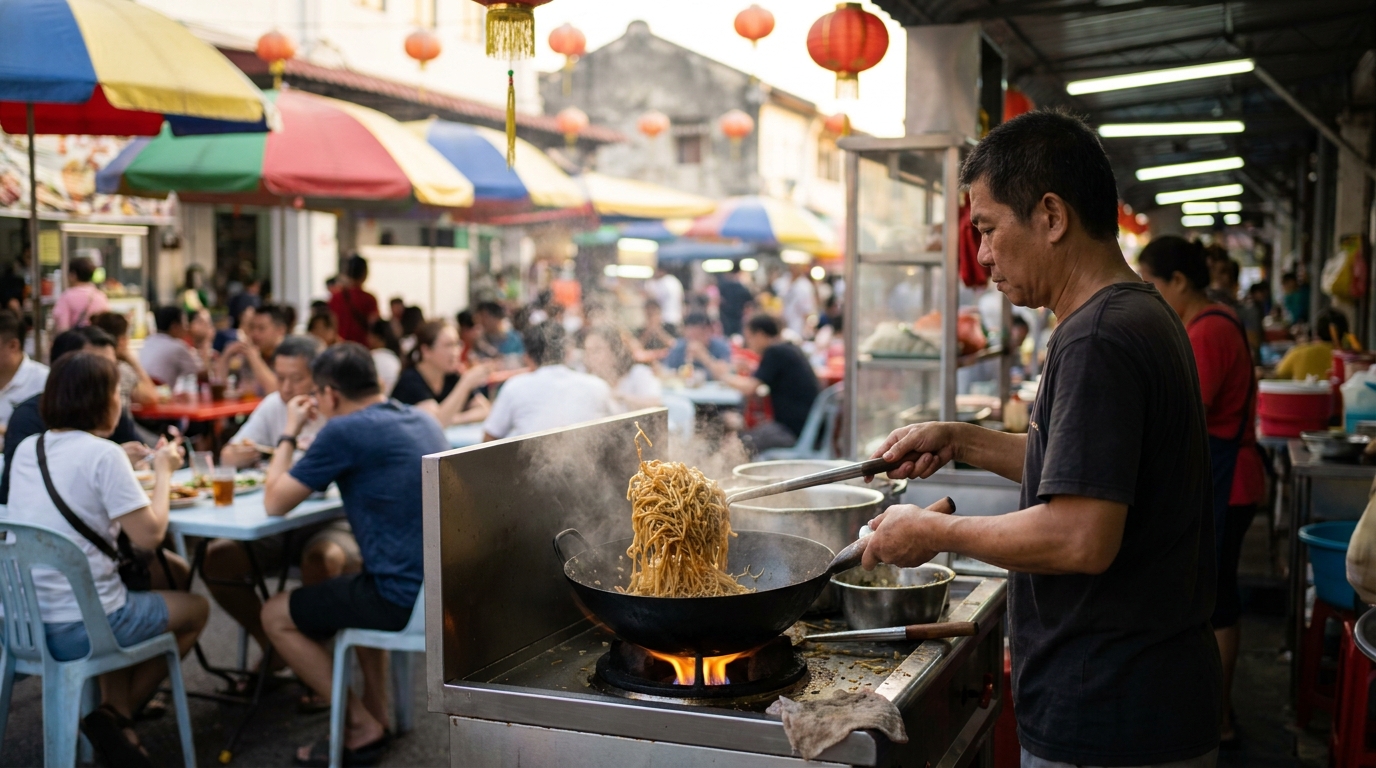
Gurney Drive Hawker Centre
Location: Gurney Drive seafront, 3km from George Town core
When: Daily 5pm-midnight (some stalls from noon)
The most famous all-in-one hawker destination on the island. Dozens of stalls in an open-air complex by the sea. Best visited after 6:30pm when all stalls are fully operational. Grab from George Town (~12-15 MYR).
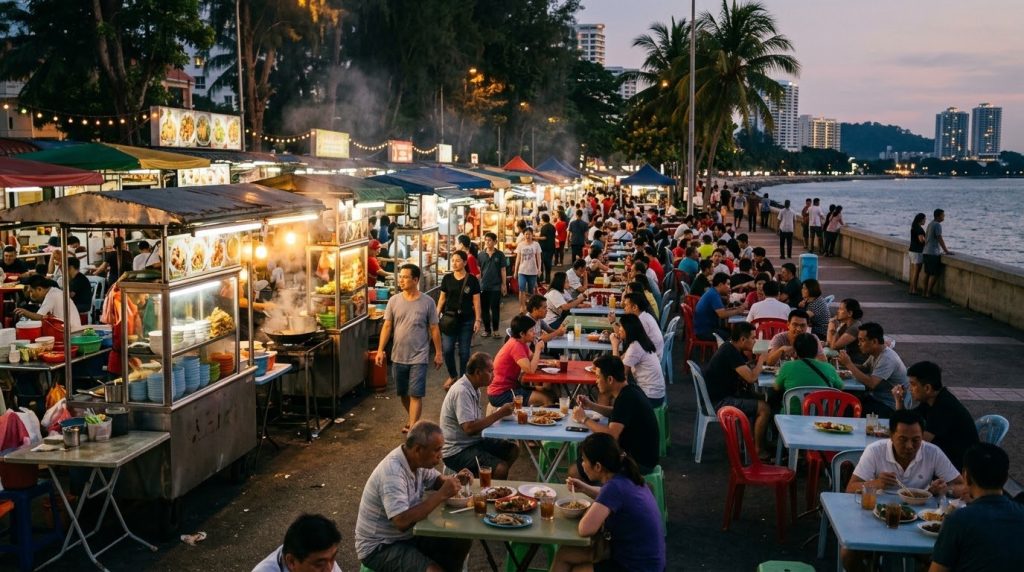
New Lane Hawker Centre (Lorong Baru)
Location: New Lane, George Town
When: 6pm-midnight
Local’s pick over tourist-dominated Gurney Drive. Smaller, more authentic. Famous for its oyster omelette and char kway teow.
Chulia Street Hawker Stalls
Location: Lebuh Chulia, George Town
When: 6pm-11pm
A row of hawker stalls on George Town’s main backpacker street. Convenient for travelers staying in the heritage zone.
Food day trips beyond George Town
George Town’s hawker scene gets most of the attention, but some of Penang’s best-regarded versions of its signature dishes sit outside the city. Balik Pulau, a rural stretch about 30 to 45 minutes from George Town by road, is where many locals go for assam laksa, and several countryside stalls there simmer a more concentrated mackerel broth than the George Town versions most visitors try first.
Balik Pulau is also Penang’s durian country. Orchards across the district sell fruit directly through the June to August season, and roadside stalls set up specifically around that window, making a Balik Pulau run worth timing around durian season if that is the draw.
Batu Ferringhi and the fishing villages along the island’s north coast add a second kind of food day trip, built around fresh seafood rather than hawker noodles. Smaller, family-run seafood restaurants near the fishing jetties tend to serve the day’s catch rather than a fixed menu, so asking what came in that morning is worth doing before ordering.
None of these trips need a tour booking. A rental car, a Grab ride or a hired driver for a half-day covers Balik Pulau or the north coast comfortably, making either a reasonable afternoon detour from a George Town base rather than requiring a separate overnight stay.
Go hungry and go with low expectations about opening hours; countryside stalls keep looser, more weather-dependent schedules than anything in the city.
Halal, vegetarian and other dietary needs
Penang’s food scene splits cleanly along its communities, which makes dietary planning easier than it looks. Indian Muslim mamak stalls, the source of nasi kandar, roti canai and mee goreng mamak, are halal by default and some of the most reliable halal options on the island, open long hours and often serving food around the clock.
Chinese hawker stalls are the opposite case. Char kway teow, Hokkien mee and most noodle dishes traditionally use lard or pork, so these are not halal unless a stall specifically advertises otherwise, and that labelling is the exception rather than the rule at most hawker centres.
Vegetarians have more options than the hawker-stall list alone suggests. Dedicated Indian vegetarian restaurants, serving banana leaf rice, dosai and idli, are common around George Town, and Chinese vegetarian restaurants marked with the yellow Buddhist vegetarian symbol serve mock-meat versions of many hawker classics, including noodle dishes that otherwise rely on pork or lard.
For food allergies, communication is the real barrier rather than availability. Many hawker stall operators have limited English, so naming the specific ingredient to avoid, rather than a general dietary category, gets a more reliable result. Carrying the allergy written down in Malay or Mandarin removes most of the risk.
Hawker centre etiquette: ordering, queuing and paying
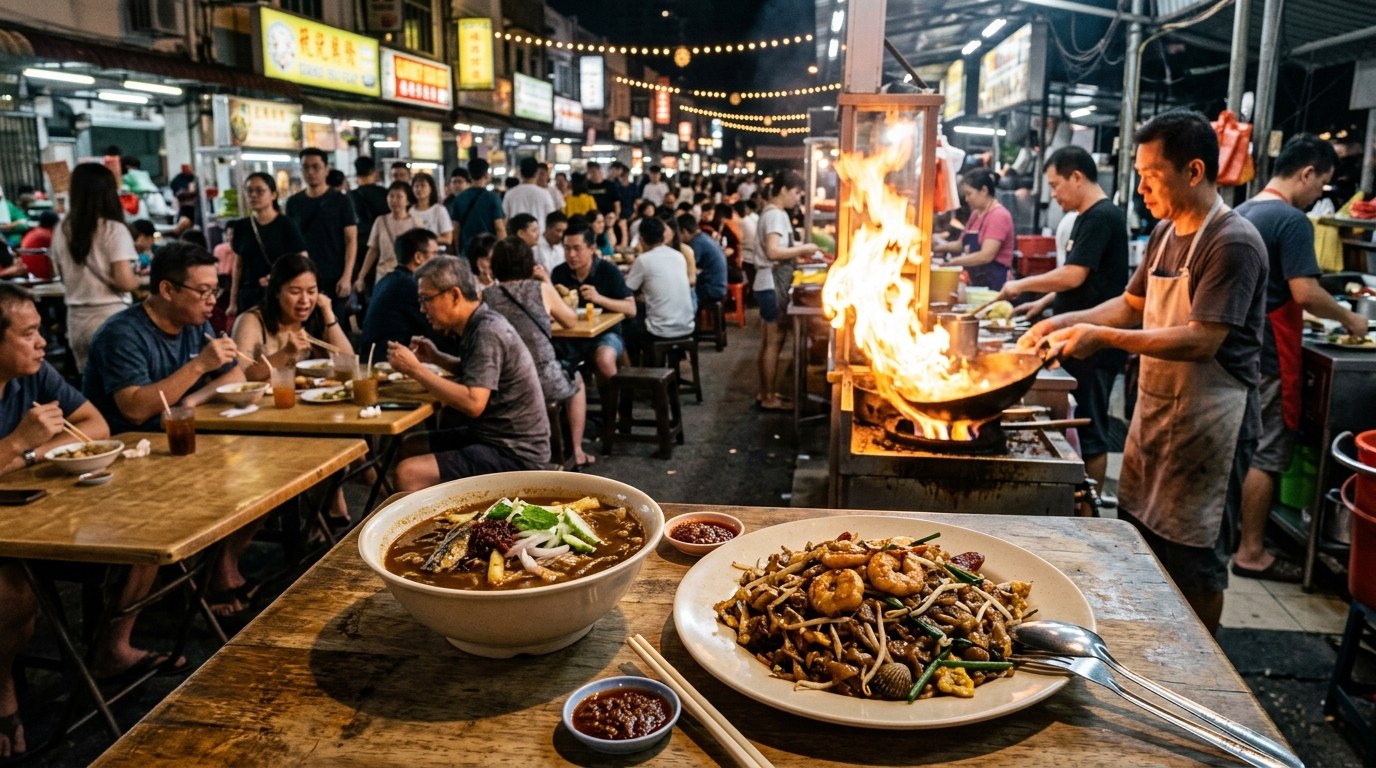
Hawker centres run on a system that is easy once you have seen it once, but confusing on a first visit. You find a table first, often sharing it with strangers since communal seating is standard, then walk between stalls ordering individual dishes rather than sitting down to a single menu.
Each stall usually sells one or two dishes and nothing else, which is why a complete meal at a hawker centre normally means visiting two or three different counters for noodles, a side and a drink. Table numbers, written on a card or painted on the tabletop, tell the stall where to deliver your order once it is ready.
Drinks come from a separate stall almost everywhere, distinct from the food vendors, so do not expect your noodle stall to also sell you a drink.
Payment happens at each stall individually, in cash, when you order or when the food arrives, not at the end of the meal as a single bill. Small notes matter: hawker stalls rarely carry change for a large bill, and queuing with close-to-exact change moves the line faster for everyone behind you.
Peak meal windows draw real queues at the most popular stalls, so joining the line and deciding what to order while you wait is normal practice, not something that marks you as a tourist.
Tips for Eating in Penang
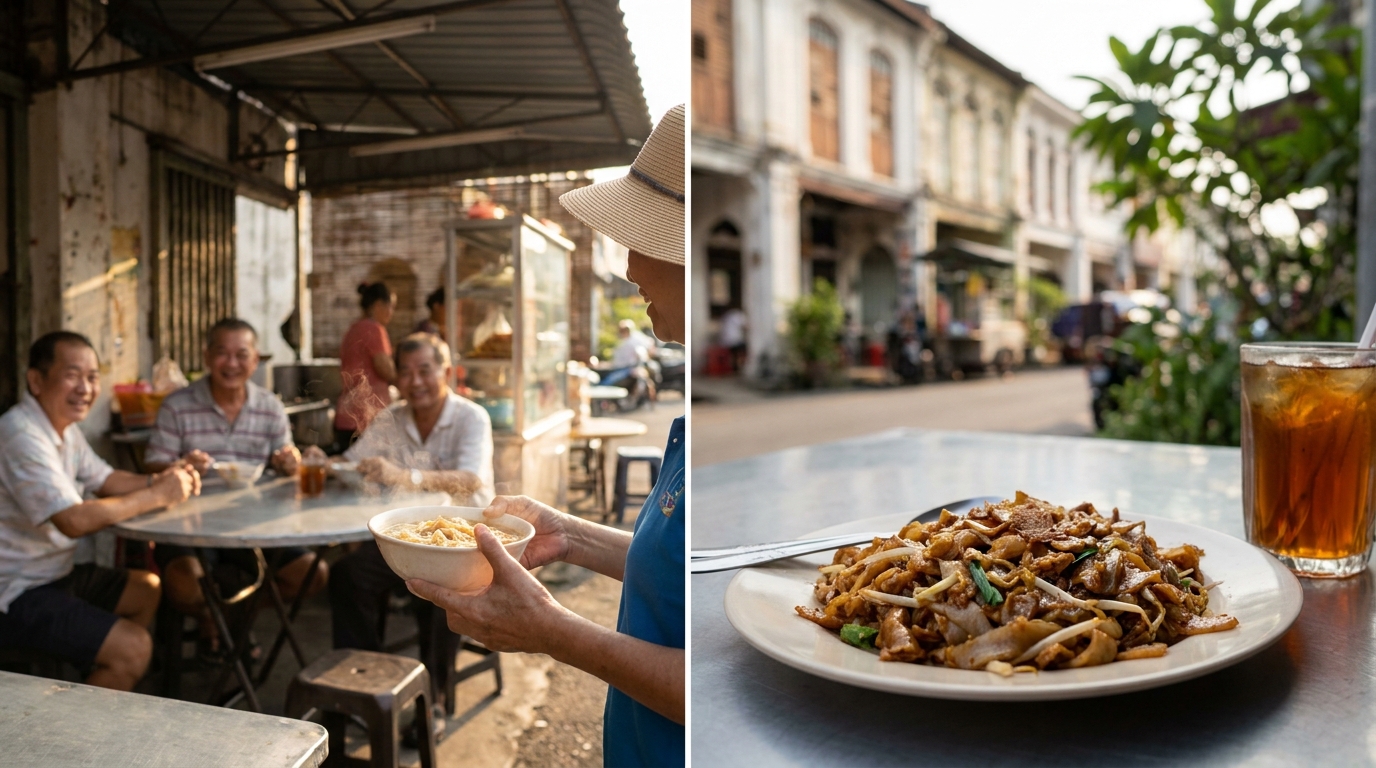
- Arrive early: The best stalls (especially assam laksa and char kway teow) sell out. Morning stalls close by 11am. Evening hawkers are busiest 7-9pm.
- One stall at a time: In hawker centers, each stall sells one or two dishes — order from multiple stalls to build a complete meal.
- Cash only: Virtually all hawker stalls are cash. Carry small bills (RM1, RM5, RM10).
- Say “less spicy”: Most dishes can be made less spicy on request (“kurang pedas” in Malay).
- Drinks: Order drinks (teh tarik, fresh fruit juice) from a separate drink stall — hawker centers usually have one dedicated drinks vendor.
For where to stay near the best food areas, see Where to Stay in Penang.
Frequently Asked Questions
Why is Penang famous for food?
Penang’s 200+ years as a trading port brought Hokkien Chinese, Malay, Tamil Indian, and Nyonya communities together in close proximity, creating a distinct fusion cuisine found nowhere else. The hawker culture that developed in the 19th century still operates today with the same dishes.
What is the most popular food in Penang?
Char kway teow and assam laksa are the most celebrated. Nasi kandar is the most distinctly Penang dish (not found in the same form elsewhere in Malaysia).
Is the food in Penang cheap?
Very. A full hawker meal (noodle dish + side + drink + dessert) costs 15-25 MYR ($3-5.30). Even a generous spread at Gurney Drive Hawker Centre runs 30-50 MYR ($6.40-10.70) per person.
Are there vegetarian options in Penang?
Yes — Indian vegetarian restaurants (banana leaf rice, dosai, idli) are widespread. Most Chinese vegetarian restaurants (identified by the yellow Buddhist vegetarian symbol) serve mock-meat versions of all hawker classics.
We only recommend services we’ve researched and trust.
Sources:
1. Penang Global Tourism — registered hawker stalls and food heritage data, 2025
2. CNN Travel — World’s 50 Best Foods list featuring Penang assam laksa, 2024
3. Malaysia Heritage Department — Penang hawker food culture listing under National Heritage Act, 2023