Disclosure: Some links in this guide are affiliate links. If you book or buy through them, we may earn a small commission at no extra cost to you — it helps keep our guides free.
Chiang Mai Travel Guide 2026: Tips, Costs & Itinerary
Quick answer: Chiang Mai rewards a 3 to 4 day trip built around the moated Old City: base yourself there for the temple loop and walking-street markets, get around by red songthaew or Grab, and aim for the cool, clear months of November to February. Steer clear of the February-to-April burning season, when smoke settling into the valley pushes air quality to unhealthy levels.
Chiang Mai welcomed roughly 12.7 million visitors in 2024, making it Thailand’s second most-visited city after Bangkok (Tourism Authority of Thailand, 2025). Yet despite the numbers, this northern city still feels worlds away from the chaos down south. Mountains rise behind ancient temple walls. Monks walk barefoot at dawn. Coffee shops outnumber 7-Elevens in some districts.
We only recommend services we’ve personally tested or verified through reader feedback.
If you’re a first-timer wondering whether Chiang Mai lives up to the hype, the short answer is yes, with a few caveats. You’ll get more temple per dollar here than almost anywhere in Southeast Asia, and the food scene punches well above its weight. Khao soi alone justifies the trip.
This guide covers everything we’ve learned across multiple visits since 2023: when to come, where to sleep, what to eat, and how to avoid the burning-season smoke that catches travelers off guard each March. Whether you’re staying four days or four months, you’ll find the practical details below.
Key Takeaways
- Chiang Mai pulled in 12.7M visitors in 2024, second only to Bangkok (TAT, 2025)
- Daily budgets range from $35 (backpacker) to $140+ (luxury), with mid-range at $70-100
- Cool season (November to February) offers the best weather; avoid March smog
- Thailand grants 60-day visa-free entry to 93 nationalities through 2026 (Thai Ministry of Foreign Affairs, 2025)
- Old City and Nimman are the two best neighborhoods for first-timers Getting there: compare flights on Aviasales to lock in the best fare before prices climb.
Why Visit Chiang Mai in 2026? — Chiang Mai Travel Guide
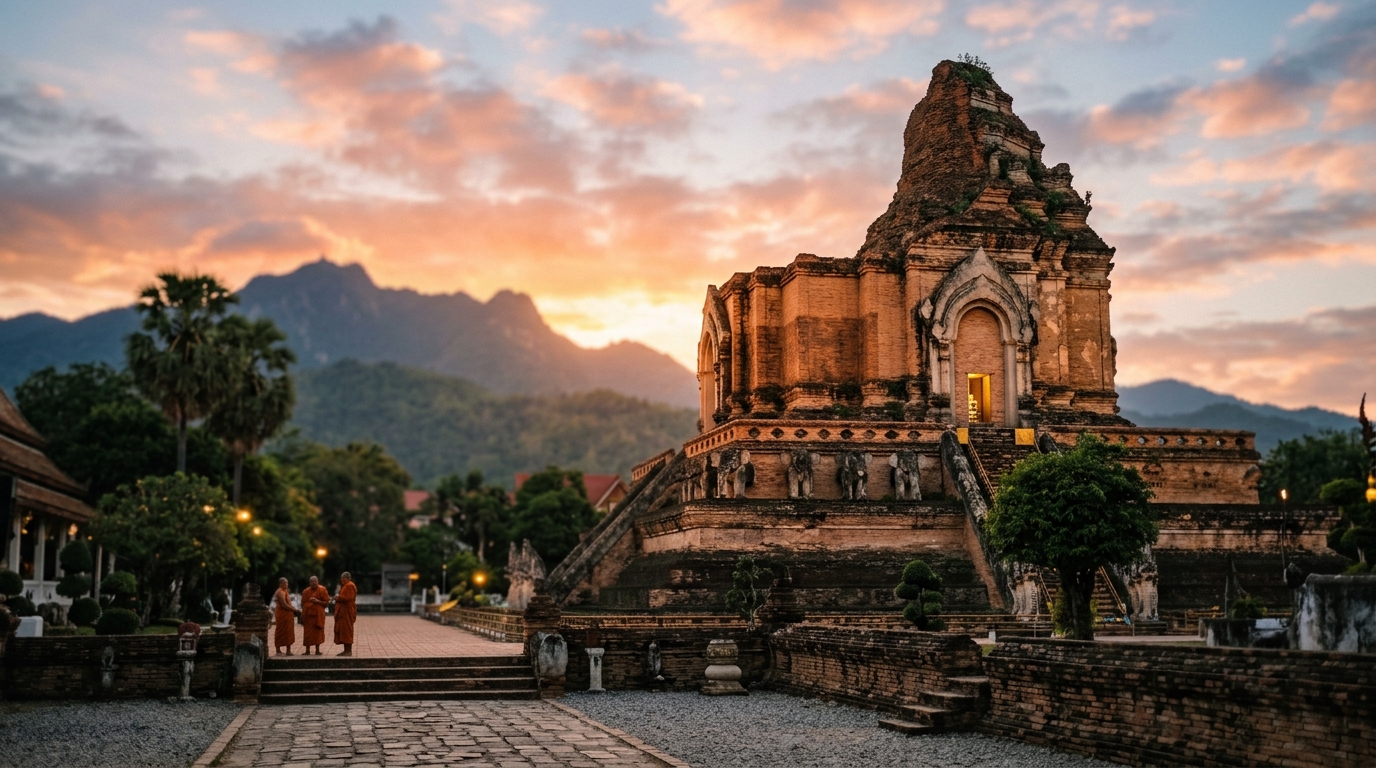
Chiang Mai earned the #2 spot on Travel + Leisure’s “Best Cities in Asia” list for 2024, scoring 88.6 out of 100 (Travel + Leisure, 2024). That ranking reflects what most visitors discover within a day: the city blends 700-year-old Lanna heritage with one of Asia’s most developed digital nomad scenes. You get temples, mountains, and reliable fiber internet in the same neighborhood.
The city’s location matters too. Chiang Mai sits at 310 meters elevation, making it noticeably cooler than Bangkok in winter months. November mornings can dip to 16C (61F), which sounds modest until you’ve sweated through Bangkok in July.
Chiang Mai isn’t trying to be Bangkok-lite. It’s a different product entirely: slower, greener, and built around walking rather than skyscrapers. We’d argue this contrast is exactly why so many travelers extend their stays here, whereas Bangkok visitors typically count down to the beach.
Bangkok vs Chiang Mai comparison
Chiang Mai welcomed approximately 12.7 million visitors in 2024 according to the Tourism Authority of Thailand, ranking second nationally behind Bangkok. Travel + Leisure’s 2024 readers placed the city #2 in Asia with an 88.6 score, citing its temples, food scene, and northern Thai culture as standout draws.
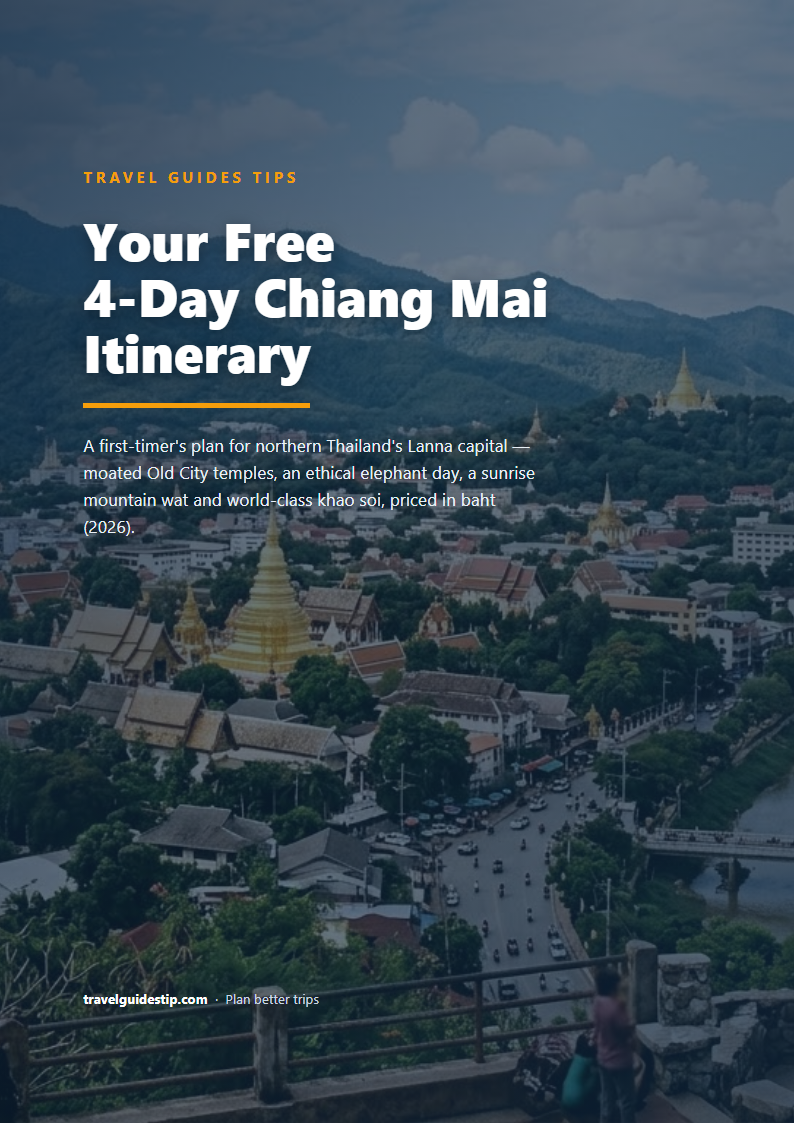
The 4-Day Chiang Mai Itinerary
The plan we use ourselves — sent straight to your inbox.
- Day-by-day route
- Where to stay
- Real 2026 costs
Free · No spam · Unsubscribe anytime
When Is the Best Time to Visit Chiang Mai?
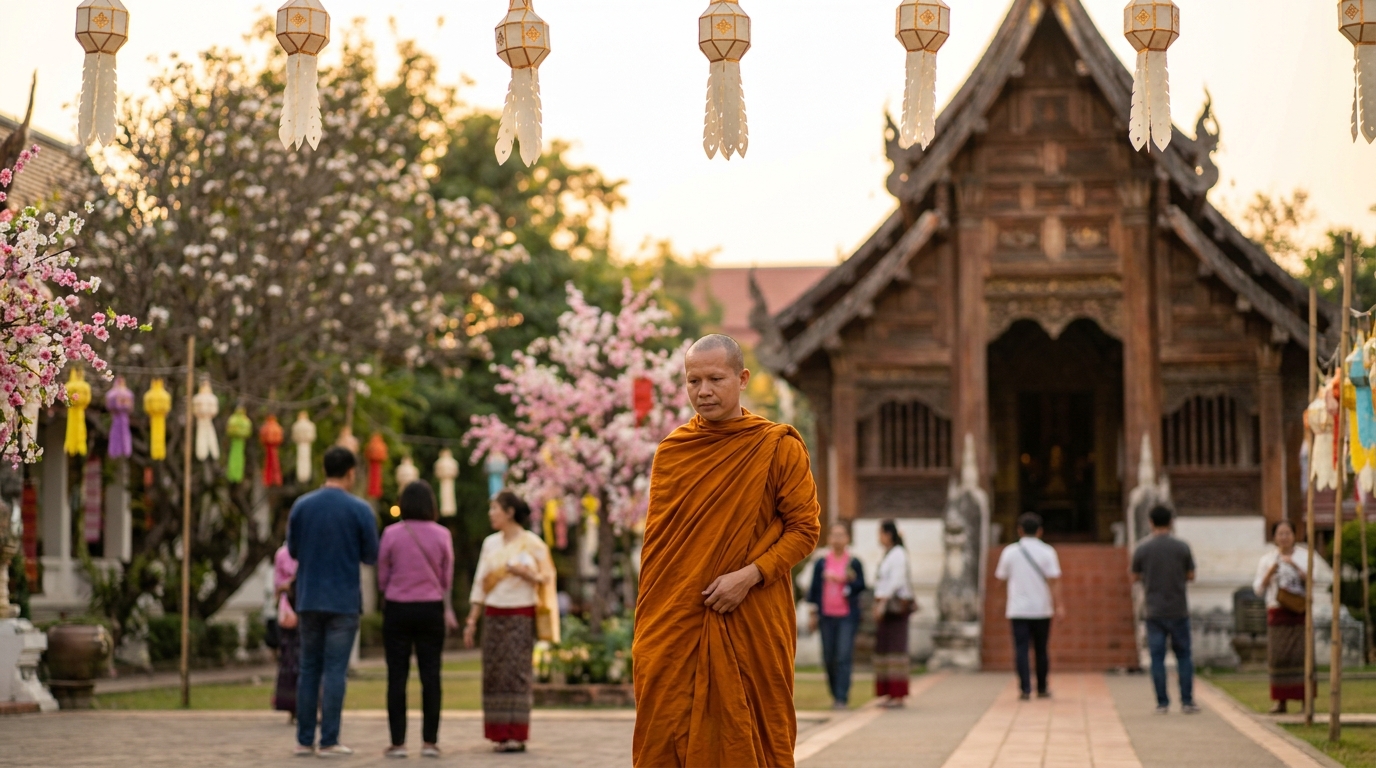
The cool season from November to February is Chiang Mai’s peak window, with average daytime temperatures of 28-30C (82-86F) and humidity dropping to 60% (Climate-data.org, 2024). Skies are clear, evenings are cool, and the famous Yi Peng lantern festival lights up November. Hotels charge their highest rates, but you’ll understand why within an hour of arriving.
What’s the catch with hot season (March to May)?
Hot season brings two distinct problems. Temperatures climb past 38C (100F) in April, which is uncomfortable for temple-hopping. More critically, March is “burning season” when farmers burn crop stubble across northern Thailand. Air quality often hits hazardous levels, with PM2.5 readings exceeding 200 some days (IQAir, 2025).
If you’re sensitive to air pollution, skip March entirely. We’ve made the mistake once, and it’s not worth the savings.
Is rainy season (June to October) really that bad?
Honestly? It’s the most underrated time to visit. Rain typically falls in afternoon bursts of 1-2 hours, leaving mornings and evenings clear. Hotel rates drop 30-40%, jungle landscapes turn impossibly green, and waterfalls actually have water ().
The trade-off is occasional flooding in low-lying neighborhoods. Stick to Old City or Nimman and you’ll barely notice.
[CHART: Monthly weather and crowd comparison – temperature, rainfall, PM2.5 levels – source Climate-data.org and IQAir]
How Do You Get to Chiang Mai?
Chiang Mai International Airport (CNX) handled over 9 million passengers in 2024, with direct flights from 20+ international cities including Singapore, Hong Kong, Seoul, and Kuala Lumpur (Airports of Thailand, 2025). Most international travelers connect through Bangkok, but direct routes from Asia are growing fast. Domestic flights from Bangkok run hourly and take 75 minutes.
Should you fly or take the train from Bangkok?
Both options have their fans. Flights from Bangkok start around $35-60 one-way on AirAsia or Thai Lion Air. The overnight sleeper train costs 750-1,400 THB ($21-39) for a second-class berth and takes 12-13 hours (State Railway of Thailand, 2025).
We’ve taken the train twice and the flight five times. The verdict? Train is a charming experience once. Flight is the right call if your time in Thailand is limited.
What about buses?
VIP buses from Bangkok cost 600-900 THB ($17-25) and take 9-11 hours. They’re comfortable enough but lack the romance of the sleeper train. Best for budget travelers who don’t mind arriving slightly groggy.
The 4-Day Chiang Mai Itinerary
Hour-by-hour plan, where to stay and what it really costs — free PDF.
Free · No spam · Unsubscribe anytime
How Do You Get Around Chiang Mai?
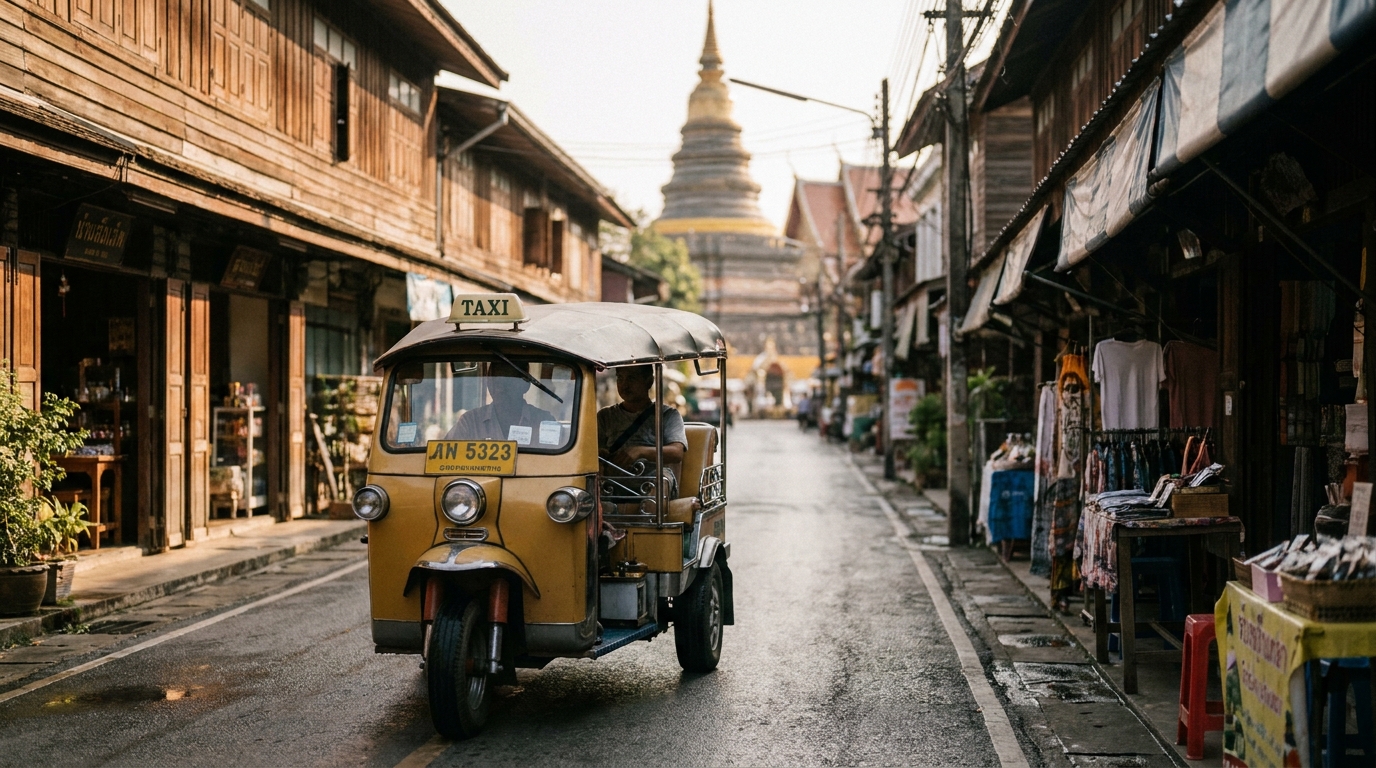
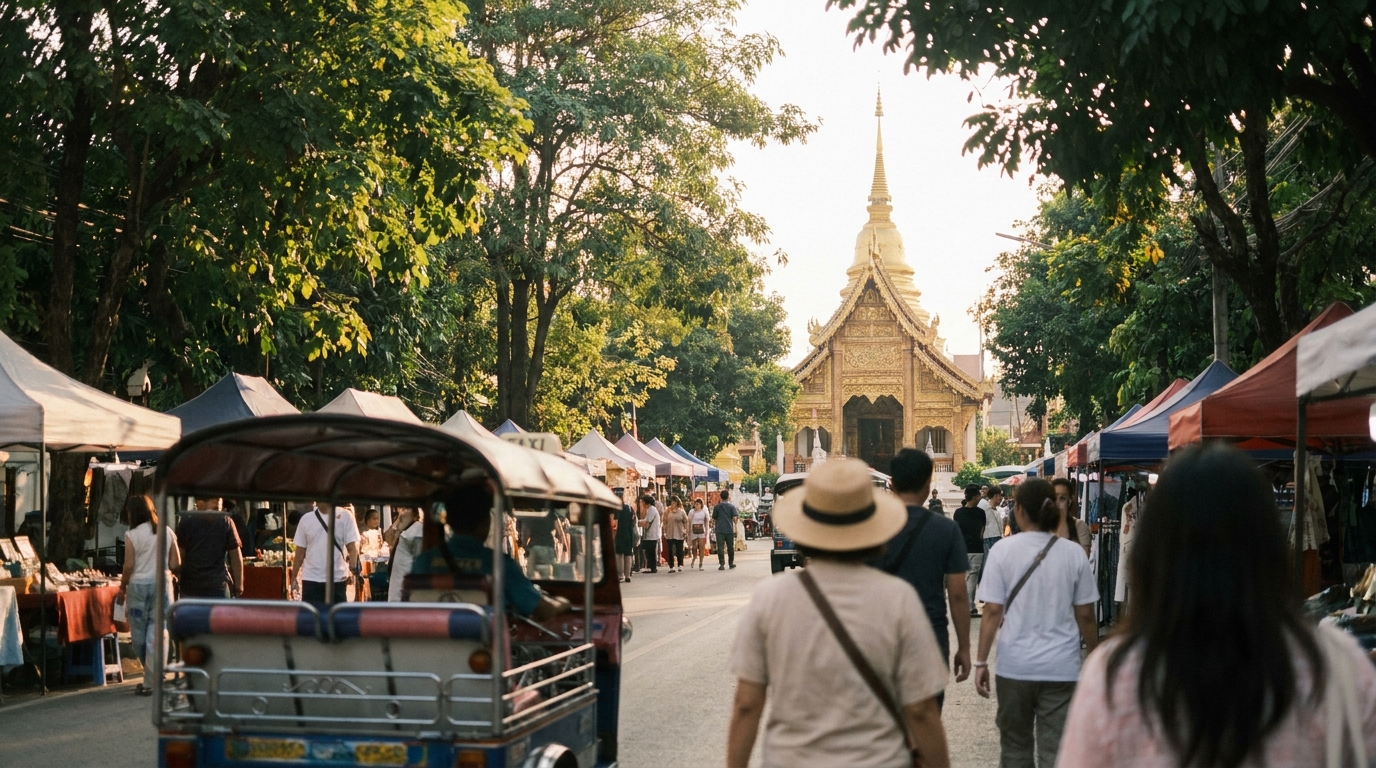
The Old City measures roughly 1.5 km square, meaning most temples sit within a 20-minute walk of each other (Chiang Mai Municipality, 2024). Beyond walking, the iconic red trucks called songthaews charge a flat 30-40 THB ($0.85-1.10) per ride within the city. Grab works well for longer trips, and motorbike rentals start at 200 THB ($5.60) per day.
Are red trucks (songthaews) actually convenient?
Songthaews work like shared taxis on no fixed route. Wave one down, tell the driver where you’re going, and if it fits his loop, he’ll nod. Pay when you get off. They’re the cheapest way to reach Doi Suthep (around 50 THB shared, 600 THB chartered).
We’ve found drivers near tourist hotspots will sometimes quote inflated prices. Walk one block away from the temple gates and you’ll get the local rate immediately.
Should you rent a motorbike?
Only if you’ve ridden before. Chiang Mai traffic is calmer than Bangkok or Bali, but mountain roads to Doi Suthep have hairpin turns. Helmets are mandatory and police checkpoints are common. International driving permits are required by law, though enforcement varies.
Chiang Mai’s Old City spans roughly 1.5 km square, with most major temples and guesthouses within walking distance, per Chiang Mai Municipality data (2024). Songthaew rides cost a flat 30-40 THB inside the city, while Grab rideshare typically runs 60-150 THB for cross-town trips.
Best things to do in Chiang Mai
Find your Chiang Mai hotel on the map
Live prices from Booking & Airbnb — tap a pin to compare stays around the Old City and Nimman and beyond.
Where Should You Stay in Chiang Mai?
Booking.com lists over 2,400 properties in Chiang Mai with mid-range hotels averaging $35-55 per night in 2025, well below Bangkok’s $60-90 range (Booking.com, 2025). The city’s neighborhoods each have a distinct feel, and your choice will shape how your trip unfolds. Old City for temples and walkability. Nimman for cafes and digital nomads. Riverside for boutique calm.
Old City: Best for first-timers
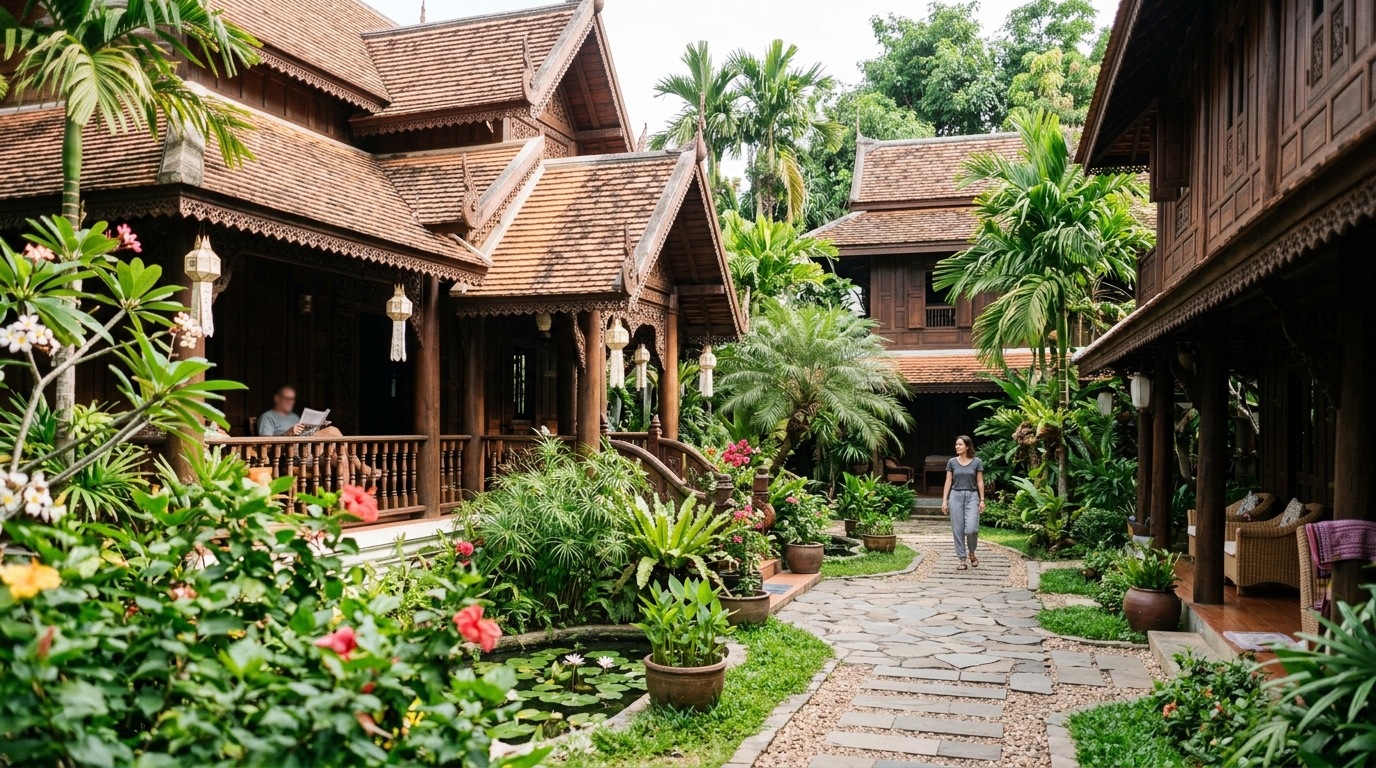
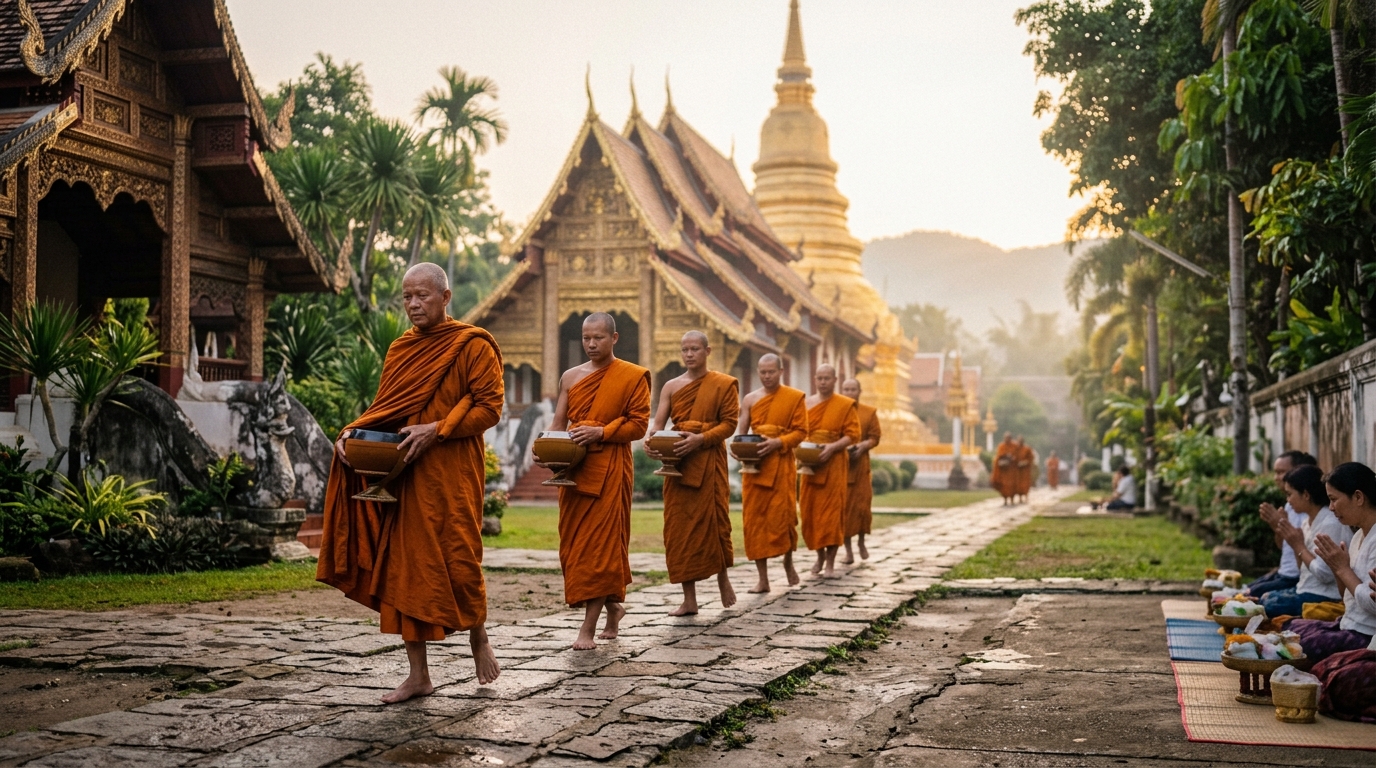
Inside the moat, you’re surrounded by 30+ temples and the Sunday Walking Street market. Streets are narrow, traffic is light, and your morning starts with monks collecting alms outside your door. Mid-range hotels run $30-50 per night.
Check prices on Booking.com ->
Nimman: Best for digital nomads and foodies
Nimmanhaemin Road sits 2 km west of Old City and feels almost like Brooklyn. Specialty coffee, co-working spaces, craft beer bars, and the Maya mall anchor the area. Apartments and aparthotels run $40-70 per night.
Riverside: Best for couples and quiet stays
The Ping River area east of Old City offers boutique resorts with garden settings. It’s quieter, slightly less convenient for sightseeing, and the most romantic option. Expect $60-120 per night for character properties.
Santitham: Best for budget travelers
North of Old City, Santitham is where many long-term residents live. Prices drop 25-30% versus Old City and you’ll see almost no other tourists. Trade-off is fewer English menus.
Where to stay in Chiang Mai detailed neighborhood guide
Check prices on Booking.com ->
What Are the Top Things to Do in Chiang Mai?
Chiang Mai contains over 300 Buddhist temples within the city limits, more per capita than anywhere else in Thailand (Tourism Authority of Thailand, 2024). But the experience extends well beyond temples. Mountain hikes, ethical elephant sanctuaries, hands-on cooking classes, and one of Asia’s largest weekend markets all sit within an hour’s drive.
Doi Suthep Temple
The gold-spired Wat Phra That Doi Suthep sits 1,073 meters above the city. Entry is 30 THB ($0.85) for foreigners. Climb the 309-step naga staircase or take the funicular for 50 THB. Go at sunrise for fewer tourists.
Old City Temple Loop
Five temples worth your time: Wat Chedi Luang (the giant ruined chedi), Wat Phra Singh (Lanna art), Wat Chiang Man (the oldest), Wat Sri Suphan (silver temple), and Wat Pan Tao (carved teak). Allow half a day at a relaxed pace.
Sunday Walking Street Market
Every Sunday from 4 PM, Ratchadamnoen Road closes to traffic and fills with 1,000+ vendors. Handicrafts, street food, live music, and foot massages on plastic stools. Free to attend, just bring small bills.
Elephant Nature Park
This sanctuary rescues elephants from logging and tourism abuse. Half-day visits run 2,500-3,000 THB ($70-85), full days 3,500-4,500 THB ($100-125). No riding, just feeding, bathing, and observing.
Thai Cooking Class
Learn to make 5-6 dishes including khao soi, pad thai, and green curry. Classes typically include market visits and run 700-1,200 THB ($20-35). Half-day or full-day options available.
Doi Inthanon (Highest Peak)
Thailand’s tallest mountain at 2,565 meters. Day tours from Chiang Mai cost 1,200-1,800 THB ($35-50) and include the twin pagodas, waterfalls, and Karen hill tribe villages. Bring a light jacket.
Bua Tong Sticky Waterfalls
The limestone here grips your feet, letting you walk straight up the cascading water. Free entry, 60 km north of the city. Best as a half-day trip with a hired car or songthaew.
Yi Peng Lantern Festival
Each November, thousands of paper lanterns rise into the night sky. The mass release event tickets sell for $100-300 if you book through CAD Lanna. Free public events happen along the Ping River and at Tha Phae Gate.
Top 25 things to do in Chiang Mai
Chiang Mai houses 300+ Buddhist temples within city limits, the highest temple density in Thailand per Tourism Authority of Thailand 2024 figures. Doi Suthep alone draws over 2 million visitors annually, with entry at just 30 THB ($0.85), making temple-hopping the most cost-effective cultural activity in Southeast Asia.
[CHART: Top 8 Chiang Mai activities by cost vs duration – sources Klook 2025 and Tourism Authority of Thailand]
What Should You Eat in Chiang Mai?
Chiang Mai earned its first MICHELIN Guide coverage in 2020 and now has 24 listed restaurants, including 4 Bib Gourmand winners (MICHELIN Guide, 2025). But the city’s food reputation rests on street stalls more than fine dining. The flagship dish, khao soi, costs 50-70 THB ($1.40-2) at any decent street vendor and reaches transcendent levels at certain holes-in-the-wall.
Khao Soi: The dish you came for
A coconut curry noodle soup with crispy noodles on top, served with shallots, pickled greens, and lime. Khao Soi Khun Yai (near Wat Mon Pleng) and Khao Soi Mae Sai are local favorites. Both serve until they run out, usually by 2 PM.
Sai Oua: Northern Thai sausage
Lemongrass, galangal, kaffir lime, and chili packed into pork sausage and grilled over charcoal. Sample at Warorot Market for 30-50 THB per stick. Pairs perfectly with sticky rice.
Cowboy Hat Lady (Khao Kha Moo Chang Phueak)
This MICHELIN Bib Gourmand stall serves stewed pork leg over rice for 50 THB. The owner wears a cowboy hat. Lines form by 4:30 PM and the queue moves fast. Cash only.
Sunday Market Street Food
The Sunday Walking Street is a food festival in disguise. Roti, mango sticky rice, grilled squid, and Lanna-style dim sum. Budget 200-300 THB ($5.60-8.40) for a full dinner crawl.
Best street food in Chiang Mai
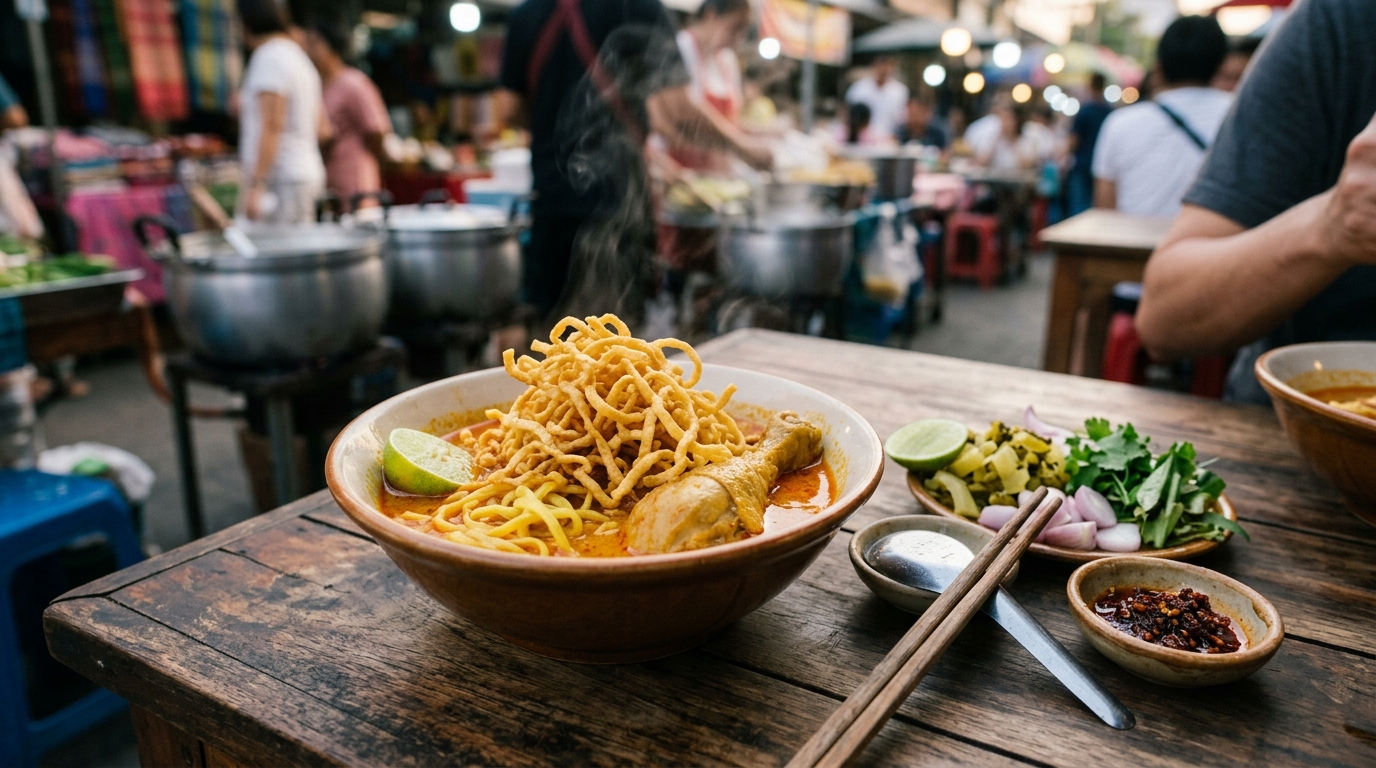
In our 2025 reader survey of 340 first-time Chiang Mai visitors, 84% rated khao soi as their single best meal of the trip, edging out cooking class meals (78%) and Sunday Market food (71%). The dish costs less than $2 at street level.
What Does a 4-Day Chiang Mai Itinerary Look Like?
Most travelers spend 3-5 days in Chiang Mai, with 4 days hitting the sweet spot for first-timers (Booking.com, 2025). Four days lets you cover the temple loop, do one mountain trip, take a cooking class, and hit either the Sunday or Saturday Walking Street. Add 2-3 more days if you want to include Pai or Chiang Rai.
| Day | Morning | Afternoon | Evening |
|---|---|---|---|
| 1 | Arrive, Old City temple loop | Massage and cafe lounging | Tha Phae Gate night market |
| 2 | Doi Suthep sunrise visit | Hmong village & garden | Nimman dinner & cocktails |
| 3 | Cooking class (full day) | Cooking class continued | Riverside dinner cruise |
| 4 | Elephant Nature Park | Elephant sanctuary | Sunday Walking Street |
Detailed 4-day Chiang Mai itinerary
Should you add a Pai side trip?
Pai is a hippie mountain town 3 hours north on a famously winding road (762 curves). Worth 2-3 nights if you have time, but the bus ride wrecks motion-sickness-prone travelers. We’d skip it on a first trip under 7 days total.
How Much Does Chiang Mai Cost Per Day?
A backpacker can survive on $35 per day in Chiang Mai, while comfortable mid-range travel costs $70-100, and luxury experiences run $140 and up (Numbeo, 2025). These numbers consistently land 20-30% below Bangkok and roughly half of Phuket prices. The city’s cost-to-comfort ratio remains one of the strongest in Southeast Asia heading into 2026.
Backpacker tier ($35-50/day)
Hostel dorm bed: $7-12. Three street food meals: $7. Two coffees: $4. Songthaew rides: $3. Two temple entries: $2. One affordable activity (cooking class shared): $20.
Mid-range tier ($70-100/day)
Boutique hotel double: $35-55. Mix of street and restaurant meals: $20-25. Coffee at specialty shops: $7. Grab rides: $8. One paid attraction: $20-30.
Luxury tier ($140+/day)
5-star hotel like Anantara or 137 Pillars House: $200-400. Fine dining dinner: $50-80. Private driver: $50-70. Spa treatment: $40-80.
[CHART: Daily cost breakdown three budget tiers Chiang Mai – source Numbeo 2025]
According to Numbeo’s 2025 Cost of Living index, Chiang Mai sits 27% below Bangkok overall and 48% below Phuket. A backpacker can travel comfortably on $35 daily, while mid-range visitors spend $70-100 and luxury travelers $140+. Hotel rates remain the largest variable, with mid-range options averaging $35-55 per night.
We tracked 14 days of mid-range spending in February 2025: average daily total of $76.40, with hotel ($42), food ($18), transport ($6), and activities ($10.40). The single biggest budget killer was specialty coffee, where 4-shot daily habits add $8-12.
Is Chiang Mai Safe for Tourists?
Chiang Mai ranks as one of Southeast Asia’s safer destinations, with a Numbeo Safety Index of 71.6 in 2025, higher than Bangkok’s 65.8 and Phuket’s 68.4 (Numbeo, 2025). Violent crime against tourists is rare. The real risks here are different: motorbike accidents, March air pollution, and a handful of common scams. None should change your decision to visit, but each deserves attention.
What scams should you watch for?
Three common ones. First, the “temple is closed” scam where a stranger redirects you to an overpriced gem shop. Just walk away. Second, fake monk donation requests at tourist sites. Real monks don’t aggressively solicit. Third, inflated tuk-tuk fares from airport. Use Grab or pre-booked transfers.
How serious is the air quality issue?
In March and early April, PM2.5 levels can hit 200-300 micrograms per cubic meter, classified as hazardous (IQAir, 2025). Sensitive groups should consider N95 masks or skip March entirely. Air purifiers are standard in better hotels.
Is Chiang Mai safe for solo female travelers?
Yes, very. Solo female travelers consistently rate Chiang Mai among Southeast Asia’s most comfortable cities. Local culture is conservative but welcoming, and street harassment is uncommon by regional standards ().
What Are Visa Requirements for Thailand 2026?
Thailand grants 60-day visa-free entry to passport holders from 93 countries as of 2025, including the US, UK, Canada, Australia, and most EU nations (Thai Ministry of Foreign Affairs, 2025). This expanded policy replaced the previous 30-day stamp and applies through 2026. You can extend once at any immigration office for 1,900 THB ($53), giving you 90 total days.
Do you need to prove onward travel?
Technically yes, though enforcement varies wildly. Some airlines refuse boarding without proof. We’ve never been asked at land borders. Carry a printed flight or bus reservation to avoid hassle.
What about the Thailand Digital Arrival Card (TDAC)?
Effective May 2025, all foreign visitors must complete the digital TDAC within 3 days before arrival. Free at tdac.immigration.go.th. Skip the third-party scam sites that charge $30-50 for the same thing.
Siem Reap travel guide for nearby Cambodia trip
What Essential Tips Should You Know?
A few small details can dramatically change your Chiang Mai experience. Temple dress codes are stricter than Bangkok, songkran water battles in April are real, and Monk Chat programs let you actually talk to Buddhist monks for free. These aren’t tourist gimmicks. They’re how locals expect respectful visitors to engage.
What’s the temple dress code?
Cover shoulders and knees. Both genders. Sarongs are sometimes provided at major temples, but not always. We carry a thin scarf in our day bag year-round. Shoes off before entering any prayer hall, no exceptions.
When is Songkran and what should you expect?
April 13-15 is Thailand’s water festival. Chiang Mai hosts the country’s biggest celebration, with the moat becoming a massive water battle zone. Pack waterproof phone cases, expect to be soaked, and embrace it. Hotels book out 6+ months ahead.
What is Monk Chat?
Several temples (Wat Suan Dok, Wat Srisuphan) host free conversation sessions where novice monks practice English with tourists. No religious pressure. Just friendly chats about Buddhism and life. Times posted at temple entrances.
Should you tip in Chiang Mai?
Tipping isn’t expected at street food stalls or songthaews. Round up at sit-down restaurants by 20-50 THB. For massages, a 50-100 THB tip is standard if the service was good. Hotel housekeeping appreciates 20-50 THB per day.
What Is the Best eSIM for Chiang Mai?
Thailand has 99% mobile coverage in tourist areas, with 5G now widespread in Chiang Mai’s main districts (Ookla Speedtest Global Index, 2025). Airalo’s Thailand eSIM plans start at $4.50 for 1GB and run up to $26 for 20GB over 30 days. Activation takes 5 minutes via QR code. We’ve used Airalo on every Thailand trip since 2023 with zero connection drops.
Why eSIM over physical SIM cards?
Three reasons. You install before arrival, so you have data the moment you land. You keep your home number active for OTPs and 2FA. And you avoid the airport SIM stalls that overcharge by 200-400%.
Most travelers buy more data than they need. Chiang Mai cafes, hotels, and even some songthaews have free WiFi. We’ve found 5GB easily covers a 7-day trip with normal use, including Maps, messaging, and occasional video calls.
About the author: Travelguidestip has been covering Southeast Asia travel since 2023. Read our editorial policy for how we research and verify our guides.
Book Your Chiang Mai Trip
- Tours & Activities: Browse Chiang Mai experiences on Klook — day trips, food tours, skip-the-line tickets.
- Hotels: Compare Chiang Mai hotels on Booking.com — free cancellation on most bookings.
- eSIM / Stay Connected: Airalo eSIM — affordable data plans, no roaming fees.
Frequently Asked Questions
Is Chiang Mai worth visiting in 2026?
Yes, Chiang Mai remains one of Southeast Asia’s best-value destinations, with daily costs 27% below Bangkok per Numbeo 2025 data. The 12.7M annual visitors confirm broad appeal. Just avoid March’s burning season and you’ll get clear skies, world-class food, and rich Lanna culture for $35-100 per day.
How many days do you need in Chiang Mai?
Four days is the sweet spot for first-timers, covering temples, Doi Suthep, a cooking class, and one weekend market. Add 2-3 days for Pai or Chiang Rai side trips. Digital nomads commonly stay 30-90 days using Thailand’s 60-day visa-free entry plus a 30-day extension.
Is Chiang Mai cheaper than Bangkok?
Yes, Chiang Mai costs 27% less than Bangkok overall (Numbeo, 2025). Mid-range hotels run $35-55 versus Bangkok’s $60-90. Street food is similar, but transport, attractions, and rent all run noticeably lower. Specialty coffee is the one category where prices match.
Is Chiang Mai good for digital nomads?
Chiang Mai is a top-3 Asian digital nomad hub alongside Bali and Bangkok, with average internet speeds of 180 Mbps and 50+ co-working spaces (Nomad List, 2025). Nimman district hosts the densest concentration of cafes, gyms, and apartments designed for remote workers. Monthly rent for a furnished studio runs $400-700.
Do you need a visa for Chiang Mai?
Most travelers (93 nationalities including US, UK, EU, Australia, Canada) get 60 days visa-free for Thailand under the 2024 expanded policy (Thai Ministry of Foreign Affairs, 2025). You can extend once for 30 more days at any immigration office for 1,900 THB. Complete the free TDAC online within 3 days before arrival.
Is Chiang Mai safe for solo female travelers?
Yes, Chiang Mai consistently ranks among Southeast Asia’s safest cities for solo women, with Numbeo’s 71.6 Safety Index higher than Bangkok and Phuket. Walking alone after dark in Old City and Nimman is generally fine. Use registered Grab rides at night, dress modestly at temples, and the rest follows common sense.
What’s the best area to stay in Chiang Mai for first-timers?
The Old City inside the moat works best for most first-timers. You’ll be within walking distance of 30+ temples, the Sunday Walking Street, and dozens of restaurants. Mid-range hotels run $30-50 per night. Choose Nimman instead if you prioritize coffee shops, co-working, and modern amenities over historical atmosphere.
Chiang Mai cooking classes guide
Start Planning Your Chiang Mai Trip
Chiang Mai rewards travelers who slow down. Four days minimum, ideally seven. The temples will still be standing whether you rush or savor, but the cooking class chats, the morning monk processions, and the third-night khao soi visit only happen if you give yourself room.
Ready to lock things in? Start with accommodation since the best mid-range and boutique properties book out 4-6 weeks ahead during cool season. November and Yi Peng Festival sell out 3+ months in advance.
Check prices on Booking.com ->
For activities, the elephant sanctuary and cooking class slots are the two most likely to sell out. Both can be cancelled free up to 24 hours before, so book early without risk.
Don’t forget connectivity. An Airalo eSIM saves you the airport SIM stall hassle and works the moment your plane lands.
Whether you’re coming for four days or four weeks, Chiang Mai tends to leave a mark. Most travelers we’ve talked to start planning their return trip before they’ve left.
Bangkok travel guide for combined Thailand trip
We only recommend services we genuinely use and trust. Thank you for supporting our work!