Is Penang Worth Visiting?
By TravelguidestipUpdated 10 min readHow we earn
Hotel buttons open Stay22 (Booking.com, Agoda and others) and tour buttons open GetYourGuide. We may earn a commission at no extra cost to you.
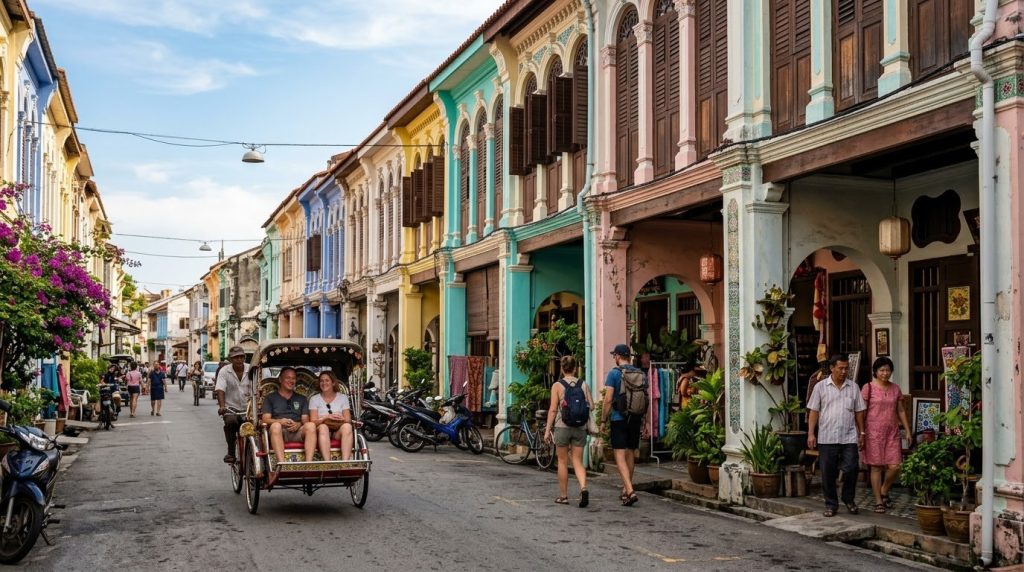
Yes, Penang is worth visiting. It rewards travellers chasing food, heritage and walkable street life, and disappoints anyone expecting a beach holiday to headline the itinerary.
What makes it worth the stop
- Cheap hawker food. A generous daily food budget covering three hawker meals plus snacks lands around AUD 17.10–27.35 · USD 12.32–19.70 (MYR 50–80).
- Walkable heritage. The old town is compact enough to walk in a day, with Peranakan shophouses, Chinese clan temples and colonial-era buildings.
- Easy half-day. Penang Hill and Kek Lok Si Temple sit close enough to combine into one half-day trip from George Town.
The honest downsides
- Ordinary beach. Batu Ferringhi is workable but ordinary sand and water, a secondary attraction.
- Quiet nightlife. George Town is quiet after dark outside a handful of rooftop bars.
- Heat and humidity. Penang sits near sea level year-round with consistently high humidity.
Yes, Penang is worth visiting: George Town’s old town has carried UNESCO World Heritage status since 2008, its hawker scene runs past 100 operating stalls within the historic core alone, and three to four nights is enough to cover the essentials without rushing. The catch: it rewards travellers chasing food, heritage and walkable street life, and disappoints anyone expecting a beach holiday to headline the itinerary.
| What Penang offers | The reality | Best for |
|---|---|---|
| George Town UNESCO heritage core (listed 2008) | Walkable old town, clan houses, colonial streets, street art | Culture-first travellers |
| Hawker food scene | 100+ stalls, mains from AUD 1.71–6.15 · USD 1.23–4.43 (MYR 5–18) | Food-first travellers |
| Penang Hill and Kek Lok Si Temple | Cooler summit air, Malaysia’s largest Buddhist temple complex | Half-day sightseers, families |
| Batu Ferringhi beach | Workable but ordinary sand and water, a secondary attraction | Not a beach-first trip |
| Day trips (Cameron Highlands, Langkawi) | Langkawi flights from AUD 21 · USD 15 (MYR 60) one-way | Multi-stop Malaysia itineraries |
| Typical stay length | 3–4 nights covers the core sights without rushing | First-time visitors |
George Town’s heritage core is the headline reason to go
George Town earned UNESCO World Heritage listing in 2008, inscribed jointly with Malacca as the Historic Cities of the Straits of Malacca, and the designation still shapes a visit today.
The old town is compact enough to walk in a day, with Peranakan shophouses, Chinese clan temples and colonial-era buildings within a few streets of each other, not spread across a city that needs a car.
Khoo Kongsi, the most elaborate of George Town’s clan houses, is worth the entry fee for the roof carving alone, and Cheong Fatt Tze Blue Mansion runs guided tours through a restored 19th-century courtyard residence most first-time visitors rank a highlight.
Layered on the heritage architecture is George Town’s street art trail, anchored by Ernest Zacharevic’s murals from the 2012 George Town Festival, which turned narrow back lanes into an open-air gallery still drawing visitors more than a decade later. None of this requires much planning.
A things to do in Penang list built around the heritage zone covers a full day on foot, with breaks built in for the next reason people actually come.
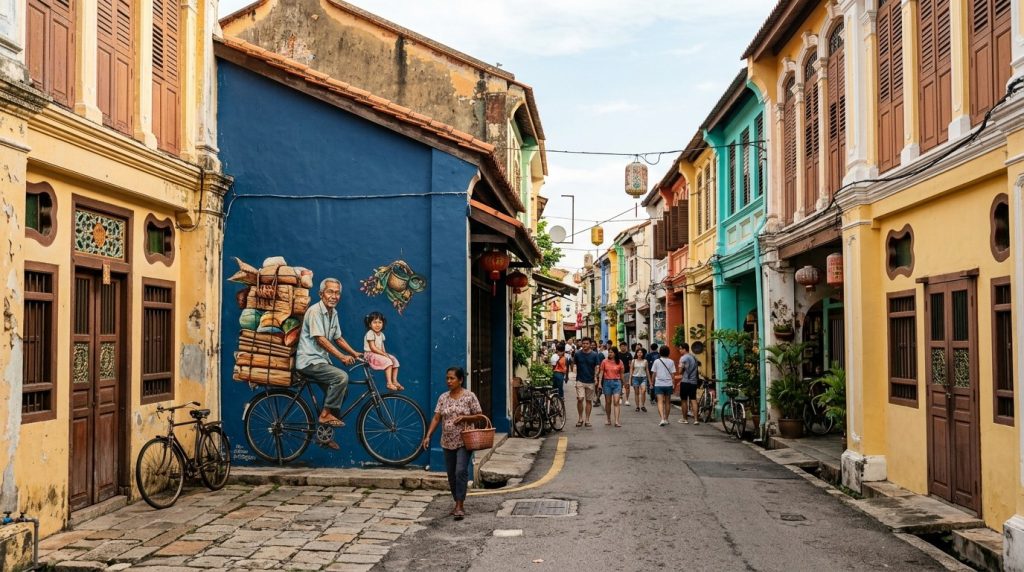
Penang is a food destination first, a heritage destination second
Ask anyone who has actually been to Penang what they remember most, and the answer is usually a dish, not a building. Penang has been named one of the world’s best street food cities more than once, and the reputation holds up on price.
A plate of char kway teow, wok-fried over charcoal heat with cockles and Chinese sausage, runs AUD 2.74–4.10 · USD 1.97–2.96 (MYR 8–12), and a bowl of assam laksa, the sour tamarind-fish broth unlike the coconut-milk laksas of Singapore or Kuala Lumpur, costs AUD 1.71–2.39 · USD 1.23–1.72 (MYR 5–7).
Nasi kandar, the all-day curry-rice tradition served banjir-style with sauces mixed across the plate, runs AUD 4.10–6.15 · USD 2.96–4.43 (MYR 12–18) for two proteins. A generous daily food budget covering three hawker meals plus snacks lands around AUD 17.10–27.35 · USD 12.32–19.70 (MYR 50–80), low enough that food alone can justify the trip before heritage or beaches factor in.
Gurney Drive and New Lane are the two best-known hawker centres for variety in one stop, and a full Penang food guide maps the stalls worth queuing for. This is the strongest single argument for visiting Penang: a food destination that also has excellent heritage architecture, not the other way around.
Penang Hill and Kek Lok Si make an easy half-day
Penang Hill and Kek Lok Si Temple sit close enough to combine into one half-day trip from George Town, and both are worth the detour. The Penang Hill funicular climbs to a summit noticeably cooler than the coastal heat below, with views over George Town and the strait separating the island from mainland Malaysia.
Kek Lok Si, in nearby Air Itam, is Malaysia’s largest Buddhist temple complex, built over more than a century and anchored by a multi-tiered pagoda and a towering Kuan Yin statue visible from much of the surrounding area.
Neither site demands a full day, part of why they pair well, and both sit close enough to Air Itam Market to fold in an early laksa stop on the way down. If you are deciding between two and three nights, our verdict on how long to stay in Penang explains why 3 nights leaves a spare half-day for Kek Lok Si.
Batu Ferringhi and the honest beach verdict
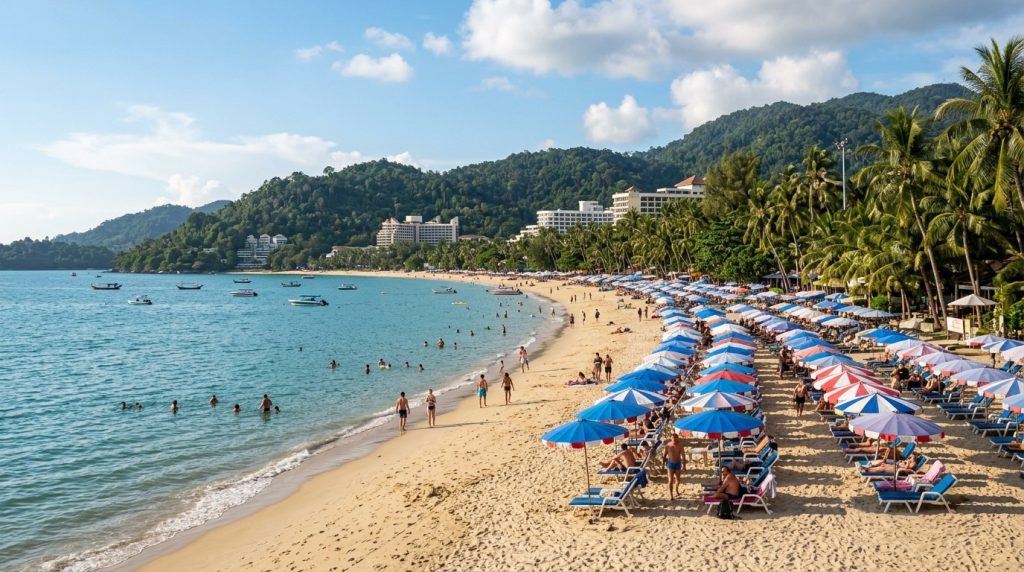
Batu Ferringhi is Penang’s main beach strip, and it is worth setting expectations before booking a room there expecting a beach holiday. The sand and water clarity trail well behind Langkawi or Thailand’s better island beaches, a result of Batu Ferringhi’s position closer to shipping lanes and river outflow than the reef-fringed coasts further south.
That does not make it a bad place to spend an evening. A sunset walk along the strip, a seafood dinner at a beachfront restaurant and a night stroll through the Batu Ferringhi pasar malam are all worthwhile additions to a George Town-based trip. What it is not is a reason to visit Penang on its own.
Treat the beach as a bonus bolted onto a food-and-heritage trip, not the centrepiece, and it will not disappoint travellers who arrive expecting Langkawi-grade water.
Day trips stretch a Penang base further
Penang works well as a base for regional day trips, useful if you are weighing a longer Malaysia itinerary rather than a standalone city break. Cameron Highlands, Malaysia’s hill-station tea country, is reachable by shared van in a few hours and offers cooler-climate contrast to Penang’s coastal heat. Langkawi is a different kind of comparison. If Malacca is also on the list, our honest Malacca verdict explains why it works best as a 1-night add-on rather than the centrepiece of a Malaysia trip.
The direct passenger ferry between the two islands has been suspended since 2020, so the practical way to combine them now is the 35-minute flight, fares from around AUD 21 · USD 15 (MYR 60) on AirAsia, Firefly and Malaysia Airlines.
If beaches and rainforest matter as much as food and heritage, a full Penang vs Langkawi comparison breaks down which island suits which traveller, and whether splitting a trip between both is worth the extra flight.
Who should skip Penang
Penang is not the right call for every traveller, and it is worth being honest about who should skip it or treat it as a short add-on rather than the main event.
Beach-resort-only travellers, who want a pool, a swim-up bar and reliable turquoise water without a heritage detour, should not build a Malaysia trip around Penang, since Batu Ferringhi will not deliver what Langkawi or a Thai island beach town can.
Party and nightlife seekers looking for a dense bar strip or club scene will find George Town quiet after dark outside a handful of rooftop bars, since the city’s energy runs through its hawker centres and markets, not a nightlife district.
Travellers who dislike heat and humidity should also think twice, since Penang sits near sea level year-round with consistently high humidity that Cameron Highlands or Penang Hill only partially offsets.
For these three groups, Langkawi, with its beaches, cable car and cooler sea breeze, is the better-fitting island, worth reading about before locking in George Town as your only Malaysian stop.
A sample 3-day Penang plan
Day one covers George Town’s heritage core on foot: start early at Cheong Fatt Tze Blue Mansion before the tour groups arrive, walk the street art trail through the back lanes around Lebuh Armenian and Love Lane, and spend the afternoon moving between Khoo Kongsi and the other clan houses before finishing with dinner at Gurney Drive or New Lane hawker centre.
Pace this day around food and heat rather than a strict schedule, since George Town rewards ducking into a kopitiam or a shaded five-foot way whenever the midday sun gets heavy.
Day two is the half-day up Penang Hill and Kek Lok Si, covered in detail above, paired with a slower afternoon back in George Town for the sights day one didn’t reach, the Peranakan Mansion, a Chinese temple, or a second round of hawker food at a different centre to compare against day one’s choices.
An evening walk along the Esplanade or a rooftop bar finishes the day without needing a late-night taxi back from Batu Ferringhi.
Day three is the honest beach day at Batu Ferringhi, treated as a bonus rather than the trip’s centrepiece: a late-morning swim, lunch at a beachfront restaurant, and the pasar malam in the evening if the timing lines up.
Travellers with a fourth day typically use it for one of the day trips covered below, Cameron Highlands for cooler air or Langkawi for a different beach standard entirely, rather than a second day inside George Town itself.
This pace assumes four to five hours of solid sightseeing each day with long food and heat breaks built in; travellers trying to pack in every item on a wider Penang checklist usually end up rushing hawker meals, which defeats much of the point of visiting in the first place.
Beyond George Town: rainforest, gardens and the national park
The Habitat Penang Hill, a rainforest canopy walk and nature park reached via the Penang Hill funicular, adds a more structured nature experience than the open hill-top views covered above, with a roughly 1.6km trail through virgin rainforest inside the UNESCO Penang Hill Biosphere Reserve.
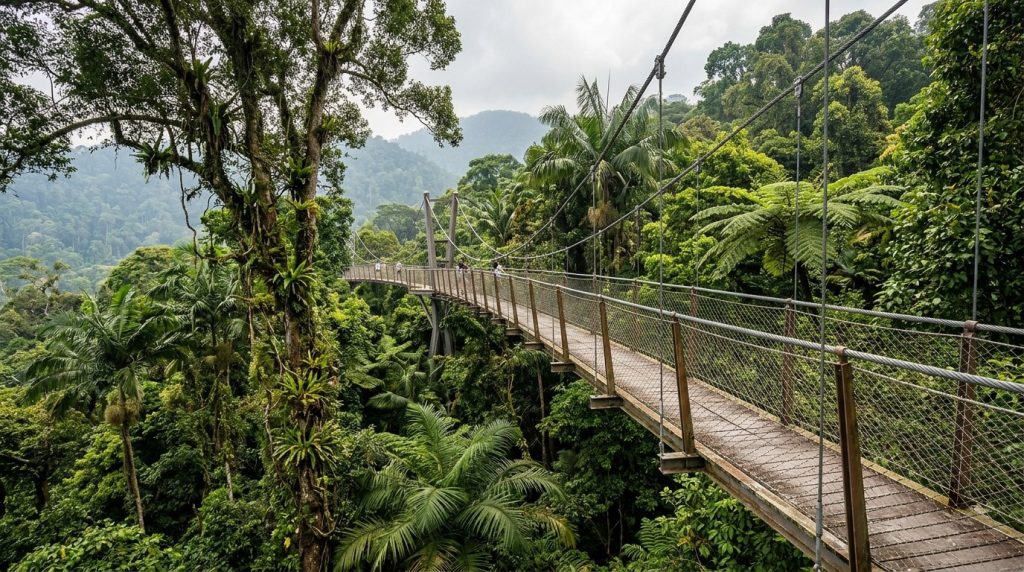
Standard adult entry runs in the region of AUD 17 · USD 12 (MYR 50-60) for foreign visitors, though ticket tiers and prices do shift, so check the current rate before building a half day around it.
Penang Botanical Gardens, a free, century-old colonial-era garden near Air Itam, suits a cooler early-morning walk before the day heats up, and the resident long-tailed macaques are a reliable sighting without needing to detour to a dedicated wildlife park.
The Tropical Spice Garden, on the island’s north coast near Batu Ferringhi, runs a paid, guided walk through cultivated spice plantings and is a practical half-day pairing with a beach afternoon rather than a separate George Town-based trip.
Penang National Park, on the island’s northwest tip, is the most physically demanding of the four and charges foreign visitors an entrance fee of AUD 17 · USD 12 (MYR 50) for adults and AUD 3.41 · USD 2.46 (MYR 10) for children, payable by card only at the gate.
The main draws are Pantai Kerachut, with its turtle hatchery, and Monkey Beach, both reached by a jungle trail of an hour or more each way, or by a short boat ride for visitors who want the beach without the hike.
This is a half-day-minimum trip, not a quick add-on, so pair it with a lighter afternoon rather than trying to combine it with George Town sightseeing on the same day. All four of these nature-based stops reward an early start, both for cooler walking temperatures and because Penang’s heat and humidity build quickly after mid-morning regardless of the season.
Getting around Penang and what a day of transport costs
Rapid Penang’s bus network is the cheapest way to cover ground beyond walking distance, with single fares running roughly AUD 0.65-2.30 · USD 0.47-1.67 (MYR 1.40-5) depending on distance, and a free CAT (Central Area Transit) shuttle loops through George Town’s heritage core specifically for sightseeing.
Buses are a reasonable way to reach Batu Ferringhi or the airport on a budget, though schedules thin out in the evening and journey times run longer than a car during peak traffic.
Grab is the practical default for most visitors once the day’s plan covers more ground than George Town’s walkable core, cheaper than a metered taxi for the same trip and simple to use without needing cash on hand.
It is the straightforward choice for the Penang Hill, Botanical Gardens, Tropical Spice Garden and Penang National Park trips covered above, none of which sit on a convenient single bus route from the heritage core.
A Grab from the airport into George Town typically undercuts the fixed-price airport taxi coupon by a noticeable margin, though both options are reasonable for a first arrival with luggage; Rapid Penang’s airport bus line is the cheapest option of the three but the slowest, and not the best choice straight off a long flight with luggage in tow.
Walking remains the best way to see George Town’s own streets, since many of the lanes carrying street art and clan houses are narrow enough that a car or even a bicycle adds little speed over covering the same ground on foot. Comfortable, closed shoes matter more than they might elsewhere, given uneven five-foot ways and the heat most visitors underestimate on a first day before acclimatising.
Where to stay if you are going
Where you base yourself changes how much of Penang’s food and heritage you actually reach on foot.
A room inside George Town’s UNESCO core, on or near Lebuh Chulia, Lebuh Armenian or Love Lane, puts you within walking distance of the clan houses, street art and most hawker stalls worth queuing for — a bigger factor here than in most Southeast Asian cities, given how street-level the appeal is.
Batu Ferringhi suits travellers who want a beach base with day trips into George Town rather than the reverse, at the cost of a bus or Grab ride for meals. A full where to stay in Penang guide breaks down both areas by budget, alongside the boutique shophouse hotels that are now one of George Town’s own draws.
Penang earns a yes for travellers who put food and heritage ahead of beach time, and a more cautious yes, treated as a short add-on rather than the main stop, for anyone who does not. Three to four nights in George Town, with a half-day up Penang Hill and an honest evening at Batu Ferringhi, covers the trip well without over-planning it.
Find your Penang hotel on the map
Live prices from Booking, Airbnb and more — move the map or change dates to compare stays across George Town and Batu Ferringhi.