Disclosure: Some links in this guide are affiliate links. If you book or buy through them, we may earn a small commission at no extra cost to you — it helps keep our guides free.
Phuket is safe on the numbers that count: Thailand sits at Smartraveller’s Level 2 “exercise a high degree of caution” advisory, two tiers below the highest warning of 4, and violent crime against tourists stays rare. The real exception is the water, where an estimated 20 to 30 tourists drown off Phuket’s beaches every year, almost all of them during the May-to-October monsoon when red flags are flying.
| Risk | How likely | How serious | What actually prevents it |
|---|---|---|---|
| Drowning in rip currents (May-Oct monsoon) | Moderate, 20-30 deaths a year | Fatal | Obey red flags, swim only at lifeguard beaches |
| Scooter or motorbike crash | High | Injury to fatal | Correct licence class, IDP, helmet every ride |
| Jet-ski or rental “damage” scam | Moderate | Financial, USD 300-1,500 | Video the vehicle before you take it, never hand over your passport |
| Drink spiking and theft, Bangla Road | Low to moderate | Financial, occasionally medical | Buy your own drink, keep it in hand |
| Border-region unrest | Low in Phuket itself | Not applicable to this island | Avoid the Thailand-Cambodia border zone, hundreds of kilometres away |
The real danger is the water, not crime
The thing most likely to kill a tourist in Phuket is a rip current, not a criminal. Phuket’s west-coast beaches run a red-flag system in four languages, and a red flag is not a suggestion to be careful, it means swimming is forbidden.
Local authorities warn that an estimated 20 to 30 tourists drown here each year, and the pattern repeats every monsoon season from May to October, when the Andaman Sea turns unpredictable and rip currents pull swimmers straight out from shore.
Karon Beach is the worst single spot, recording up to 18 separate rip currents in a season, and the southern end of Kata Yai carries the same reputation. Both are wide, popular, photogenic beaches, which is exactly why red flags there get ignored.
A calm-looking surface tells you nothing, because a rip current can form in minutes and is often invisible from the sand. If you see a red flag, do not swim, and stick to beaches with an active lifeguard tower during the monsoon months. This single habit prevents more deaths than any other precaution on this page.
Scooters, licences and what your insurance will not cover
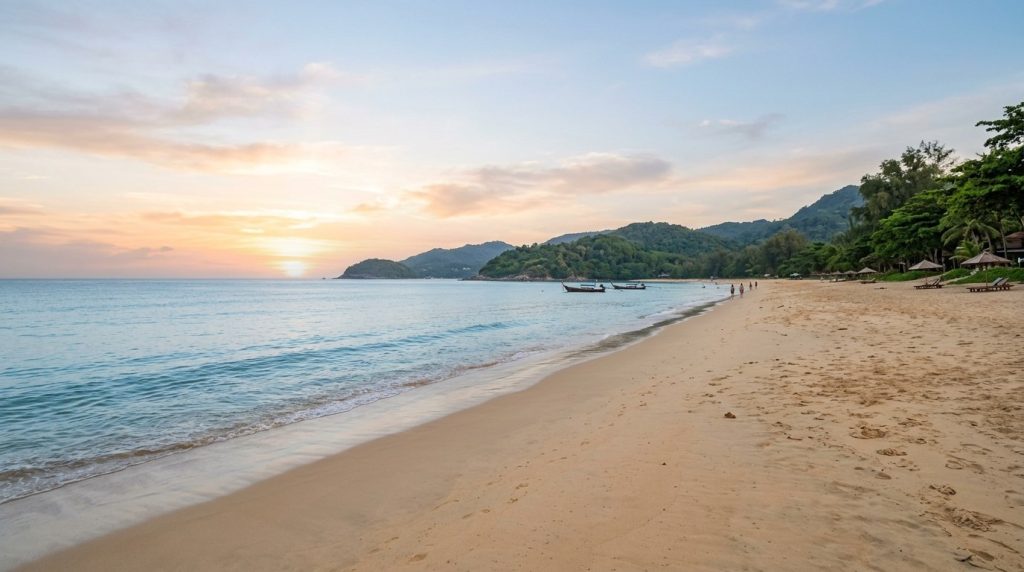
A scooter crash causes more serious tourist injuries in Phuket than any other single activity, and the licence in your wallet decides whether your insurer pays if it happens to you.
Thai law treats every rental scooter as a motorcycle regardless of engine size, so the 110cc and 125cc Honda Click and Scoopy bikes lining every rental shop in Patong and Kata legally require a motorcycle-endorsed licence plus an International Driving Permit, not a car licence.
Australian insurers apply the same line: for anything under 125cc you need a current, valid Australian driver’s licence, and for anything over 125cc you need a current, valid Australian motorcycle licence, and riding without the correct one voids the claim outright. Riding without a helmet, or after drinking, voids it too.
None of this is a technicality insurers waive after the fact. If you cannot produce the right licence at the roadside or in a claim, the accident becomes a bill you pay yourself, on top of the Phuket travel budget breakdown you planned around.
If your home licence does not cover motorcycles, take a taxi, a Grab, or a private driver instead, all of which fit comfortably into most versions of an itinerary for Phuket.
Scams that still work in Phuket
The jet-ski damage scam still works in Phuket because it targets people in a hurry to get back to the beach.
You return a rented jet-ski or scooter, and the operator points to a scratch or dent, tells you it is new damage, and demands cash on the spot, typically AUD 423 · USD 305 (THB 10,000) at the low end up to AUD 2,115 · USD 1,524 (THB 50,000), using today’s rate of 1 USD = 32.8 THB.
Some operators hold your passport as a deposit and will not return it until you pay. Marine police ran a crackdown in April 2025, seizing eight unlicensed jet-skis and arresting five operators for exactly this racket, so enforcement exists but does not reach every operator on every beach.
Protect yourself before you take the keys: film a full walkaround video of every panel and scratch in good light, refuse to hand over your actual passport and offer a photocopy instead, and rent from operators attached to a hotel or a licensed beach concession rather than the cheapest stall on the sand.
Nightlife safety around Bangla Road
Theft after drink spiking is the real nightlife risk on Bangla Road, not violent crime. Tourist Police Volunteers in Patong have warned specifically about spiked drinks, describing a pattern where a substance believed to be GHB is slipped into a drink and the victim is robbed once they are incapacitated, roughly 15 to 20 minutes later.
These incidents are not constant, but they recur every peak season, and the entry point is almost always an unattended drink at a bar or street stall. Buy your own drink directly from the bar, watch it get made, and keep it in your hand.
Do not accept a drink from a stranger, and do not leave a glass on a table while you dance or step outside. Bangla Road itself is heavily lit and patrolled, and street violence against tourists there is uncommon, so the sensible response is the drink rule above, not avoiding the street altogether.
Who should think twice about Phuket
Phuket is a poor fit for a few specific travellers rather than a broad category of people. Weak or non-confident swimmers who plan unsupervised beach time during the May-to-October monsoon are taking on real drowning risk that a strong swimmer at a lifeguard beach is not.
Anyone without a motorcycle-endorsed licence who intends to rely on a rented scooter as their main transport should reconsider, because an accident becomes both a medical bill and an uninsured one.
Solo travellers planning a heavy night out on Bangla Road who intend to carry cash, cards, and a passport, and to leave drinks unattended between rounds, are building in the exact conditions the spiking scams exploit. None of these are reasons to skip Phuket, they are reasons to change one specific behaviour.
Choosing a safer base
Where you sleep in Phuket changes your real-world risk more than almost any other single decision.
A base a short walk from Patong’s nightlife strip suits travellers who want to be in the middle of it and are comfortable with the drink-safety habits above, while families and quieter travellers do better basing further along the coast, closer to lifeguard-patrolled sections of beach and away from the after-midnight crowd.
Compare the best hotels in Phuket and the best beach resorts in Phuket with this trade-off in mind rather than price alone, since a marginally cheaper room metres from an unpatrolled rip-current beach is not actually the better deal.
Find your Phuket hotel on the map
Live prices from Booking, Airbnb and more — move the map or change dates to compare stays across Phuket.