Where to Stay in Killarney: Best Areas & Where to Book (2026)
By TravelguidestipUpdated 11 min readHow we earn
Hotel buttons open Stay22 (Booking.com, Agoda and others) and tour buttons open GetYourGuide. We may earn a commission at no extra cost to you.
Our top choice
First time in Killarney? Stay in the town centre.
Pubs, restaurants and every tour pickup within walking distance, so no car and no hotel changes.
Our pick there: Killarney Plaza Hotel & Spa: Kenmare Place in Killarney town centre, steps from the National Park entrance
5 areas: where to sleep, what to book nearby
Quick answer: Stay in the town centre if you want pubs, restaurants and tour pickups within walking distance and no car; choose Muckross Road or Aghadoe if you are driving and want the lakes and the national park at your door.
Check prices: live rates and availability for your dates
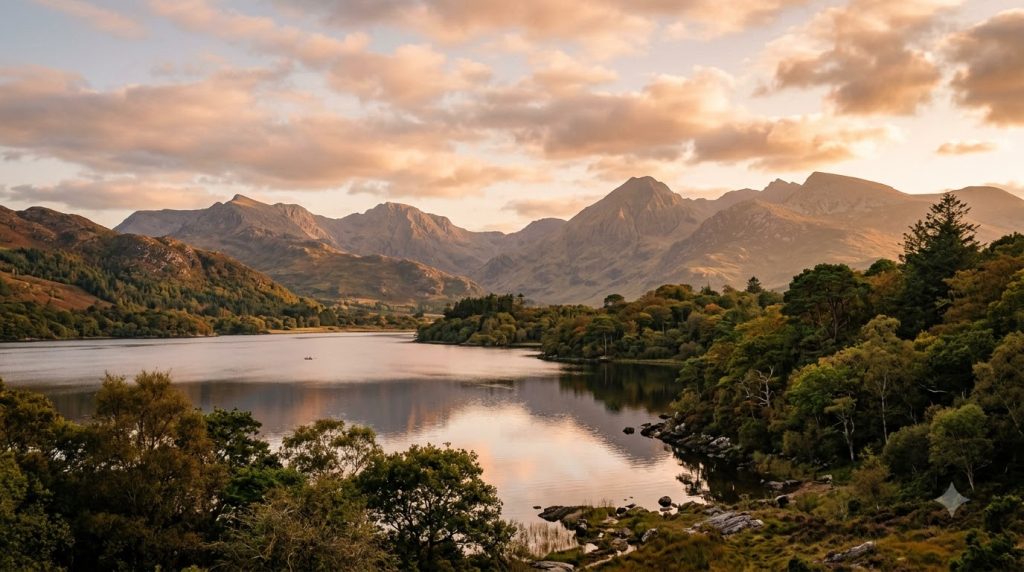
Figuring out where to stay in Killarney comes down to one decision: do you want to walk to dinner, or wake up looking at the lakes? The town is small, the national park starts at the edge of it, and the Ring of Kerry begins a few minutes down the road. Get the base right and you barely move for a week.
Getting to Killarney
Killarney railway station, run by Iarnród Éireann, has direct trains to Cork, Dublin and Tralee, with onward connections into the rest of the Irish rail network from those three hubs.
Bus Éireann covers the same corridors by road, with services linking Killarney to Cork, Tralee, Limerick (and on to Galway), Kenmare and Skibbereen, which makes a car optional for travellers arriving without one and sticking mainly to the town centre, covered above.
Kerry Airport sits at Farranfore, about 17 kilometres from Killarney, roughly midway between Killarney and Tralee, and a connecting train runs from Farranfore railway station into Killarney railway station, so a short rail hop covers the last leg for anyone flying in.
Cork Airport, the region’s other main air option, is about 89 kilometres from Killarney and is reachable by bus or rail, a longer transfer than Farranfore but often worth it if Cork has the better flight schedule from a traveller’s starting point.
Travellers driving themselves in from Dublin or Cork reach Killarney via the N22 and N21/N23 road network, the same approach roads where the budget hotels covered in “The outskirts and approach roads” above cluster.
The areas at a glance
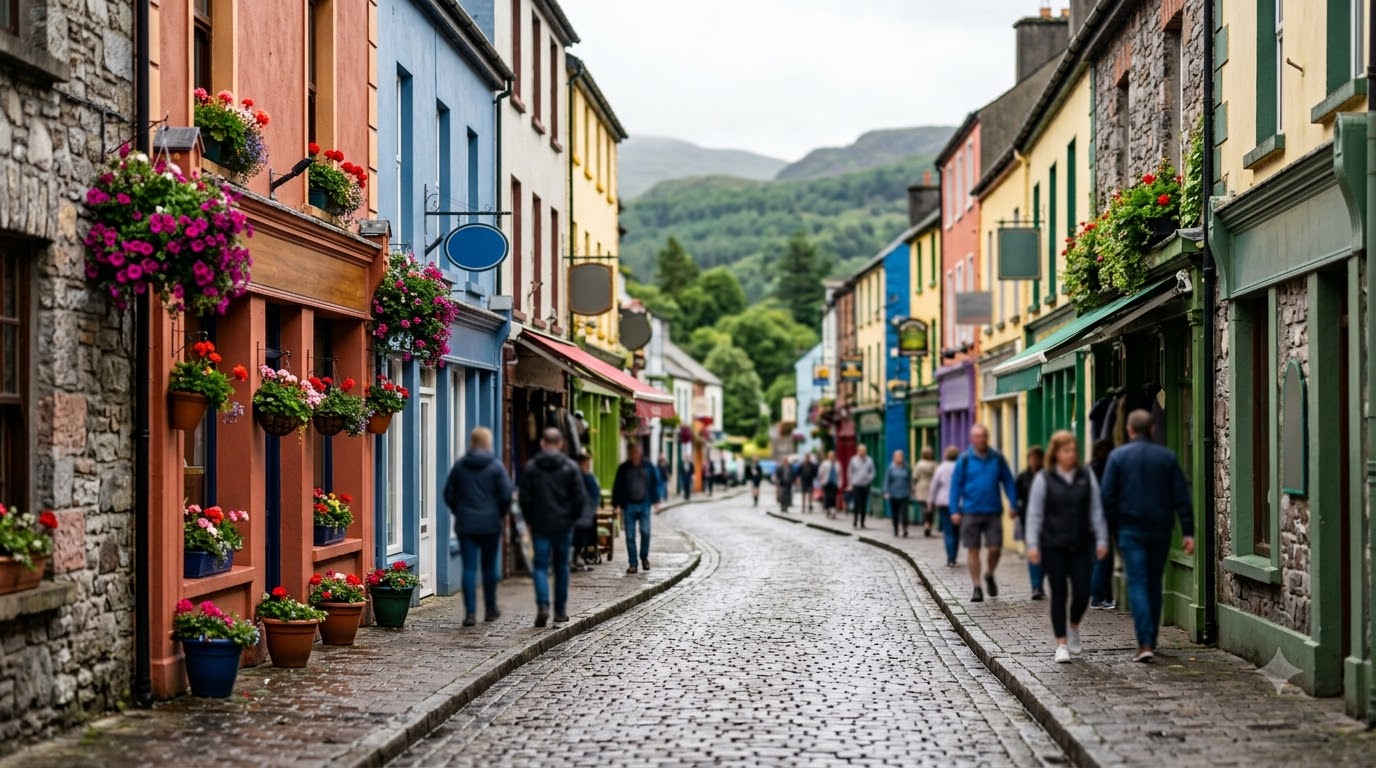
Killarney is a compact grid of a town wrapped tight against a very big national park.
Almost everything visitors book falls into one of four or five pockets: the walkable centre, the Muckross Road corridor that runs south toward the lakes, the high ground at Aghadoe looking down over the water, and the countryside west of town where the Ring of Kerry road starts.
The centre is the tightest and busiest; everything else trades footpaths for greenery and views. The single most important thing to know is that these areas sit close together, so the real question is car or no car, not one side of a big city versus another.
The town centre
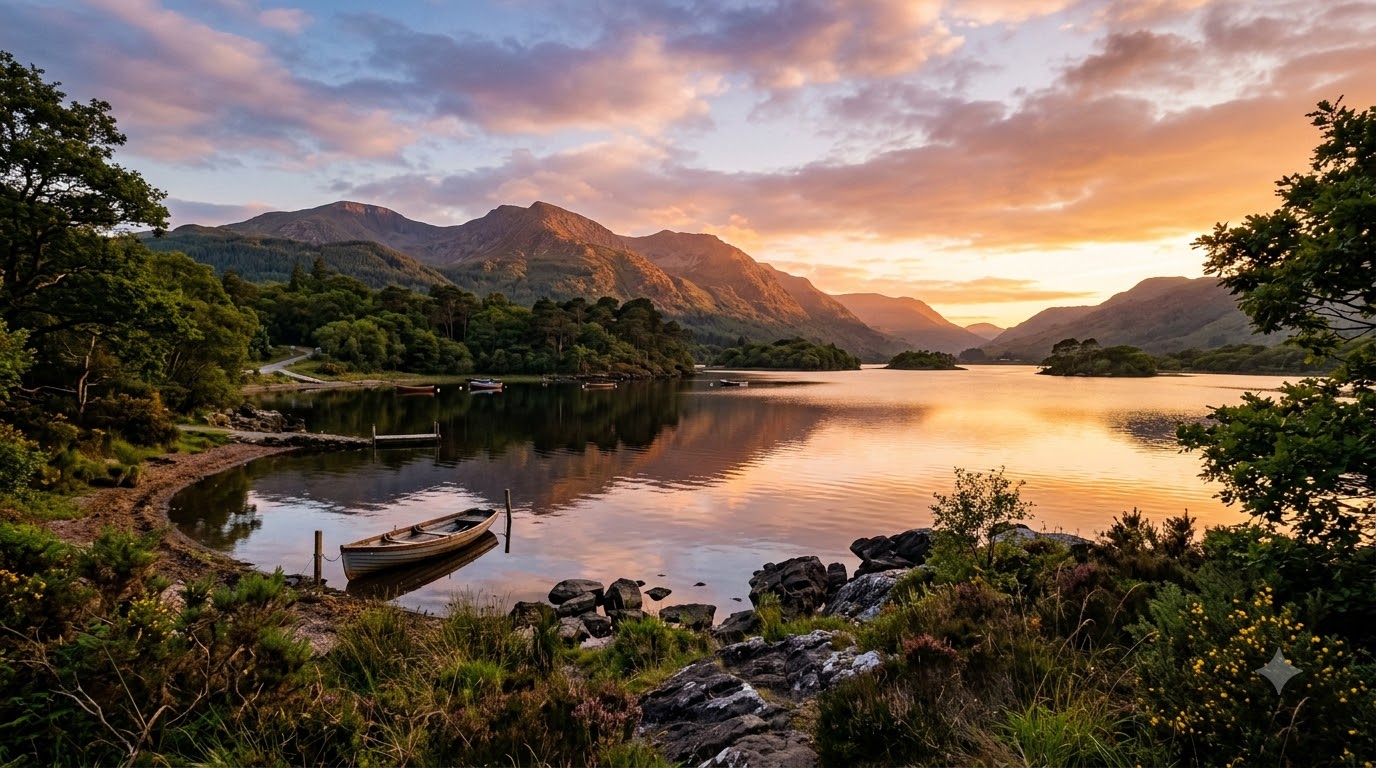
This is where most people should stay, and where most first-timers get it wrong by assuming they need to move around. They don’t. The centre, around High Street, Main Street, New Street and College Street, packs the pubs, the restaurants, the trad music and nearly every tour pickup into a few walkable blocks.
Day tours to the Ring of Kerry, the Gap of Dunloe and Dingle collect you here in the morning and drop you back at night, which is exactly why basing here and driving out daily beats hopping between hotels.
The trade-off the photos hide is noise. Rooms over or near the main pub streets can stay lively late, especially on summer weekends and during festivals, so ask for something set back or higher up if you sleep light. Parking is the other catch.
Many town-centre places have limited or paid parking, and the pedestrian core is a squeeze for a car. If you have a rental, confirm the parking situation before you book. On foot, though, this is the easiest base in Kerry, and Killarney hotels here run the full range from budget guesthouses to high-end.
Our pick in The town centre: Killarney Plaza Hotel & Spa (Kenmare Place in Killarney town centre, steps from the National Park entrance).
Muckross Road and the lakeshore
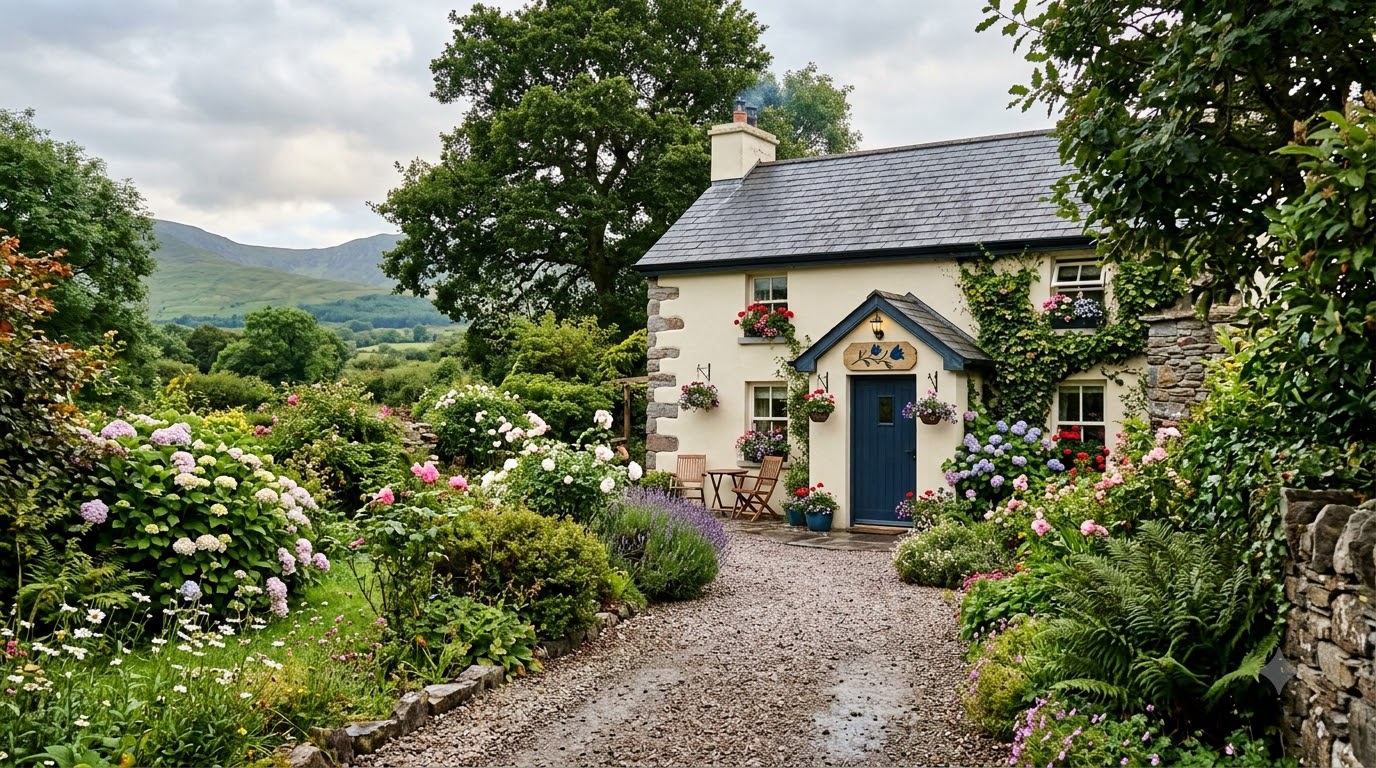
Muckross Road is the corridor most people mean when they say they want to stay “out by the park.” It runs south from the centre toward Muckross House and the lakes, and it is lined with hotels and guesthouses that sit right on the edge of the national park.
You get grounds, trees and lake air, and you can still walk or cycle into town along a footpath if you pick the near end. The far end, toward Muckross itself, is greener and quieter, and there you really want a car or a bike.
The catch here is distance. What looks like “next to the park” on a map can be a longer walk into town than you expect after a day out, and taxis get scarce late in high season. This stretch suits couples and anyone who wants somewhere calmer to come back to.
It is also the natural base for exploring Killarney National Park, whose main gates, Muckross House and the Torc Waterfall trailhead all sit along or just off this road.
Aghadoe and the high ground
Aghadoe is the ridge northwest of town, and it is where you go for the postcard view down over Lough Leane and the mountains. It is a short drive from the centre but feels rural and still, with a handful of hotels and B&Bs strung along the higher ground.
Wake up here on a clear morning and the whole valley is laid out below you. That view is the entire reason to book Aghadoe.
The trade-off is total car dependence. There is nothing to walk to, no pub around the corner, no shop, so every dinner and every tour means driving or a taxi both ways. Factor that into the cost, because a cheaper room up here can end up dearer once taxis are added. Aghadoe suits drivers, couples on a quieter trip, and anyone who values the view over convenience.
Fossa and the Ring of Kerry road
Fossa is a small village a few minutes west of Killarney on the N72, right where the Ring of Kerry drive begins. It is a string of hotels, holiday parks and B&Bs along the road toward Killorglin, backed by mountains and close to the lakes at their western end.
This is a practical base if the Ring of Kerry is your main plan, because you are already pointed the right way each morning and skip the town traffic.
The honest trade-off is that Fossa is not a walkable destination in its own right. You drive to town for dinner and to the trailheads for walks, and the road can be busy in summer. It suits families and drivers who want space, a bit of value, and a head start on the loop.
If your trip is built around driving and you have picked out where to stay in Killarney mainly as a launchpad, this end of town works well.
The outskirts and approach roads
The edges of Killarney, along the N22 from Cork and the roads out toward Killorglin and Kenmare, hold a cluster of budget hotels, motels and larger guesthouses. These are the places to look at when the centre is booked out or priced high in peak summer, which happens often. You get easy parking, more room for your money, and a straightforward drive in.
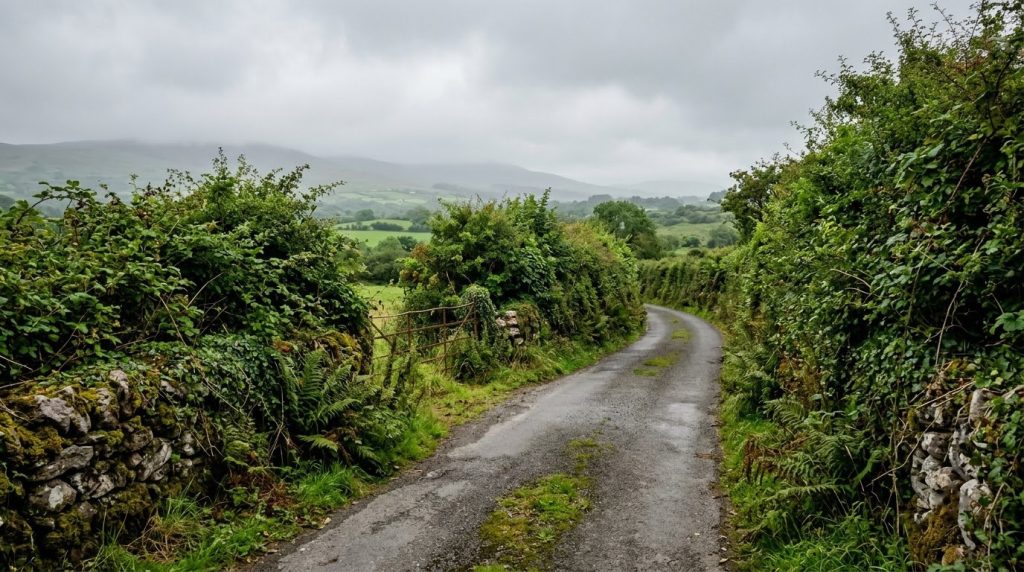
The obvious catch is that you are committed to driving or taxiing for everything, including a night at the pub. For a car-free trip this is the wrong choice; for a road trip where the hotel is just a bed, it is sensible and cheaper. This is a fine option for budget travellers, families on a driving holiday, and anyone arriving late and leaving early.
Best Self-Catering and Apartment Stays in Killarney
Self-catering apartments and holiday homes sit alongside the hotels and B&Bs already covered in each area above, rather than forming a separate pocket of town, so the same car-or-no-car logic from “Which area is right for you” still applies when picking one.
A self-catering base in or near the town centre keeps the walkability this guide recommends for first-timers while adding a kitchen, which suits a longer stay or a trip where cooking some dinners in keeps costs down after a big day on the Ring of Kerry.
Groups and families often do better with a self-catering house on the outskirts or along the approach roads, since a larger unit with parking and separate bedrooms usually costs less per person than booking multiple hotel rooms for the same group.
Whichever pocket of town a self-catering listing sits in, the trade-offs already described for that area, walkability in the centre, car dependence at Aghadoe, distance along Muckross Road, still apply in full; self-catering changes the room, not the location trade-off.
Booking a self-catering stay earlier than a hotel room is worth doing in peak summer, since the pool of apartments and holiday homes in and around Killarney is smaller than the pool of hotel rooms, and the best-located ones go first.
Which area is right for you
| Traveller type | Best area | Why |
|---|---|---|
| First-timer, no car | The town centre | Pubs, food and tour pickups all on foot |
| Couples | Muckross Road or Aghadoe | Lake views and quiet, still close to town |
| Families | Fossa or the outskirts | Space, parking and value, easy driving |
| Budget / backpacker | The outskirts | Cheaper rooms, easy parking, short drive in |
| Nightlife and pubs | The town centre | Trad music and late bars at your door |
| Car-free travellers | The town centre | The only base that works without driving |
What to book first
Book the room first, and book it early if you are coming in summer or over a festival weekend, because the centre sells out and prices climb. Decide car or no car next, since that single choice picks your area: no car means the centre, a car opens up Muckross Road, Aghadoe, Fossa and the outskirts.
Book the big-ticket tours, the Ring of Kerry, the Gap of Dunloe and Dingle, once your dates are locked, and check whether pickup is from your hotel or a town-centre point. For trip planning and what is open, Discover Ireland has the current details for Kerry.
Live nightly prices from Booking, Airbnb, Hotels.com and more across every Killarney area — move the map or change your dates to compare.
Kerry Weather by Month
Valentia Observatory, the long-running weather station in County Kerry closest to Killarney, records February as the coldest month, with a daily mean of about 7.5°C, and August as the warmest, with a daily mean of around 15.4°C.
January is the wettest month on record at Valentia, averaging about 187mm of rain, which lines up with the FAQ note below that winter in Killarney is quiet and green but wetter, with shorter days.
Kerry sits on the same latitude as Newfoundland but stays far milder, since prevailing westerly winds off the warm North Atlantic Current moderate the temperature year-round rather than letting it swing to Canadian extremes.
That mildness cuts both ways for trip planning: summer rarely gets uncomfortably hot, which suits long days on the Ring of Kerry, but no month is reliably dry, so the waterproof layer covered next is not a seasonal extra, it is a year-round essential.
Killarney town itself sits inland from Valentia and tends to run a touch warmer and slightly less exposed to the strongest Atlantic wind than the coast, but the same broad pattern, mild and damp rather than hot and dry, holds for the whole of Kerry.
What to Pack for Killarney
Layers matter more than any single heavy item, since Kerry’s weather can shift from sun to a passing shower and back within the same afternoon, even outside the wetter winter months already covered in the FAQ below.
A proper waterproof jacket, rather than a showerproof one, earns its weight for the Gap of Dunloe, Torc Waterfall and any walking inside Killarney National Park, where there is little shelter once you are away from the main gates.
Sturdy, broken-in walking shoes matter for the same trails, since the park’s paths mix gravel, boardwalk and the occasional muddy stretch after rain, and this is not terrain that rewards a brand-new pair of shoes.
A daypack with room for the waterproof layer, a reusable water bottle and a basic first-aid kit covers the Ring of Kerry and Gap of Dunloe day trips already recommended above, where shops and pharmacies thin out once you leave town.
Travellers without a car should pack for walking more than driving: comfortable everyday shoes for the town-centre cobbles and pub-hopping evenings matter as much as the hiking gear needed for a single big day out.
Related where-to-stay guides
- Where to Stay in Dingle
- Where to Stay in Kinsale
- Where to Stay in Kilkenny
- Where to Stay in Westport
- Where to Stay in Doolin
Frequently asked questions
Is Killarney expensive?
Killarney runs a bit pricier than smaller Kerry towns because it is the region’s tourism hub, and rooms in the centre peak in July and August and around festivals. You can bring costs down by staying on the outskirts or booking early. The live map shows real current prices across every area so you can compare on the day.
Do you need a car in Killarney?
Not if you stay in the town centre. Day tours to the Ring of Kerry, the Gap of Dunloe and Dingle pick up in town, and the national park starts at the edge of it, so you can have a full trip without driving. A car only becomes useful if you base out by the lakes, at Aghadoe or in Fossa.
How many days should you spend in Killarney?
Three to four nights is the sweet spot. That gives you a day in the national park, a full day on the Ring of Kerry, a day for the Gap of Dunloe or Dingle, and time in town without rushing. Two nights works if you are only doing the park and one loop.
What is the best area for first-time visitors?
The town centre. It puts the pubs, restaurants and every tour pickup within walking distance, so you never need a car and you never move hotels. Base here, drive or ride out each day, and come back to the same room, which is how most people do Killarney well.
When is the best time to visit Killarney?
Late spring and early autumn, roughly May and September, give you long days, lighter crowds and better room availability than midsummer. July and August are busiest and dearest. Winter is quiet and green but wetter, with shorter days and some tour operators closed.