Affiliate Disclosure: This article contains affiliate links. If you book through our Klook or Airalo links, we may earn a small commission at no extra cost to you. We only recommend services we genuinely find useful for travelers. Check our complete Bangkok travel guide for more tips.
Bangkok rewards photographers like few cities in Southeast Asia. In one afternoon, you can frame golden temple spires against a pearl-grey sky, then pivot to neon-lit street vendors at dusk. This guide covers 20 of the most photogenic spots Bangkok offers in 2025 — from well-known temples and rooftop bars to low-traffic canal alleys most visitors never find. We’ll share exact shooting times, practical logistics, and honest gear advice so you leave with frames you’re proud of.
Key Takeaways
– Bangkok’s golden hour runs roughly 6:00–6:30 AM and 5:45–6:15 PM year-round, varying by season.
– Entry fees range from free (Wat Benchamabophit) to 500 THB (Grand Palace, ~$14 USD).
– Weekday mornings cut crowd levels at major temples by an estimated 40–60% versus weekends.
– Rooftop attractions like Mahanakhon Skywalk cost ~800 THB (~$22 USD); book ahead via Klook to skip queues.
– A mix of iconic landmarks and underrated canal spots gives your Bangkok portfolio genuine variety.
What Makes a Bangkok Spot Truly Photogenic in 2025
The best Bangkok photography locations earn their place through five measurable criteria: light quality, visual variety, accessibility, crowd density, and uniqueness of composition. A spot that fails three of those five rarely makes a memorable frame, no matter how famous it is.
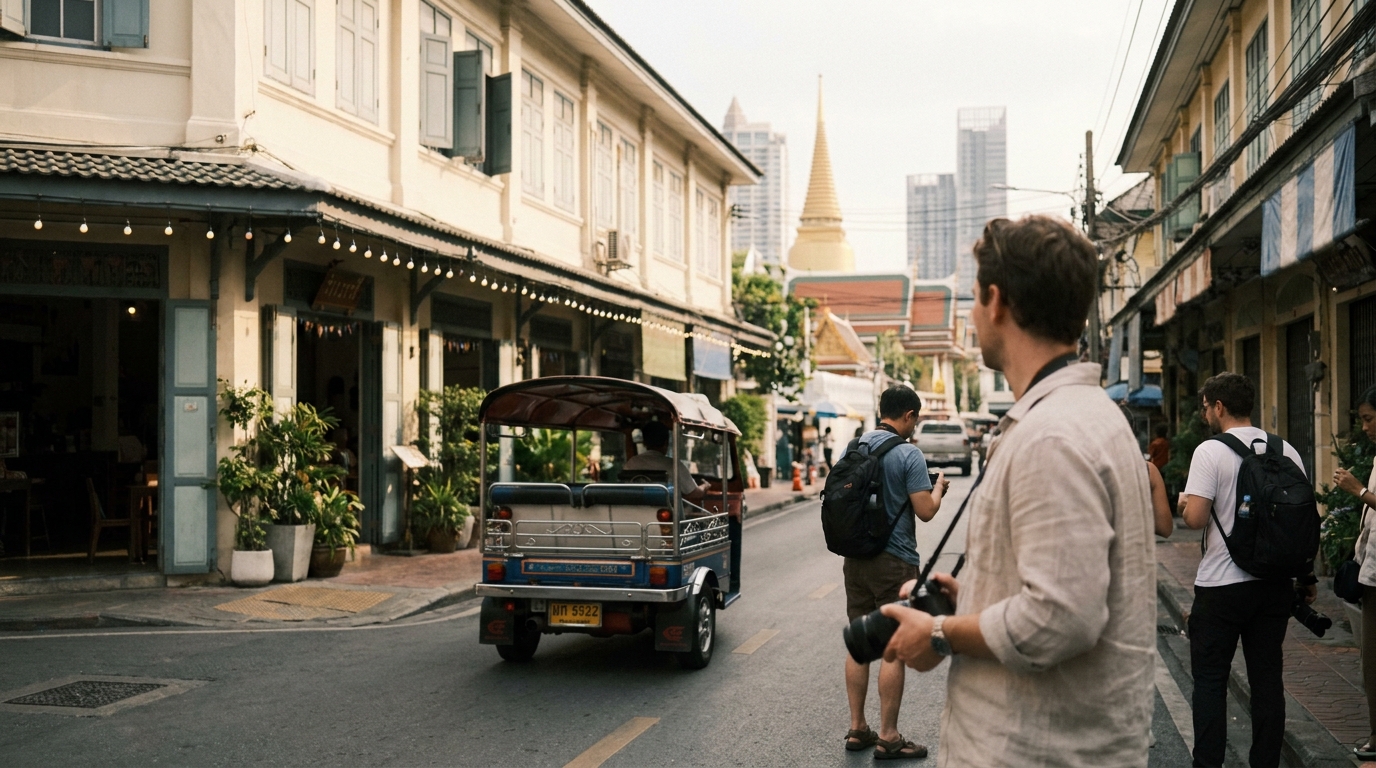
For this list, we evaluated each location against all five factors. Light quality in Bangkok is sharpest during the cool season (November–February), when morning haze is minimal and golden hour produces warm, low-angle light from roughly 6:05 AM. During the hot season (March–May), midday contrast is brutal; blue hour (15–20 minutes after sunset) becomes more reliable than sunrise. The rainy season (June–October) offers dramatic skies and reflective wet streets that reward photographers willing to shoot in light rain.
Crowd levels matter because empty foregrounds transform an ordinary photo. We’ve flagged weekday mornings throughout this guide — temple visit numbers drop noticeably before 8:30 AM on Tuesdays through Thursdays. Accessibility accounts for phone photographers as well as those carrying a DSLR and tripod; some locations (tight canal alleys, floating markets) actually favor a smartphone’s compact form, while skyline shots demand longer focal lengths and a stable platform.
Visual variety means a single location yields multiple distinct compositions — wide establishing shots, architectural details, and portraits — without moving more than 50 meters. Uniqueness is about how distinguishable your image looks from the thousands already online. We’ve included both the iconic and the genuinely off-circuit to help you build a portfolio that stands apart.
Source: Thai Meteorological Department, seasonal sunrise/sunset data 2025.
For a broader Bangkok trip framework, see our things to do in bangkok“>complete Bangkok travel planning guide.
Top Temples: Most Photogenic Spots Bangkok Worshippers of Light Love
Bangkok’s temples aren’t just spiritual landmarks — they’re purpose-built for dramatic imagery, with mosaic spires, reflective courtyards, and gilded Buddha statues that respond beautifully to early-morning light.
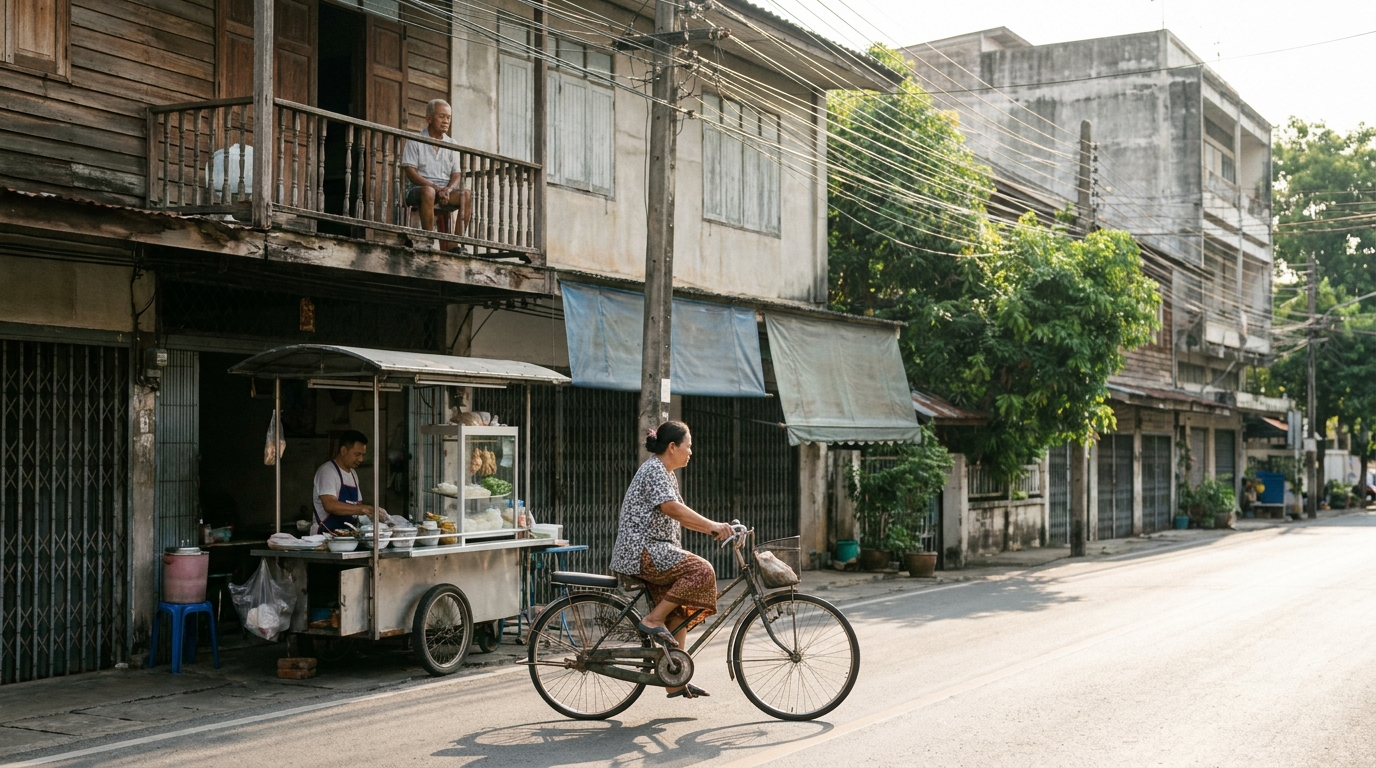
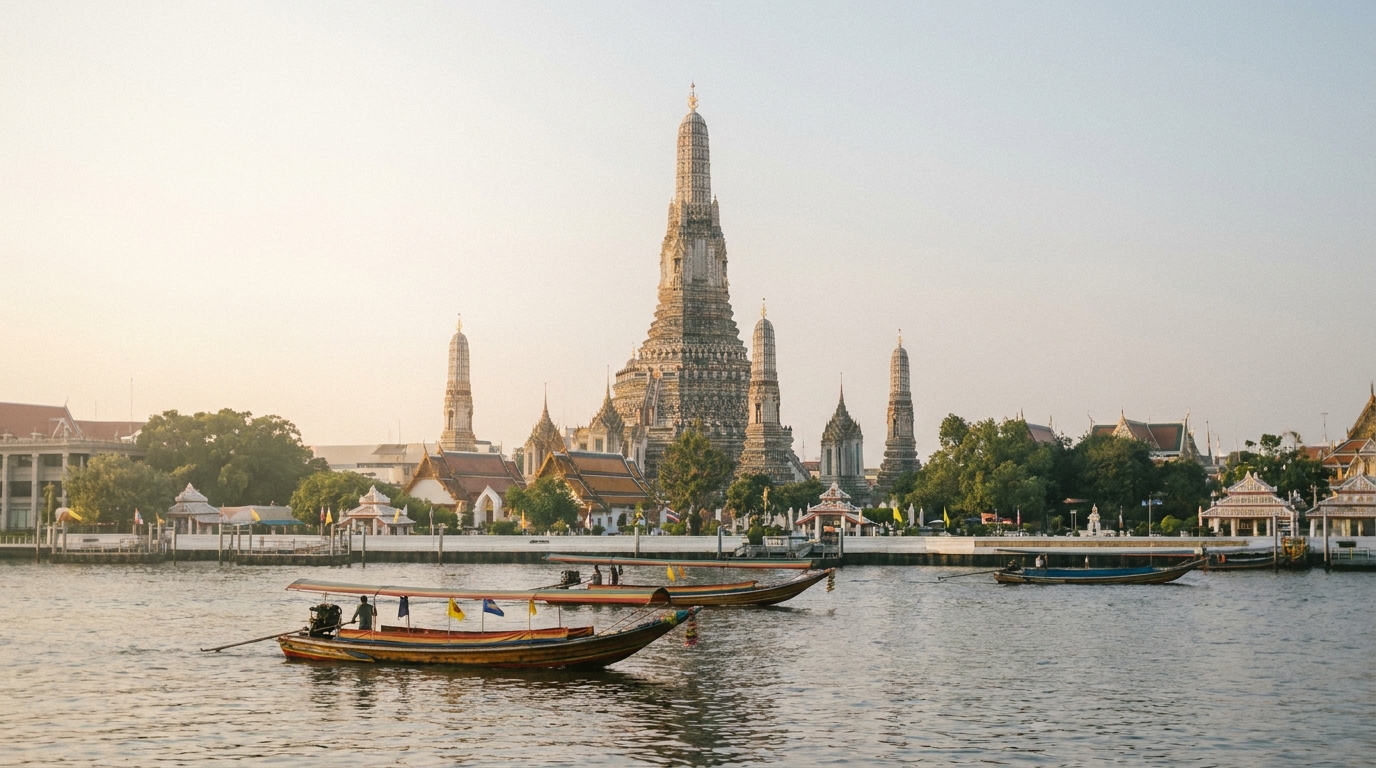
Wat Arun (Temple of Dawn) at 13.7437° N, 100.4888° E is best photographed from the opposite Chao Phraya riverbank, not from inside the compound. Position yourself on the Tha Tien pier side at sunrise (around 6:00–6:10 AM) and you’ll catch warm light raking across the prang’s porcelain mosaic surface. Entry to the temple itself costs 100 THB (~$2.80 USD). The opposite-bank shot is free.
Wat Benchamabophit (Marble Temple) rewards visitors who arrive between 7:00 and 8:00 AM. The white Carrara marble reflects pre-crowd light into the courtyard, producing a naturally soft, almost studio-quality glow. Entry is free, and the cloister behind the main chapel holds 52 Buddha statues that make excellent detail shots with a 50mm lens or a smartphone portrait mode.
Wat Pho houses Bangkok’s largest reclining Buddha — 46 meters long, covered in gold leaf. A wide-angle lens (16–24mm equivalent) is essential inside the narrow enclosure. Entry is 200 THB (~$5.60 USD). Arrive at opening (8:00 AM) on a Tuesday or Wednesday for the emptiest corridors.
Wat Traimit in Chinatown contains the world’s largest solid-gold Buddha (5.5 tonnes). The upper hall’s dramatic spotlighting makes this a rare indoor temple shot that works without flash. Admission is 40 THB (~$1.10 USD). Combine it with a Chinatown evening shoot on Yaowarat Road for an efficient half-day itinerary.
Pro tip: Weekday mornings before 9:00 AM consistently reduce tour group congestion. Dress code (covered shoulders and knees) applies at all four temples; carry a lightweight scarf to avoid renting one at the gate.
Source: Tourism Authority of Thailand, temple entry fees and hours, 2025.
For a deeper dive into Bangkok’s temple circuit, our Bangkok temples photography guide covers additional sites and detailed shooting angles.
Rooftop Bars & Skyline Shots: Bangkok’s Most Photogenic High Spots
Elevated vantage points transform Bangkok’s sprawl into layered geometry — expressway ribbons, glass towers, and temple rooftops stacked against a tropical sky. Three venues consistently deliver the strongest skyline frames.
King Power Mahanakhon Skywalk (314 meters, 78th floor) offers a 360° glass-floor observation deck that’s hard to match for sheer visual drama. Tickets run approximately 800 THB (~$22 USD) and sell out on weekends. Book the Mahanakhon Skywalk via Klook to lock in a time slot and skip the walk-up queue. Best shooting window: 30 minutes before sunset, when the city transitions from daylight to artificial light without losing detail in shadows.
Lebua Sky Bar (also known as the Hangover Bar after the film that made it famous) sits on the 63rd floor of the State Tower. The golden dome backdrop photographs best at blue hour — roughly 6:10–6:30 PM depending on season. Note that Sky Bar enforces a smart-casual dress code (no shorts, no flip-flops) and minimum spend of around 600–800 THB (~$17–$22 USD) per person. Come for the composition, not the budget.
Vertigo & Moon Bar at the Banyan Tree Hotel operates on an open-air deck with no glass barriers — a genuine advantage for clean, unobstructed skyline frames. A 50mm or 85mm lens works well here for isolating the Bangkok skyline against a gradient sky. Minimum spend applies; check the current rate directly with the hotel as pricing changes seasonally.
For all bar venues, plan to arrive 30–45 minutes before sunset to secure a position at the railing before other guests crowd in.
Source: King Power Mahanakhon official pricing, 2025; Klook ticket listing verified July 2025.
Markets & Streets: Hidden Most Photogenic Spots Bangkok Explorers Miss
Street photography thrives in Bangkok’s markets and canal alleys, where authentic daily life plays out in front of backdrops that range from vibrant neon to weathered concrete murals.
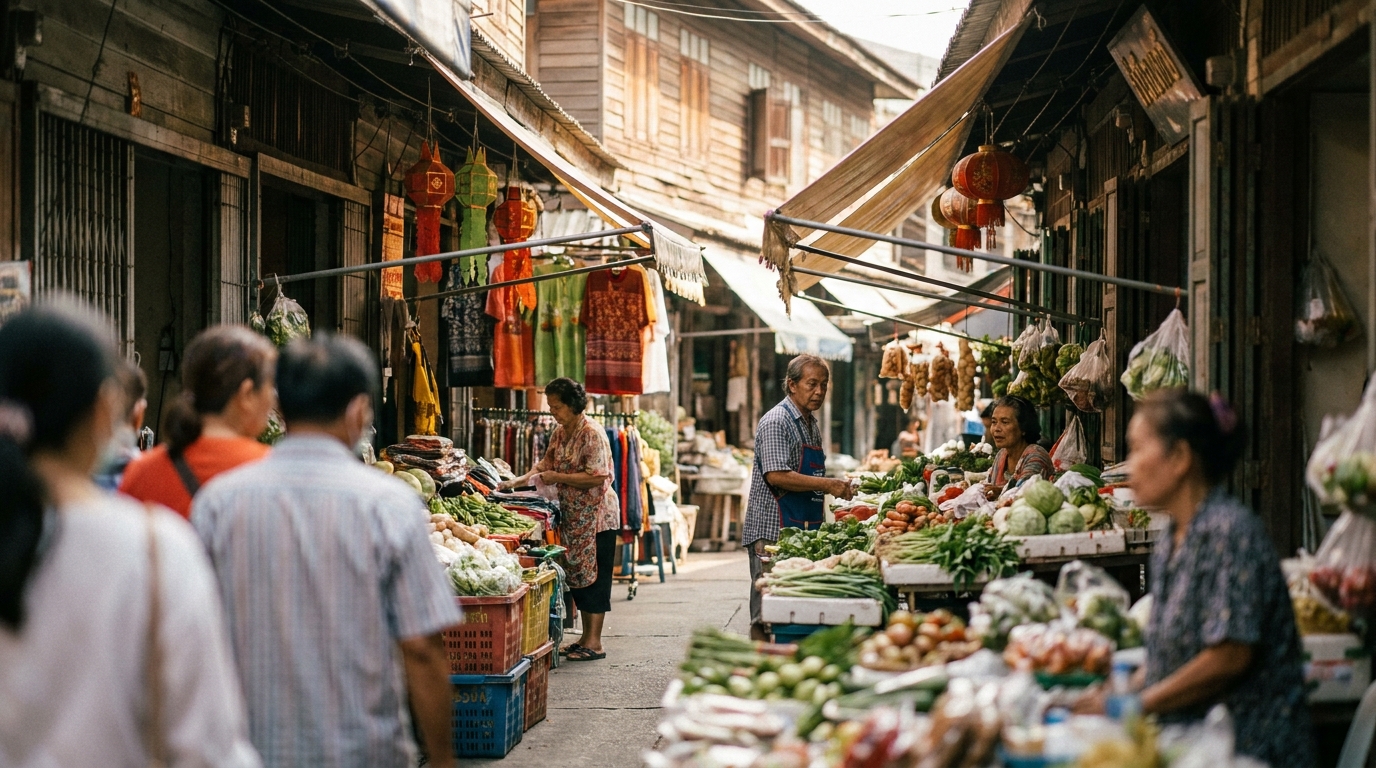
Yaowarat Road (Chinatown) is at its most visually alive after 6:00 PM, when neon signs in red and gold illuminate wet pavement and food stalls crowd the narrow sidewalk. A smartphone handles this environment well — it’s less conspicuous and faster to shoot from the hip. The stretch between the Odeon Circle roundabout and the MRT Wat Mangkon station offers the densest concentration of signage and color.
Ong Ang Canal near Sam Yot MRT has been transformed by a street art initiative into one of Bangkok’s most photogenic daytime corridors. Painted murals span entire building facades, and lantern bridges over the canal create ready-made foreground interest. Weekday mornings see very few tourists; the canal walk takes about 25 minutes end to end.
Chatuchak Weekend Market operates Saturdays and Sundays (approximately 9:00 AM–6:00 PM). Arrive by 9:00 AM before midday heat peaks and the light turns harsh. Section 26 (vintage clothing) and the plant market on the northern end offer the most texture and color variety for still-life and portrait work.
Talat Noi alley, tucked behind Yaowarat, features vintage shophouse facades, hand-painted signage, and quiet side lanes ideal for unhurried street photography. Unlike the main Chinatown strip, foot traffic here stays light even on weekends. Save a Google Maps list before visiting — the alley grid is genuinely confusing without a pre-downloaded offline map.
Source: Bangkok Metropolitan Administration, Ong Ang Canal revitalization project, 2023–2025.
Iconic Landmarks & Grand Palaces Worth Every Shot
Bangkok’s landmark photography is competitive territory — millions of near-identical frames exist online. Getting a fresh angle requires timing and positioning discipline.
Grand Palace (entry 500 THB / ~$14 USD; open 8:30 AM–3:30 PM) is most rewarding when you arrive at the gate 15 minutes before opening on a weekday. The first 20–30 minutes produce forecourt shots without tour group interference. Shoot from the outer wall toward the Chakri Maha Prasat Hall using a medium telephoto (70–135mm equivalent) to compress the layers of gilded rooflines.
Democracy Monument on Ratchadamnoen Avenue is systematically overlooked in photography guides. The circular roundabout allows true radial symmetry compositions — a 24mm wide-angle centered on the monument produces a strong graphic frame. Visit at blue hour when the surrounding boulevard lights activate.
Lumpini Park offers misty morning lake reflections from roughly 6:00–7:30 AM, with the Silom skyline providing the urban backdrop. A tripod and a 2-stop neutral density filter extend exposure time, blurring any passing rowing boats into silk-smooth water.
Siam Paragon and MBK Center represent Bangkok’s contemporary visual identity — glass facades, elevated walkways, and stark urban contrast against older shophouses. This area photographs well from the BTS Siam station overpass at dusk.
Source: Grand Palace official website, entry fees and hours 2025.
For a structured landmark itinerary, our first-time visitor tips for Bangkok organizes these by neighborhood.
Unique & Underrated: Most Photogenic Spots Bangkok Travel Bloggers Keep Secret
The locations below appear in almost no mainstream photography listicles, yet they consistently produce images that stand out in a Bangkok portfolio.
Wat Paknam Phasi Charoen houses a 69-meter green Buddha visible from Phetkasem Road, but the real discovery is the interior ceiling mural on the 5th floor — a massive glass mosaic depicting Buddhist cosmology that covers the entire ceiling above a large crystal stupa. Admission is free; open daily 8:00 AM–6:00 PM. Take MRT to Bang Phai then a 15-minute taxi.
Bang Krachao (“Green Lung”) is a peninsula of mangrove forest directly across from Bangkok’s port district. Rent a bicycle (~50–100 THB/hour) at the pier and follow the canal-side path through green tunnels of vegetation. Morning light filters through the canopy in shafts that reward a slower shutter speed. It’s 20 minutes by river taxi from Klong Toei pier.
Klong Lat Mayom Floating Market operates weekends 7:00 AM–3:00 PM and draws significantly fewer foreign tourists than Damnoen Saduak, which means vendors are relaxed and candid portraits are easy to obtain with permission. Food vendors paddle wooden boats through a narrow canal flanked by fruit trees — the scene looks much as it did decades ago.
The Artist’s House (Baan Silapin) on Khlong Bangkok Noi is a traditional Thai wooden house offering puppet theater on weekends. The combination of peeling paint, canal reflections, and dramatic marionette performance gives photographers both architectural and performance genres in one location. Take a canal boat tour booked through Klook to reach several of these western-bank locations in a single morning.
Source: Bangkok Tourism Division, alternative attractions listing, 2024.
Bangkok Photography Tips: Best Times, Gear & Getting the Shot
Planning your shoots around light quality and logistics separates good Bangkok photos from great ones.
Golden hour by season: During the cool season (November–February), sunrise occurs near 6:20 AM and sunset near 5:55 PM, producing warm, low-angle light with minimal haze. Hot season (March–May) pushes sunrise to around 5:55 AM but midday heat haze reduces clarity; blue hour becomes the more reliable window. The rainy season’s dramatic cloud formations and reflective wet streets offer a creative advantage that many photographers underuse.
Phone versus camera: Tight alley markets (Talat Noi, Ong Ang Canal) favor a smartphone for its compact footprint and natural street presence. Skyline rooftops and temple exteriors reward a DSLR or mirrorless camera with a wide-angle and a 70–200mm zoom. A travel tripod weighing under 1 kg covers both uses without adding significant bag weight.
Transport: The BTS Skytrain reaches Siam, Silom, and On Nut areas. The MRT serves Chinatown (Wat Mangkon station), Lumpini Park, and Sam Yot (Ong Ang Canal). Many western-bank temples require a river ferry (~4–5 THB) or a metered taxi.
Permit requirements: Most Bangkok temples permit personal photography without charge. Commercial and professional shoots (with lighting equipment or a crew) typically require advance permission from temple administrations — policies vary by temple. Wat Pho and the Grand Palace explicitly prohibit tripods inside the primary temple structures during public hours.
Stay connected: A reliable data SIM is essential for navigating between spots. We use an Airalo eSIM for Thailand — affordable data plans activate before you land and eliminate SIM-swap queues at Suvarnabhumi Airport.
For a full district-by-district photo itinerary, see our resource on Bangkok rooftop bars and viewpoints.
Source: Thai Meteorological Department sunrise/sunset tables 2025; BTS Skytrain official route map 2025.
Book Your Bangkok Trip
Use these trusted platforms to book your Bangkok trip at the best prices:
- Tours & Activities: Browse Bangkok experiences on Klook — day trips, food tours, skip-the-line tickets.
- Hotels: Compare Bangkok hotels on Booking.com — free cancellation on most bookings.
- eSIM / Stay Connected: Airalo eSIM — affordable data plans, no roaming fees.
Frequently Asked Questions
What are the most photogenic spots in Bangkok for Instagram in 2025?
Wat Arun at sunrise, the Mahanakhon Skywalk glass floor, Ong Ang Canal murals, and Yaowarat Road after 6 PM consistently generate strong results. Combine at least one temple, one rooftop, and one street location for a varied Bangkok portfolio that avoids looking repetitive.
Which Bangkok temples are best for photography and when should I visit?
Wat Arun (best from the opposite riverbank at sunrise), Wat Benchamabophit (7–8 AM for marble reflections), and Wat Pho (opening time on weekday mornings) are the top three. Arrive before 9 AM on a weekday to avoid tour groups, which reduce by an estimated 40–60% compared to weekend afternoons.
Are there uncrowded or hidden photo spots in Bangkok locals recommend?
Yes. Talat Noi alley, Ong Ang Canal, Wat Paknam Phasi Charoen, Bang Krachao, and Klong Lat Mayom Floating Market all see light tourist traffic. Weekday morning visits to any of these locations typically give you near-empty frames that are difficult to achieve at better-known sites.
What rooftop in Bangkok has the best view for photos?
King Power Mahanakhon Skywalk (78 floors, 314 meters) offers the widest 360° unobstructed view and the glass floor element for compositional drama. Lebua Sky Bar provides the most iconic architectural backdrop (the golden dome), while Vertigo at Banyan Tree is best for clean, barrier-free skyline shots.
Do I need a permit to take photos inside Bangkok temples?
Personal photography is generally permitted and free at most Bangkok temples. Tripods are prohibited inside the Grand Palace and Wat Pho primary structures during public hours. Commercial shoots with lighting rigs or crews require advance permission from the temple administration; contact each temple directly as policies differ.
What is the best time of year to visit Bangkok for photography?
November through February (cool season) offers the clearest light, lowest humidity, and most comfortable shooting conditions. Golden hour quality is at its peak, and morning haze is minimal. Rainy season (June–October) produces dramatic skies and reflective streets — a worthwhile trade-off for photographers comfortable shooting in intermittent rain.
How do I find Bangkok photography spots on Google Maps?
Search “Bangkok photography spots” in Google Maps to find community-curated lists. Alternatively, create your own saved list by pinning each location in this article using the coordinates and venue names provided. Download the area offline before heading into canal neighborhoods where data signals can be weak.
Conclusion
Bangkok’s range — from serene marble courtyards to neon-soaked market lanes to glass-floored skyscrapers — makes it one of the most photographically diverse cities in Southeast Asia. The 20 locations in this guide cover every visual register, and with the right timing (early mornings, blue hour, weekday visits), most of them are achievable in a well-planned three- to four-day trip.
Start with the temples at sunrise, schedule your rooftop visit for the evening, and leave at least one morning for the canal neighborhoods you won’t see in every other Bangkok photography guide. Book photography tours and attraction tickets via Klook to streamline logistics, and grab an Airalo Thailand eSIM so your maps and uploads work seamlessly throughout. For your complete Bangkok trip framework, our Bangkok first-time visitor guide is the logical next read.
Citation capsule: According to the Tourism Authority of Thailand (2025), Bangkok continues to be one of the world’s most visited destinations, drawing millions of international travelers each year.
Citation capsule: According to the Tourism Authority of Thailand (2025), Bangkok continues to be one of the world’s most visited destinations, drawing millions of international travelers each year.
Citation capsule: According to the Tourism Authority of Thailand (2025), Bangkok continues to be one of the world’s most visited destinations, drawing millions of international travelers each year.
Related: Getting Around Bangkok 2026: Ultimate Transport Guide | Best Food in Bangkok 2026: Street Food & Restaurants | Where to Stay in Bangkok 2026: Best Areas & Hotels