Is Uluwatu Worth Visiting? (2026)
By TravelguidestipUpdated 9 min readHow we earn
Hotel buttons open Stay22 (Booking.com, Agoda and others) and tour buttons open GetYourGuide. We may earn a commission at no extra cost to you.
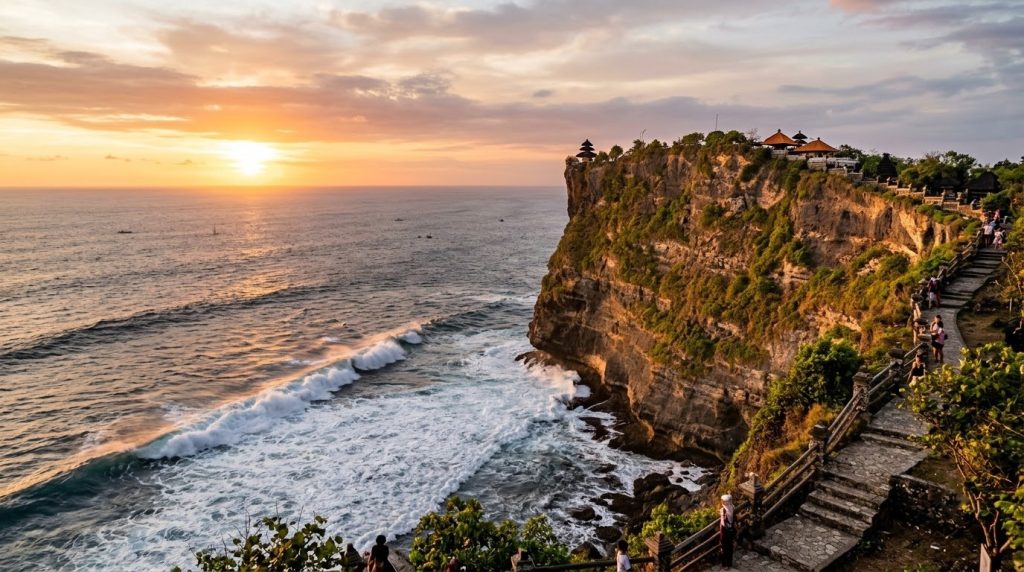
Uluwatu is worth visiting if clifftop surf breaks and sunset views matter more to you than convenience, and the trade is real: the Kecak Fire Dance at Uluwatu Temple costs AUD 12 · USD 9 (IDR 150,000) for a single evening, and Padang Padang Beach sits at the bottom of roughly 120 stone steps.
Uluwatu is not worth visiting if you cannot manage stairs, do not want to rent a scooter or book a driver for every meal, or expect to swim at any hour regardless of the tide.
| Traveller type | Worth it? | Nights to give it | Why |
|---|---|---|---|
| Surfers, intermediate to advanced | Yes | 3 to 5 nights | Reef breaks at Uluwatu, Padang Padang and Bingin stack one after another along the same stretch of coast |
| Couples chasing clifftop sunset photos | Yes | 2 to 3 nights | Clifftop resorts and the Kecak Fire Dance are not replicated anywhere else on the island |
| First Bali trip on a tight budget | No | Skip or 1 night | No walkable centre, every meal needs a scooter or a driver |
| Families with strollers or very young kids | No | Skip | Beach access is a stair descent, not a walk-in shoreline |
| Backpackers who want a walkable base | No | Skip | The nearest bar, warung and beach can sit a 10 to 20-minute drive apart |
| Honeymooners on a short overall trip | Conditional | 1 to 2 nights | Worth a splurge night, not the whole stay, if total nights in Bali are limited |
What Uluwatu has that the rest of Bali does not
Uluwatu has one thing no other part of Bali can offer: a continuous limestone clifftop running for kilometres above the Indian Ocean, with reef breaks stacked one after another beneath it.
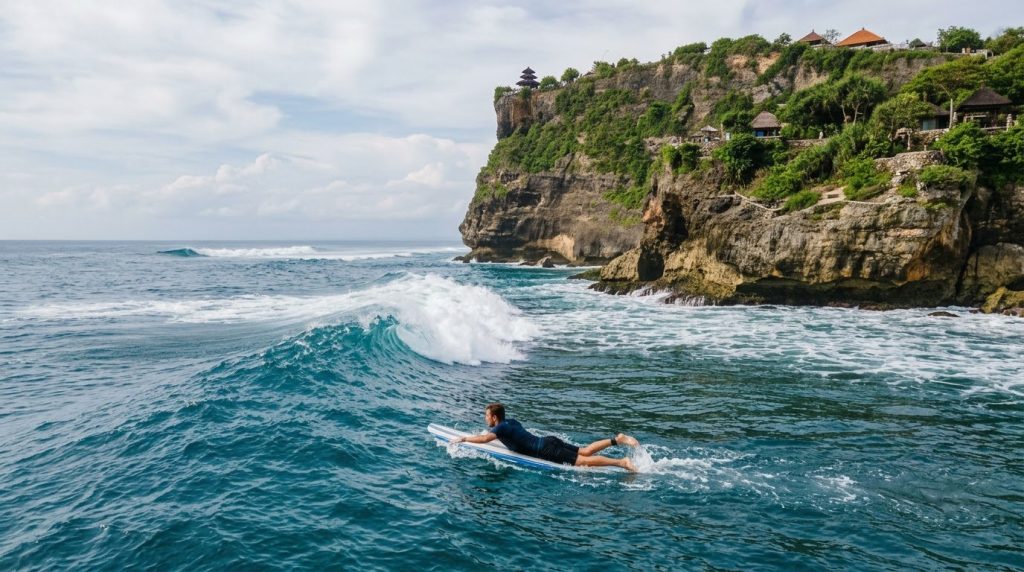
Uluwatu, Padang Padang, Bingin, Balangan and Dreamland sit within a short drive of each other on the same peninsula, giving surfers a menu of breaks that no single beach town elsewhere in Bali can match.
Restaurants and bars here are built directly into the cliff face rather than set back from a flat shoreline, so a sunset drink comes with a view straight down onto the surf rather than a beach walk to reach one.
Seminyak and Canggu have flatter, more walkable beachfronts, and Ubud has rice terraces and a cooler climate, but neither has this coastline. That clifftop setting is Uluwatu’s entire case, and it is a genuine one for the right traveller.
The beaches, the stairs and the tides
Every beach worth reaching on the Uluwatu stretch sits at the bottom of a stair descent, and most are only fully swimmable within a specific tide window. Padang Padang Beach is reached by roughly 120 stone steps down a narrow staircase cut through a rock crevice, and it is not wheelchair or stroller friendly.
The cove itself swims well most of the day, but the rock entrance narrows at high tide, so low to mid tide is the easier time to get in and out. Bingin Beach involves around 150 steps carved into the cliff, steep in places, with the climb back up taking roughly 10 minutes and genuinely testing anyone unfit for it.
The reef beneath Bingin exposes at low tide, which is good for surfing but leaves little water for swimming, so mid tide is usually the safer window for a swim rather than a paddle over exposed reef. Suluban and Blue Point Beach, closer to Uluwatu village itself, run down similarly long flights of cliff stairs.
None of these beaches work with heavy luggage, a stroller or a bag full of gear carried down casually.
Why you cannot walk anywhere here
Uluwatu is not one walkable village, it is a string of separate clifftop hamlets connected only by road, so a scooter or a driver becomes part of daily life here rather than a backup plan.
Scooter rental runs AUD 6–8 · USD 4–6 (IDR 70,000–100,000) a day, and a private driver for a full day of sightseeing runs AUD 47–63 · USD 34–45 (IDR 600,000–800,000), figures worth weighing against the rest of a trip budget in our Bali travel budget breakdown.
Uluwatu to Ngurah Rai Airport takes about 25 minutes at best and up to 1.5 hours at peak traffic, and Uluwatu to Ubud is about 51 minutes at best but realistically 1.5 to 2.5 hours each way.
Those numbers matter because “Uluwatu” gets applied loosely across the whole Bukit Peninsula, and Pecatu, Bingin, Padang Padang and Ungasan are distinct places with their own drive times between them, not one compact town you can cross on foot.
The temple and the Kecak dance, and whether they are worth the trip
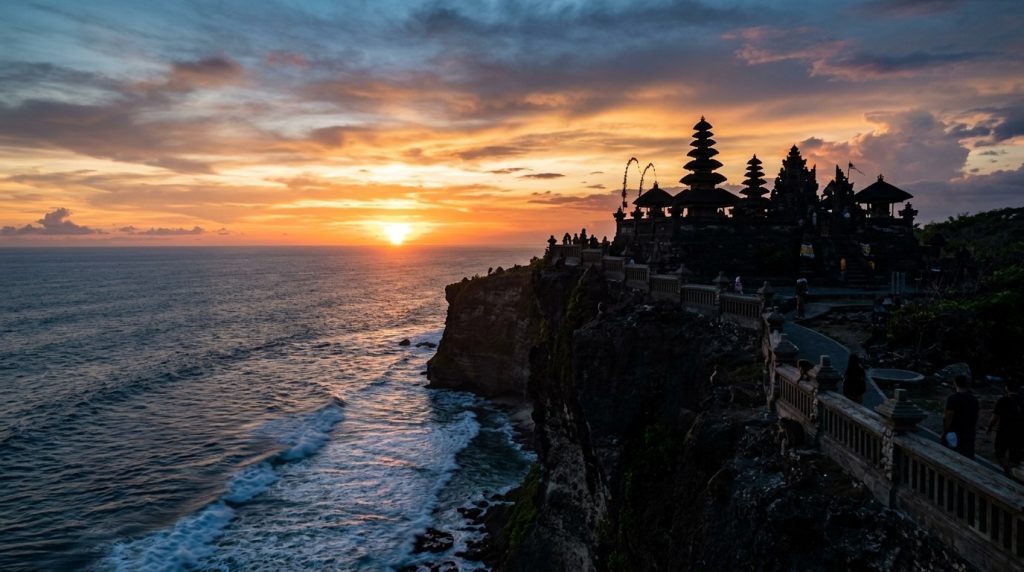
Uluwatu Temple and its sunset Kecak Fire Dance are worth one evening of a Uluwatu stay, not much more of your time here.
Foreign adult entry to the temple costs AUD 5 · USD 3 (IDR 60,000), and the 18:00 Kecak Fire Dance requires a separate ticket at AUD 12 · USD 9 (IDR 150,000) per adult, which regularly sells out by 17:00, so arriving early to buy tickets matters more than arriving early for the view.
The clifftop setting at sunset, with the dance performed against the ocean drop, is the real draw, and it delivers on that specific promise.
It is also worth knowing before you go that the temple’s resident macaques are bold enough to grab an estimated 5 to 10 phones a day from visitors, along with sunglasses and hats, so keep anything loose zipped away rather than in a hand or a pocket.
Who should skip Uluwatu
Skip Uluwatu if a stroller, a wheelchair or any mobility limitation is part of the trip, because every beach worth reaching here sits behind a stair descent with no ramp alternative.
Skip it if the budget does not stretch to daily scooter rental or driver fees, because there is no walkable centre to fall back on the way there is in Ubud or Seminyak.
Skip it if the whole Bali trip runs under 7 to 10 nights and needs one single base, since Uluwatu sits far enough from Ubud and, at peak traffic, even the airport, that it works better as a 2 to 3-night add-on than the trip’s only stop; compare it against Bali’s other areas to stay before committing to one base.
And skip it if clifftop views and surf culture genuinely do not interest you, because that is the entire premise behind paying resort prices on an isolated peninsula with a long stair walk down to a beach that might not even be swimmable when you get there.
Best time to visit Uluwatu
Uluwatu’s case for a visit gets noticeably stronger in the dry season, roughly April through October, when offshore trade winds groom the surf into cleaner, more consistent sets and the clifftop sunsets that are the main non-surfing draw come with clearer skies rather than cloud cover.
Outside that window, from around November to March, Bali moves into its wet season, and the reef breaks along the Uluwatu stretch can still produce swell, but rain and cloud cut into the sunset views and the Kecak Fire Dance’s open-air setting more often.
Several surf guides note that experienced surfers can still find workable waves in the wet season, so a surf-focused trip is not ruled out outside the dry months the way a sunset-and-swim trip is.
Because the whole premise of staying in Uluwatu rests on clifftop views, surf and dry-season sunsets rather than indoor attractions, a wet-season booking narrows the odds of the trip delivering on that premise.
Travellers with flexible dates get more out of the dry season specifically; travellers locked into wet-season dates by flights or school terms should treat Uluwatu as a shorter add-on rather than the trip’s main stop, and lean on the indoor-friendly option of a shorter temple-and-dinner evening rather than a full beach day that rain could cancel.
Within the dry season, July and August line up with the busiest international surf and tourist crowds, so a traveller chasing a quieter clifftop stay without the wet-season risk does better aiming for the shoulder months either side – roughly April-May or September-October – when the weather is still mostly dry but the crowds at the Kecak Fire Dance and the main surf breaks have thinned slightly.
One date to plan around regardless of season is Nyepi, Bali’s Day of Silence, which falls on 19 March 2026, running 6am to 6am the following day.
Ngurah Rai Airport closes completely for the full 24 hours, streets empty out and vehicles are banned, and visitors already on the island are required to stay inside their accommodation for the day, with beaches, restaurants and the temple itself closed along with everything else.
It is not a reason to avoid Bali altogether, but a trip timed to land or depart on or around that date needs rebuilding around the closure rather than treated as a normal travel day.
Beyond surfing and the temple: what else there is to do
Uluwatu’s case rests mainly on surf and sunset views, but a non-surfer with an evening to fill has a genuine second option beyond the temple: the clifftop bar and beach club scene built directly along the same stretch of coast.
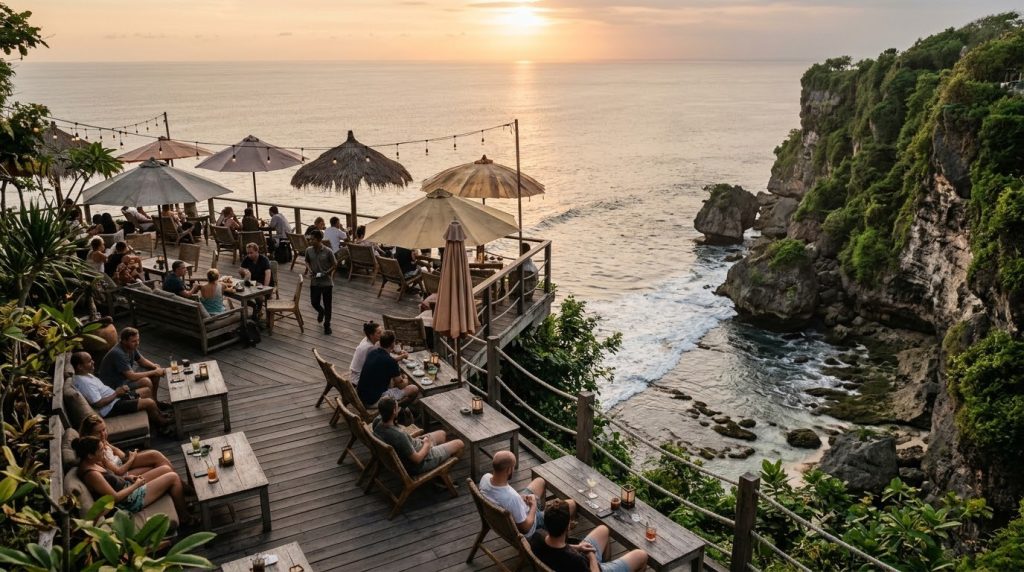
Single Fin, perched right above Suluban Beach, is the long-running version of this – open daily, functioning as a casual surf-watching spot by day and a busier sunset bar as evening sets in, with a direct view down onto the same break the surfers are riding.
It runs as a regular bar and restaurant rather than a ticketed venue, so there’s no separate entry fee – the cost is whatever food and drink gets ordered.
Savaya, in Pecatu, is the higher-end version of the same idea: a cliffside beach club with an infinity pool roughly 100 metres above the ocean, open for both daytime beach-club use and evening dining and music events.
Entry runs from around AUD 12-47 · USD 9-34 (IDR 150,000-600,000) depending on the day and the acts booked, though that fee does not include food or drink, and a table with proper seating generally needs a minimum spend well beyond the entry price on busier nights.
Between the two, a traveller gets a cheap, casual option and a paid, dressed-up option covering more or less the same sunset-over-the-surf view that the temple sells as its headline experience.
None of this changes the core trade-off described above – Uluwatu is still built around the coastline rather than a walkable town centre – but it does mean a non-surfing, non-temple evening here is not automatically a wasted one.
Swimming safety beyond the tide windows already covered
The tide notes for Padang Padang and Bingin cover timing, but it’s worth being clear that none of the beaches along this stretch run lifeguard patrols the way a main tourist beach elsewhere on the island might.
That matters most at the lesser-known coves rather than the main surf breaks: rip currents can build quickly during rougher swells, and the same reef that creates good waves for surfers can make swimming hazardous once conditions turn.
Checking conditions with hotel staff or a local surf shop before swimming, rather than judging purely by eye from the clifftop, is the safer habit here, since the view from above can look calm while the water at beach level is running a stronger current than it appears.
The stair descents themselves add a second, separate risk that has nothing to do with the water: the steps at Padang Padang and Bingin are uneven stone and can be slippery with sea spray or after rain, and there is no handrail along most of the route down.
Proper footwear rather than flip-flops is worth packing specifically for this stretch of the trip, and the climb back up, already noted as a genuine effort at Bingin, is harder again carrying a surfboard, a cooler bag or young children rather than just a towel.
None of this makes Uluwatu unusually dangerous compared with other reef-break coastlines, but it is a different risk profile from a flat, patrolled beach, and it is worth going in with that expectation rather than assuming the same level of oversight found on a resort beach elsewhere in Bali.
Where to stay if you decide to go
Clifftop resorts near Uluwatu Temple suit a short splurge stay built around the view, mid-range hotels in Uluwatu village suit a multi-night base within walking distance of Suluban Beach, and surf-camp rooms in Padang Padang suit anyone chasing the reef breaks on a budget.
Our best hotels in Uluwatu guide breaks down all three tiers by price and location, and if Uluwatu turns out to be the wrong fit, the best hotels across Bali compares it against Seminyak, Ubud, Canggu and Sanur side by side.
Find your Uluwatu hotel on the map
Live prices from Booking, Airbnb and more — move the map or change dates to compare stays around Uluwatu.