Best Food in Phuket 2026: 10 Must-Try Dishes + Markets
By TravelguidestipUpdated 15 min readHow we earn
Hotel buttons open Stay22 (Booking.com, Agoda and others) and tour buttons open GetYourGuide. We may earn a commission at no extra cost to you.
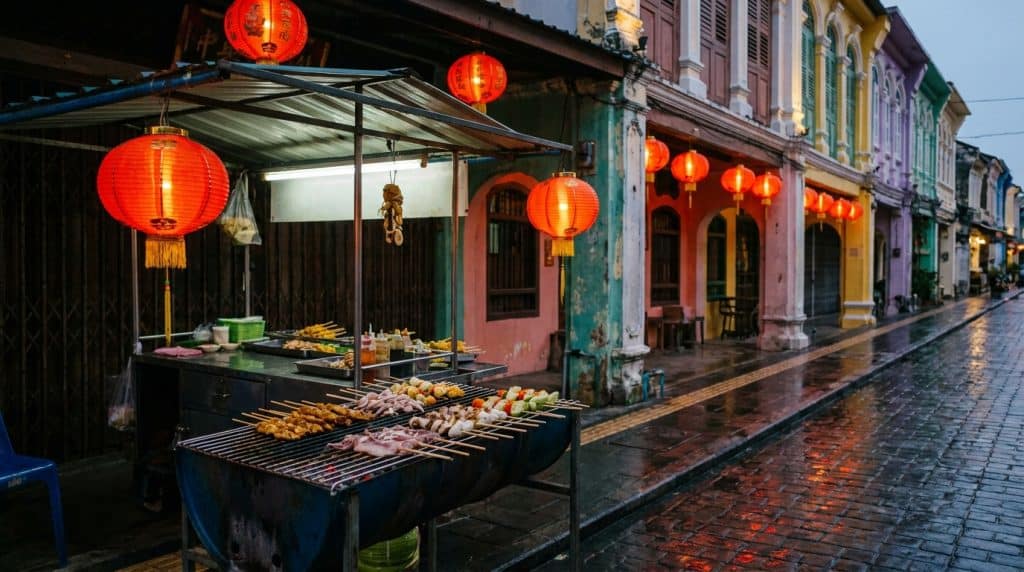
In short
- Phuket’s 10 must-try dishes cost between 40-150 THB ($1.15-$4.30) from street vendors
- Old Town Phuket is the island’s best food neighborhood, with prices 30-40% below beach areas
- Rawai Seafood Market lets you pick live seafood and have it cooked for 100-200 THB
- An inexpensive meal averages 200 THB ($5.70) on the island (Numbeo, 2026)
Phuket’s food scene stands apart from the rest of Thailand. An inexpensive restaurant meal here averages 200 THB ($5.70), while a mid-range dinner for two runs about 1,350 THB ($38.50) (Numbeo, 2026). What makes Phuket different? The island developed its own cuisine, shaped by centuries of Chinese-Hokkien immigration, Muslim communities, and the Andaman Sea’s abundant seafood.
We’ve eaten my way through Phuket’s Old Town noodle shops, beachside seafood grills, and night market stalls across multiple trips. This guide covers the 10 dishes you shouldn’t leave without trying, the best street food areas, night markets worth visiting, and restaurant recommendations across every budget.
We only recommend services we genuinely trust. Learn more.
What Are the Must-Try Dishes in Phuket?
Quick answer: Phuket’s must-eat dishes are mee hokkien (Hokkien-style stir-fried noodles), oh tao (oyster omelet), moo hong (braised pork belly), and oh aew (shaved-ice dessert), all rooted in the island’s Hokkien-Thai heritage. Find them cheapest in Old Town Phuket around Thalang Road and the Sunday Walking Street, where most plates run 30-100 THB ($0.85-$2.85).
Phuket’s signature dishes reflect its unique Hokkien-Thai heritage, distinct from Bangkok or northern Thai cooking. Street food prices in Phuket average 40-100 THB ($1.15-$2.85) per dish, making it possible to sample the full range for under $10 a day (Tourism Authority of Thailand, 2025). Here are the 10 dishes that define the island’s food identity.
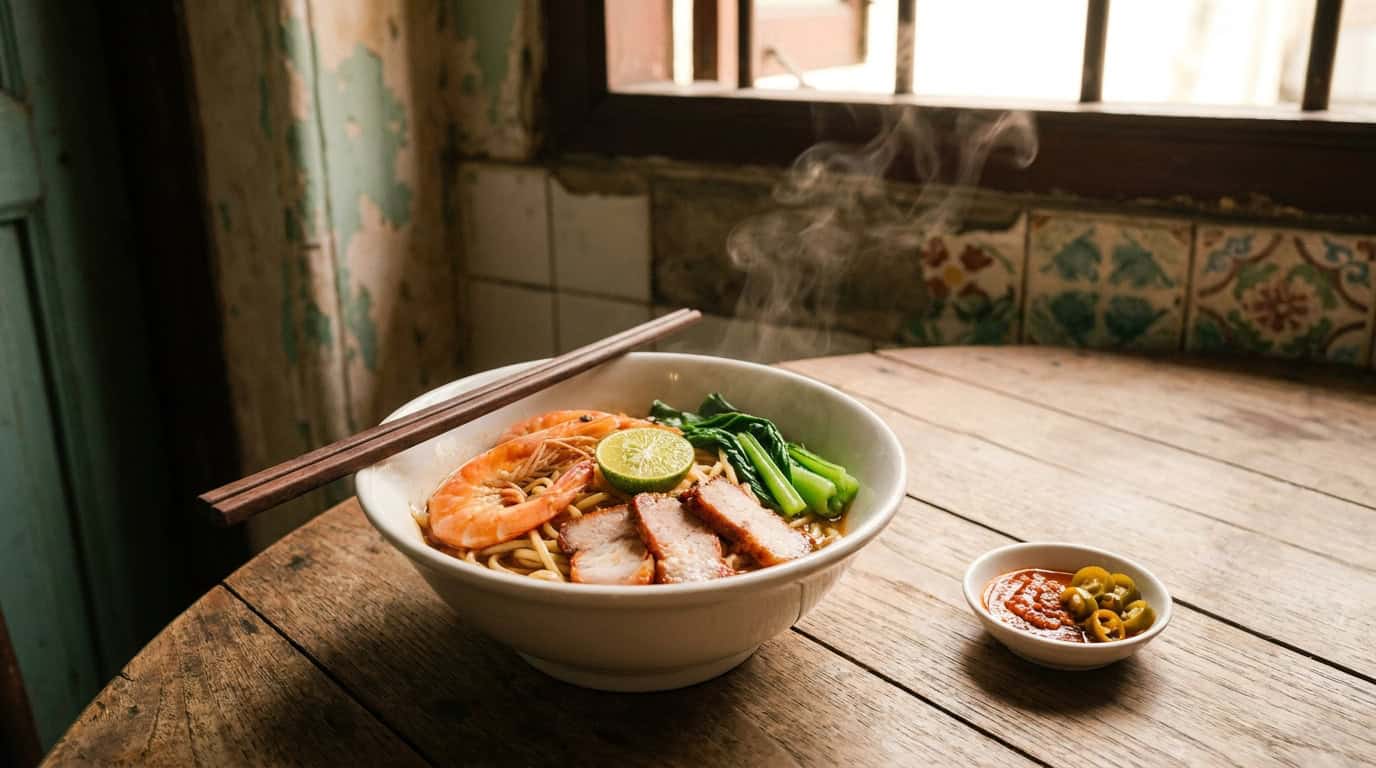
Phuket’s local cuisine blends Hokkien Chinese, Malay Muslim, and Thai traditions into a distinct regional food identity, with signature dishes like mee hokkien and oh tao costing 40-100 THB per serving at street stalls across Old Town (Tourism Authority of Thailand, 2025).
1. Mee Hokkien Phuket
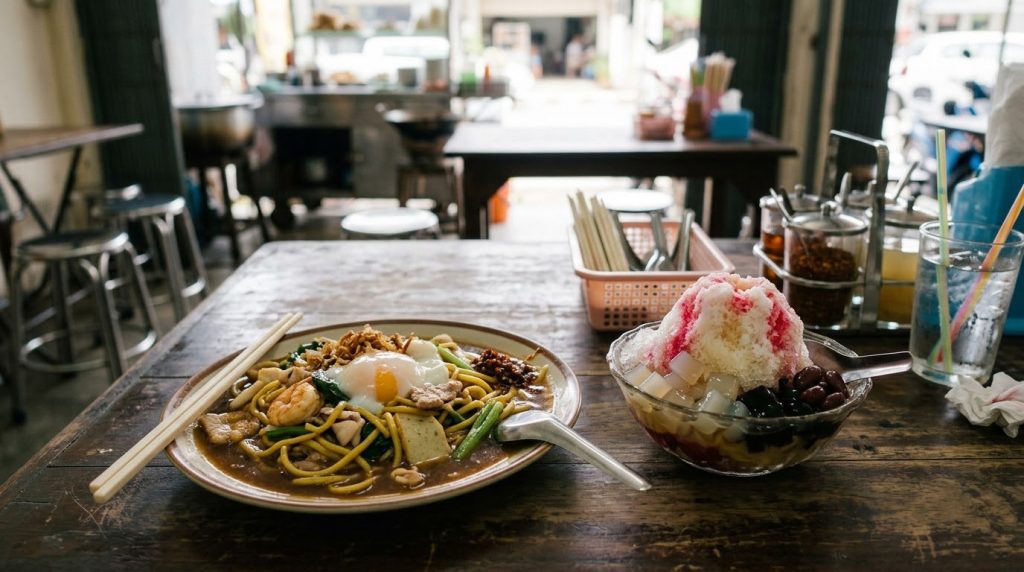
Thick yellow egg noodles in a rich, slightly sweet pork-and-shrimp broth. This is Phuket’s signature dish, brought by Hokkien Chinese immigrants generations ago. You won’t find this version anywhere else in Thailand. Mee Ton Po on Phuket Road in Old Town is the most famous spot, with bowls from 50-80 THB ($1.43-$2.30). The broth takes hours to prepare. Don’t leave without trying it.
2. Oh Tao (Phuket Oyster Omelet)
A crispy-edged egg pancake loaded with fresh oysters, bean sprouts, and a tangy dipping sauce. Phuket’s version uses smaller, sweeter local oysters than the Bangkok style. Street vendors at Naka Market and Old Town Sunday Walking Street sell excellent oh tao for 50-80 THB.
3. Kanom Jeen (Rice Noodles with Curry)
Thin fermented rice noodles served with your choice of curry, from mild fish curry to fiery crab curry. Locals eat this for breakfast. The best spots are the small stalls in Phuket Town’s morning markets, where you’ll pay 30-50 THB for a plate. Load up from the vegetable tray, as fresh herbs, bean sprouts, and pickled cabbage are free accompaniments.
4. Lobster and Fresh Seafood
Phuket’s Andaman coast delivers fresh lobster, king prawns, squid, and fish daily. A grilled lobster at Rawai Seafood Market costs 400-800 THB ($11.50-$23) depending on size, with cooking fees of 100-200 THB. That’s a fraction of what you’d pay in any Western country for the same quality.
5. Moo Hong (Phuket Braised Pork Belly)
Slow-braised pork belly in a dark, aromatic sauce with pepper, garlic, and soy. It’s a Peranakan-influenced dish you won’t find on Bangkok menus. The meat falls apart at the touch of chopsticks. Lock Tien food court in Old Town serves one of the best versions for 60-80 THB.
6. Oh Aew (Phuket Shaved Ice Dessert)
Shaved ice topped with chewy red and white jelly cubes, grass jelly, basil seeds, and sweet syrup. It’s Phuket’s answer to hot afternoons. Find it at street stalls throughout Old Town for 30-40 THB ($0.85-$1.15). The combination of textures makes it addictive.
7. Roti
Phuket’s Muslim community perfected this flaky, buttery flatbread cooked on a hot griddle. Served with condensed milk, banana, egg, or chocolate. The best roti vendors cluster near the mosques in Phuket Town, charging 30-60 THB per piece. Watching the dough get stretched and spun is half the experience.
8. Gaeng Som (Sour Curry)
A southern Thai curry that’s thinner, spicier, and more sour than central Thai curries. Made with tamarind, turmeric, and whatever fish is fresh that day. It’s an acquired taste for some, but locals consider it essential. Most local rice-and-curry shops serve it for 50-70 THB.
9. Phuket-Style Dim Sum
The island’s Chinese heritage shows up in its dim sum traditions. Steamed dumplings, pork buns, and siu mai fill morning tea shops in Old Town. Dim Sum Ko Khun Aew on Rassada Road is a local institution. Dishes cost 20-40 THB each. Go before 9 AM; they sell out fast.
10. Nam Phrik Kung Siap (Smoked Shrimp Chili Paste)
A pungent dip made from smoked dried shrimp, chilies, and shrimp paste. You’ll find it served alongside fresh vegetables and rice at local restaurants. It’s intensely flavorful and unlike anything in the tourist-zone menus. Ask for it at Old Town lunch spots, typically 40-60 THB as a side dish.
Ever notice how travel food guides focus on the same dishes you can find in any Thai city? Phuket’s food identity is genuinely different. Mee hokkien, oh tao, moo hong, and oh aew exist almost exclusively here. Skip the generic pad Thai at a beach restaurant and hunt these down instead.
Find your Phuket hotel on the map
Live prices from Booking & Airbnb — tap a pin to compare stays around Patong and Kata Beach and beyond.
Where Are the Best Street Food Areas in Phuket?
Phuket’s street food culture centers on Old Town and spreads outward to beach areas and suburban markets. The island’s food sector contributes billions of baht to local GDP, with Old Town alone housing over 200 food vendors within a compact walkable area (Phuket Provincial Government, 2024). Here are the five best areas to eat on the street.
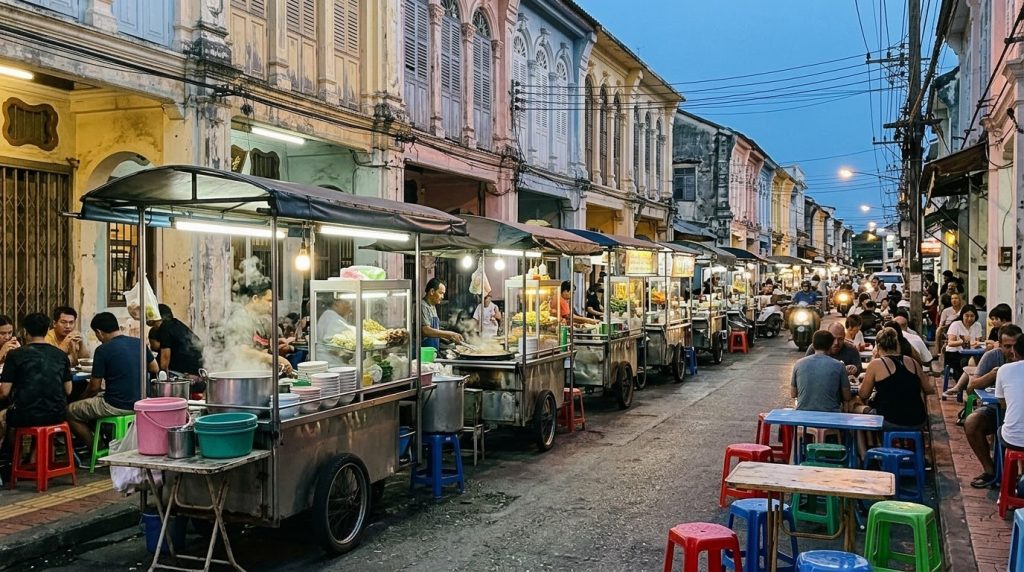
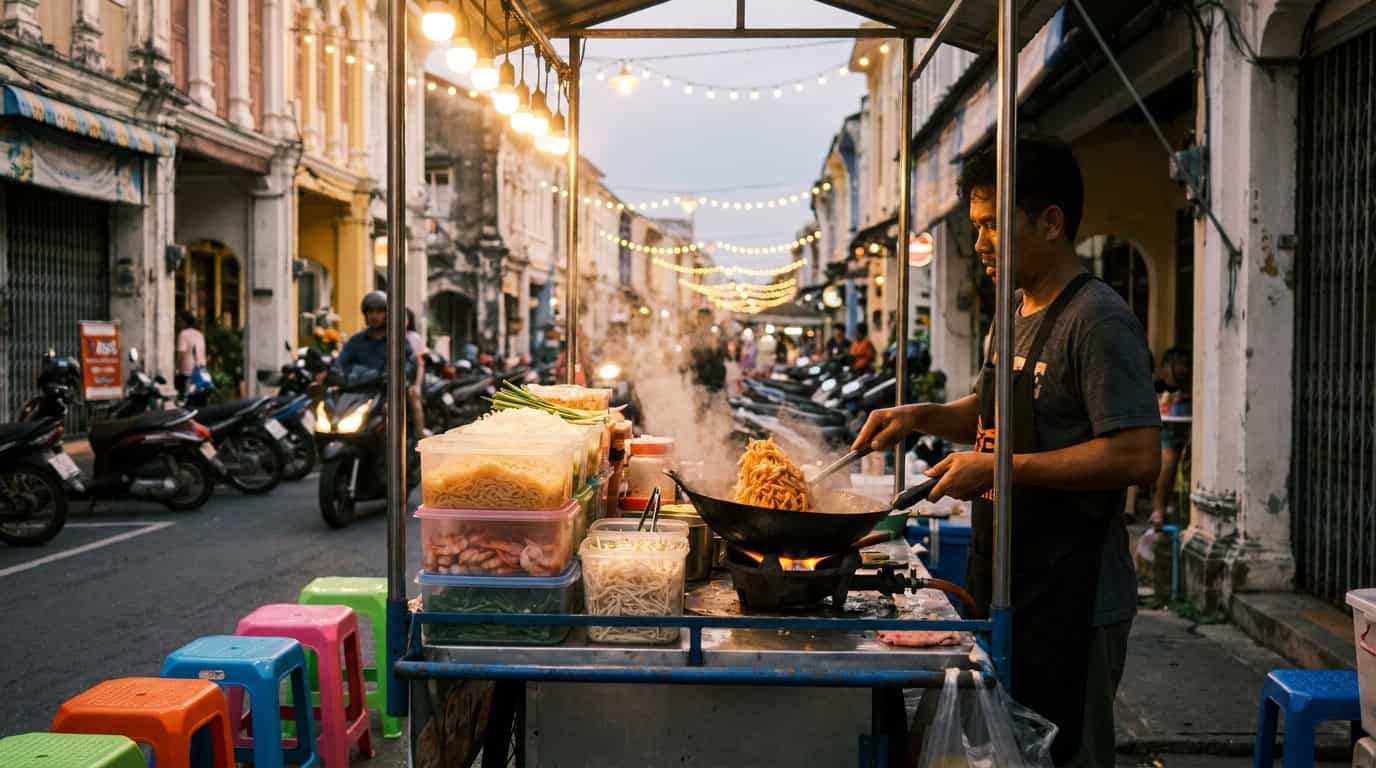
Old Town Phuket concentrates over 200 food vendors in a walkable area, serving signature Hokkien-Thai dishes at 30-40% lower prices than beach-zone restaurants, according to Phuket Provincial Government data from 2024.
The Old Town meals were consistently better tasting and roughly 35% cheaper. Not even close.
Old Town Phuket
The undisputed champion. Soi Romanee, Thalang Road, and Dibuk Road concentrate the island’s best local food within walking distance. Morning markets sell kanom jeen and dim sum. Afternoon brings mee hokkien and rice-curry shops. Sunday Walking Street (4-9 PM) transforms the area into an open-air food festival.
What to eat: Mee hokkien at Mee Ton Po, dim sum at Ko Khun Aew, oh aew dessert from any cart, and moo hong at Lock Tien.
Price range: 30-100 THB ($0.85-$2.85) per dish.
Best time: 7-10 AM for morning markets, 11 AM-2 PM for lunch stalls, 4-9 PM on Sundays.
Chillva Market
A young, trendy market in Phuket Town that runs Thursday through Saturday, 5-11 PM. The food section is excellent, with Thai street food alongside fusion options like Japanese-Thai tacos and Korean corn dogs. The vintage clothing and craft stalls make it a full evening experience.
What to eat: Grilled pork skewers, roti, milk tea, and seasonal Thai desserts.
Price range: 40-150 THB ($1.15-$4.30).
Best time: 6-9 PM before the biggest crowds hit.
Malin Plaza Patong
If you’re staying in Patong and want night market food without trekking to town, Malin Plaza delivers. Located behind Jungceylon mall, it’s a compact open-air food court with 30+ stalls. The quality is a step above the Bangla Road tourist traps.
What to eat: Grilled seafood, pad Thai, spring rolls, and mango sticky rice.
Price range: 60-200 THB ($1.70-$5.70).
Best time: 6-10 PM nightly.
Naka Weekend Market
Phuket’s largest market operates Saturday and Sunday, 4-11 PM, near the edge of Phuket Town. The food section is enormous, with stalls selling everything from grilled river prawns to rolled ice cream. It’s part food court, part entertainment venue, with live music and shopping mixed in.
What to eat: Grilled giant river prawns, Thai-style crepes, coconut ice cream, and fried chicken.
Price range: 50-300 THB ($1.43-$8.55).
Best time: 5-8 PM, before the most crowded stretch.
Rawai Seafood Market
This isn’t a night market. It’s a working waterfront fish market where you pick your own live seafood, lobster, crab, prawns, squid, fish, and carry it a few steps to a cooking stall. They’ll grill, steam, or stir-fry it to order. Cooking fees run 100-200 THB per dish. The setting on Rawai’s waterfront adds to the atmosphere.
What to eat: Grilled lobster, steamed crab, stir-fried squid, and garlic prawns.
Price range: Seafood 200-800 THB + cooking 100-200 THB. A full dinner for two costs 500-1,500 THB ($14-43).
Best time: 4-7 PM for the freshest selection.
Identical dishes (pad Thai, grilled prawns, fried rice) tend to cost noticeably more in Patong than in Old Town. Rawai Seafood Market offered the best value per gram on fresh seafood, with lobster prices roughly 40% below restaurant equivalents.
Which Night Markets Have the Best Food?
Phuket’s night markets attract thousands of visitors each weekend, combining street food with shopping and live entertainment. Naka Weekend Market alone draws an estimated 10,000-15,000 visitors per evening during peak season (Phuket Gazette, 2024). Here’s where to eat after dark.
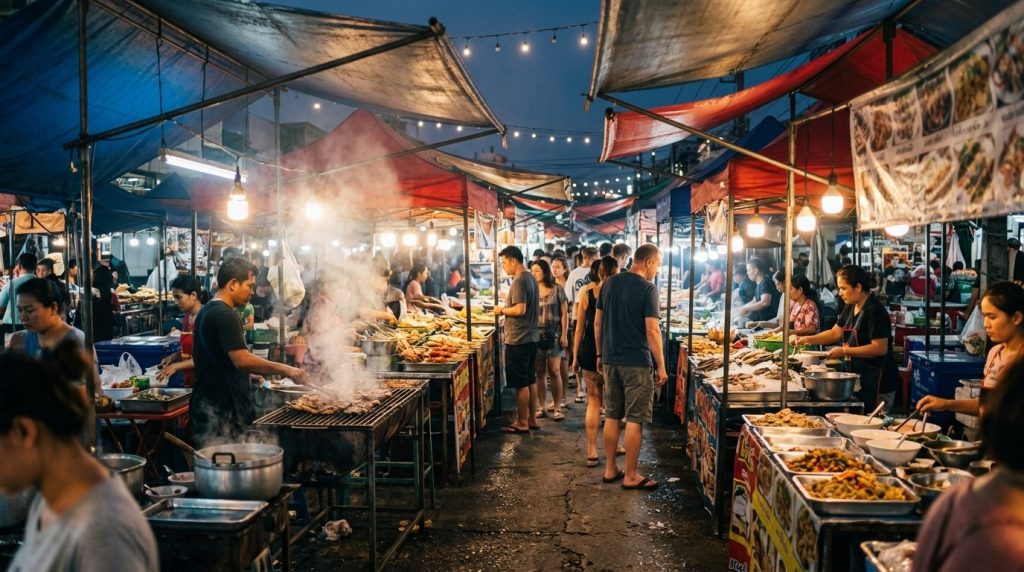
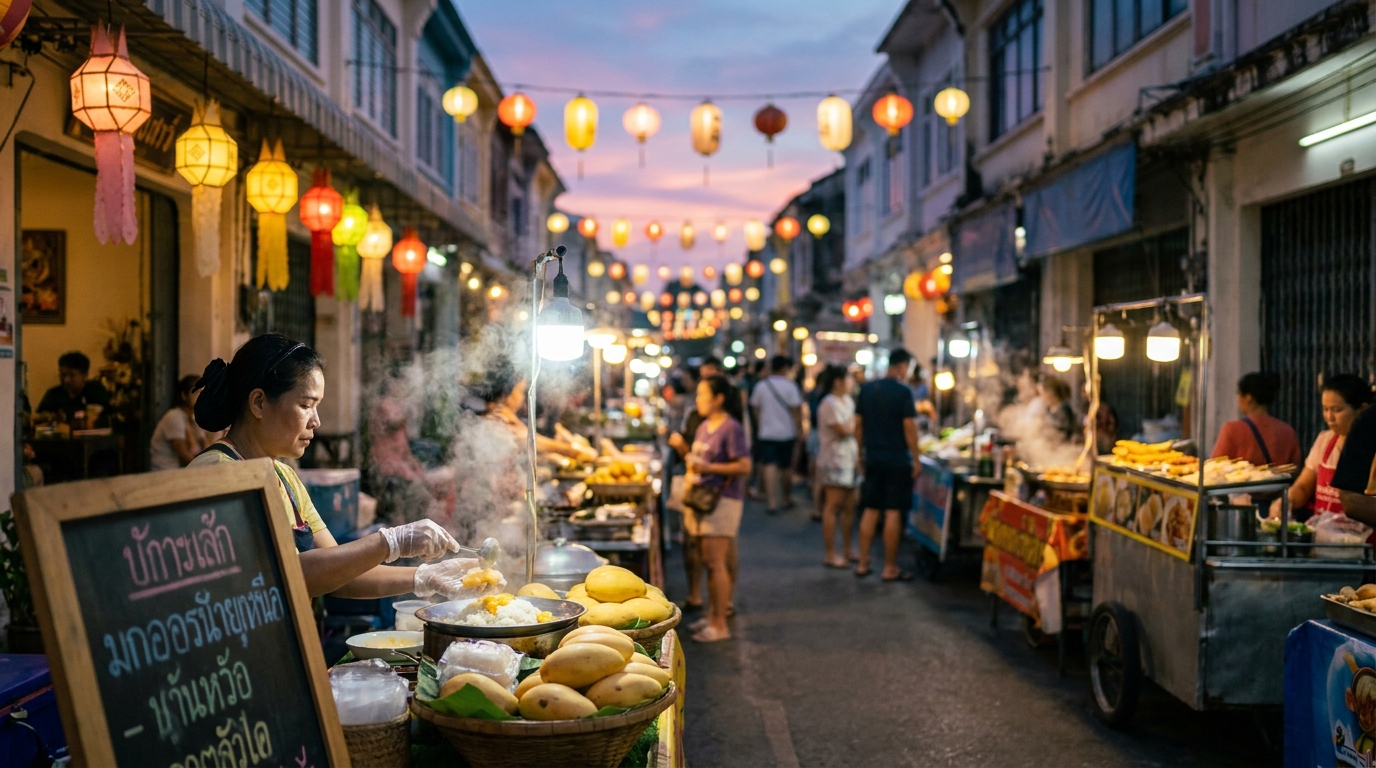
Phuket’s Naka Weekend Market draws 10,000-15,000 visitors per evening during peak season, with over 100 food stalls serving Thai street food, grilled seafood, and fusion dishes at prices ranging from 50-300 THB per item (Phuket Gazette, 2024).
Naka Weekend Market
Hours: Saturday-Sunday, 4-11 PM
Signature dishes: Grilled giant river prawns (150-300 THB), rotisserie chicken (120 THB), coconut pancakes (30 THB), Thai milk tea (40 THB).
Vibe: Large, bustling, a mix of tourists and locals. Arrive early (5 PM) for the best food stall selection before the shopping crowds peak.
Chillva Market
Hours: Thursday-Saturday, 5-11 PM
Signature dishes: Pork satay (10-15 THB per stick), Korean corn dogs (80 THB), artisan ice cream (60 THB), Thai-style crepes (40 THB).
Vibe: Younger, trendier crowd. More Instagram-friendly presentation. The vintage clothing section is excellent for shopping between bites.
Old Town Sunday Walking Street
Hours: Sunday only, 4-9 PM
Signature dishes: Oh tao oyster omelet (50-80 THB), mee hokkien (50 THB), oh aew shaved ice (30 THB), local kuih desserts (20-40 THB).
Vibe: The most authentic of Phuket’s markets. Locals outnumber tourists here. The setting among Sino-Portuguese shophouses adds atmosphere that no other market matches.
Malin Plaza (Patong)
Hours: Nightly, 6-11 PM
Signature dishes: Grilled squid (100-150 THB), pad Thai (60-80 THB), fresh fruit shakes (40-60 THB).
Vibe: Convenient for Patong visitors. Compact and easy to cover in an hour. Less authentic but solid quality.
Phuket Indy Market
Hours: Wednesday-Thursday, 5-10 PM
Signature dishes: Local curries over rice (40-60 THB), grilled meat skewers (20-30 THB), and seasonal fruits.
Vibe: The most local of the bunch. Mostly Thai visitors. English signage is minimal. If you want to eat where tourists don’t go, this is your market.
What’s your ideal market experience? If it’s authenticity, head to the Sunday Walking Street. If it’s variety and atmosphere, Naka Weekend Market wins. If it’s convenience, Malin Plaza works fine.
What Are the Best Restaurants in Phuket for Every Budget?
Phuket earned multiple Michelin recognitions in the 2025 Guide Thailand, with restaurants spanning street food to fine dining categories (MICHELIN Guide, 2025). The island proves that great food doesn’t require a big budget, though it certainly rewards one.

The 2025 MICHELIN Guide Thailand recognized several Phuket restaurants with stars and Bib Gourmand awards, spanning from street-side noodle shops averaging 50-80 THB to fine dining establishments with tasting menus exceeding 3,000 THB per person.
What separates Phuket’s food scene from other Thai islands is depth. Koh Samui and Krabi have good restaurants, but they don’t have a distinct regional cuisine. Phuket’s Hokkien-Thai-Muslim cooking traditions create flavors you literally can’t find anywhere else. The mee hokkien broth alone takes 6-8 hours to prepare from a recipe that’s been passed down through families.
Street Food and Budget ($1-5 / 35-175 THB)
Mee Ton Po (Old Town): The most famous mee hokkien in Phuket. Rich broth, generous shrimp, and noodles with real bite. Expect a queue at lunch. 50-80 THB per bowl.
Lock Tien (Old Town): A food court-style space serving moo hong, oh tao, and other Phuket specialties. No frills. Cash only. Most dishes 40-80 THB. Open lunch through early evening.
Raya Restaurant (Dibuk Road): A heritage house restaurant in Old Town that’s been serving Phuket-style Thai food for decades. The crab curry and mee sua are excellent. Most dishes 80-150 THB. Air-conditioned. One of the best value-to-quality ratios on the island.
Mid-Range ($5-20 / 175-700 THB)
One Chun (Old Town): Modern Phuket cuisine in a restored shophouse. The menu features traditional dishes with slightly refined presentation. Mains 120-300 THB. Reservations recommended for weekend dinners.
Tu Kab Khao (Old Town): Southern Thai cooking with a focus on local ingredients. The gaeng som and stir-fried stink beans are standouts. Mains 150-350 THB. Cash and card accepted.
Bang Pae Seafood (Thalang): A local seafood restaurant away from the tourist beaches. Fresh fish and shellfish at prices significantly below beachfront restaurants. A seafood dinner for two costs 400-800 THB.
Fine Dining ($30-80+ / 1,050-2,800+ THB)
PRU at Trisara Resort: Phuket’s most acclaimed fine dining restaurant, with a focus on locally grown and sourced ingredients from their own farm. Tasting menus start around 3,500 THB ($100). Reservations essential.
Bampot Kitchen (Chalong): Creative cooking that blends Thai and international techniques. The menu changes seasonally. Mains 350-700 THB. Casual atmosphere despite the quality.
Blue Elephant Phuket (Old Town): Set in a stunning Sino-Portuguese governor’s mansion, this branch of the Bangkok institution serves refined Thai cuisine. Cooking classes available. Mains 300-600 THB. The setting alone is worth the visit.
What Are the Best Phuket Food Tours?
Guided food tours in Phuket cover more dishes and hidden stalls than most visitors find on their own. A guide’s local knowledge is the difference between eating tourist pad Thai and discovering family-run mee hokkien shops. Compare Old Town food tours on GetYourGuide.
Phuket food tours are guided walks covering 6-8 tastings across Old Town’s back streets over 3 hours; tour prices vary by operator. Book on GetYourGuide.
I took a food tour on my second Phuket trip and regretted not doing it first. A local guide can lead you to stalls you might otherwise walk past without a second glance. One of them, a moo hong vendor in a side alley off Thalang Road, served the best bite of my entire trip.
Old Town Evening Food Walk
A 3-hour guided walk through Phuket Old Town’s best food stalls. Expect 6-8 tastings: mee hokkien, oh tao, dim sum, roti, oh aew, and local kuih desserts. Guides explain the Chinese-Hokkien history behind each dish. From 1,200-2,000 THB ($34-57).
Why book it: The best stalls have no English signage. A guide gets you past the language barrier and straight to the good stuff.
Thai Cooking Class with Market Visit
Start at a Phuket Town wet market where you’ll shop for ingredients with your instructor. Then cook 3-4 dishes: pad Thai, green curry, tom kha soup, and mango sticky rice. Classes last 4-5 hours. From 1,000-2,500 THB ($29-72).
Why book it: You take the recipes home. The market visit alone teaches you more about Thai ingredients than any cookbook.
Rawai Seafood Market Experience
Some tours combine a guided visit to Rawai Seafood Market with cooking instruction. You’ll learn how to pick the freshest catch, negotiate prices, and watch your selections get cooked to order. From 1,500-2,500 THB including seafood. It’s a less structured but more spontaneous alternative to formal cooking classes.
What Should First-Time Visitors Know About Phuket Food?
Food safety in Thailand has improved steadily, with over 70% of street vendors nationwide meeting government hygiene certification standards (WHO Thailand, 2024). Phuket’s food scene is safe, affordable, and rewarding, but a few practical tips will improve your experience.
Spice Levels
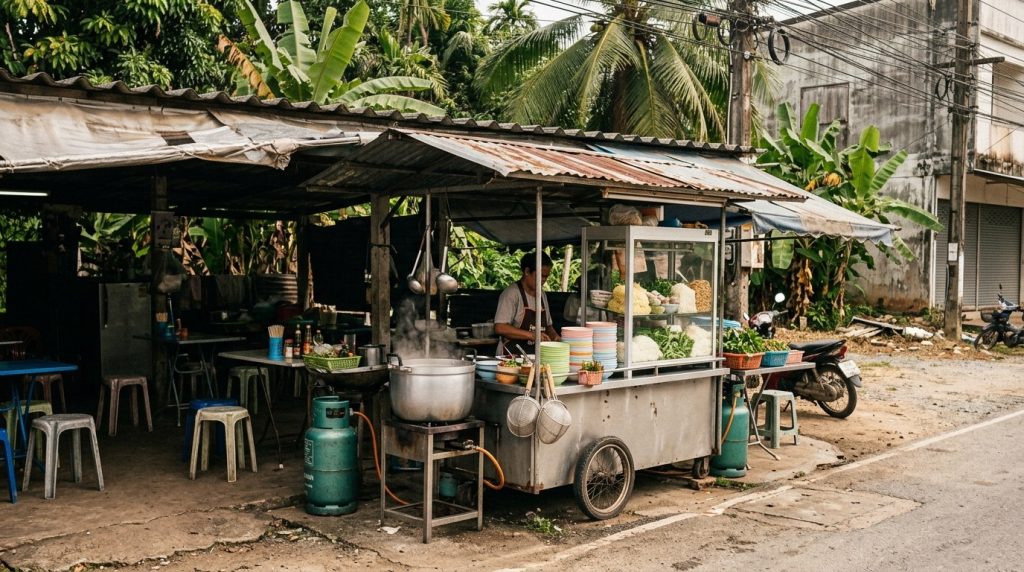
Southern Thai food is spicier than Bangkok food. What locals call “not very spicy” will still pack heat for most visitors. Say “mai pet” (not spicy) to start. You can always add chili from the condiment tray. Phuket’s curries, especially gaeng som, are particularly fiery.
Food Safety Tips
Eat at busy stalls. High turnover means fresh food. Avoid pre-cooked dishes sitting in trays for extended periods. Stick to cooked-to-order options. Ice at established restaurants is factory-made and safe. Bottled water costs 10-15 THB at any convenience store.
Vegetarian Options
Look for “jay” (vegan) restaurants marked with yellow flags and red text. They operate year-round in Phuket Town. During the Vegetarian Festival (October), the entire island goes vegan-friendly with hundreds of temporary food stalls. Kanom jeen, pad Thai, and many curries can be made vegetarian on request. Say “mai sai neua sat” (no meat).
Best Times to Eat
Morning markets open at 6 AM for kanom jeen and dim sum. Lunch stalls run 11 AM to 2 PM. The best street food action happens 5-10 PM at night markets. Rawai Seafood Market peaks from 4-7 PM. Old Town Sunday Walking Street serves food from 4-9 PM.
Tipping
Not expected at street stalls. At sit-down restaurants, round up the bill or leave 20-50 THB. Fine dining adds a 10% service charge.
Allergies
Peanuts, shellfish, and fish sauce appear in almost everything. Carry a translated allergy card if you have severe allergies. The phrase “pom/chan pae [ingredient]” means “We’re allergic to [ingredient].” Google Translate’s camera mode reads Thai menus in real time.
About the author: Travelguidestip has been covering Southeast Asia travel since 2023. Read our editorial policy for how we research and verify our guides.
Book Your Phuket Trip
Use these trusted platforms to book your Phuket trip at the best prices:
- Tours & Activities: Browse Phuket experiences on GetYourGuide — day trips, food tours, skip-the-line tickets.
- Hotels: Compare Phuket hotels on Booking.com — free cancellation on most bookings.
- eSIM / Stay Connected: Airalo eSIM — affordable data plans, no roaming fees.
Related guide: 15 Hidden Gems in Phuket Most Tourists Never Find (2026)
Frequently Asked Questions
What is Phuket’s signature dish?
Mee hokkien Phuket is the island’s most iconic dish: thick yellow egg noodles in a slow-cooked pork-and-shrimp broth. It originated with Hokkien Chinese immigrants and exists almost exclusively on this island. You won’t find the same recipe in Bangkok or Chiang Mai. A bowl costs 50-80 THB ($1.43-$2.30) at Old Town stalls.
How much does food cost in Phuket per day?
Budget eaters spend 300-500 THB ($8.55-$14.30) per day on street food and local restaurants. Mid-range diners average 800-1,500 THB ($22.85-$42.85). Fine dining runs 2,000-5,000+ THB ($57-143+) per meal. An inexpensive restaurant meal averages 200 THB ($5.70) according to Numbeo’s 2026 data (Numbeo, 2026).
Is Phuket street food safe to eat?
Yes. Over 70% of Thai street vendors meet national hygiene certification standards (WHO Thailand, 2024). Eat at stalls with high customer turnover. Choose cooked-to-order dishes over pre-made trays. Street food in Phuket is generally as safe as restaurant food, and often fresher.
Where is the best street food area in Phuket?
Old Town Phuket is the clear winner. It concentrates over 200 food vendors within a compact walkable area, with prices 30-40% lower than beach zones and a focus on authentic Phuket-specific dishes you won’t find anywhere else on the island.
Do I need to speak Thai to order food in Phuket?
No. Most vendors in tourist areas understand pointing, numbers, and basic English. Learning “ao an nee” (I want this one), “mai pet” (not spicy), and “check bin” (the bill) covers 90% of situations. A smile and a point work everywhere else.
Start Eating Your Way Through Phuket
Phuket rewards hungry travelers with a food culture you can’t replicate anywhere else in Thailand. The Hokkien noodles, oyster omelets, and braised pork dishes here carry flavors built over centuries of immigration and adaptation. From 30 THB oh aew shaved ice to multi-course meals at PRU, the range is enormous.
Start with a food tour to get oriented. Then spend at least two evenings exploring Old Town’s stalls and one visit to Rawai Seafood Market. Budget three to four meals per day for serious food exploration, because Phuket is a place where breakfast, lunch, and dinner all deserve their own adventures.
The best tours sell out during peak season, especially in December and January.