Best Food in Siem Reap: Top Dishes and Restaurants 2026
Siem Reap serves some of Southeast Asia’s most underrated food — bold, aromatic Khmer cooking built on fresh herbs, fermented fish paste, and coconut milk that costs almost nothing to eat well. This guide covers the top dishes you need to try, where to find them, what to pay, and which neighborhoods are worth your time at the table.
Key Takeaways
– Cambodia’s food tourism sector grew 18% in 2024, with Siem Reap driving most of that growth (Ministry of Tourism Cambodia, 2024)
– A full street food dinner for two costs $5-8 USD in the Old Market area (Numbeo, 2025)
– Amok, Cambodia’s national dish, appears on menus across 80% of Siem Reap restaurants (Phnom Penh Post Food Report, 2024)
– The Night Market food stalls draw an estimated 3,000 visitors per evening during peak season (TAC, 2025)
– Cooking class tourism in Siem Reap generates over $2.1M annually for local operators (UNWTO Cambodia Report, 2025)Affiliate Disclosure: We include affiliate links at no extra cost to you.
What Makes Khmer Food Different From Thai and Vietnamese Cuisine
Related: best day trips from Siem Reap.
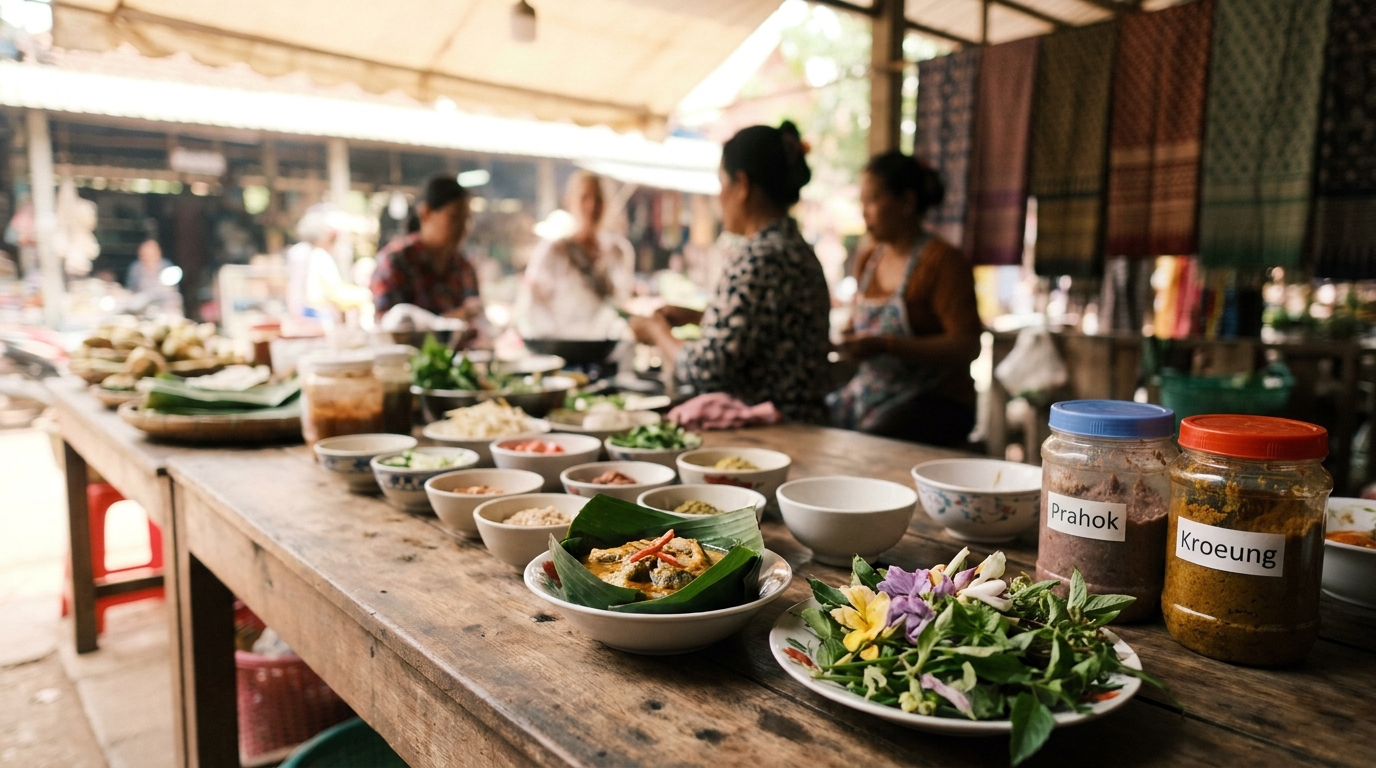
Khmer cuisine stands apart because it relies on a base paste called kroeung — a blend of lemongrass, galangal, kaffir lime, and turmeric — rather than the stir-fry sauces dominant in neighboring countries. Dishes are generally less spicy than Thai food and less herb-forward than Vietnamese, with a deeper, earthier fermented note from prahok (fermented fish paste) running through many recipes.
Sour flavors from tamarind and lime play a central role, and coconut milk appears in steamed dishes, curries, and desserts alike. Most meals arrive with a side of fresh vegetables and a dipping sauce. At a street stall, you eat communally; at upscale Khmer restaurants near the temples, dishes are plated individually with clean presentation.
The 6 Dishes You Must Try in Siem Reap
Related: our complete Siem Reap travel guide.
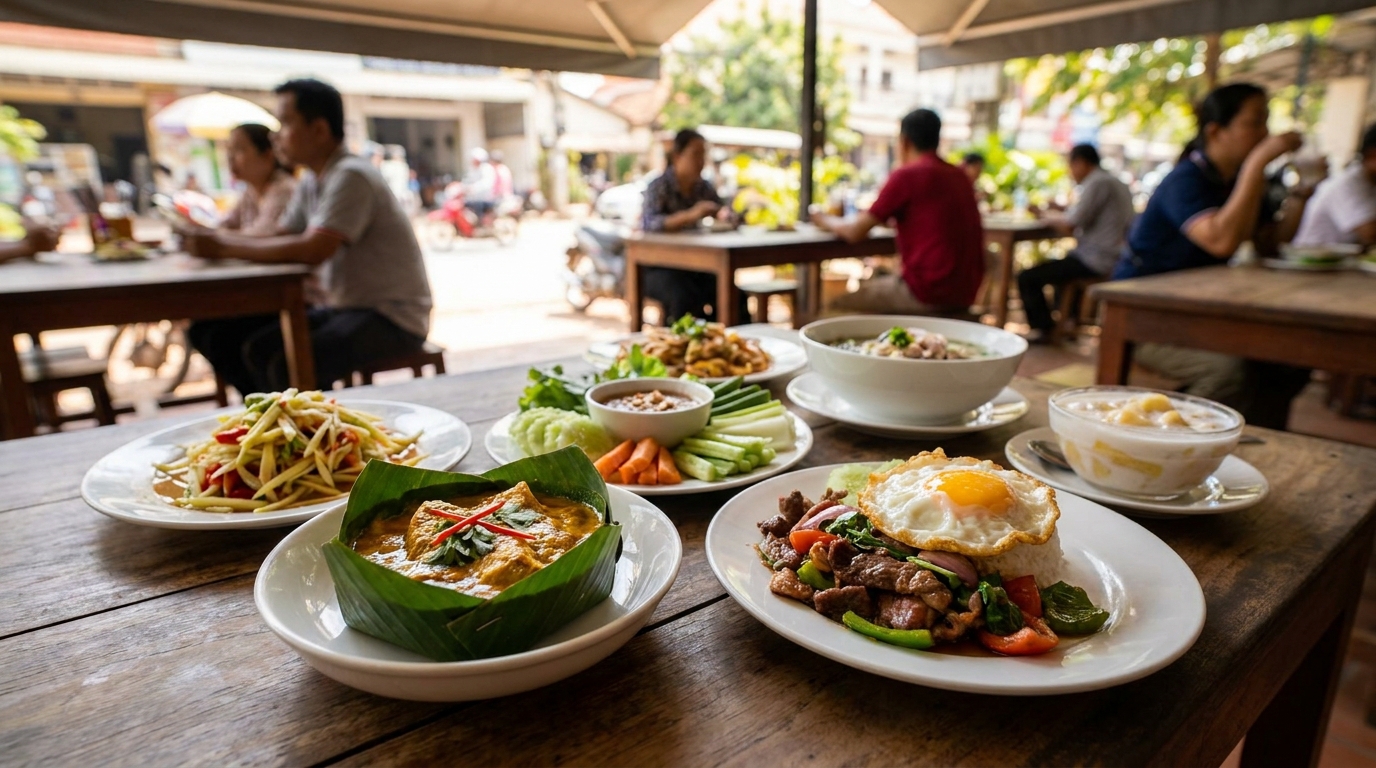
The Siem Reap food scene rewards travelers who go beyond amok and try the full range of local cooking. These six dishes represent the breadth of Khmer cuisine from street level to sit-down dining.
| Dish | Description | Avg. Street Price | Avg. Restaurant Price |
|---|---|---|---|
| Fish Amok | Steamed fish curry in banana leaf, coconut milk base | $2.50 | $6–9 |
| Bai Sach Chrouk | Grilled pork over broken rice, served with clear soup | $1.50 | $4–6 |
| Nom Banh Chok | Rice noodles in green fish sauce curry, eaten at breakfast | $1.00 | $3–5 |
| Lok Lak | Stir-fried beef cubes with lime-pepper sauce on rice | $3.00 | $7–12 |
| Khmer Red Curry | Mild coconut curry with lemongrass, eggplant, sweet potato | $2.50 | $6–10 |
| Kuy Teav | Rice noodle soup with pork or beef broth, morning staple | $1.00 | $3–5 |
Fish Amok is the dish visitors order first and locals are proud to serve. The fish — usually catfish or snakehead — is steamed inside a banana leaf cup with a kroeung paste base, coconut cream, and egg that sets into a custard-like texture. It tastes lighter than it sounds. Bai Sach Chrouk is what locals eat before 8 AM — pork marinated in coconut milk and garlic, grilled over charcoal, and served on broken rice with a thin soup. You will pay $1–2 at any market stall. Nom Banh Chok, called “Khmer noodles,” is a breakfast dish made from fermented rice noodles dressed in green fish sauce curry and topped with raw banana blossom, bean sprouts, and mint. It is refreshing, cheap, and filling.
Best Restaurants in Siem Reap for Khmer Food
Related: best time to visit Siem Reap.
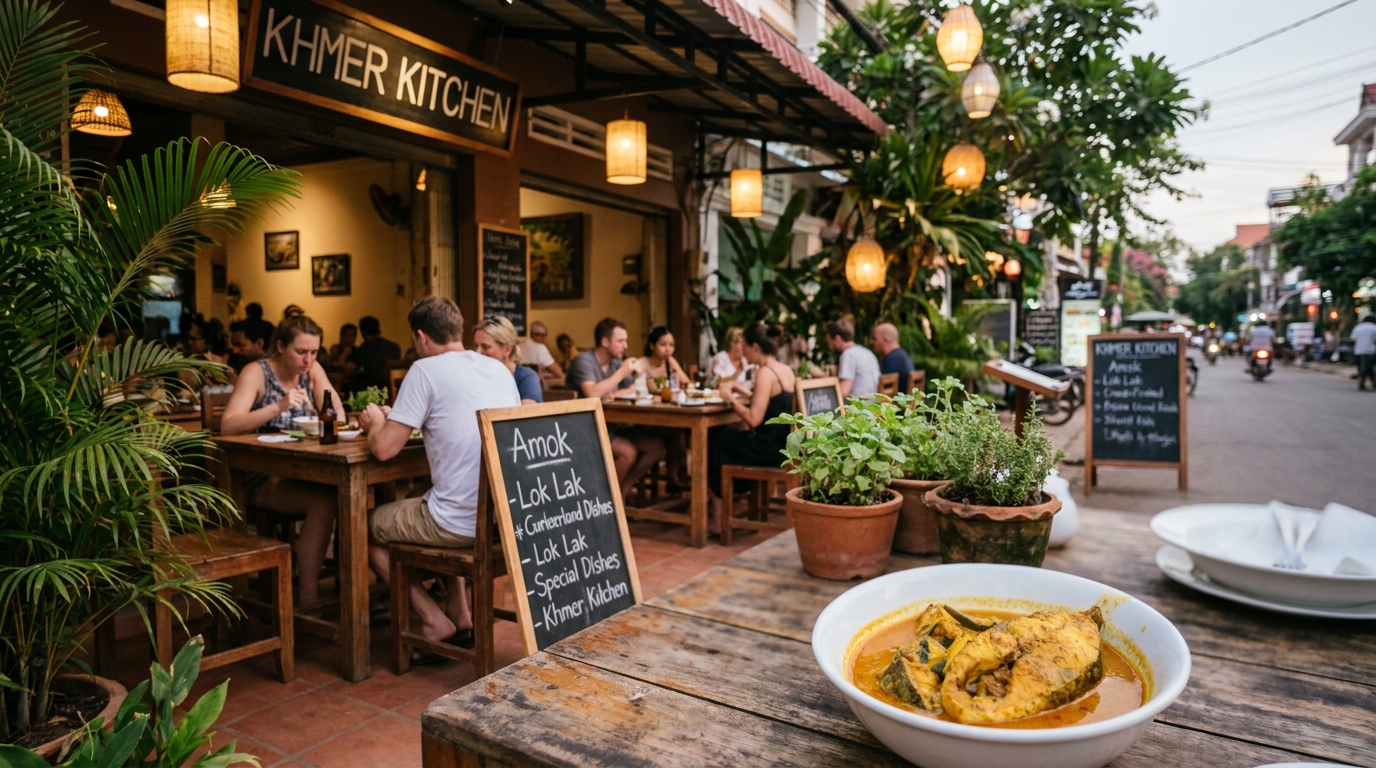
The strongest Khmer dining options cluster along Street 8 (the restaurant row behind the Old Market), around Kandal Village, and near the riverfront. Below are our top picks across budget ranges.
Mahob Restaurant (Street 8, across from Wat Bo) is the most recommended spot for traditional Khmer cooking, with a menu developed by chef Luu Meng. The fish amok at $8.50 and the Khmer red curry at $9 are benchmarks for quality. Book ahead on weekends — seats fill by 7 PM.
Cuisine Wat Damnak (House 172, Wat Damnak Village) runs a tasting menu for $28 per person using hyper-local ingredients sourced from Tonle Sap lake villages. It books weeks ahead during high season (November–March). This is the one fine-dining address in Siem Reap worth the price.
Chanrey Tree (Pithnou Street, near the Night Market) bridges local and tourist-friendly dining with a rooftop terrace. Main dishes run $7–14. The lok lak and the grilled river prawns ($12) are standouts.
For budget travelers, Khmer Kitchen (opposite the Old Market, multiple branches) serves reliable $4–6 set meals in a casual setting. It has fed travelers since 2003 and remains consistent.
For accommodations near these restaurants, Booking.com lists 200+ properties within walking distance of Pub Street, ranging from $15 guesthouses to $80 boutique hotels. Agoda often has lower rates for properties in Kandal Village, which puts you inside the restaurant corridor.
See our full [siem reap hotels guide] for neighborhood-by-neighborhood hotel picks.
Street Food in Siem Reap: Where to Eat and What to Pay
Related: Bali travel guide.
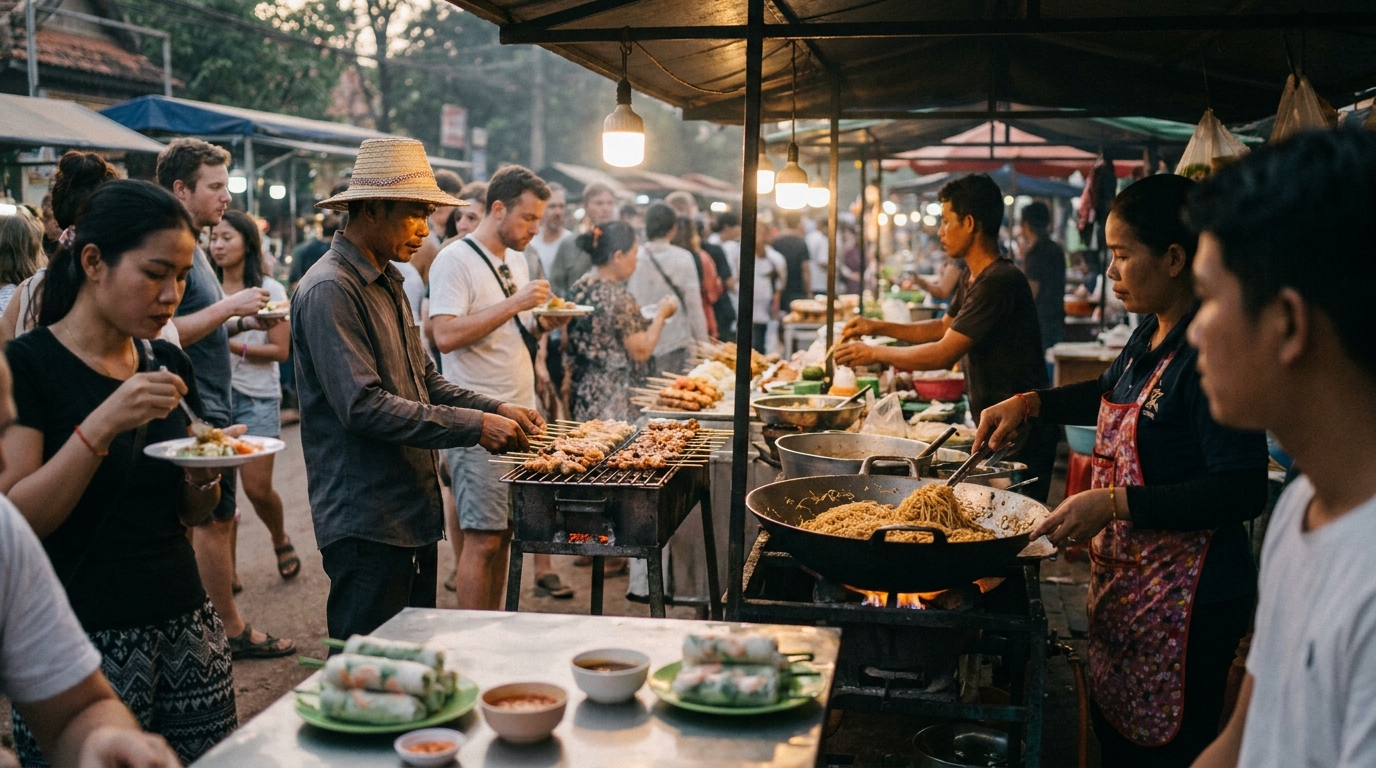
Street food is the fastest way to eat well and spend little in Siem Reap. The three best street food zones are the Old Market (Psar Chas) area, the Night Market on Charles de Gaulle, and Angkor Night Market near Sivatha Boulevard.
At the Old Market area stalls (open from 5:30 AM), breakfast costs $1–2: kuy teav noodle soup, nom banh chok, or sticky rice with mango. By evening, the same stalls shift to grilled meats, papaya salad ($1.50), and fried rice ($2). The Night Market food section runs from 5 PM to midnight and has 40+ vendors. Insect snacks (fried tarantulas, crickets) are a tourist staple here — priced at $1–3 per serve.
For a guided experience, Klook lists a Siem Reap street food walking tour for $22 per person that covers six stops across the Old Market district, including a visit to a wet market and a tuk-tuk ride between locations. We consider it good value for first-time visitors who want context alongside the food.
Pair street food nights with our [siem reap night market guide] for what else to do after dinner.
Cooking Classes in Siem Reap: Learn to Make Khmer Food
Related: Da Nang travel guide.
Taking a Khmer cooking class is one of the most practical ways to understand the cuisine, and Siem Reap has a strong selection at all price points. Most classes run half-day (3–4 hours) and include a market visit, hands-on cooking for 3–4 dishes, and a sit-down meal of what you made.
Coconut Cooking School (Road to Angkor, north of town) charges $24 per person for a morning class that starts with a 45-minute Psar Leu wet market tour. You cook amok, spring rolls, and a banana blossom salad. Maximum 10 students per session.
Le Tigre de Papier (Pub Street) offers a longer 5-hour class for $35 that covers five dishes and is taught in English and French. Their fish amok and Khmer red curry sessions are the most popular.
Klook also lists several cooking experiences in Siem Reap starting from $18 — useful for comparing options and reading verified reviews before booking. Check current availability here.
Browse more activity options in our [best things to do siem reap] guide.
Vegetarian and Vegan Options in Siem Reap
Related: Siem Reap travel cost.
Siem Reap handles vegetarian diets better than most Southeast Asian cities, partly because Buddhist temple culture has created local demand for meatless cooking. Traditional amok can be made with tofu, and most curry dishes have a vegetable version available on request.
Vibe Cafe (Kandal Village) is a fully plant-based restaurant popular with long-term expats. The jackfruit lok lak ($7) and coconut banana pancakes ($4) are standouts. It opens at 7:30 AM and closes by 9 PM.
Banlle Vegetarian Restaurant (Street 7) has been operating since 2009 and serves meat-free Khmer dishes for $3–6. The eggplant with kroeung paste is the best item on the menu.
At any street stall, point to vegetables and say “men dak sach” (no meat) — most vendors can accommodate basic requests. Prahok (fermented fish paste) is used as seasoning in many sauces, so confirm with vendors if strict vegan eating matters.
Stay connected while exploring — an Airalo Cambodia eSIM gives you 5 GB data for $9, with no roaming fees. It activates in minutes and keeps maps and restaurant apps running all day.
Best Cafes and Bakeries in Siem Reap
Siem Reap’s cafe scene has grown sharply since 2022, driven by a younger local population and increased digital-nomad traffic. The best cafes cluster in Kandal Village (a 15-minute walk from Pub Street) and along Sok San Road near the boutique guesthouses.
The Sister Srey Cafe (near the Old Market) is a long-running favorite for breakfast — avocado toast, acai bowls, and Cambodian iced coffee (strong, sweet, over condensed milk). Expect to pay $4–7 per meal. They source from a local social enterprise farm. The cafe fills by 8:30 AM on weekends.
Gelato Lab (Pub Street) makes small-batch flavors using Cambodian coconut, lemongrass, and tamarind. A two-scoop cone costs $2.50. It is the best dessert stop after a temple day.
Brown Coffee (multiple locations, including Road to Angkor) is the Cambodia-wide chain equivalent of a reliable Western-style cafe: reliable espresso, air-conditioning, and fast Wi-Fi. A latte runs $2.50–3. The Kandal Village branch has outdoor seating under shade trees.
For your full Siem Reap itinerary, see our [siem reap 3 day itinerary] and [angkor wat day trip guide].
Frequently Asked Questions
How much does food cost per day in Siem Reap?
Budget travelers eating at street stalls and local markets spend $8–15 USD per day on food. Mid-range travelers mixing street food with sit-down restaurants typically spend $20–35 per day. Fine dining at Cuisine Wat Damnak or similar runs $35–50+ per person for dinner alone. (Numbeo, 2025)
Is the food in Siem Reap safe to eat?
Street food in Siem Reap is generally safe when you eat at busy, high-turnover stalls where food is freshly cooked. Avoid pre-cooked items sitting in open air for hours. Tap water is not safe to drink — use bottled water (around $0.50/bottle) or filtered water from cafes. Most travelers experience no issues when following basic food safety habits.
What is the best dish to try in Siem Reap for first-timers?
Fish amok is the standard first recommendation — it is distinctly Cambodian, mild enough for most palates, and available everywhere. Bai sach chrouk (grilled pork over rice) is the second pick for something eaten the way locals eat it, as a $1.50 breakfast from a market stall. Both represent core Khmer flavors without intense spice.
Are there good restaurants near Angkor Wat?
A cluster of restaurants operates near the Angkor Wat temple complex, primarily along the road between the main gate and Siem Reap town. Most are tourist-facing and priced $5–12 per main course. For better quality and value, eat in Siem Reap town (20 minutes by tuk-tuk) before or after your temple visit. Our [angkor wat visitor guide] covers logistics including meal timing.
Can I find international food in Siem Reap?
Yes. Pub Street and the surrounding blocks have Italian, French, Indian, Mexican, and Japanese restaurants. Quality varies widely. The best non-Khmer meal in town is arguably at a French-Cambodian fusion bistro like Le Malraux (Sivatha Boulevard), where a three-course dinner runs $22–28. That said, eating international food in Siem Reap is largely unnecessary given how strong the local options are.
What time do Siem Reap restaurants close?
Most local restaurants and street stalls close by 9–10 PM. Restaurants in the Pub Street area stay open until midnight or 1 AM. Breakfast stalls near the markets open as early as 5:30 AM and sell out by 9 AM. The Night Market food vendors run from 5 PM to midnight daily.
Do restaurants in Siem Reap accept credit cards?
Many mid-range and upscale restaurants accept Visa and Mastercard. Street stalls and small local restaurants are cash only. USD is widely accepted and preferred; Cambodian riel is used for small change. Bring small denomination USD bills (1s and 5s) for markets and street food.
Conclusion
Siem Reap rewards food-focused travelers with one of Southeast Asia’s most affordable and distinctive dining scenes. From a $1 bowl of nom banh chok at dawn to a $28 tasting menu at Cuisine Wat Damnak, the range is wider than most visitors expect. The key is mixing street stalls with sit-down Khmer restaurants, eating breakfast where locals eat, and spending at least one evening exploring Night Market food stalls on foot.
For your Siem Reap trip: book accommodations in Kandal Village or near the Old Market on Booking.com or Agoda, grab an Airalo Cambodia eSIM before you land, and book a street food walking tour or cooking class through Klook to get the most out of the local food culture. The temples are the reason most people come to Siem Reap — but the food is often the reason they wish they had stayed longer.
See also: [cambodia travel guide] and [siem reap budget travel tips]