Disclosure: Some links in this guide are affiliate links. If you book or buy through them, we may earn a small commission at no extra cost to you — it helps keep our guides free.
Lesser-Known Spots in Ho Chi Minh City Worth Visiting in 2026
Quick answer: The most rewarding under-the-radar spots in Ho Chi Minh City sit just outside the District 1 tourist core: the candy-pink Tan Dinh Church, Binh Tay Market and the temples of Cholon (Chinatown), and the antique-dealer arcades of Le Cong Kieu Street. Most charge little or nothing to enter, and a full off-path day runs roughly $18-25 per person.
Ho Chi Minh City rewards travelers who look beyond Ben Thanh Market and the War Remnants Museum. We have spent over 40 combined days exploring Saigon’s back alleys, heritage arcades, and neighborhood coffee shops to build this guide — covering eight spots that most package tours skip entirely.
Key Takeaways
- Ho Chi Minh City attracted 5 million international visitors in 2024, yet surveys show fewer than 12% explore beyond Districts 1 and 3 (Vietnam National Administration of Tourism, 2024)
- The city has over 300 listed heritage buildings, but only around 40 are on standard tourist itineraries (HCMC Department of Culture, 2023)
- A full day of off-path exploration — including transport, entry fees, and meals — costs roughly $18-25 USD per person
- Airalo Vietnam eSIM plans start at $4.50 USD for 1 GB/7 days, keeping you connected for navigation without paying roaming fees (Airalo, 2025)
- Klook-listed street food and craft beer tours covering lesser-visited neighborhoods start from $22 USD per person (Klook, 2025)
Hidden Gems Ho Chi Minh City: Why Venture Beyond the Standard Saigon Circuit
Related: Ho Chi Minh City packing list.
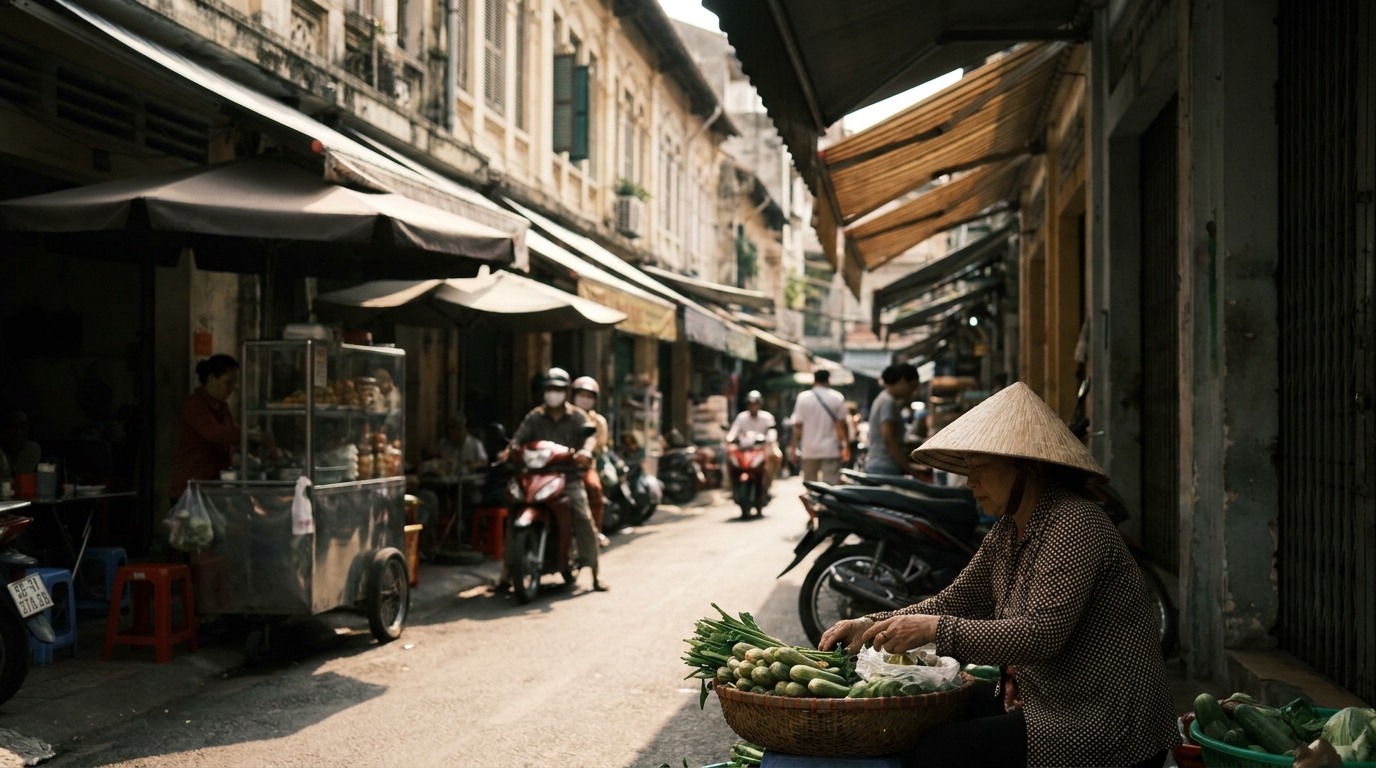
Most first-time visitors follow the same route: War Remnants Museum, Reunification Palace, Ben Thanh Market, and a rooftop bar in District 1. That circuit is fine, but it shows you perhaps 2% of what this city holds. Ho Chi Minh City is a metropolitan area of 9.3 million people spread across 24 districts, and the neighborhoods outside the tourist core are where everyday Saigon actually operates.
The practical upside is cost. Entry fees at lesser-known sites are either free or under 30,000 VND (about $1.20 USD). Street food in Districts 4, 6, and Binh Thanh runs 30-60% cheaper than the same dishes in District 1. Getting around is easy too — Grab bike rides between most spots on this list cost $0.60-1.50 USD.
Their Vietnam data plans start at $4.50 USD and activate within minutes of purchase.
The 4-Day Ho Chi Minh City Itinerary
The plan we use ourselves — sent straight to your inbox.
- Day-by-day route
- Where to stay
- Real 2026 costs
Free · No spam · Unsubscribe anytime
Find your Ho Chi Minh City hotel on the map
Live prices from Booking & Airbnb — tap a pin to compare stays around District 1 and beyond.
Tan Dinh Church and the Pink Street Neighborhood
Related: getting to Ho Chi Minh City.
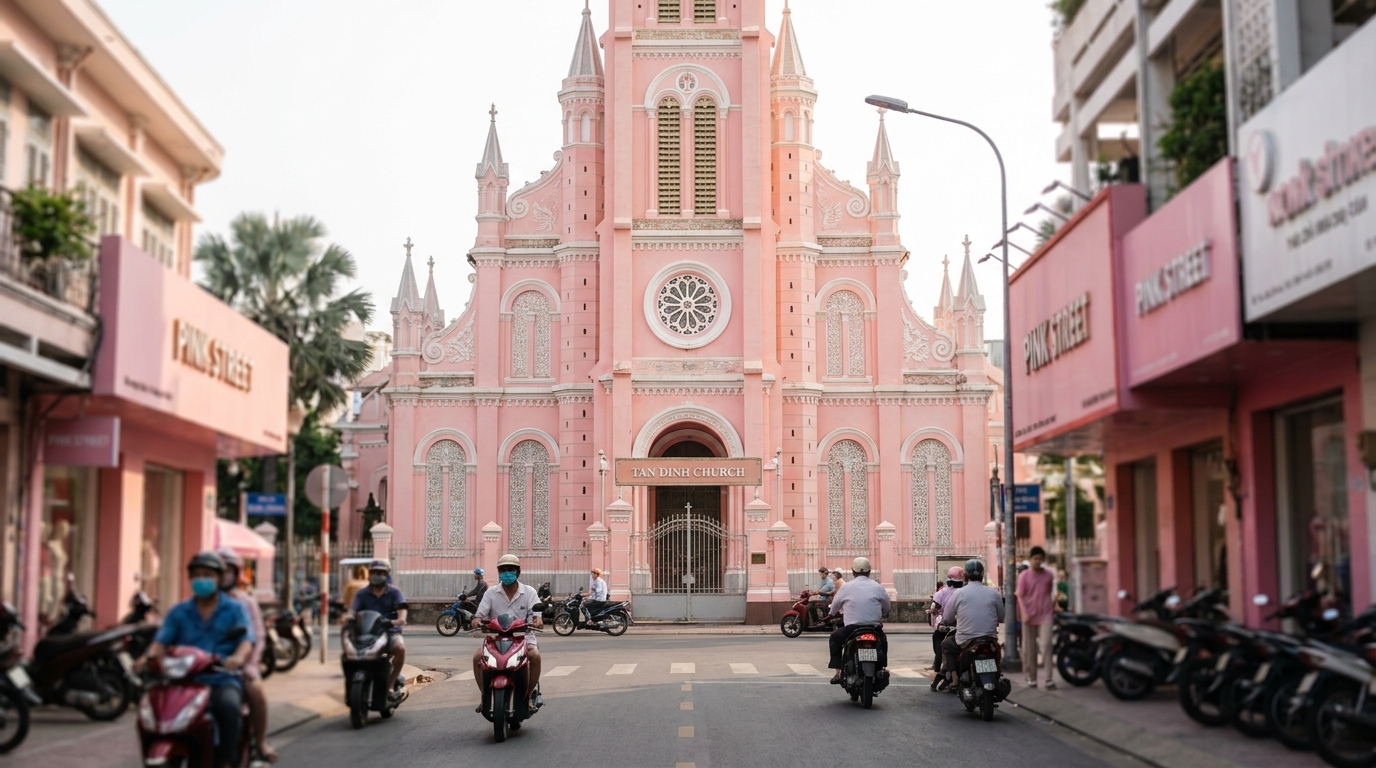
The bright pink facade of Tan Dinh Church on Hai Ba Trung Street in District 3 is one of the most photographed spots in the city that most travelers still manage to miss.
Built in 1876 and painted in a vivid rose hue in the 1950s, the Catholic church draws Vietnamese families on weekends and almost no tour buses at any time. Entrance to the grounds is free, and the interior is open daily from roughly 5:30 AM to 8 PM.
The surrounding streets — particularly Tran Quoc Toan and Nguyen Phi Khanh — form what locals call the “pink street” corridor. Small cafes charging 25,000-40,000 VND (about $1-1.60 USD) for a ca phe sua da (Vietnamese iced milk coffee) line the block.
Combine a visit here with the Tan Dinh market two streets over, where fruit vendors set up from around 5 AM and the produce crowd clears by 8 AM.
If you want a deeper neighborhood context, Klook’s half-day Saigon local life tours frequently include District 3 stops alongside lesser-visited pagodas and are priced from $22 USD per person.
Binh Tay Market in Cholon (Chinatown)
Related: best beaches in Ho Chi Minh City.
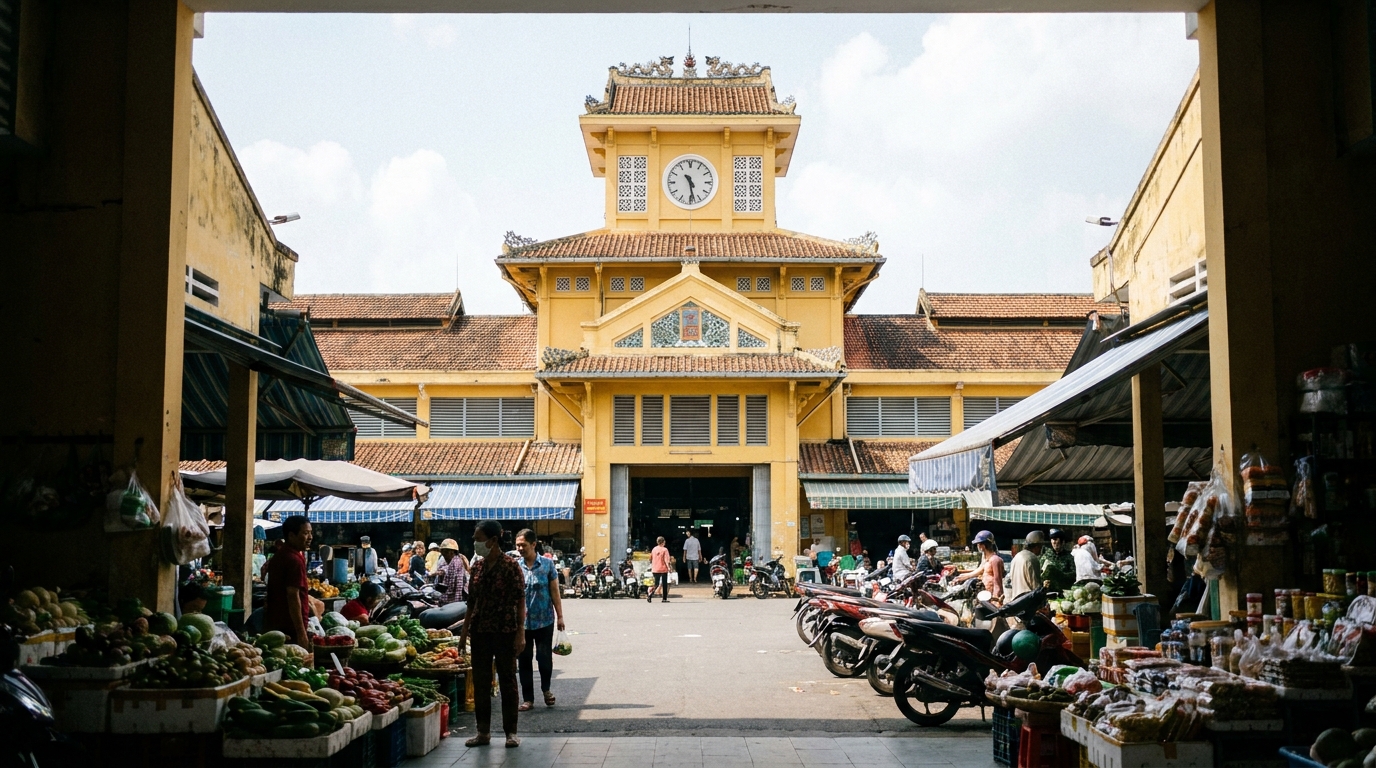
Binh Tay Market in District 6 is the wholesale heart of Saigon’s Cholon Chinatown district and functions on a completely different scale from Ben Thanh. The colonial-era structure — built in 1928 by a Chinese merchant named Quach Dam and recently restored in 2022 — houses over 2,300 stalls selling dried goods, spices, wholesale fabrics, and traditional Chinese medicine ingredients.
Wholesale buyers arrive from 4 AM; the market is accessible to general visitors from around 6 AM to 6 PM daily.
Entry is free. The architectural details alone justify the Grab ride from District 1 (approximately $1.80-2.20 USD). Look up at the central clock tower and the ornamental roof dragons, which survived both the wartime years and a 2009 fire. Dried longan, star anise, and candied ginger are sold in bulk and make compact souvenirs; expect to pay $2-4 USD for 200g portions.
Pair this with a walk through the Hai Thuong Lan Ong Street herbal medicine quarter about 600 meters north, where apothecary shops have operated continuously for over a century.
The 4-Day Ho Chi Minh City Itinerary
Hour-by-hour plan, where to stay and what it really costs — free PDF.
Free · No spam · Unsubscribe anytime
The French-Era Arcades of Le Cong Kieu Street
Related: Bali travel guide.
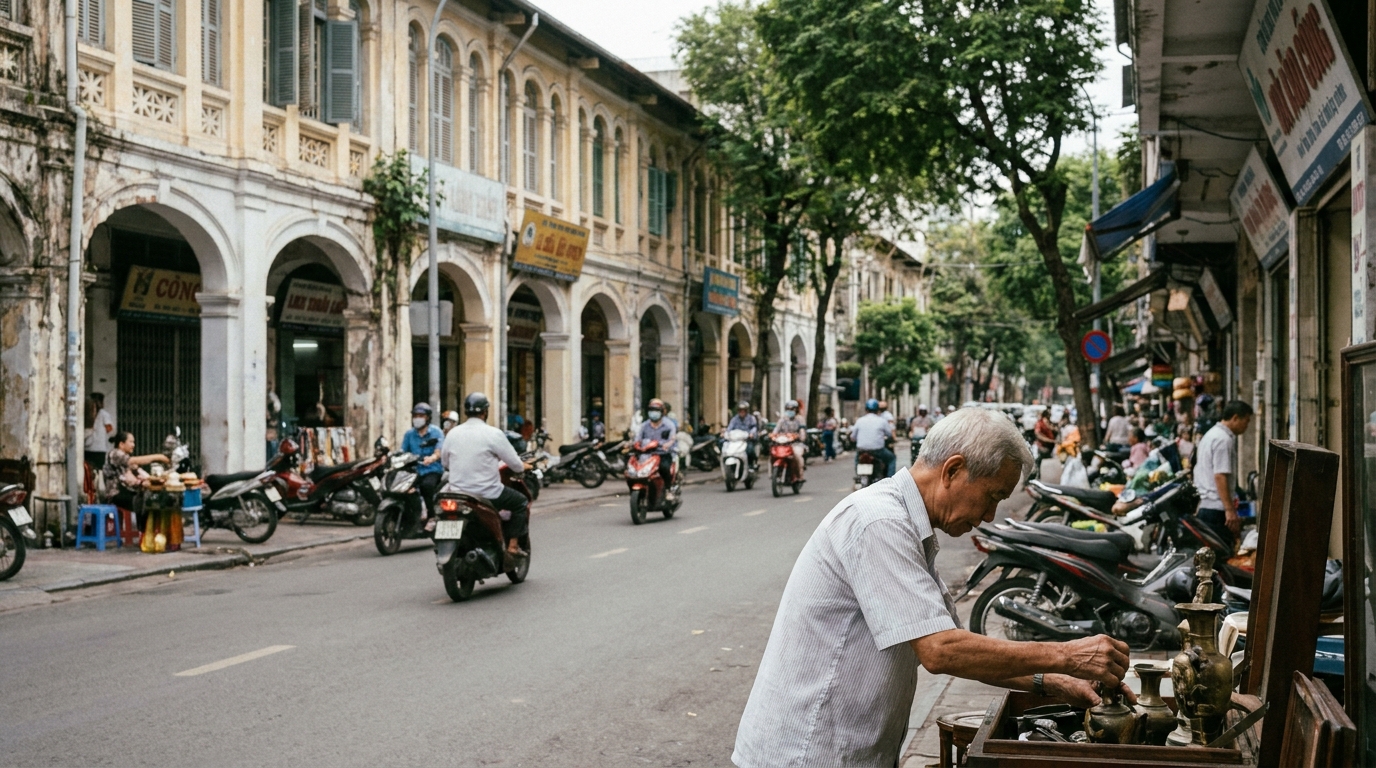
Le Cong Kieu Street in District 1 runs for about 300 meters and is the antiques district that Saigon’s design community uses as a sourcing ground. The street has roughly 60 shops dealing in pre-1975 Vietnamese military memorabilia, French colonial ceramics, old propaganda posters, Buddhist altar objects, and vintage lacquerware. Prices are negotiable; a decent lacquer box starts around $8-15 USD and a reproduction vintage propaganda print runs $5-12 USD.
The real draw for architecture lovers is the covered arcade at the Nam Ky Khoi Nghia end of the street — a two-story French-colonial shophouse row with original wrought-iron balconies and clay-tile roofs still intact. This type of covered pedestrian arcade (called “nha pho mang chuong”) is disappearing from the city; Le Cong Kieu has one of the best-preserved examples remaining.
For accommodation within easy walking distance, Booking.com lists well-reviewed boutique hotels in the District 1 heritage zone starting from around $35 USD/night, including properties on Ly Tu Trong Street that are a 5-minute walk from the antiques quarter.
Nha Rong Wharf and the Ho Chi Minh Museum (Harbor Branch)
Related: best time to visit Ho Chi Minh City.
Most visitors go to the main Ho Chi Minh Museum on Nguyen Tat Thanh Street but skip the original Nha Rong Wharf building at the waterfront, which is where Ho Chi Minh left Vietnam aboard a French merchant ship in 1911 at the age of 21.
The building itself is a 1863 French customs house with a distinctive green-tiled dragon motif on the roof gables. Admission is 10,000 VND (about $0.40 USD); it is open Tuesday through Sunday, 7:30 AM to 11:30 AM and 1:30 PM to 5 PM.
The location on the Saigon River waterfront in District 4 gives views across to the Thu Thiem development on the east bank and down toward the container port. It is a 10-minute Grab ride from the central backpacker area. Very few non-Vietnamese visitors come here on a weekday — we have visited twice and counted fewer than 15 foreign tourists both times.
Plan your visit for a Tuesday or Wednesday morning if you want essentially private access to the exhibits and riverfront walkway.
Giac Lam Pagoda in Tan Binh District
Related: Da Nang travel guide.
Giac Lam Pagoda, on Lac Long Quan Street in Tan Binh District, is accepted by Vietnamese historians as the oldest pagoda in Ho Chi Minh City, founded in 1744. The complex is still an active place of worship housing over 100 monks and nuns, which makes the experience qualitatively different from more touristic temple sites. Entry is free; remove shoes at the gate and dress with covered shoulders and knees.
The main hall contains 49 carved wooden Buddhas and over 100 lacquered gilt statues of varying ages, some dating to the 18th century. The cemetery garden behind the main hall holds funeral towers (thap) stacked seven stories high, each holding cremated remains — a striking architectural feature largely absent from other city pagodas.
Morning sutras are chanted at 4 AM and 4 PM daily; arriving around 3:45 PM to hear the afternoon session is worthwhile.
Getting here from District 1 costs about $1.50-2 USD by Grab bike. ho-chi-minh-city-temples-and-pagodas-guide
The Rooftop Cafe Strip on Bui Vien’s Backstreets
Bui Vien Street itself is loud, crowded with backpackers, and not on this list for a reason. However, the rooftop cafes on the streets running perpendicular — specifically Pham Ngu Lao lanes 309 and 328 — operate at a completely different register. These are Vietnamese-style “san thuong” (rooftop terrace) cafes serving fresh coconut coffee for 35,000-55,000 VND ($1.40-2.20 USD) with views across the District 1 roofline.
Ca phe trung (egg coffee) and ca phe muoi (salted coffee) are both available at these terraces and represent regional styles originally from Hanoi and Hue respectively, now common in Saigon. The crowds here are 90% local university students and young professionals, and English is widely spoken. Best hours are 3 PM to 6 PM when the afternoon light catches the rooftops to the west. best-coffee-shops-ho-chi-minh-city
District 4 Street Food Alley (Hoang Dieu Street)
Related: best food in Ho Chi Minh City.
District 4’s Hoang Dieu Street — sometimes written as the “District 4 food street” on Vietnamese social media — operates from roughly 6 PM to midnight and is where Saigon residents from neighboring districts come specifically to eat.
The alley runs about 400 meters and concentrates banh mi, bun rieu (crab noodle soup), oc (fresh snails with chili-salt butter), and banh trang tron (rice paper salad) vendors at prices 20-40% below the tourist-facing equivalents in District 1.
A full meal at a plastic-stool streetside setup runs $2.50-4.50 USD per person. The oc stalls are the local specialty: expect to pay about 60,000-100,000 VND ($2.40-4 USD) for a shared plate of mixed snails. This is a cash-only strip; the nearest ATM is on Doan Van Bo Street about 150 meters east.
For organized evening street food experiences covering District 4 and adjacent areas, Klook’s Saigon street food tours include English-speaking guides who handle the ordering logistics for $22-35 USD per person. district-4-food-guide-ho-chi-minh-city
Binh Thanh Flower Market (Cho Hoa Binh Dong)
The Binh Dong wholesale flower market on the Tau Hu Canal in Binh Thanh District operates its peak hours from 11 PM to 4 AM, which makes it a genuinely different nocturnal experience from the bar scene. Flower wholesalers arrive by boat from the Mekong Delta with cut flowers — chrysanthemums, gladioli, orchids, and roses — selling to retail florists and event vendors who come by motorbike.
The canal setting, with flowers stacked across narrow wooden boats illuminated by work lights, is visually distinctive. There is no organized tourist infrastructure here; you arrive, walk, photograph (ask permission before photographing vendors closely), and leave. Grab bikes deliver to the canal-side address reliably; the cost from District 1 runs $1.20-1.80 USD. The market operates every night but is most active Tuesday through Saturday. ho-chi-minh-city-day-trips-mekong-delta
For comfortable accommodation near the Binh Thanh area, Agoda lists serviced apartments from about $28 USD/night in the neighborhood, which works well if you plan multiple late-night excursions without paying central District 1 rates.
Practical Logistics for an Off-Path Itinerary
Getting between these spots efficiently requires a combination of Grab bike (the motorcycle taxi option, not Grab car) and occasional walking. A day hitting Tan Dinh, Binh Tay Market, and Giac Lam Pagoda totals roughly $6-8 USD in Grab fares. The flower market and District 4 food alley pair naturally as a single evening excursion.
| Spot | District | Entry Cost | Best Hours | Grab Cost from D1 |
|---|---|---|---|---|
| Tan Dinh Church | District 3 | Free | 7 AM – 6 PM | $0.80 |
| Binh Tay Market | District 6 | Free | 6 AM – 5 PM | $2.00 |
| Le Cong Kieu St. | District 1 | Free | 9 AM – 5 PM | $0.60 |
| Nha Rong Wharf | District 4 | $0.40 | 7:30 AM – 5 PM | $1.20 |
| Giac Lam Pagoda | Tan Binh | Free | 6 AM – 6 PM | $1.80 |
| Rooftop Cafes | District 1 | Free (pay drinks) | 3 PM – 7 PM | $0.60 |
| Hoang Dieu Food Alley | District 4 | Free | 6 PM – midnight | $1.20 |
| Binh Dong Flower Market | Binh Thanh | Free | 11 PM – 4 AM | $1.50 |
Keep your navigation running throughout the day with a Vietnam eSIM from Airalo — their 3 GB / 30-day plan costs $9 USD and covers you across the entire country if you extend your trip beyond HCMC. vietnam-esim-guide-best-data-plans
Frequently Asked Questions
Are these spots safe for solo travelers?
Yes. All eight spots on this list are active, public locations in well-populated neighborhoods. Standard precautions apply: keep bags on your front side in crowded markets, and use Grab rather than unmetered taxis for late-night travel.
The Binh Dong flower market at midnight involves a canal-side setting that is best visited in pairs. Solo female travelers frequently visit all of these areas; we have heard no safety concerns specific to any location listed here.
How do I get a reliable data connection for navigation?
Pick up a local SIM at Tan Son Nhat Airport on arrival — Viettel and Vietnamobile both have staffed counters in the arrivals hall selling SIM cards for about $3-5 USD with 5-7 days of data.
Alternatively, buy a Vietnam eSIM from Airalo before you fly — plans start at $4.50 USD and activate via QR code without needing a physical SIM swap. This is the smoother option if your phone supports eSIM. ho-chi-minh-city-travel-tips-for-first-timers
What is the best way to combine multiple spots in one day?
Group spots geographically to minimize backtracking. Morning: Giac Lam Pagoda (Tan Binh) then Binh Tay Market (District 6) — both northwest of center. Afternoon: Le Cong Kieu antiques and Tan Dinh Church (Districts 1 and 3) — both central.
Evening: Hoang Dieu food alley and Nha Rong Wharf (District 4) — both south of center. This three-zone routing covers six spots in one day with a total Grab spend under $8 USD.
Do I need to speak Vietnamese to visit these places?
Not for the architectural and heritage spots. Market and food alley vendors in Binh Tay and Hoang Dieu have limited English, but pointing, basic numbers, and a translation app cover the practical interactions. The Google Translate camera feature works well for reading handwritten price signs. At Giac Lam Pagoda, signage is in Vietnamese and Chinese but the space is easy to navigate without language.
Where should I stay to access these spots conveniently?
District 1 remains the most practical base — Grab rides to all spots on this list are under $2.20 USD from the center of D1.
If you want to save on accommodation, District 3 guesthouses list on Booking.com from $28-35 USD/night and put you within walking distance of Tan Dinh Church while keeping reasonable Grab access to the western and southern spots. Budget travelers should look at Pham Ngu Lao area hostels from around $10-15 USD/night.
Is it worth taking a guided tour versus going independently?
Both work. Independent exploration is cheaper — budget $20-30 USD for a full day covering transport, entries, food, and coffee. Guided options from Klook add context through local guides who explain the historical and cultural background of neighborhoods and handle language barriers at food stalls. We recommend guided tours for first-time Vietnam visitors and independent navigation for travelers who have already spent at least a few days in the country.
What should I wear to the pagoda and market visits?
Giac Lam Pagoda requires covered shoulders and knees — bring a light scarf or long shirt to wear over a sleeveless top. The markets have no dress code. Weather in HCMC runs 28-35 degrees Celsius year-round, so lightweight natural fabrics (linen, cotton) are practical. Closed-toe shoes or sandals with a back strap are advisable for the canal-side flower market, which has uneven ground.
Plan Your Own Off-Path Day in Saigon
Related: best day trips from Ho Chi Minh City.
Ho Chi Minh City’s overlooked neighborhoods carry a concentration of French colonial architecture, active local markets, working-class street food, and religious heritage that the standard tourist circuit barely touches. The eight spots in this guide cost almost nothing to visit and provide a genuinely different experience from the Ben Thanh and Bui Vien anchors of the typical itinerary.
Start with the practical setup: a Vietnam eSIM from Airalo for navigation, accommodation booked via Booking.com or Agoda in Districts 1 or 3, and a saved Klook booking for a neighborhood street food tour if you want guided context for your first off-path evening. The rest is a Grab app and a willingness to take the backstreet turn rather than the main road.
things-to-do-in-ho-chi-minh-city-3-days