Disclosure: Some links in this guide are affiliate links. If you book or buy through them, we may earn a small commission at no extra cost to you — it helps keep our guides free.
Hanoi Packing List 2026: What To Bring and Skip
Quick answer: Pack for Hanoi’s volatility, not its latitude: a packable rain jacket year-round, breathable layers for humid summers, and a genuine warm sweater plus a light insulating jacket for the damp December-to-February cold. Add comfortable walking shoes for the Old Quarter’s uneven pavements and scooter-dodging, plus modest, knee-and-shoulder-covering clothing for temple and mausoleum visits. Skip bulky toiletries and heavy outerwear — both are cheap to buy once you land.
Packing for Hanoi is easier when you know exactly what the city demands — and what it can supply cheaply once you land. This guide covers every essential item, what to skip to save luggage space, and why each decision matters for Hanoi’s volatile weather and urban street life.
Key Takeaways
- Hanoi averages 1,680 mm of rain per year, so a packable rain jacket is non-negotiable regardless of season (Vietnam National Hydrometeorological Service, 2024)
- Street-market prices mean toiletries, flip-flops, and basic clothing cost 30-60% less in Hanoi than at home — skip bulky duplicates (Numbeo Cost of Living, 2025)
- Winter months (December-February) drop to 12-15 degrees Celsius at night; a mid-weight layer is essential, not optional
- Hanoi’s Old Quarter streets are narrow, uneven, and crowded — hard-shell suitcases are a liability; a 40-50L carry-on backpack outperforms them
- A 1 GB/day Vietnamese SIM card costs around USD 5 for 30 days; buying an Airalo eSIM before departure saves airport queue time (Airalo, 2025)
Understanding Hanoi’s Climate Before You Pack
Related: getting to Hanoi.
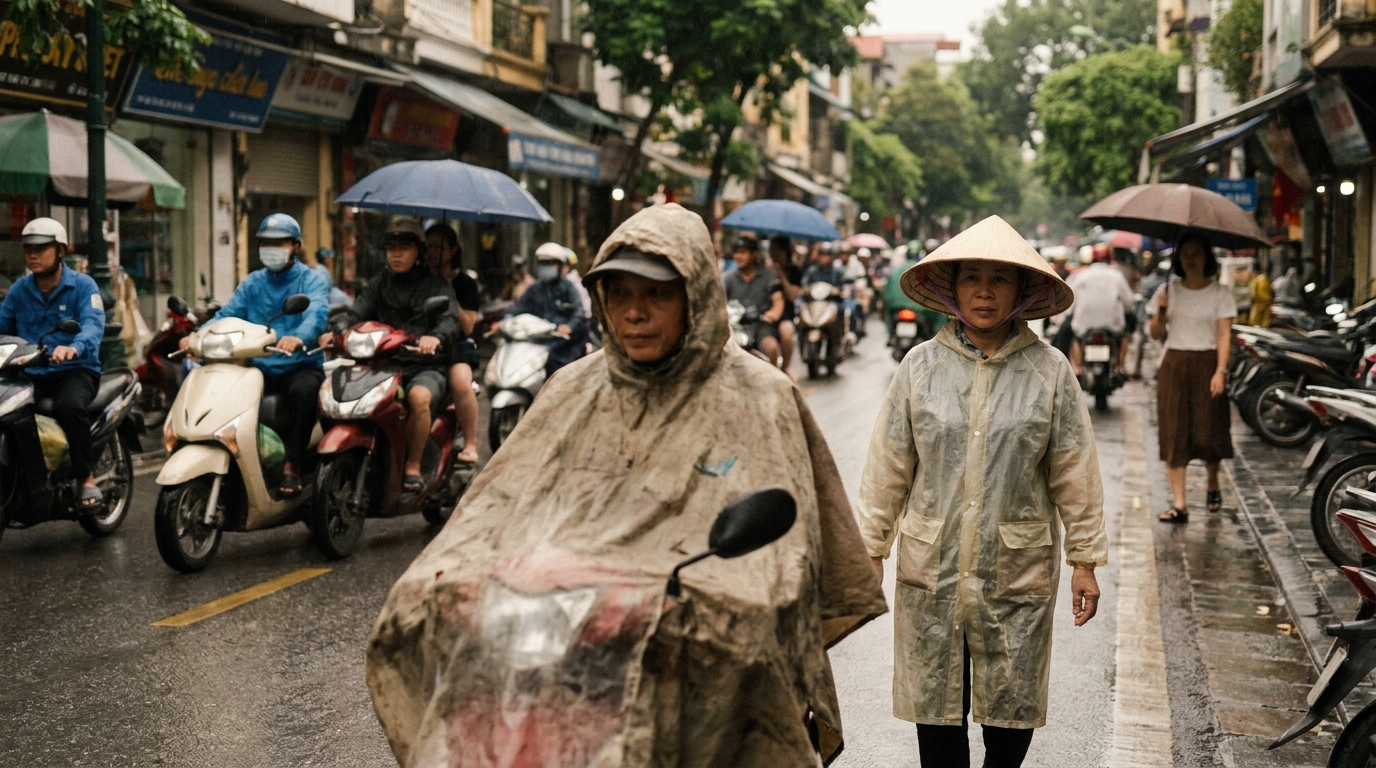
Pack for the season, not the country, because Hanoi has four distinct seasons unlike southern Vietnam. Winter (November-March) is cool and drizzly, hovering between 12 and 20 degrees Celsius. Summer (May-September) is hot and humid, reaching 38 degrees with high UV. The shoulder months of April and October bring the most unpredictable weather — warm days followed by sudden downpours.
| Season | Months | Temp Range (C) | Key Packing Note |
|---|---|---|---|
| Winter | Nov-Mar | 12-20 | Layer up; fleece or light down jacket |
| Spring | Mar-Apr | 20-27 | Light rain jacket; mix of tees and a long sleeve |
| Summer | May-Sep | 29-38 | Moisture-wicking fabrics; strong SPF 50 sunscreen |
| Autumn | Sep-Nov | 22-30 | Packable rain jacket; light layers |
The single most versatile piece for every season is a packable rain jacket under 300 grams. We use a Decathlon Forclaz model (around USD 35) and it has survived five Hanoi trips across all seasons.

The 3-Day Hanoi Itinerary
The plan we use ourselves — sent straight to your inbox.
- Day-by-day route
- Where to stay
- Real 2026 costs
Free · No spam · Unsubscribe anytime
The Right Bag: Carry-On Backpack vs. Suitcase
Related: hidden gems in Hanoi.
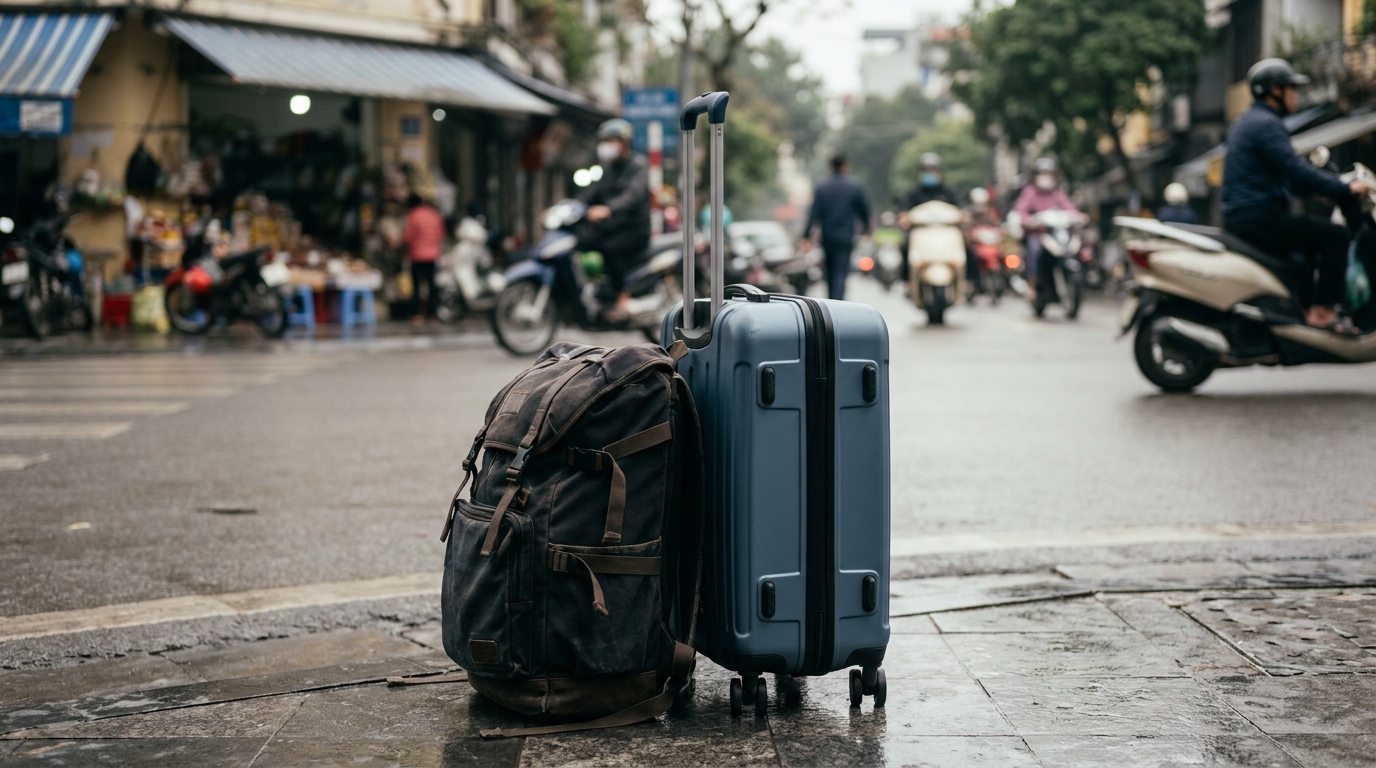
A 40-50L travel backpack is the correct choice for Hanoi, full stop. The Old Quarter’s 36 mapped streets (pho) are paved with uneven stone and often blocked by motorbikes, food carts, and construction — rolling a hard-shell case is genuinely difficult and draws unwanted attention. Budget guesthouses in the Hoan Kiem area also have narrow stairwells.
Carry-on size (under 56x36x23 cm) keeps you off checked-luggage fees on VietJet and Bamboo Airways, which both charge USD 12-25 for hold bags on domestic routes (VietJet Air fee schedule, 2025). For accommodation, book via Booking.com or Agoda to filter by neighborhood — staying in Hoan Kiem means you can walk everywhere and keep your bag manageable.
Pack one personal item bag (maximum 40x30x20 cm) for day trips to Ha Long Bay or Ninh Binh. We recommend a 20L daypack that compresses flat when empty.
Clothing: What to Bring and What to Buy There
Related: things to do in Hanoi.
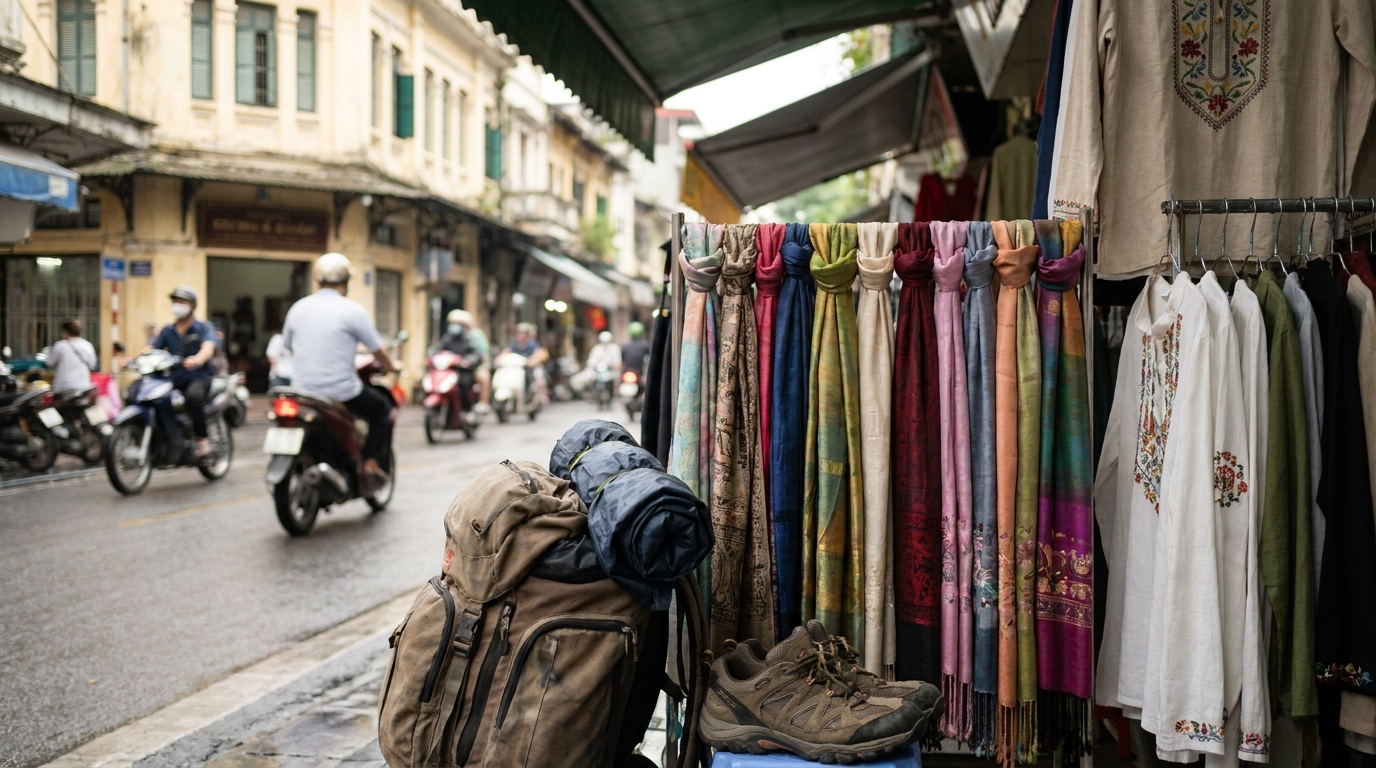
Bring exactly seven days of base clothing, even for a 14-day trip, because laundry service in Hanoi costs USD 1-2 per kilogram and takes 24 hours. The Old Quarter has over 200 laundry shops; you will never run out of options.
Bring from home:
- 3-4 moisture-wicking T-shirts (synthetic or merino wool; merino handles odor better across multiple wears)
- 2 pairs of lightweight trousers or zip-off pants — shorts alone get you turned away from Tran Quoc Pagoda and the Temple of Literature
- 1 pair of jeans or smart casual trousers for rooftop bars or nicer restaurants
- 1 packable rain jacket (doubles as a wind layer for Ha Long Bay boat trips)
- 1 mid-layer fleece or light down jacket if traveling November-March
- 5-7 pairs of underwear (merino or synthetic, not cotton)
- 3-4 pairs of socks; bring one pair of wool socks for cool nights
- 1 pair of walking shoes with good grip for wet pavements
- 1 pair of sandals (or buy Bitis sandals in Hanoi for under USD 8)
Skip and buy in Hanoi:
- Flip-flops: USD 2-5 at Dong Xuan Market
- Basic tees and tank tops: USD 3-8 at Old Quarter shops
- Rain poncho: USD 1-2 at any corner store (motorbike-style, they work well)
- Swimsuit: USD 6-15 at Hang Gai Street
Browse Klook’s Hanoi experiences for cooking classes and cyclo tours where dress code matters — most request covered shoulders and knees, so those lightweight trousers earn their space twice over.
The 3-Day Hanoi Itinerary
Hour-by-hour plan, where to stay and what it really costs — free PDF.
Free · No spam · Unsubscribe anytime
Shoes: The Most Underestimated Decision
Related: best food in Hanoi.
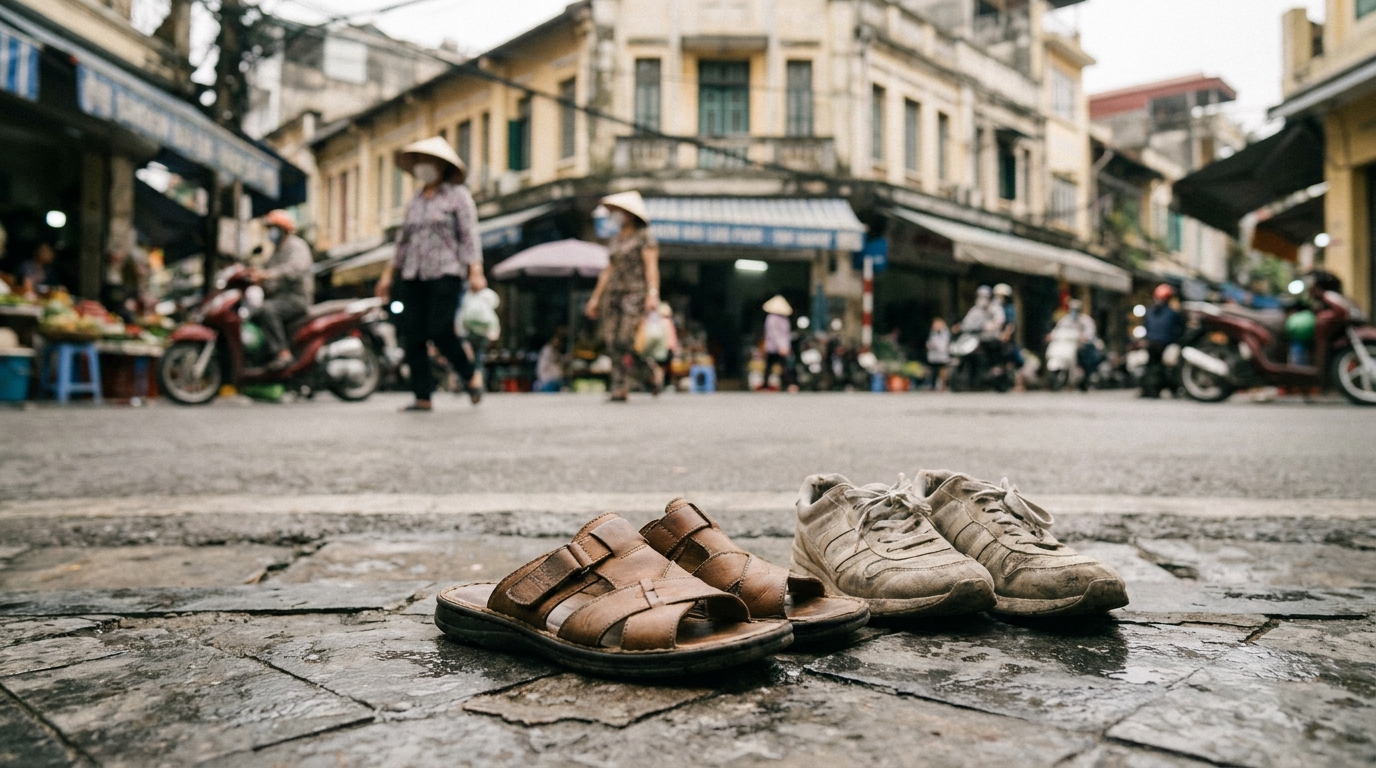
Your shoes will determine whether Hanoi is comfortable or miserable. Hoan Kiem Lake’s perimeter path, the 36 Streets, and most temple entrances involve standing, walking on slick stone, or removing footwear at entry. Budget around 8-12 km of walking per day in the Old Quarter.
One pair of supportive walking shoes or trail runners with a grippy rubber sole handles 90% of Hanoi’s terrain. Add a packable pair of sandals or slip-ons for pagoda visits, guesthouse common areas, and beach detours to Ha Long Bay. That is two pairs total — sufficient for any Hanoi trip duration.
Avoid leather-soled dress shoes entirely. Even in dry weather, Hanoi’s streets have cooking oil spillage, vegetable scraps, and wet tile. In the rainy season, slick stone is genuinely hazardous without rubber grip.
Find your Hanoi hotel on the map
Live prices from Booking & Airbnb — tap a pin to compare stays across the Old Quarter and beyond.
Electronics and Connectivity
Related: best day trips from Hanoi.
Vietnam uses Type A and Type F outlets at 220V/50Hz. North American devices (Type A) plug in directly; European two-pin devices (Type C/F) also fit. If you travel with UK or Australian plugs, bring one universal adapter — Hanoi’s airport sells them for USD 8 but airport prices run 40% higher than the city.
For connectivity, an Airalo Vietnam eSIM provides 3 GB for 15 days at around USD 5, activates remotely before you land, and works in both Hanoi and Ha Long Bay. Alternatively, Viettel and Vietnamobile physical SIMs cost USD 5-8 at Noi Bai Airport with 1 GB/day included.
Essential electronics list:
- Smartphone with offline Google Maps downloaded for Hanoi
- Portable power bank (at least 10,000 mAh) — street food queues, temple visits, and night market browsing kill batteries fast
- Universal adapter (one plug; Hanoi’s sockets accept Type A directly)
- Laptop or tablet if working remotely (Hanoi has solid cafe Wi-Fi averaging 30-50 Mbps per Speedtest, 2025)
- Camera or confirm your phone camera handles low light — Hanoi’s night street scenes and the Train Street require decent low-light performance
Leave behind: international MiFi devices (local SIMs are cheaper), heavy DSLR lenses unless you are a professional (phone cameras now outperform kit lenses in low light), and redundant charging cables beyond one per device. Read our guide to Hanoi’s best street food neighborhoods for walking routes that justify that power bank.
Toiletries and Health Essentials
Related: Hanoi itinerary.
Vietnam’s pharmacies (nha thuoc) are well-stocked, cheap, and open late. Most toiletries can be sourced in Hanoi within 10 minutes of landing at any Old Quarter pharmacy for USD 1-4 per item.
That said, three categories are worth bringing from home: sunscreen stronger than SPF 30 (local brands cap at SPF 30 in most budget stores), prescription medications, and insect repellent with 30%+ DEET (sold locally but less reliably outside the city center).
Bring:
- SPF 50 sunscreen (100ml or less for carry-on; Vietnamese humidity melts it fast so bring enough for the trip)
- DEET-based insect repellent — Hanoi itself has minimal mosquito issues, but day trips to Ninh Binh and Ba Vi National Park do
- Prescription medications plus a 3-day buffer supply in case of delays
- Small first-aid kit: blister plasters, antihistamine tablets, oral rehydration salts
- Hand sanitizer (80ml works through airport security)
Skip:
- Full-size shampoo and conditioner — local brands like Double Rich cost USD 0.50/bottle
- Razors — 3-blade disposables cost USD 0.80 at Circle K convenience stores
- Toothpaste — available everywhere, including the 24/7 7-Eleven at Hoan Kiem
If you need a Hanoi-based doctor or clinic, the Hanoi Family Medical Practice on Van Phuc Street sees walk-ins and costs around USD 60-80 for a consultation (Family Medical Practice, 2025). For accommodation with in-house pharmacies nearby, Booking.com lets you filter for central Hoan Kiem properties within 500 meters of a pharmacy.
Documents, Money, and Security Items
Related: Bali travel guide.
Carry both physical and digital copies of every document. Vietnamese immigration occasionally requests printed copies at land border crossings, though Noi Bai Airport accepts e-visas on a phone screen. The e-visa for most nationalities costs USD 25 for 90 days single-entry and processes in 3 business days at evisa.xuatnhapcanh.gov.vn (Vietnam Immigration Department, 2025).
Documents checklist:
- Passport (valid at least 6 months beyond your departure date)
- Vietnam e-visa confirmation (printed + digital copy)
- Travel insurance card with 24/7 emergency number
- Vaccination record if entering from countries with yellow fever requirements
- Two debit/credit cards from different networks (Visa and Mastercard both accepted at most ATMs)
Cash management: Hanoi’s Old Quarter runs mostly on cash for food stalls, xe om (motorbike taxis), and markets. Withdraw VND at Techcombank or Vietcombank ATMs — both charge zero foreign transaction fees to the bank and have a USD 500 equivalent withdrawal limit. Agoda and Booking.com hotels in the mid-range tier (USD 40-90/night) accept cards, but always carry at least USD 20 equivalent in VND.
A slim RFID-blocking card holder or money belt worn under clothing protects against the few pickpocket incidents that occur in the Ta Hien “Beer Street” area on weekend nights. For guided safety on nights out, check Klook’s Hanoi food and drink tours, which include a local guide who navigates the busier scenes.
Day Trip Extras for Ha Long Bay and Beyond
Related: best beaches in Hanoi.
Most Hanoi visitors take at least one overnight trip — Ha Long Bay, Ninh Binh, or Sapa. Each adds specific packing requirements. For Ha Long Bay cruises (typically 2D/1N or 3D/2N), you need: a swimsuit, biodegradable sunscreen (required on some cruise operators including Dragon Legend and Paradise Elegance to protect the UNESCO World Heritage marine ecosystem), sea-sickness tablets if you are susceptible, and a small dry bag for kayaking.
For Sapa trekking (3-4 hours from Hanoi by train), add: trekking poles (rentable locally for USD 2/day), waterproof hiking shoes or gaiters, and a warmer layer than you need in Hanoi — Sapa averages 10 degrees lower.
Frequently Asked Questions
Is a visa on arrival available for Hanoi in 2026?
Vietnam no longer offers standard visa-on-arrival for most nationalities. The e-visa system replaced it and costs USD 25 for 90 days for citizens of 80+ countries. Apply at evisa.xuatnhapcanh.gov.vn at least 3 business days before arrival. Citizens of several ASEAN nations enter visa-free. (Vietnam Immigration Department, 2025)
What is the baggage allowance on budget airlines flying into Hanoi?
VietJet Air and Bamboo Airways — both common for domestic legs into Noi Bai Airport — allow 7 kg carry-on free and charge USD 12-25 for hold luggage depending on route and booking tier. Vietnam Airlines includes 23 kg checked baggage on most international tickets. Always verify at booking. (VietJet Air, Bamboo Airways fee schedules, 2025)
Can I do laundry in Hanoi easily?
Yes. The Old Quarter has over 200 laundry shops charging USD 1-2 per kilogram with 24-hour turnaround. Most guesthouses either offer in-house laundry or a referral. This means you can easily pack for 7 days and re-wear items on longer trips without issue.
Is tap water safe to drink in Hanoi?
No. Tap water in Hanoi is not safe for direct drinking. Bottled water (500 ml) costs USD 0.20-0.30 at convenience stores. Most hotels provide complimentary bottled water. Bring a water bottle with a filter (like a Grayl Geopress) to reduce plastic waste and save money across a 10+ day trip.
What currency should I carry in Hanoi?
Vietnamese Dong (VND) is the only accepted currency in local markets, street food stalls, and local transport. Some tourist-facing hotels and tour operators accept USD at roughly 1 USD to 25,000 VND. Withdraw VND from Vietcombank or Techcombank ATMs which have lower fees. Credit cards are accepted at mid-range and upscale restaurants and hotels.
Is Hanoi safe for solo travelers?
Hanoi is generally safe for solo travelers including solo women. The main risks are motorbike-related bag snatching in certain areas late at night and traffic when crossing streets. Keep bags on the wall side of pavements, not the road side. The Old Quarter and Hoan Kiem Lake area are well-lit and have police presence until midnight. (Numbeo Safety Index, 2025)
What should I NOT pack for Hanoi?
Skip heavy hair dryers (most hotels above USD 20/night provide them), drone cameras without a Vietnamese Civil Aviation Authority permit (USD 150 fine if caught flying without one), and expensive jewelry. Also leave behind thick bath towels — hostels and guesthouses at USD 15/night and above always include them.
Final Thoughts: Pack Light, Buy Smart
Related: Da Nang travel guide.
Hanoi rewards travelers who pack lean and stay nimble. The city’s excellent street markets, cheap laundry, and well-stocked pharmacies make over-packing genuinely unnecessary — and a liability when you are dodging motorbikes through the Old Quarter’s narrow lanes. Stick to a 40L backpack, nail your climate-appropriate layers, protect your documents, and grab everything else on the ground.
Ready to plan the rest of your trip? Browse curated Hanoi day tours on Klook, lock in your hotel rate early on Booking.com or Agoda, and activate your Airalo Vietnam eSIM before you board so you hit the ground running. See our full Hanoi travel guide for itineraries, food recommendations, and neighborhood breakdowns to complete your planning.