
Disclosure: Some links in this guide are affiliate links. If you book or buy through them, we may earn a small commission at no extra cost to you — it helps keep our guides free.
Best Time to Visit Koh Samui 2026: Month-by-Month Weather Guide
Quick answer: The best time to visit Koh Samui is December to April, the Gulf of Thailand dry season, when you get the most sunshine and calmest seas. October and November are the wettest, roughest months and are best avoided, while July to September often stays surprisingly dry with lower prices.
Key Takeaways: The best time to visit Koh Samui is December to April (Gulf dry season). Unlike Phuket and Krabi on the Andaman Coast, Koh Samui faces the Gulf of Thailand — meaning its weather patterns are completely different. October and November are the worst months (heavy rain, rough seas). July to September can be surprisingly good — calm seas and lower prices. November is statistically Koh Samui’s wettest month with an average 320mm of rainfall — more than double any other month.
Most travel sites give the same generic “November to April is best in Thailand” advice, which is wrong for Koh Samui. See our Koh Samui Travel Guide and Where to Stay in Koh Samui for full trip planning.
For comparison, our Krabi Travel Guide covers how the Andaman Coast dry season differs from Koh Samui’s Gulf timing. Because the island sits on the Gulf of Thailand side, its dry and wet seasons are offset from the Andaman Coast by about 6 months. This guide gives you accurate, Gulf-specific weather information by month.
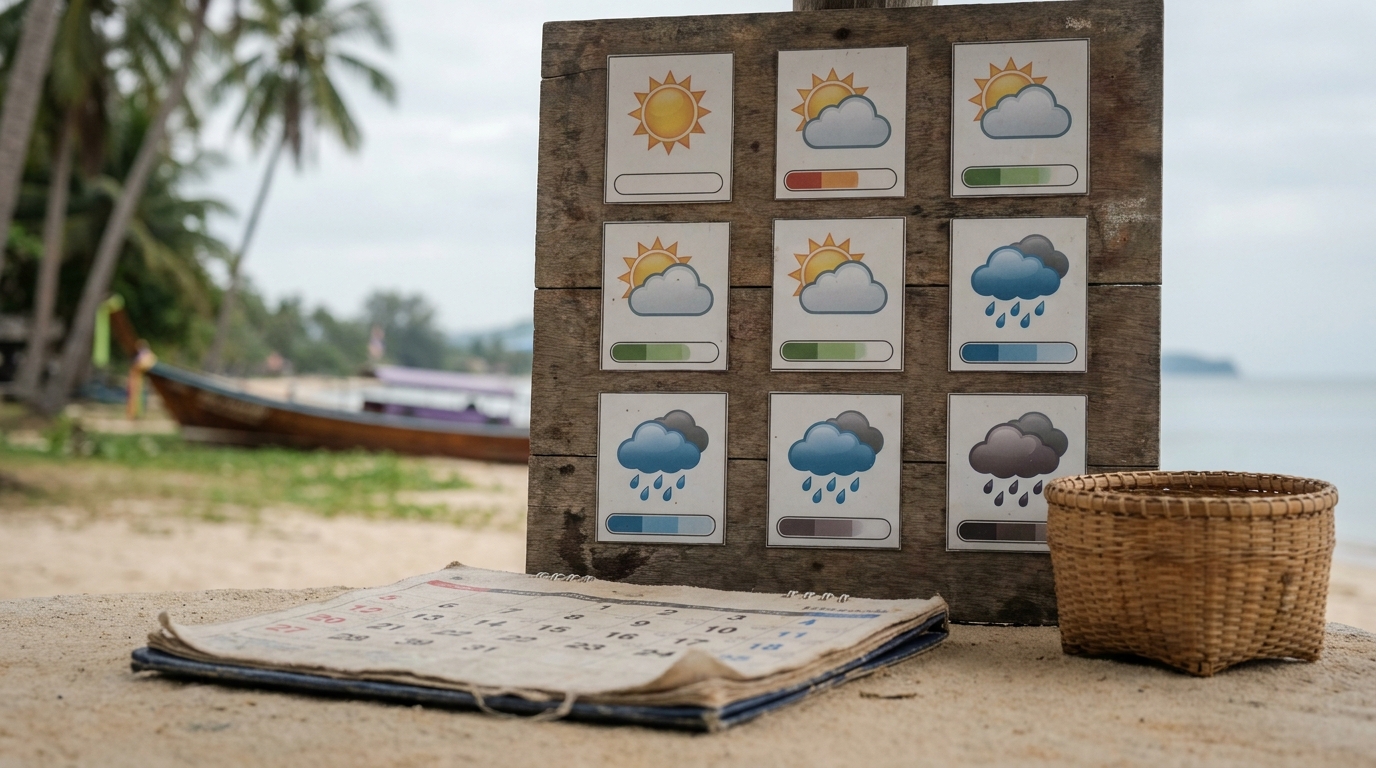
Quick Reference: Monthly Weather Ratings — Best Time To Visit Koh Samui
| Month | Weather | Rain | Crowds | Prices | Rating |
|---|---|---|---|---|---|
| January | ★★★★★ | Low | High | High | Best |
| February | ★★★★★ | Low | Medium-high | High | Best |
| March | ★★★★★ | Very low | Medium | Medium-high | Excellent |
| April | ★★★★ | Low | Low-medium | Medium | Very Good |
| May | ★★★ | Medium | Low | Low | Good |
| June | ★★★★ | Low-medium | Low | Low | Good |
| July | ★★★★ | Low | Low | Low | Good |
| August | ★★★★ | Low | Low | Low | Good |
| September | ★★★ | Medium | Low | Low | OK |
| October | ★★ | Very high | Low | Low | Avoid |
| November | ★ | Extremely high | Low | Low | Avoid |
| December | ★★★★★ | Low | Very high | Very high | Best (if budget allows) |
The 5-Day Koh Samui Itinerary
The plan we use ourselves — sent straight to your inbox.
- Day-by-day route
- Where to stay
- Real 2026 costs
Free · No spam · Unsubscribe anytime
The Gulf of Thailand vs. Andaman Coast — Why It Matters

Thailand has two coastlines separated by the Malay Peninsula:
- Andaman Coast (Phuket, Krabi, Koh Phi Phi): Best November to April; wet May to October
- Gulf of Thailand (Koh Samui, Koh Pha Ngan, Koh Tao): Best December to April AND July-August; wet October-November
This means:
1. When Phuket is in the middle of its wet season (May-June), Koh Samui can be fine
2. When Phuket is in its dry season (January), Koh Samui is also in its dry season
3. Koh Samui’s monsoon hits later in the year (October-November vs. May for Andaman)
Practical implication: If you’re in Thailand during July or August and can’t decide between Phuket and Koh Samui, Koh Samui is the better choice — it’s drier while Phuket is in full monsoon.
Find your Koh Samui hotel on the map
Live prices from Booking & Airbnb — tap a pin to compare stays around Chaweng Beach and beyond.
Month-by-Month Breakdown

December — Best Month (with caveats)
Weather: Dry, warm (25-30°C), excellent visibility for snorkeling
Rain: Very low (average ~100mm for the month)
Sea: Calm, clear, perfect for swimming and marine park tours
The most popular time to visit. The weather is reliably excellent — but so is everyone else’s schedule. December, especially Christmas week and New Year, brings the island’s highest prices and largest crowds. Accommodation in Chaweng can be double the shoulder-season rate.
Best for: Those who prioritize guaranteed weather and can afford peak prices. Book accommodation 2-3 months ahead for December.
Skip if: You’re on a budget or hate crowds.
January — Joint Best Month
Weather: Peak dry season, coolest temperatures (24-29°C)
Rain: Very low
Sea: Flat and clear
January delivers everything December does with slightly fewer crowds after the New Year holiday rush subsides (mid-January onwards). Still expensive, but the tail-end of January sees prices beginning to soften.
Best for: First-time visitors who want perfect conditions and plan 2-3 months ahead.
February — Excellent
Weather: Still dry, temperatures begin to warm (26-31°C)
Rain: Very low
Sea: Excellent
February is arguably the sweet spot — dry weather, clearer than January, prices slightly lower. Valentine’s Day week fills the romantic resorts in Bophut and Choeng Mon, but overall crowds are more manageable than December-January.
Best for: Couples and anyone who wants good weather without peak-season chaos.
March — Very Good
Weather: Warm and generally dry (28-33°C)
Rain: Low-moderate; brief afternoon showers possible but rare
Sea: Still calm
March marks the end of the true dry season. Weather remains excellent through most of the month. Temperatures peak in April-May. Prices start to soften from February levels as Europeans return from winter sun holidays.
Best for: Budget-conscious travelers who still want dry weather. Good value month.
April — Good to Very Good
Weather: Hot (30-34°C), occasional showers
Rain: Increasing but still manageable
Sea: Mostly calm with occasional chop
Songkran (Thai New Year) falls in mid-April. If you visit during Songkran week, expect water-fight street parties across the island — either great fun or an inconvenience depending on your perspective. Book accommodation well ahead for this week.
Best for: Travelers who enjoy warmth and can handle the occasional shower. Good prices outside Songkran week.
May — Shoulder Season Starts
Weather: Hot and humid (30-34°C), increasing cloud and showers
Rain: Moderate (~160mm average)
Sea: Occasional swells; Ang Thong Marine Park may close on some days
May marks the start of the Gulf wet season. Rain is typically short afternoon showers rather than all-day rain, so mornings are often fine for beach activities. Prices drop 20-30% from peak season.
Best for: Budget-conscious travelers willing to accept some rain in exchange for lower prices.
June-August — Underrated Shoulder Season
Weather: Warm with occasional showers; mornings often clear (28-32°C)
Rain: Low to moderate (~60-130mm)
Sea: Gulf of Thailand is calm during this period — significantly calmer than the Andaman Coast
June through August is the Andaman Coast’s full wet season (avoid Phuket). But the Gulf of Thailand is shielded from the southwest monsoon by the peninsula. Koh Samui gets limited rain in these months — far less than most tourists expect.
Prices are 30-50% lower than peak season. Beaches are uncrowded. The Ang Thong Marine Park runs tours regularly in June-August on calm days.
Best for: Budget travelers, those visiting from Europe or Australia who travel in European summer, and anyone who hates crowds. An underrated value period.
September — Acceptable
Weather: Humid, increasing cloud and rain (28-32°C)
Rain: Moderate to high (~180mm)
Sea: Can be choppy; some tour cancellations
September brings more reliable rain than the earlier summer months. Weather can be grey and showery for multi-day periods. Still workable but requires flexibility.
Best for: Extreme budget seekers. Prices hit their annual low. Not recommended as a primary choice.
October — Avoid
Weather: Wet, grey, potential tropical storms (27-31°C)
Rain: Very high (~240mm)
Sea: Rough; most marine park tours cancelled
October is when the northeast monsoon hits the Gulf of Thailand hard. Heavy rain, rough seas, and occasional tropical depressions are common. Some resorts reduce operations; some close entirely.
Best for: Nobody particularly. If you must visit, Koh Samui’s jungle and culture can still be explored — just don’t come expecting beach weather.
November — Worst Month
Weather: Heavy rain, potential typhoons (26-30°C)
Rain: Extremely high (~300mm; can exceed 400mm in bad years)
Sea: Very rough; most water activities cancelled
November is statistically the wettest month on the Gulf of Thailand. Flooding has affected low-lying parts of Chaweng and Nathon in bad years. Ang Thong Marine Park is effectively closed for the month.
Best to avoid entirely. Fly to the Andaman Coast instead (Phuket, Krabi are in their dry season from November). You can compare flights on Aviasales to find the cheapest dates and routes.
Cheapest Months to Visit Koh Samui

Ranked by typical accommodation pricing (cheapest first):
1. September (~40-50% below peak)
2. October (~40-50% below peak — but bad weather)
3. May (~30% below peak)
4. June (~30-35% below peak)
5. July-August (~25-30% below peak)
Best value month: July or August — low prices, reasonable weather, uncrowded beaches.
Koh Samui vs Phuket: When to Choose Each
| Month | Choose Koh Samui if… | Choose Phuket if… |
|---|---|---|
| Jan-Apr | Either works; Phuket slightly drier | You want more activity variety |
| May-Sep | Koh Samui is drier | You want to avoid rain entirely |
| Oct-Nov | Neither is ideal; Phuket wins | You must go; Phuket has less rain |
| Dec | Both excellent | You want larger beaches |
Frequently Asked Questions
What is the rainy season in Koh Samui?
October and November are the wettest months. Unlike the Andaman Coast’s May-October rainy season, Koh Samui’s heavy rain falls October-November due to the northeast monsoon hitting the Gulf of Thailand.
Is July a good time to visit Koh Samui?
Yes — July is often overlooked but is a good month. The Gulf of Thailand is shielded from the southwest monsoon, so July tends to be drier than most people expect, with low prices and few tourists.
What is the hottest month in Koh Samui?
April and May see the highest temperatures (32-35°C). December to February are cooler and more comfortable (25-29°C).
Does Koh Samui flood during typhoon season?
Koh Samui can experience flooding in October-November during heavy rainfall years, particularly in low-lying areas of Chaweng and Nathon. The risk is real but not guaranteed every year.
We only recommend services we’ve researched and trust.
Sources:
1. Thailand Meteorological Department — Gulf of Thailand seasonal climate data and monthly rainfall averages 2015-2024
2. Tourism Authority of Thailand — Koh Samui seasonal visitor statistics 2025
3. NOAA Global Surface Summary of Day — historical rainfall data for Koh Samui weather station