Affiliate Disclosure: This article contains affiliate links. If you book through our links, we may earn a small commission at no extra cost to you. We only recommend services we genuinely use and trust. Check our complete Bali travel guide for more tips.
Planning a Southeast Asia trip and stuck between two favourites? You’re not alone. Bali and Thailand top every bucket list for good reason, but they suit very different travellers. We’ve spent weeks in both destinations researching real costs, real roads, and real experiences so you can skip the guesswork. By the end of this guide, you’ll know exactly which destination fits your budget, travel style, and timeline in 2026.
Key Takeaways
– Bali’s average daily budget runs $50–$80 USD; Thailand ranges $40–$75 USD depending on region.
– Thailand is a full country with 30+ major destinations; Bali is one island roughly the size of Delaware.
– Both offer visa-on-arrival for most Western passports in 2026.
– Thailand leads on infrastructure and food variety; Bali leads on wellness culture and villa luxury.
– A two-week trip for two people is achievable in both destinations for around $3,000 USD with smart planning.
Bali vs Thailand: Quick Comparison Table (2026)
At a glance, Bali and Thailand look similar on paper — warm weather, temples, beaches, affordable food. But they serve up genuinely different experiences, and the table below will save you hours of research.
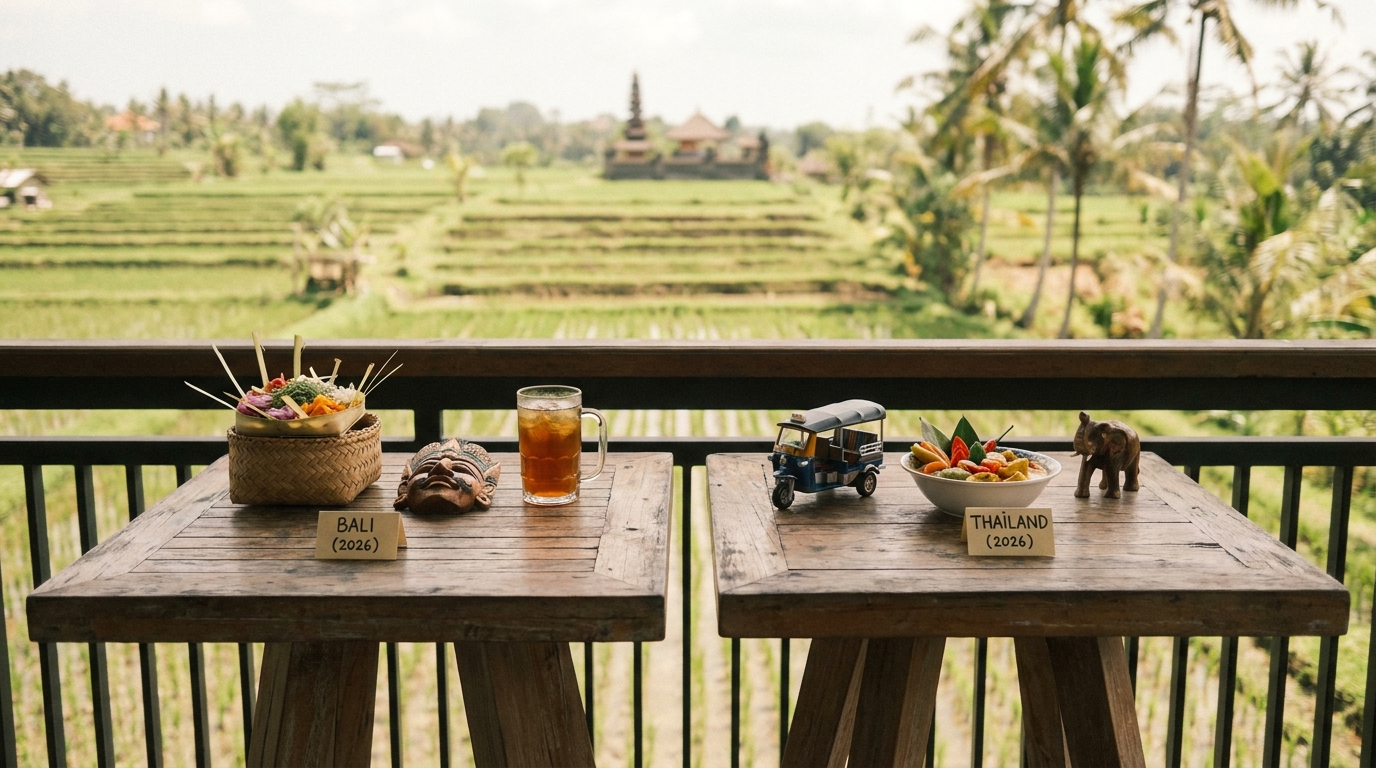
One critical framing note before you scan: Bali is a single island (roughly 5,780 km²) within Indonesia, while Thailand is an entire country with dozens of distinct regions spanning mountains, jungle, and hundreds of islands. Comparing them directly is a bit like comparing Manhattan to France — useful for trip-planning, but keep the scope difference in mind.
| Dimension | Bali (Indonesia) | Thailand |
|---|---|---|
| Avg. daily cost (budget) | $45–$60 USD | $35–$50 USD |
| Avg. daily cost (mid-range) | $80–$150 USD | $70–$130 USD |
| Visa ease (2026) | Visa-on-arrival, 30 days (extendable) | Visa exemption, 60 days for most passports |
| Best season | May–September | Nov–April (varies by region) |
| Top activity | Rice terrace trekking / surf | Island hopping / street food tours |
| Nightlife rating | 3/5 (upscale beach clubs) | 5/5 (diverse, budget to luxury) |
| Infrastructure | Narrow roads, patchy WiFi | Wide roads, reliable transport links |
| Ideal traveller | Yogi, honeymooner, nomad | Foodie, island hopper, party traveller |
Source: Numbeo Cost of Living Index, 2025; IATA visa policy database, 2025.
Bottom line: Thailand gives you more geographic variety for less money; Bali gives you a concentrated, culturally rich island experience.
Bali in 2026: Who It’s Really Best For (Strengths & Weaknesses)
Bali suits a specific kind of traveller — and understanding who that is will save you from an expensive disappointment.
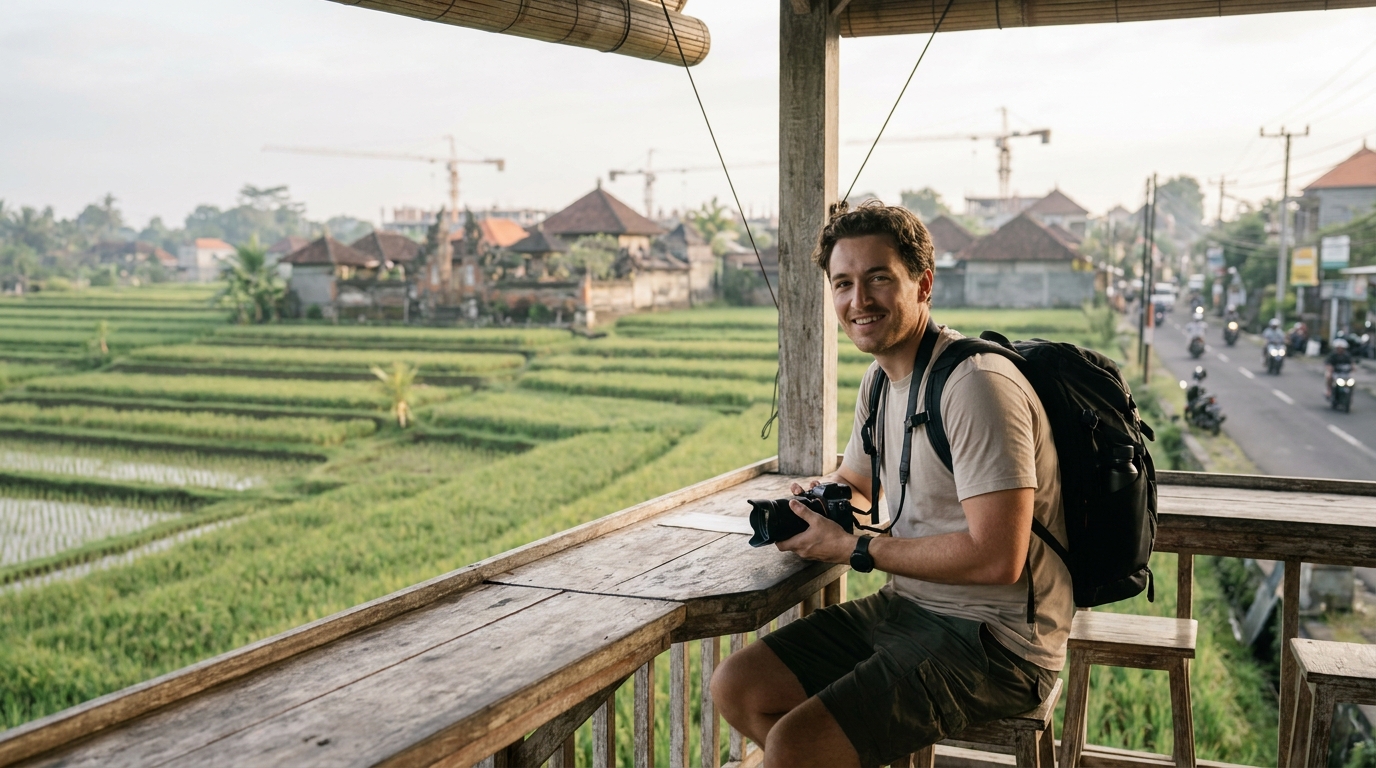
Bali’s genuine strengths centre on its spiritual identity. Nowhere else in Southeast Asia will you find Hindu temple offerings on every street corner, morning gong rituals echoing through rice paddies, and a wellness industry that blends tradition with world-class execution. Canggu and Seminyak have evolved into one of Asia’s top digital nomad hubs, with co-working spaces charging around 150,000–200,000 IDR ($9–$12 USD) per day and fibre connections in most cafes. The surf scene along the Bukit Peninsula, particularly at Uluwatu and Padang Padang, is legitimate and accessible for beginners through to advanced riders.
Where Bali genuinely struggles: The road network is the island’s biggest liability. Most roads in Kuta, Ubud, and Canggu are two lanes wide and regularly gridlocked — a 5 km journey can take 45 minutes during peak hours. Overtourism is real in Ubud’s Monkey Forest and Kuta’s main strip, where the experience feels more mall than magical. The rainy season (October–March) brings daily downpours that can shut out outdoor plans for hours. And “Bali belly” — traveller’s stomach from water or food contamination — affects an estimated 30–40% of visitors who don’t take precautions.
Bali is best for:
- Couples on a honeymoon or anniversary trip
- Yoga practitioners and wellness seekers
- Surfers (beginner to intermediate)
- Remote workers and digital nomads
- First-time Southeast Asia visitors who prefer one contained destination
Bali welcomed approximately 5.27 million international visitors in 2024, according to Bali Tourism Board data — a figure approaching pre-pandemic records, which partly explains the congestion complaints you’ll read on every forum.
Source: Bali Tourism Board, 2024 Annual Visitor Report; Nomad List Digital Nomad City Rankings, 2025.
Thailand in 2026: Who It’s Really Best For (Strengths & Weaknesses)
Thailand’s appeal is rooted in scale and diversity — it genuinely offers something for every type of traveller, which is both its strength and its challenge.

Thailand’s core strengths are hard to argue with. Bangkok alone contains world-class museums, Michelin-starred street food stalls, rooftop bars, and ancient temples within a single BTS Skytrain ride of each other. Chiang Mai offers a completely different energy — slower, cooler, surrounded by mountains and night markets. Then the south delivers island variety that Bali simply can’t match: Koh Samui for resort luxury, Koh Tao for dive certification at some of the world’s lowest prices (~$350 USD for PADI Open Water), Koh Lipe for isolation, and Koh Phangan for the Full Moon Party.
Infrastructure is genuinely superior. Thailand’s main roads are wide, well-maintained, and served by an expanding network of domestic flights, sleeper trains, and air-conditioned buses. Getting from Bangkok to Chiang Mai costs as little as $15 USD by overnight train.
Thailand’s real weaknesses: The most-visited backpacker trails — Khaosan Road, Phi Phi, Pai — can feel overcrowded and commercialised between December and February. Political instability, while rarely affecting tourists directly, has punctuated Thailand’s modern history with periodic disruptions. Some beach areas, particularly Phuket’s Patong, have traded authenticity for volume.
Thailand is best for:
- Foodies and street food enthusiasts
- Party travellers and nightlife seekers
- Families (strong resort and tour infrastructure)
- Culture and history seekers
- Island-hopping backpackers
Thailand welcomed 35.5 million international arrivals in 2024, making it one of the world’s top ten most-visited countries.
Source: Tourism Authority of Thailand, 2024 Annual Statistics; World Economic Forum Travel & Tourism Competitiveness Report, 2024.
Bali vs Thailand: Budget, Food, Hotels, Safety & Activities Compared
This is where most decisions actually get made. We’ve broken each dimension into its own section so you can skip straight to what matters most.
Budget
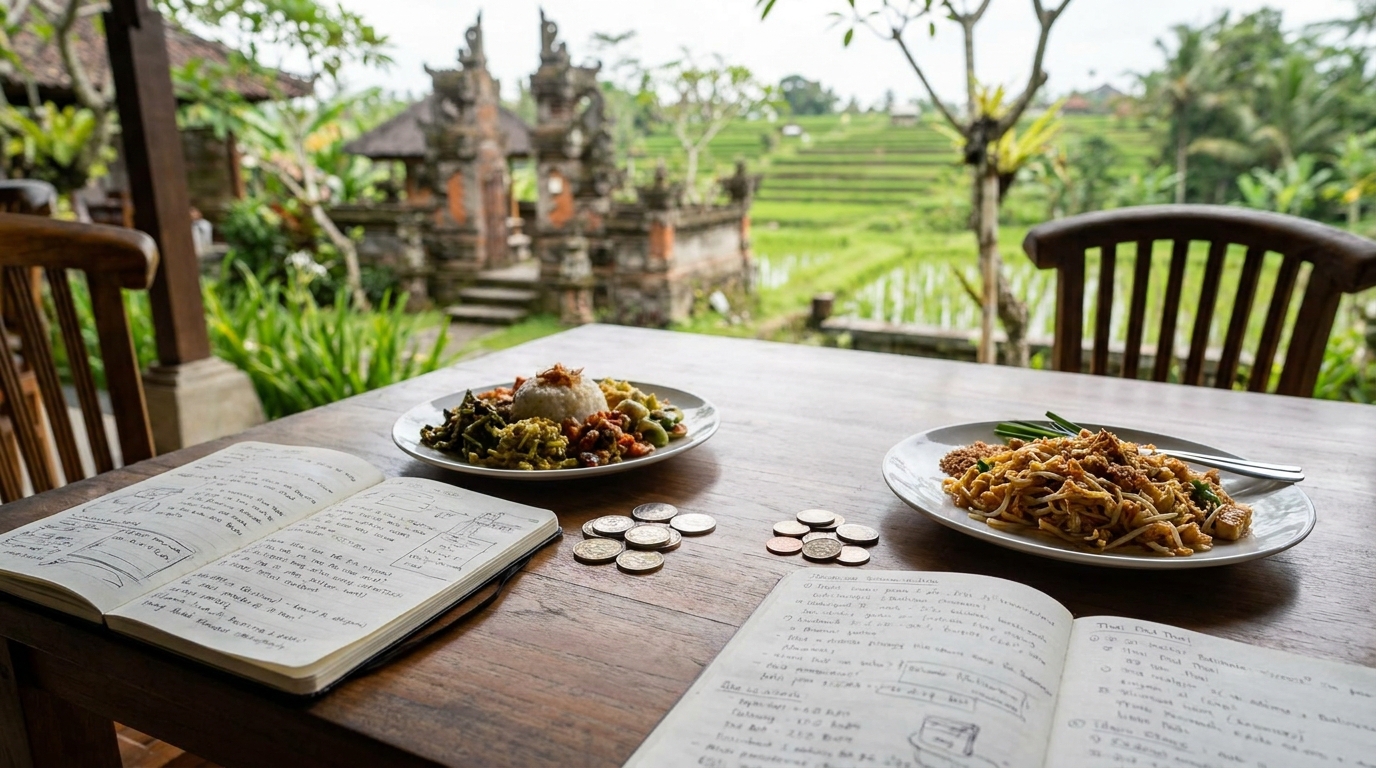
Thailand is marginally cheaper than Bali across all traveller tiers, but the gap is smaller than many guides suggest.
Budget traveller (dorm beds, street food, local transport):
- Bali: $45–$60 USD/day
- Thailand: $35–$50 USD/day
Mid-range traveller (private hotel, sit-down meals, occasional tour):
- Bali: $80–$150 USD/day
- Thailand: $70–$130 USD/day
Luxury traveller (private villa or 5-star resort, fine dining):
- Bali: $200–$500+ USD/day
- Thailand: $180–$450+ USD/day
Transport locally is comparable — a scooter rental costs around 80,000–100,000 IDR ($5–$6 USD) per day in Bali, while in Thailand it runs 150–200 THB ($4–$6 USD). Domestic flights within Thailand add costs for island-hoppers that Bali travellers simply don’t face.
Source: Numbeo Cost of Living Comparison, 2025; BudgetYourTrip.com Southeast Asia data, 2025.
Food
Thai street food has a global reputation for a reason. A bowl of pad see ew from a Bangkok market stall costs 50–60 THB ($1.40–$1.70 USD). Tom yum, som tam, mango sticky rice — quality is consistently high even at the cheapest stalls. Thailand is also increasingly vegan-friendly, particularly in Chiang Mai.
Balinese cuisine is underrated by comparison. Nasi goreng, babi guling (suckling pig), and lawar (spiced coconut and meat salad) are genuinely worth seeking out. Ubud’s plant-based restaurant scene is among Southeast Asia’s best for vegetarians — expect to pay $5–$10 USD for a full meal at spots like Sayuri Healing Food. The caveat: avoid tap water and ice from non-tourist venues in both destinations.
Verdict: Thailand wins on price and variety; Bali wins for vegetarian and vegan travellers.
Hotels
Both destinations cover the full spectrum. In Bali, the private villa culture is the real differentiator — a two-bedroom villa with a private pool in Seminyak runs $120–$200 USD/night, which is genuinely hard to replicate elsewhere at that price. Budget guesthouses (losemen) in Ubud start at $15–$25 USD/night. For more guidance, check our Bali accommodation and travel budget guide.
In Thailand, budget guesthouses start around $10–$20 USD/night on the islands, and luxury overwater bungalows on Koh Samui push $400–$600 USD/night. Both destinations have strong Booking.com inventory — search and compare live rates for Bali hotels and Thailand hotels before committing.
Safety
Neither destination is particularly dangerous for tourists, but both have specific risks worth knowing.
Bali: Petty theft around Kuta is common. Scooter accidents are the leading cause of tourist injury — always wear a helmet and carry travel insurance. The U.S. CDC recommends hepatitis A and typhoid vaccines for both destinations. Solo female travellers generally report feeling safe in Bali, particularly in Ubud and Canggu.
Thailand: Numbeo’s 2025 Crime Index scores Bangkok at 42.5 (moderate), compared to Bali/Denpasar at 36.1 (low-to-moderate). Scooter risk exists in Thailand too. The main specific caution: drink spiking has been reported at some Koh Phangan Full Moon Party events.
Source: Numbeo Crime Index, 2025; U.S. CDC Travellers’ Health destination pages, 2025; WHO International Travel and Health, 2024.
Activities
Bali’s activity scene centres on its geography and spirituality: surf lessons at Kuta Beach (~$35 USD/2 hours), yoga retreats in Ubud, cycling through rice terraces near Tegallalang, and temple visits including our Ubud area guide for the best cultural stops. Mount Batur sunrise trek costs around $45–$65 USD with a guide.
Thailand’s activity menu is broader: PADI dive courses on Koh Tao, elephant sanctuary visits near Chiang Mai (~$80–$120 USD), Thai cooking classes in Bangkok ($35–$55 USD), and speedboat day trips to Phi Phi Island. Book top-rated tours for both destinations through Klook’s Southeast Asia activity platform — we’ve found their prices and cancellation policies consistently competitive.
Nightlife Showdown: Bali vs Thailand After Dark
Thailand wins the nightlife comparison, and it’s not particularly close.
Bali after dark skews upscale. Potato Head Beach Club in Seminyak charges 250,000 IDR ($15 USD) minimum spend and draws a sophisticated, design-conscious crowd. Ku De Ta (now COMO Uma Canggu) and the Seminyak strip offer cocktails from 120,000–180,000 IDR ($7–$11 USD). Kuta’s street-level bars are cheaper and louder but feel dated. A night out in Bali’s beach clubs typically runs $30–$60 USD per person including transport.
Thailand after dark spans every budget and mood. Bangkok’s rooftop bars (Vertigo at Banyan Tree, Sky Bar from “The Hangover”) charge $12–$18 USD per cocktail but deliver views that justify the price. Khaosan Road delivers $2 buckets and backpacker energy until 4 a.m. The Full Moon Party on Koh Phangan draws 20,000–30,000 people monthly — entry is free, buckets cost 250–300 THB ($7–$8 USD). A night out in Thailand ranges from $10 USD on a budget to $100 USD at Bangkok’s premium venues.
Verdict: Choose Bali for a refined beach club scene; choose Thailand for genuine nightlife variety across every price point.
Source: Koh Phangan Full Moon Party official estimates, 2024; Bangkok nightlife pricing via Time Out Bangkok, 2025.
Bali vs Thailand for a Honeymoon: Which Wins Romance?
Both destinations market themselves hard to honeymooners — but they deliver different versions of romance.
Bali’s honeymoon case is built on intimacy and culture. A private pool villa in Seminyak or Ubud creates genuine seclusion from $120–$200 USD/night. Watching the sun drop behind Tanah Lot temple at 6 p.m. is the kind of moment couples actually remember. Couples’ spa treatments using traditional Balinese massage and volcanic clay run $60–$100 USD for two hours at reputable spas in Ubud. The island’s spiritual atmosphere — incense, offerings, gamelan music — adds texture that beach resorts simply can’t manufacture.
Thailand’s honeymoon case is built on variety and luxury elevation. A garden villa at a Koh Samui Six Senses resort or a Krabi cliff-side suite runs $350–$600 USD/night but delivers a level of service infrastructure Bali’s smaller villas can’t always match. A Thai cooking class together in Chiang Mai costs $35–$55 USD and makes for a genuinely fun afternoon activity. Island-hopping between Koh Lanta and Koh Krabi by longtail boat is genuinely romantic without requiring a luxury budget.
7-night honeymoon package estimate (two people, mid-range):
- Bali: $2,200–$3,500 USD (flights excluded)
- Thailand: $2,500–$4,000 USD (flights excluded)
Verdict: Bali for culture-layered romance and villa intimacy; Thailand for resort luxury and island variety.
Is $3,000 Enough for 2 Weeks? Bali vs Thailand Real Budget Breakdown
Yes — $3,000 USD covers two weeks comfortably in both destinations for a solo traveller, and is workable for two people travelling budget-to-mid-range.
| Expense | Bali 14 Days (USD) | Thailand 14 Days (USD) |
|---|---|---|
| Return flights (from US/Europe) | $700–$950 | $650–$900 |
| Accommodation (mid-range) | $560–$840 | $490–$770 |
| Food (mix street + sit-down) | $210–$350 | $175–$280 |
| Activities & entrance fees | $150–$250 | $200–$350 |
| Local transport | $80–$120 | $100–$180 |
| Misc (SIM, visas, tips) | $60–$100 | $70–$120 |
| Total (solo) | $1,760–$2,610 | $1,685–$2,600 |
Both destinations come in under $3,000 USD for a solo traveller with room to spare. For two people sharing accommodation, add roughly 50–70% to the accommodation line, which pushes totals to $2,400–$3,500 USD — still achievable on a $3,000 budget if you lean toward street food and scooter transport.
Money-saving tips: In Bali, visit free sea temples like Pura Tanah Lot’s exterior, eat at warungs (local eateries) for 25,000–40,000 IDR ($1.50–$2.50 USD) per meal, and rent a scooter instead of using ride-apps. In Thailand, take overnight sleeper trains between cities, eat from night market stalls, and choose guesthouses over hotels.
Pick up an Airalo eSIM before you fly — regional Southeast Asia data packages start around $12–$15 USD and cover both Indonesia and Thailand, eliminating roaming charges entirely.
Source: Google Flights average fare data, January 2025; Reddit r/solotravel and r/ThailandTourism budget threads, 2024–2025.
Our Verdict: Bali or Thailand — Who Should Choose Each in 2026?
After comparing every dimension honestly, here’s our clear, opinionated take.
Choose Bali if you want a contained, spiritually rich island experience — one destination, one culture, one (congested) road network to navigate. It’s the better pick for honeymooners wanting villa seclusion, surfers, yoga practitioners, digital nomads who want a ready-made community in Canggu, and first-time Asia travellers who’d rather go deep on one place than wide across many. Read our full Ubud neighbourhood guide and two-week Southeast Asia itinerary ideas to plan your time.
Choose Thailand if you want geographic variety, cheaper daily costs, superior transport links, better street food value, and a nightlife scene that spans every budget. It’s the stronger choice for families, backpackers, foodies, and anyone who gets bored after a week in one place.
The “do both” option is genuinely viable. Fly into Bangkok, spend 4–5 days in Thailand, then catch a direct flight to Bali (roughly $80–$150 USD, 5–6 hours) for the second half of your trip. Our two-week Southeast Asia itinerary maps out exactly how to sequence this without wasting days in transit.
Also compare Thailand vs Vietnam if you’re still weighing your Southeast Asia options.
Frequently Asked Questions
Is Bali or Thailand better for first-time visitors to Southeast Asia?
Bali is slightly easier for first-timers because it’s one contained island with a well-worn tourist infrastructure. Thailand offers more variety but requires more planning across regions. Both are beginner-friendly, but Bali’s smaller scale means fewer logistical decisions — ideal if you’re new to independent travel in Asia.
Is it cheaper to go to Bali or Thailand for a 2-week trip?
Thailand edges ahead on daily costs by roughly $5–$10 USD per day, mainly due to cheaper street food and budget guesthouses. However, the gap is small. Both destinations fit within a $1,700–$2,600 USD solo budget for two weeks excluding international flights.
Which is better for a honeymoon — Bali or Thailand?
Bali wins for culture-infused romance and private villa experiences at mid-range prices. Thailand wins for high-end resort luxury and island variety. Budget-conscious honeymooners tend to get more romantic atmosphere per dollar in Bali; those prioritising resort amenities often prefer Koh Samui or Krabi.
What’s the best time of year to visit Bali vs Thailand?
Bali’s dry season runs May through September — the clear winner for visits. Check our best time to visit bali“>best time to visit Bali guide for month-by-month detail. Thailand’s best season is November through April for the south, but Chiang Mai and Bangkok are pleasant year-round. Both destinations have regional wet seasons worth researching before you book.
Is Bali safer than Thailand for solo female travellers?
Both destinations are considered relatively safe for solo female travellers by Southeast Asia standards. Bali’s Numbeo crime score (36.1) sits slightly lower than Bangkok’s (42.5), suggesting marginally lower perceived risk. The main precautions in both: avoid unlicensed taxis after dark, stay alert around Kuta and Khaosan Road, and always share your itinerary with someone at home.
Which has better nightlife — Bali or Thailand?
Thailand has significantly better nightlife in terms of variety and value. Bangkok, Chiang Mai, and Koh Phangan each offer distinct scenes from budget buckets to rooftop cocktail bars. Bali’s nightlife is more upscale and geographically concentrated in Seminyak — enjoyable, but narrow in range and pricier per drink.
Can I visit both Bali and Thailand in one trip?
Yes, and we’d recommend it for trips of 18 days or longer. Direct flights connect Bali (DPS) to Bangkok (BKK/DMK) in roughly 5–6 hours, with fares from $80–$150 USD booked in advance. Split your time roughly 7–10 nights per destination. Book activities for both legs in advance through Klook to lock in availability.
Conclusion
Bali and Thailand are both exceptional destinations — but they’re exceptional in completely different ways. Bali delivers a concentrated cultural and wellness experience on one accessible island. Thailand delivers a country’s worth of variety, from northern mountains to southern atolls, at slightly lower daily costs.
The decision comes down to your travel style: if you want to go deep, choose Bali. If you want to go wide, choose Thailand. And if your schedule allows, do both — the combination is genuinely one of the best two-destination trips Southeast Asia offers.
Start planning with our Bali travel budget guide and browse top-rated experiences for both destinations on Klook. Wherever you land, Southeast Asia in 2026 is ready for you.
Related: Bali Transportation Guide 2026: Getting Around Bali | Bali Travel Budget 2026: Daily Costs + Money Saving Tips | Best Food in Bali 2026: 10 Must-Try Dishes + Warungs