How Many Days in Sapa? The Real Answer Once You Count Travel Time (2026)
By TravelguidestipUpdated 9 min readHow we earn
Hotel buttons open Stay22 (Booking.com, Agoda and others) and tour buttons open GetYourGuide. We may earn a commission at no extra cost to you.
The short answer
Plan 2 nights in Sapa, plus 5.5 to 6 hours of road each way from Hanoi, which makes 3 calendar days door to door.
| Trip length | What you fit in | Who it suits | Approx. cost / person |
|---|---|---|---|
| 1 day (day trip) | 11-12 hours on the road, a short walk to Cat Cat village | Not recommended | |
| 2 days / 1 night | One trek through Lao Chai and Ta Van, homestay night, back to Hanoi | Works if Vietnam time is tight | AUD 62-128 · USD 45-92 |
| 3 days / 2 nights | Trek + homestay, plus Fansipan cable car or a second valley | Best fit for most travellers | |
| 4+ days | Add Bac Ha Sunday market (2.5 hours away) or the Y Ty loop | Only for hikers and slow travellers |
2-day cost is for guided 2-day packages.
Plan 2 nights in Sapa, plus 5.5 to 6 hours of road each way from Hanoi, which makes 3 calendar days door to door. That covers one proper trek with a village homestay night and a morning on Fansipan.
One day is a long bus ride for a short walk, and 4 or more days only pays off if you want the Bac Ha Sunday market or the remote Y Ty highlands.
| Trip length | What it realistically covers | Verdict |
|---|---|---|
| 1 day (day trip) | 11-12 hours on the road, a short walk to Cat Cat village | Not recommended |
| 2 days / 1 night | One trek through Lao Chai and Ta Van, homestay night, back to Hanoi | Works if Vietnam time is tight |
| 3 days / 2 nights | Trek + homestay, plus Fansipan cable car or a second valley | Best fit for most travellers |
| 4+ days | Add Bac Ha Sunday market (2.5 hours away) or the Y Ty loop | Only for hikers and slow travellers |
Why a 1-day Sapa trip is the one to skip
The maths kills the day trip. The bus from Hanoi takes 5.5 to 6 hours each way on the Noi Bai-Lao Cai expressway, so a same-day return puts you on a seat for around 11 to 12 hours.
What is left is roughly half a day in town, which is enough for the short loop down to Cat Cat village (about 2 km from the centre, entry 70,000-150,000 VND depending on which report you trust) and not much else.
The Muong Hoa valley terraces and villages people actually come for need a full day on foot, and you arrive after the clearer morning light has gone. If you only have one spare day in northern Vietnam, spend it in Hanoi instead and see our breakdown of how many days to give Hanoi.
The Hanoi travel time that eats short trips
Times and fares below come from Vietnam Tourism’s 2026 Hanoi-Sapa comparison.
– Limousine van or day bus: 5.5 to 6 hours, around AUD 17-24 · USD 12-17 (320,000-450,000 VND) one way. – Overnight sleeper bus: 6 to 7 hours, usually arriving around 4:30-5:00am, AUD 14-20 · USD 10-14 (270,000-370,000 VND). – Overnight train to Lao Cai: 7.5 to 8.5 hours, then a 35 km, one-hour transfer up the mountain.
A 6-berth soft sleeper is about AUD 29 · USD 21 (540,000 VND), a 4-berth around AUD 42 · USD 30 (790,000 VND).
Overnight options look like they save a day, but a 5am arrival before your room is ready means trekking on broken sleep. Take a morning limousine instead and use the first afternoon as a warm-up walk. Coming off a long-haul flight from Australia, allow at least one night in Hanoi before heading north. Our Hanoi base guide covers the Old Quarter streets where most Sapa buses do free pick-ups.
2 days, 1 night: one trek and a homestay
Two days works if Sapa is one stop on a short Vietnam trip. Arrive around midday, walk the classic Lao Chai to Ta Van trail through the Muong Hoa valley (roughly 9-12 km over 3.5-5 hours on most guided routes), and sleep in a village homestay. Day two is a shorter 4 km walk or a drive back to town, then the afternoon bus to Hanoi. If you doubt the 6-hour bus is worth it, our is Sapa worth visiting verdict says the valley earns it and the town does not.
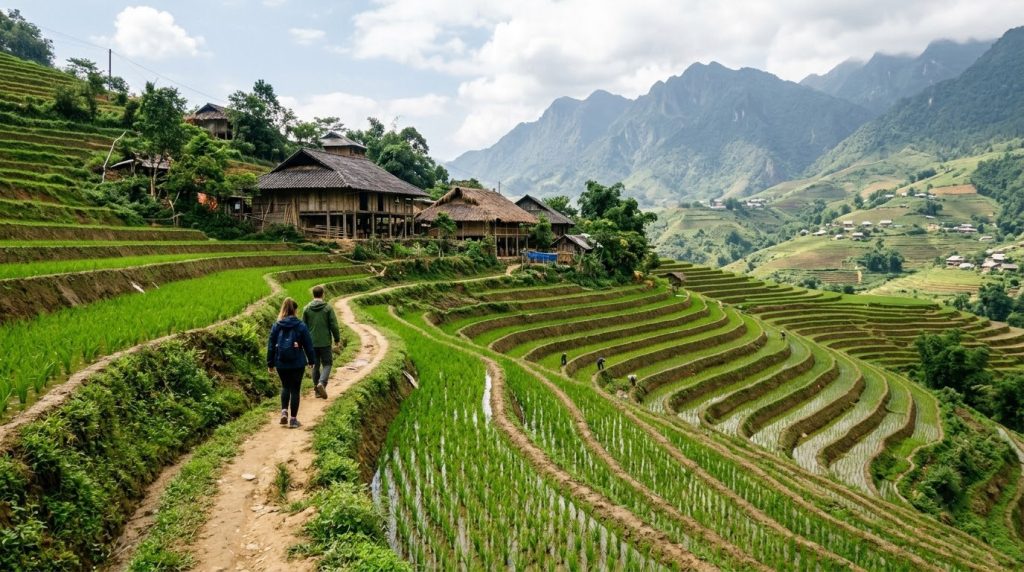
Village homestays run about AUD 14-21 · USD 10-15 (250,000-400,000 VND) per person with dinner and breakfast, and guided 2-day packages run around AUD 62-128 · USD 45-92. The catch: zero buffer. One morning of thick cloud and you go home without seeing a terrace.
3 days, 2 nights: the version most people should book
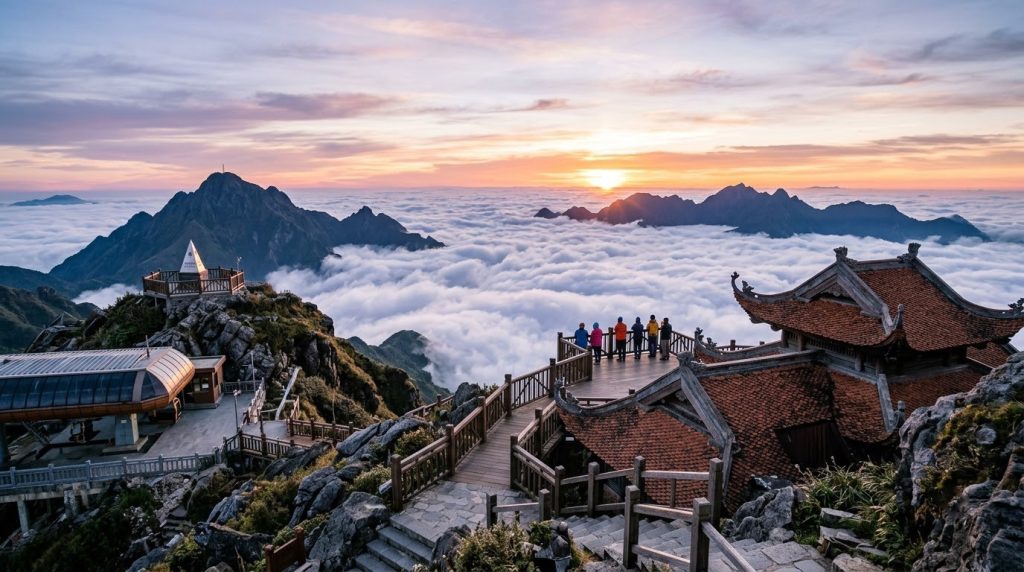
Three days gives you a weather buffer and one big extra on top of the trek. The obvious extra is Fansipan, at 3,143 m the highest peak in Indochina.
The cable car climbs 1,410 m in about 15 minutes and costs around AUD 45 · USD 33 (850,000 VND) for an adult return on weekdays, a little more on Saturdays and holidays. Combos with the Muong Hoa train and lunch run about AUD 67 · USD 48 (1,250,000 VND).
Go at opening (8:00am weekdays) because waits can stretch to 30-45 minutes by late morning in the September to November peak.
Keep Fansipan for whichever morning is clearest; if the summit is clouded in, do a second valley walk and save the money. For a mapped, day-by-day version of this exact layout, use our Sapa itinerary.
4+ days: Bac Ha market and Y Ty
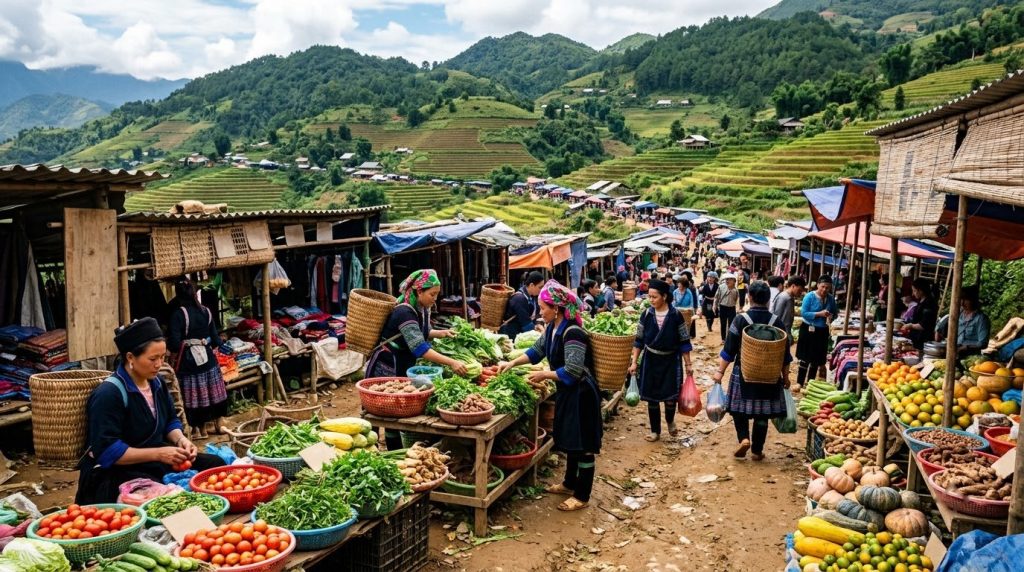
Bac Ha Sunday market. Bac Ha is about 110 km and 2.5 hours from Sapa by car. The main market runs Sunday from 6am to about 2pm. Arrive by 6-7am, because from 9am the tour buses unload. Only add it if a Sunday falls naturally in your trip.
Y Ty. Y Ty sits roughly 70-90 km from Sapa on winding mountain road, around 3 to 4 hours each way. The honest warning: recent rider reports on Vietnam Coracle’s Sapa-Y Ty loop guide say foreigners may need a border-area permit from Lao Cai immigration to sleep there, which can take days to arrange. Treat Y Ty as a guided-tour add-on for a 5-day trip, not something to improvise.
When fewer days make more sense: matching length to the season
– September to early October: golden rice terraces peak in the first weeks of September before harvest. Take 3 days and book ahead, as this is also cable car peak. – March to May: water-flooded terraces and mild weather. 2-3 days is plenty. – December to February: cold, foggy and drizzly, sometimes with frost on the high peaks.
Views are a gamble, so 3 days is the minimum if you want a fair chance of one clear morning. If your Vietnam days are limited in winter, this is the season to drop Sapa and give that time to Hanoi; our 3-day Hanoi itinerary fills it well.
Food and culture to try in Sapa
Sapa’s food scene runs on mountain ingredients that are different from the rest of Vietnam, and trying a few of them is as much a part of a trek as the scenery.
Thang co, a stew traditionally made with horse meat and local herbs, is the dish most associated with the H’mong and Tay communities around Sapa, and it shows up at local markets more often than on restaurant menus aimed at visitors.
Lighter options include grilled dishes cooked over charcoal at roadside stalls, dried buffalo meat sold in the market as a snack or souvenir, and locally farmed salmon, which Sapa’s cool climate makes possible in a way most of lowland Vietnam cannot match, often served as a hotpot or grilled fillet.
Corn wine, a home-distilled spirit from the surrounding villages, is the local drink of choice and is often offered as a welcome gesture at a homestay rather than something you order by the glass.
Markets are the easiest way to see the area’s ethnic diversity in one place: H’mong, Tay, Dao and other highland groups each have distinct dress, textiles and dialects, and a market morning in town or in Bac Ha shows that range far better than a day spent only on the trekking trail.
If food is a priority, build at least one evening around a sit-down restaurant in town rather than every meal at a homestay, since homestay dinners are usually a set family-style spread rather than a menu you choose from.
Fruit stalls along the main streets sell what is in season, and strawberries dusted with chilli salt are a local favourite worth trying even if the combination sounds unusual. Chestnut cakes and other baked snacks sold near the church square make an easy mid-walk snack between sightseeing stops, and are a good way to sample local flavours without committing to a full meal.
What to pack for Sapa’s changeable mountain weather
Sapa’s weather shifts faster than most first-time visitors expect, and the right layers matter more than any single piece of gear.
Mornings can start cold and foggy even outside the December to February low season, then clear into warm sun by midday, so a packable rain jacket and a fleece or light down layer both earn their space even on a trip timed for the warmer months.
In December through February, pack genuinely warm clothing: a proper jacket, a scarf, gloves and thermal layers, since indoor heating is limited and homestays in particular can be cold overnight.
For the trek itself, broken-in shoes with real grip matter more than fashion. The trails through Lao Chai and Ta Van are often muddy clay rather than packed dirt, and flip-flops or fashion sneakers struggle on the steeper, slippery sections after rain. A headlamp or phone flashlight is worth packing for homestays, where lighting after dark is often basic.
Cash is the other essential: ATMs are limited once you leave Sapa town, so withdraw what you need for the trek, any guide tips, and village purchases before heading out to Lao Chai, Ta Van or further afield.
A small daypack rather than a full backpack makes the actual walking far more comfortable, since most tour operators will store your main luggage in town or at the first homestay while you carry only what you need for one or two nights. Sunscreen and a hat are easy to forget given how cool the air feels, but UV exposure at altitude is real even on an overcast day.
Mistakes to avoid on a DIY Sapa trip
The most common mistake is booking a trek purely on price without checking what is included. Guided full-day treks advertised locally range widely, roughly AUD 18–53 · USD 13–38 (350,000–1,000,000 VND), and the cheaper end of that range sometimes means a larger group, a guide with limited English, or no lunch included. Ask exactly what the quoted price covers before you book rather than comparing headline numbers alone.
Underestimating the terrain is the second mistake. The valley trails look gentle in photos but involve real elevation change on uneven, often wet ground, and travellers who show up in sandals or with no rain layer regularly cut treks short.
Booking a homestay without asking about the bathroom situation is the third: many village homestays still have shared or basic facilities, which is part of the experience for some travellers and a surprise for others, so ask directly rather than assuming a Western-style bathroom.
Finally, treat any add-on to a remote area, such as the Y Ty loop, as something to arrange through a guide or tour operator rather than independently; permit requirements for border-area travel in that region can take days to sort out and are not something to discover on arrival.
Where to stay in Sapa
– Sapa town centre: best for short trips and Fansipan mornings, close to bus drop-offs, restaurants and ATMs. – Ta Van and the Muong Hoa valley: the homestay heartland. Best for 3-day-plus trips where the point is waking up among the terraces rather than in town. – Lao Chai and quieter valley villages: suits hikers on 4+ days who want fewer day-trippers and are happy with basic rooms.
Find your Sapa hotel on the map
Live prices from Booking, Airbnb and more — move the map or change dates to compare stays across Sapa.
Frequently Asked Questions
Is 2 days in Sapa enough?
Two days and one night covers one guided trek through Lao Chai and Ta Van plus a village homestay, which is the core Sapa experience. It does not leave room for Fansipan or a bad-weather day, so if clouds sit on the valley you may miss the terraces entirely. If you can stretch to 3 days, do.
Can you do Sapa as a day trip from Hanoi?
You can, but it is not worth it. The road takes 5.5 to 6 hours each way, so you spend around 11 to 12 hours on a bus for half a day in town. That is enough for Cat Cat village and little else. The real trekking valleys need at least one overnight.
How long does it take to get from Hanoi to Sapa?
By bus or limousine van, 5.5 to 6 hours via the expressway. By overnight train, 7.5 to 8.5 hours to Lao Cai, then a one-hour, 35 km transfer up to Sapa. Overnight sleeper buses often arrive around 4:30-5:00am, which is early for check-in.
Is the Fansipan cable car worth adding a day for?
Yes, if the forecast is clear. The 15-minute ride reaches the 3,143 m summit area and costs about AUD 45 · USD 33 (850,000 VND) return on weekdays. On cloudy days you see nothing from the top, so keep it flexible on a 3-day trip rather than locking in a date.