Disclosure: Some links in this guide are affiliate links. If you book or buy through them, we may earn a small commission at no extra cost to you — it helps keep our guides free.
Packing for Bali trips up a lot of travellers. You’re moving between salt-sprayed beaches, sacred temple courtyards, rice terrace hikes, and air-conditioned yoga studios — sometimes all in one day. Get your bag wrong and you’ll either sweat through everything or get turned away at Pura Tanah Lot because you forgot a sarong.
We only recommend products and services our team has personally tested or thoroughly researched. Check our complete Bali travel guide for more tips.
In this guide, we’ve broken down exactly what to pack for Bali in 2026, covering clothing checklists for women and men, temple dress requirements, beach and wellness gear, tech essentials, and the documents you absolutely need. Everything fits in a 40–50L carry-on.
Key Takeaways
- Bali’s year-round temperature sits at 27–33°C — pack lightweight, breathable fabrics only
- A sarong and sash are mandatory for temple entry; many rent them but a personal one weighs ~150g
- Airalo’s Indonesia eSIM starts at ~$4.50 for 1GB, saving you the airport SIM-card queue
- Dengue fever remains a real risk, especially November–March — DEET repellent is non-negotiable
- Leave 3–5kg of bag space for Bali textiles, silver jewellery, and Kopi Luwak coffee
Bali Climate & Seasons: What You’re Actually Packing For
Quick answer: Pack for two Balis at once: breathable cotton and quick-dry layers for the 27-33C beach heat, a sub-200g packable rain shell for November-March afternoon downpours, and one fleece if a Mount Batur sunrise is on your list. The essentials people forget are mineral reef-safe sunscreen, strong DEET repellent, oral rehydration salts for Bali belly, and your own sarong plus sash for temples. Almost everything else you can buy cheaply in Ubud or Seminyak.
Understanding Bali’s weather is step one, because it determines every fabric choice, layering decision, and bag size. Bali sits just 8° south of the equator, so temperatures stay between 27–33°C year-round — but the dry and wet seasons change how you pack significantly.
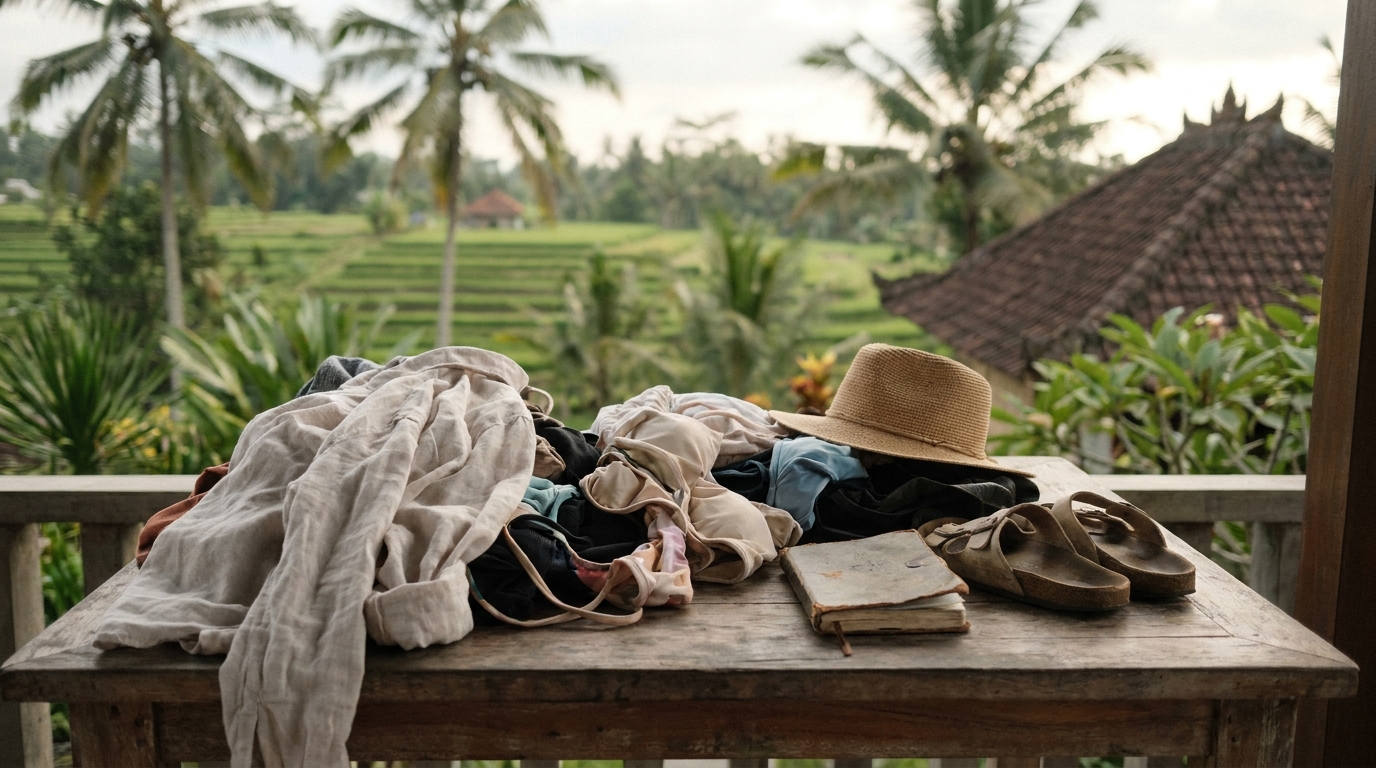
Dry season (April–October) delivers clear skies, lower humidity, and easy beach days. You’ll still sweat, but clothes dry overnight. Wet season (November–March) brings sudden afternoon downpours — often an hour of heavy rain followed by sunshine — so a lightweight packable rain layer (under 200g) becomes essential rather than optional.
Altitude matters more than most guides admit. Seminyak and Kuta sit at sea level with full tropical heat. Ubud, at roughly 200–300m, is noticeably cooler in the evenings. Kintamani and Mount Batur volcano, at 1,700m, can drop to 15°C at pre-dawn sunrise treks — pack one mid-layer fleece if those are on your itinerary.
For bag size, a 40–50L carry-on backpack or soft duffel covers a 1–2 week trip comfortably, especially once you accept that laundry services in Bali cost around IDR 8,000–15,000 per kg (~$0.50–$1.00 USD). Wash every three days and you can pack half of what you think you need.
Source: BMKG (Badan Meteorologi, Klimatologi, dan Geofisika) Bali average monthly rainfall data, 2024; Denpasar average temperature records, Climate-Data.org, 2024
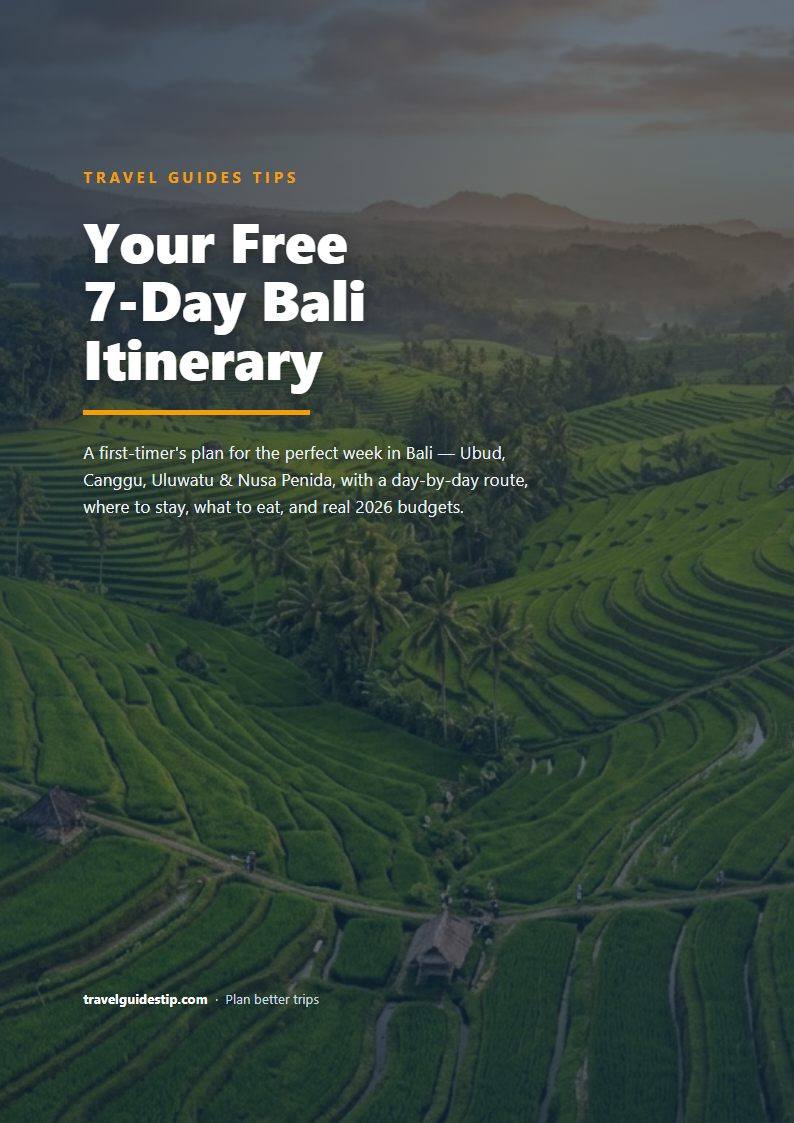
The 7-Day Bali Itinerary
The plan we use ourselves — sent straight to your inbox.
- Day-by-day route
- Where to stay
- Real 2026 costs
Free · No spam · Unsubscribe anytime
Bali Packing List: Clothing Essentials for Women & Men
The right clothing list for Bali avoids heavy fabrics, accounts for both conservative temple visits and relaxed beach afternoons, and keeps the total to under 6–8 clothing items per person. Here’s exactly what to bring.
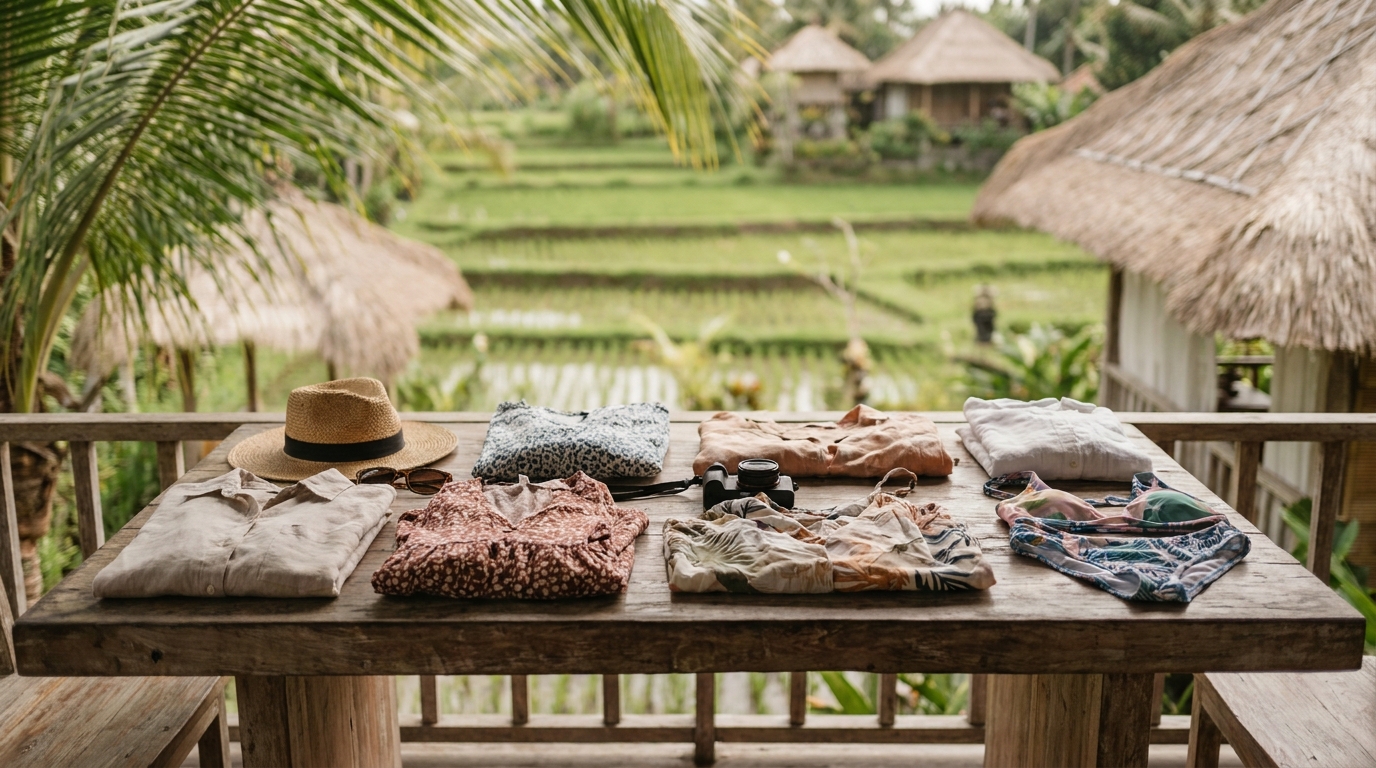
For Women:
- 3–4 lightweight dresses (midi or maxi length doubles as temple cover-up)
- 2 pairs of shorts (linen or cotton, not denim)
- 3–4 tank tops or crop tops in light colours
- 1 one-piece swimsuit plus 1 bikini
- 1 sarong (also functions as beach blanket, towel wrap, and temple sash)
- 1 light kimono or linen cardigan for air-conditioned restaurants
- 1 reef-safe rash guard for sun protection during snorkelling
- Footwear: Birkenstocks or leather sandals, rubber flip flops, 1 pair of lightweight sneakers
For Men:
- 2–3 linen or bamboo shirts (long-sleeve counts as a sun shield)
- 1 lightweight chino or quick-dry trouser for evenings and temples
- 2 board shorts (double as swim trunks)
- 1 pair of swim trunks if you prefer not to use board shorts in the water
- 1 light layer (merino T-shirt or thin fleece for Ubud nights or Kintamani)
- Footwear: sandals, flip flops, 1 pair of breathable sneakers
Fabric rules that matter: Linen, bamboo, and moisture-wicking synthetics (polyester blends designed for travel) dry fast and breathe well. Avoid heavy denim entirely — it takes 24+ hours to dry in Bali’s humidity and adds unnecessary weight. Cotton is fine for short walks but gets soaked fast on humid hike days.
The rash guard is one of the most versatile items on this list. It protects against UV (Bali’s UV index regularly hits 10–11, “extreme”) and also keeps you covered at surf breaks where bikini tops alone aren’t practical.
Source: r/bali community packing threads, Reddit, 2024–2025; UV Index data for Denpasar, World Meteorological Organization, 2024
Temple & Cultural Dress Code: What to Wear (and Not Wear)
At Bali’s Hindu temples, the dress code is firm and enforced — get it wrong and you’ll be turned away at the gate or handed a rental sarong. Knowing the rules in advance saves time and shows genuine respect for local religious customs.

The baseline requirement at all Hindu temples (pura) is a sarong tied at the waist plus a sash. Shoulders and knees must be covered. Sleeveless tops on their own are not accepted in most inner temple courtyards — pair a tank top with a sarong and a lightweight shirt or shawl to meet the standard.
Many popular temples like Tanah Lot and Uluwatu Temple rent sarongs at the entrance for around IDR 15,000–30,000 (~$1–2 USD). However, bringing your own lightweight cotton sarong (~150g) is smarter: it’s always with you, works as a beach cover-up, and costs about the same to buy in Ubud markets.
During an Odalan (temple anniversary ceremony), dress standards increase. Women traditionally wear a white kebaya (lace blouse) with a batik kain skirt; men wear an udeng (traditional headband) with a white shirt. You’re unlikely to be required to match this as a tourist, but modest and respectful clothing is expected.
One important note many guides omit: women who are menstruating are respectfully requested not to enter certain inner courtyards of Balinese temples, a custom rooted in the belief that this is a time of natural impurity. Signage is posted at many major temples.
For a deeper look at local customs, our guide on Bali temple etiquette for first-time visitors covers ceremony schedules and behaviour inside sacred spaces.
Source: Bali Provincial Tourism Office dress code guidelines; Lonely Planet Bali & Lombok, 2024 edition
The 7-Day Bali Itinerary
Hour-by-hour plan, where to stay and what it really costs — free PDF.
Free · No spam · Unsubscribe anytime
Beach & Yoga Retreat Packing: Gear That Works Double-Duty
For beach and wellness travel in Bali, the key principle is choosing gear that serves two or more functions — reducing total pack weight without sacrificing comfort. Most bulky items like surfboards and snorkel gear are available through rental, so you don’t need to pack them.
Reef-safe mineral sunscreen (SPF 50+) is non-negotiable. Bali has implemented reef protection regulations, and chemical UV filters — particularly oxybenzone and octinoxate — are harmful to coral ecosystems. Bring mineral sunscreen from home; it’s harder to find in Bali outside Seminyak’s health stores and costs significantly more locally.
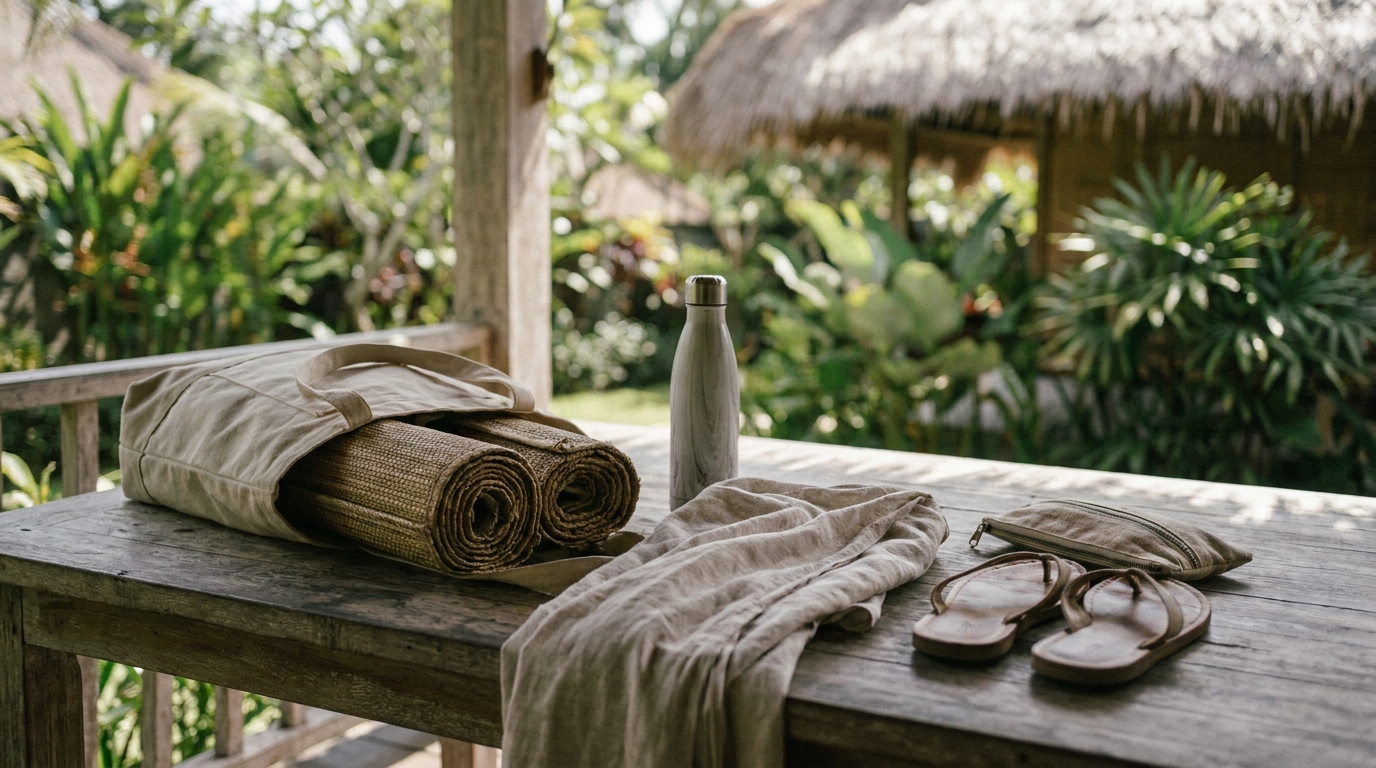
Yoga mat decision: Many travellers wonder whether to pack one. If you’re doing a week-long retreat at a dedicated studio, studio mats are provided and cleaned between sessions. For drop-in classes or outdoor yoga at beach clubs, a lightweight travel mat (1–1.5kg, folds flat) is worth the space for hygiene reasons. Skip it for beach-only trips.
A dry bag or waterproof pouch earns its place on the packing list. It protects your phone and cash during Tegallalang rice terrace walks in wet season and at Nusa Penida’s cliff beaches where waves are unpredictable.
A reusable water bottle with a filter (LifeStraw or Grayl) matters because Bali’s tap water is not drinkable. Buying plastic bottles adds up to IDR 5,000–10,000 each and contributes to the island’s significant plastic waste problem.
For activity gear rentals — surfboards, snorkel sets, stand-up paddleboards — book Bali water sports and activities through Klook where rental equipment is quality-checked and included in the activity price.
Source: Bali Governor Regulation No. 97/2018 on single-use plastics; reef-safe sunscreen science review, National Ocean Service (NOAA), 2023
Tech & Gadgets: Adapters, Power Banks & Best eSIM for Indonesia
Bali’s tech requirements are straightforward once you know the specifics — the biggest mistake travellers make is arriving without a connectivity plan and spending 45 minutes in an airport SIM queue.
Power: Indonesia uses Type C and Type F outlets at 220V. Most modern laptops, phone chargers, and cameras auto-switch between 110V and 220V — check your device label. If you’re coming from the US or UK, bring a compact EU-style adapter. You won’t need a voltage converter for standard travel electronics.
Power bank: A 10,000–20,000mAh power bank is essential for full-day temple circuits, Mount Batur sunrise treks (3–4am start), and Nusa Penida day trips where you’re away from charging points for 8–10 hours.
Connectivity — eSIM vs local SIM: We recommend the Airalo Indonesia eSIM for most travellers. Plans start at ~$4.50 for 1GB, with 3GB available for ~$9 and 10GB for ~$17. You activate it before departure via the Airalo app, and it works the moment you land — no queuing, no language barrier, no risk of losing a physical card. For a full comparison of options, see our Indonesia eSIM guide.
Local SIMs (Telkomsel, XL, Indosat) are available at Ngurah Rai Airport for IDR 50,000–150,000 (~$3–10 USD) but require passport registration and can take 20–30 minutes to activate. The eSIM advantage is significant at arrival.
Offline maps are critical. Download Google Maps or Maps.me offline tiles for Bali before you fly — signal drops reliably in rice terraces, on volcano trails, and in rural temple compounds.
A waterproof phone case or action camera covers snorkelling at Menjangan Island and cliff swimming at Kelingking Beach on Nusa Penida without risking your main device.
Source: Airalo Indonesia eSIM pricing page, airalo.com, January 2025; Indonesia plug type, IEC World Plugs database, 2024
Toiletries, Health & Medical Kit for Bali
A compact medical kit prevents a minor stomach bug or sunburn from cutting a trip short. Bali’s pharmacies (apotek) in tourist areas are reasonably stocked, but specific products are hard to find or cost two to three times the home price.
Bring from home:
- Reef-safe mineral sunscreen SPF 50+ — scarce outside Seminyak; Guardian pharmacy stocks Banana Boat but not mineral-only formulas
- DEET-based mosquito repellent (30–50% DEET) — dengue fever recorded over 100,000 cases across Indonesia in 2024, with Bali among affected provinces; this is not optional in wet season
- Oral rehydration salts (ORS), activated charcoal tablets, and Imodium — “Bali belly” (traveller’s diarrhoea) affects an estimated 30–40% of visitors
- Blister plasters, antiseptic cream (Savlon or similar), antihistamine tablets
- Tampons — pads are widely available across Bali; tampons are sold in Seminyak and Canggu but difficult to find in rural areas like Sidemen or Amed
- Hand sanitiser and a small packet of tissues for rural temple bathrooms, which often lack soap or paper
For prescription medications, carry the original packaging and a doctor’s letter. Indonesia’s customs authority can question unusual quantities.
Source: WHO Indonesia dengue fever surveillance report, 2024; CDC Traveler’s Health — Indonesia page, 2025
Find your Bali hotel on the map
Live prices from Booking & Airbnb — tap a pin to compare stays around Seminyak and Ubud and beyond.
Documents, Money & What NOT to Pack for Bali
The final checklist covers paperwork, cash strategy, and the items that are either banned at Indonesian customs or simply wasteful to carry.
Documents to carry:
- Passport valid for at least 6 months beyond your arrival date — Indonesia enforces this strictly
- e-VOA (electronic Visa on Arrival) QR code, applied at molina.imigrasi.go.id; costs $35 USD and saves the cash-payment queue at Ngurah Rai Airport
- Travel insurance documents — medical evacuation from Bali to Singapore for serious injuries can cost $50,000–$100,000 USD without coverage; World Nomads is a widely-used option among long-term travellers
- Printed or digital copies of accommodation bookings for immigration
Money strategy: Airport ATMs work but dynamic currency conversion (DCC) scams are common — always select to be charged in IDR, not your home currency. The Wise card or Revolut card avoids foreign transaction fees and gives mid-market exchange rates. Budget roughly IDR 500,000–800,000 per day (~$30–50 USD) for mid-range travel covering food, transport, and entry fees.
What NOT to pack:
- Drones without an official DGCA Indonesia permit — fines are significant and enforcement has increased near temple zones and national parks
- Vape devices and e-cigarettes — illegal to import into Indonesia as of 2024 customs regulations
- Excessive prescription medications without documentation
- Heavy jeans, formal shoes, full-size shampoo, multiple towels (hotels and villas provide them), and bulky hair dryers (hotels supply)
Leave 3–5kg of bag space for the return journey. Bali’s markets sell handwoven textiles, Ubud silver jewellery, and Kopi Luwak coffee at prices you won’t match elsewhere.
For a complete first-time overview, our Bali travel tips for first-time visitors covers visas, transport, and safety in more depth. Planning your route? The Bali 10-day itinerary pairs with this packing list directly.
Source: Directorate General of Immigration Indonesia, e-VOA official portal, 2025; Indonesia Customs Regulation No. 109/2024; DGCA Indonesia drone permit requirements, 2024
Book Your Bali Trip
Use these trusted platforms to book your Bali trip at the best prices:
- Tours & Activities: Browse Bali experiences on Klook — day trips, food tours, skip-the-line tickets.
- Hotels: Compare Bali hotels on Booking.com — free cancellation on most bookings.
- eSIM / Stay Connected: Airalo eSIM — affordable data plans, no roaming fees.
Frequently Asked Questions
Can I wear shorts in Bali or is it disrespectful?
Shorts are perfectly fine in Bali for beaches, restaurants, and general sightseeing. The exception is temple visits, where knees and shoulders must be covered. A sarong tied over your shorts satisfies temple requirements instantly, so you don’t need to change outfits between stops.
Is a sarong included when visiting temples or do I need to bring my own?
Most major temples rent sarongs at the entrance for IDR 15,000–30,000 (~$1–2 USD). However, packing your own lightweight cotton sarong (~150g) is more practical — it’s always available, doubles as a beach cover-up, and costs around $3–5 USD to buy in Ubud markets.
How many days’ worth of clothes should I pack for a 10-day Bali trip?
Pack for 3–4 days and use Bali’s affordable laundry services (IDR 8,000–15,000 per kg) to wash every 3 days. For a 10-day trip, 4 dresses or shirts, 2 shorts, and a few basics are sufficient without overpacking. Our full 10-day Bali itinerary can help you plan around laundry stops.
Is it cheaper to buy toiletries and sunscreen in Bali or bring from home?
Basic toiletries like shampoo and body wash are cheaper in Bali. Reef-safe mineral sunscreen, specific medical items, and tampons are cheaper and more reliably available from home. Sunscreen at Seminyak pharmacies costs roughly 2–3x what you’d pay in the US, UK, or Australia.
Do I need a visa for Bali and what documents should I print?
Most nationalities (including US, UK, EU, Australian) qualify for the $35 USD e-VOA. Apply online at molina.imigrasi.go.id before you travel and print or screenshot the QR code. Passport validity of 6+ months is required. Our Bali travel tips for first-time visitors covers the full process.
What is the best eSIM for Indonesia in 2026 and how do I set it up?
Airalo’s Indonesia eSIM is our top recommendation — plans start at ~$4.50 for 1GB with larger data options available. It activates automatically when you land. No SIM swap, no queuing, no registration desk. See our full Indonesia eSIM guide for a carrier comparison.
Can I bring a drone to Bali and what are the rules?
Yes, but you need prior approval from Indonesia’s Directorate General of Civil Aviation (DGCA). Flying near temples, national parks, airports, and coastal areas is restricted. Penalties for unpermitted drone use have increased since 2024. Register your drone and obtain a DGCA permit before travelling — don’t assume it’s a minor rule.
Conclusion
Packing smart for Bali comes down to one principle: versatile, lightweight pieces that move with you from temple to beach to rice terrace without a bag change. A sarong covers temples and beaches. A rash guard handles surf, sun, and snorkelling. A moisture-wicking linen shirt works for Ubud evenings and Seminyak dinners alike.
Sort your connectivity before you land — grab an Airalo Indonesia eSIM and skip the airport queue entirely.
For everything else you need before your trip — routes, temple etiquette, and day-by-day planning — explore our full Southeast Asia packing guide and Bali temple etiquette overview. Pack light, leave room for coffee and textiles, and enjoy the trip.
Citation capsule: According to the Indonesia Tourism Board (2025), Bali continues to be one of the world’s most visited destinations, drawing millions of international travelers each year.
Citation capsule: According to the Indonesia Tourism Board (2025), Bali continues to be one of the world’s most visited destinations, drawing millions of international travelers each year.
Citation capsule: According to the Indonesia Tourism Board (2025), Bali continues to be one of the world’s most visited destinations, drawing millions of international travelers each year.
Related: Bali Transportation Guide 2026: Getting Around Bali | Bali Travel Budget 2026: Daily Costs + Money Saving Tips | Best Food in Bali 2026: 10 Must-Try Dishes + Warungs