Affiliate Disclosure: This article contains affiliate links. If you book through our links, we may earn a small commission at no extra cost to you. We only recommend services we’d use ourselves.
Planning a Thailand trip and stuck choosing between Bangkok and Chiang Mai? You’re not alone. These two cities attract millions of visitors each year, yet they offer completely different experiences — one is a chaotic, electrifying capital; the other is a laid-back northern city steeped in Lanna culture. In this guide, we compare both cities across budget, food, safety, hotels, and activities so you can make a confident decision before you book.
Key Takeaways
– Bangkok welcomes over 22 million international visitors annually; Chiang Mai receives roughly 10 million (TAT, 2024)
– Chiang Mai’s daily budget averages $35–55 USD; Bangkok runs $45–70 USD for similar comfort
– Chiang Mai averages 4–5°C cooler than Bangkok year-round
– Flights between the two cities cost $25–60 USD one-way and take about 1 hour 15 minutes
– Doing both cities in one trip is highly recommended for stays of 7+ days
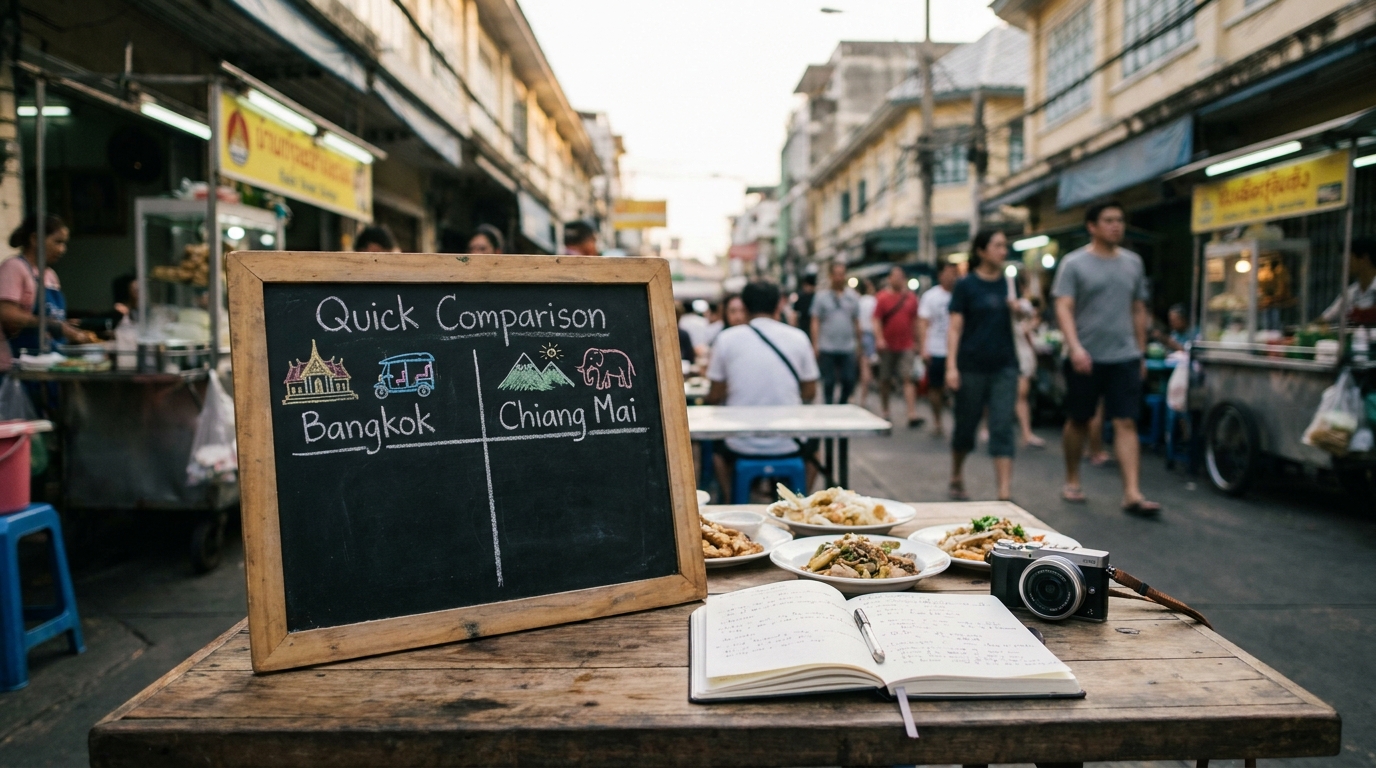
Bangkok vs Chiang Mai: Quick Comparison Table
Both cities are worth visiting, but they serve very different traveler needs — Bangkok dominates on variety and international access, while Chiang Mai wins on pace, affordability, and cultural depth.
| Category | Bangkok | Chiang Mai | Verdict |
|---|---|---|---|
| Vibe | Urban, fast-paced, cosmopolitan | Relaxed, cultural, community-driven | Depends on your travel style |
| Daily Budget | $45–70 USD | $35–55 USD | Chiang Mai wins slightly |
| Best For | First-timers, foodies, nightlife | Culture seekers, nomads, repeat visitors | Different audiences |
| Crowd Level | Very high year-round | Moderate, peaks Nov–Feb | Chiang Mai less crowded |
| Best Season | Nov–Feb (dry, cooler) | Nov–Feb (avoid Mar–Apr smoke) | Bangkok more forgiving |
| Transport In | Major international hub | Limited direct international flights | Bangkok wins |
Bottom line: If this is your first time in Thailand and you have under a week, Bangkok is the safer default. If you want a slower, more authentic experience, Chiang Mai earns its reputation. Read our full breakdown below to see which city fits your specific travel style.
Source: Tourism Authority of Thailand (TAT), 2024 Annual Visitor Statistics
Bangkok: Best For First-Timers Who Want It All
Bangkok delivers the kind of sensory overload that most travelers expect from Southeast Asia — and it backs that reputation up with world-class street food, grand temples, rooftop bars, and shopping that ranges from $1 market stalls to luxury malls.
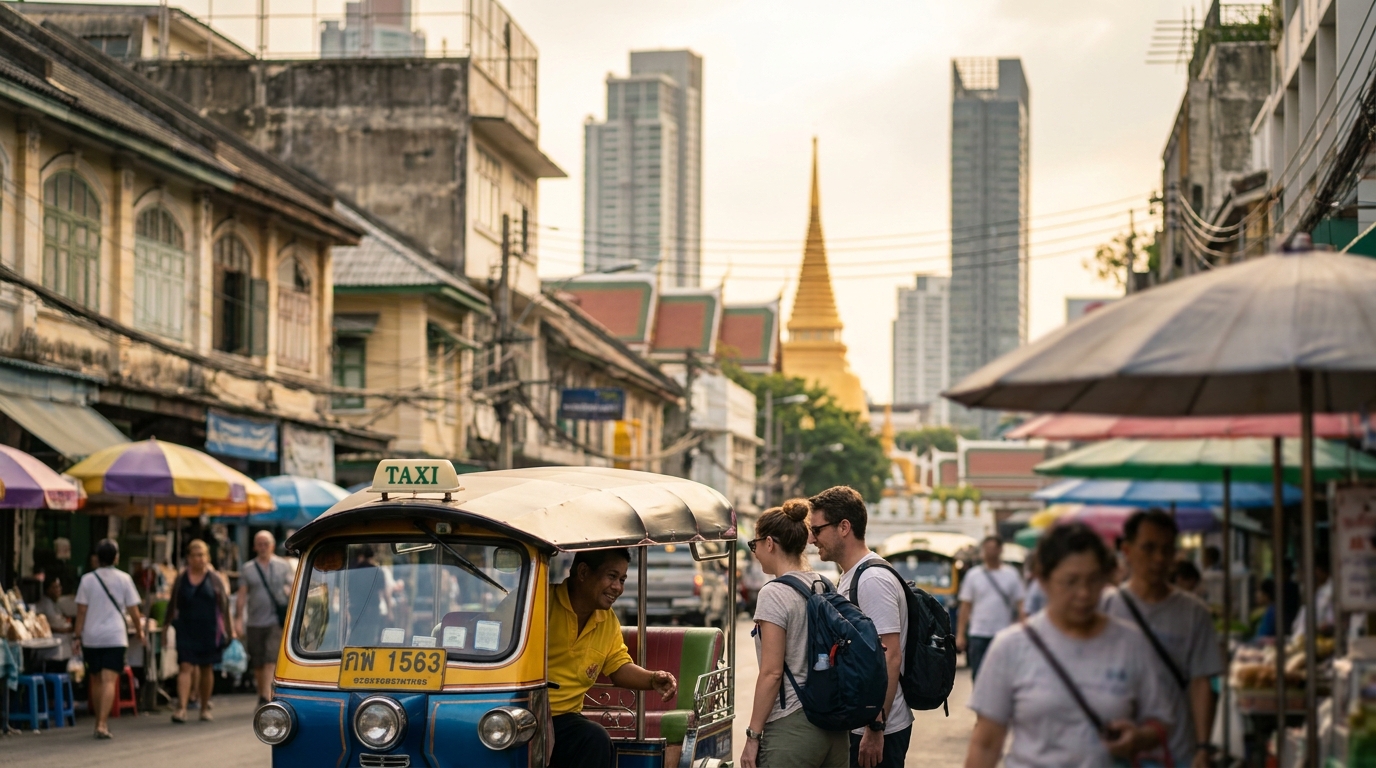
Strengths you’ll actually notice: The street food scene alone justifies a trip. Bangkok has more Michelin-starred street food vendors than almost any city in Asia — the 2024 Michelin Guide Thailand recognized over 50 Bangkok eateries, including legendary street-food spots like Jay Fai (pad kra pao, ~$15–25 USD per dish) and multiple $1–2 pad thai carts on Silom Road. The Grand Palace (entry 500 THB / ~$14 USD), Chatuchak Weekend Market, and the rooftop bars of Sathorn district are legitimate experiences that live up to the hype.
Who Bangkok suits best: First-time Thailand visitors get the most from Bangkok because it functions as a crash course in Thai culture, cuisine, and chaos simultaneously. Foodies, nightlife seekers, and transit travelers stopping over en route to islands or neighboring countries will find Bangkok hard to beat.
What Bangkok gets wrong: The heat is relentless — Bangkok averages 34°C (93°F) in April, its hottest month, with high humidity year-round (Thai Meteorological Department, 2024). Traffic between major areas like Sukhumvit and the Old Town can consume 45–90 minutes even for short distances. Khao San Road, while iconic, has become a tourist bubble that feels disconnected from the city’s real character. For short stays, Bangkok’s size (1,569 sq km) can feel overwhelming rather than exciting.
Authenticity note: Bangkok is more Westernized and commercialized than Chiang Mai. That’s not inherently bad — it means better infrastructure, more dietary options, and easier navigation — but travelers seeking traditional Thai culture will find Chiang Mai’s Old City more rewarding.
For a full rundown of what to do, check our guide to things to do in Bangkok.
Source: Thai Meteorological Department, 2024; Michelin Guide Thailand, 2024
Chiang Mai: Best For Culture-Seekers and Slow Travelers
Chiang Mai offers something Bangkok simply can’t replicate — a walkable historical center, cooler mountain air, and a pace of life that actually lets you absorb Thai culture rather than survive it.
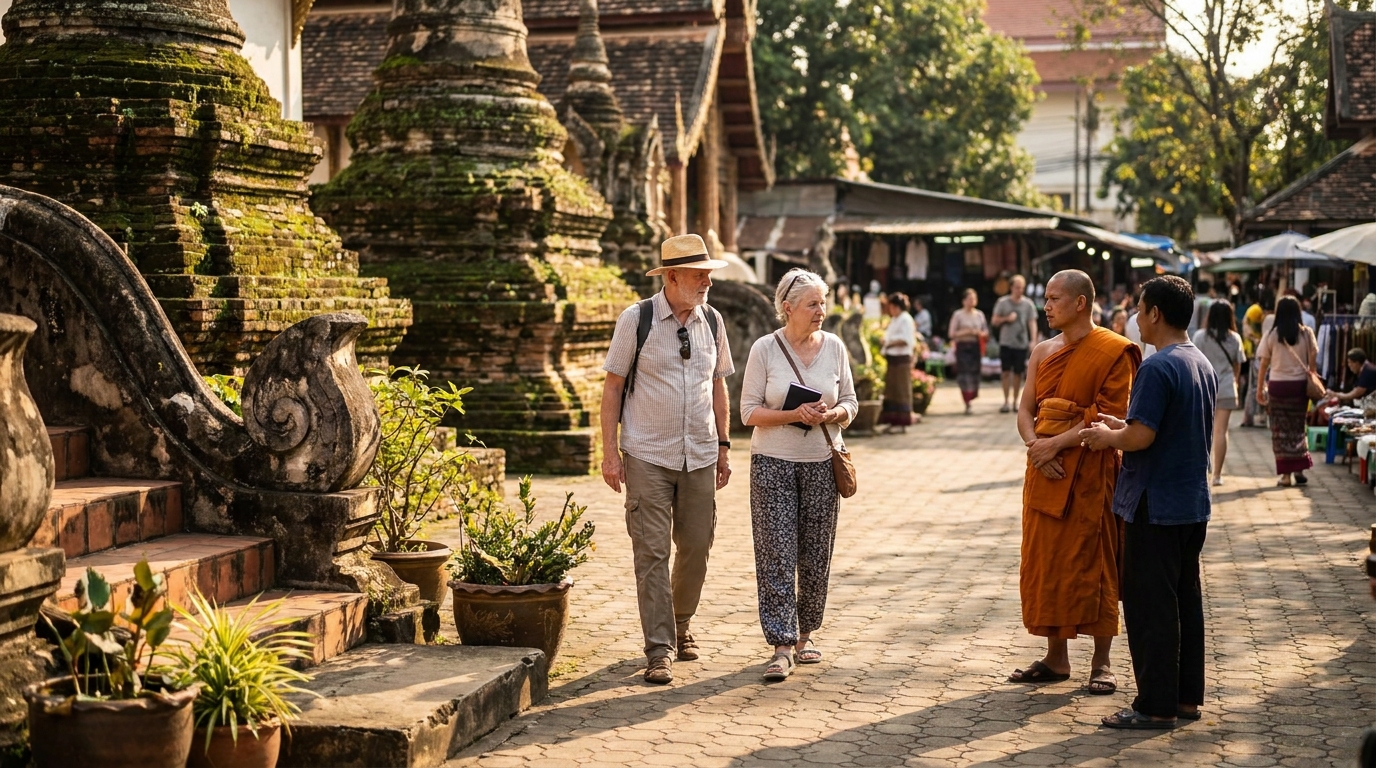
Yes, Chiang Mai is measurably cooler than Bangkok. The city sits at roughly 300 meters elevation in northern Thailand and averages 29°C (84°F) in its hottest months versus Bangkok’s 35°C+. From November through February, temperatures in Chiang Mai can drop to a comfortable 15–18°C (59–64°F) at night — light jacket weather that Bangkok never offers.
What makes Chiang Mai distinct: The Old City’s 300+ temples (including Wat Chedi Luang and Wat Phra Singh, both free or under 40 THB/$1.10 USD to enter) feel genuinely lived-in rather than staged for tourists. The Sunday Walking Street on Wualai Road runs every week and sells locally made crafts, northern Thai snacks, and handwoven textiles at prices that don’t inflate the moment you arrive. Ethical elephant sanctuaries like Elephant Nature Park (from ~$80 USD per day visit, bookable via Klook) sit within 60–90 minutes of the city center.
The digital nomad factor: Chiang Mai consistently ranks among the top 10 cities globally for remote workers. Nomad List placed it in the top 15 as recently as 2024, citing affordable co-working spaces (150–300 THB/$4–8 USD per day), fast fiber internet in most guesthouses, and a large English-speaking expat community.
Who Chiang Mai is NOT for: Travelers wanting luxury international-brand hotels, direct flights from most Western cities, or a buzzing late-night bar scene will find Chiang Mai limiting. Nightlife exists — the Nimman area has craft bars and live music — but it wraps up earlier and is far quieter than Bangkok’s districts.
One critical warning: March through April is burning season, when agricultural fires push Chiang Mai’s Air Quality Index (AQI) above 150–200 — classified as unhealthy. Avoid visiting during this window if you have respiratory concerns.
See our full Chiang Mai travel guide for neighborhood-by-neighborhood planning.
Source: Nomad List, 2024; IQAir Chiang Mai Historical AQI Data, 2024
Bangkok vs Chiang Mai: Budget, Food, Hotels, Safety & Activities
This is the section where the real decision gets made. We’ve broken down every major travel dimension so you can compare both cities at a glance.
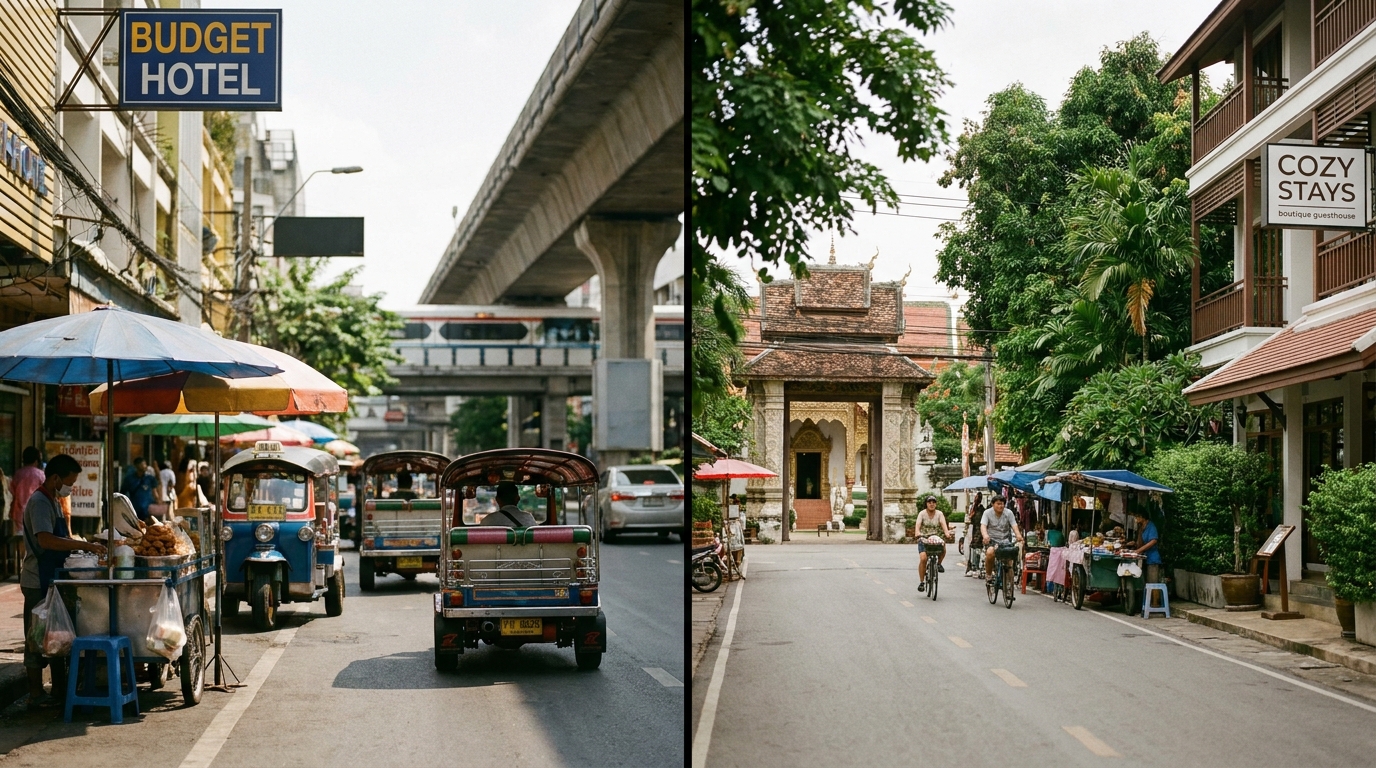
Budget
Chiang Mai comes in slightly cheaper across nearly every spending category. A comfortable mid-range traveler in Chiang Mai spends $35–55 USD per day covering a private guesthouse room, two to three meals, local transport, and one paid activity. The same lifestyle in Bangkok costs $45–70 USD, driven mainly by higher accommodation rates in well-located areas and pricier transport between distant attractions.
Budget backpackers can cut costs further in both cities — Chiang Mai hostel dorms start around 150–200 THB ($4–5.50 USD) per night, Bangkok dorms from 250–350 THB ($7–9.50 USD) in neighborhoods like Banglamphu. Street food in both cities keeps meal costs under $3–4 USD if you eat local.
Source: Numbeo Cost of Living Thailand, Q1 2025; Hostelworld average prices, 2024–2025
Food
Bangkok wins on raw variety and sheer density of options — from authentic regional Thai to Japanese omakase to vegan brunch cafes. The city’s street food scene is genuinely world-class, with dishes like boat noodles (50–60 THB/$1.40 USD) and mango sticky rice (80–100 THB/$2.20 USD) available at hundreds of stalls across every district.
Chiang Mai’s strength is northern Thai cuisine that you won’t find authentically prepared anywhere in Bangkok. Khao soi — a rich coconut curry noodle soup — costs 60–80 THB ($1.65–2.20 USD) at local spots like Khao Soi Lung Prakit Kad Kom and is reason enough to make the trip north. The city also has a thriving healthy-eating cafe scene centered around the Nimman Road area.
Hotels
Bangkok offers more five-star international brands — the Mandarin Oriental, Capella, and Park Hyatt all have Bangkok properties starting around $250–400 USD per night. Mid-range hotels in central Bangkok (Sukhumvit, Silom) run $40–80 USD for a clean, air-conditioned room with breakfast.
Chiang Mai’s boutique hotel scene offers exceptional value. Traditional Lanna-style guesthouses in and around the Old City run $25–55 USD per night and include features like garden courtyards and in-house cooking classes that Bangkok’s equivalent price point can’t match.
Search and compare both cities on Booking.com — use their filter for “boutique” in Chiang Mai and “city center” in Bangkok for the best value-to-location ratio.
Safety
Both cities are generally safe for tourists by Southeast Asian standards. Numbeo’s 2024 Crime Index rated Bangkok at 43.2 (moderate) and Chiang Mai at 26.8 (low) — Chiang Mai is measurably safer on paper.
Bangkok’s main risks are traffic (motorbike taxis and tuk-tuks carry real accident risk), petty theft in crowded tourist areas, and gem scams targeting first-timers near the Grand Palace. Chiang Mai’s seasonal air quality is the biggest health concern — AQI levels above 180 were recorded for 30+ days during March–April 2024.
Source: Numbeo Crime Index Thailand, 2024; IQAir Thailand, 2024
Activities
Bangkok’s activity menu skews toward temples, shopping, nightlife, and cooking classes. Book skip-the-line Grand Palace tickets, Chao Phraya dinner cruises, and Muay Thai stadium seats through Klook to avoid queues and overpaying at the gate.
Chiang Mai’s activities are nature and culture-heavy: elephant sanctuary day trips, doi (mountain) trekking, temple cycling tours, and traditional Thai massage school visits. Ethical elephant experiences and guided night market tours are also well-priced on Klook with verified operator reviews.
How to Get from Bangkok to Chiang Mai (And Should You Do Both?)
The distance between Bangkok and Chiang Mai is approximately 700 km (435 miles) — close enough to combine in one trip, and far enough that the journey itself deserves planning.
By air (recommended): Budget airlines AirAsia and Thai Lion Air operate multiple daily flights on this route. One-way fares range from $25–60 USD when booked 2–4 weeks out; last-minute prices can hit $80–100 USD. Flight time is approximately 1 hour 15 minutes. Don Mueang Airport (DMK) in Bangkok serves most budget routes to Chiang Mai International (CNX).
By overnight train (budget + experience): The State Railway of Thailand’s overnight sleeper from Hua Lamphong station costs $20–35 USD (second-class sleeper) and takes 11–13 hours, arriving in the morning. It’s slower but genuinely pleasant — you wake up in the north without losing a day to travel. Book at least a week ahead through the SRT website or at the station.
By bus: Several private operators (Nakhon Chai Air, Green Bus) run Bangkok to Chiang Mai in 10–12 hours for $12–20 USD. Comfortable but long — best for travelers who’ve done the train and want to compare.
Should you do both? Yes, if you have 7+ days. We recommend a minimum of 3 full days in Bangkok and 3 full days in Chiang Mai. Open-jaw flights (fly into Bangkok, depart from Chiang Mai, or reverse) save backtracking time and are priced similarly to round-trips on most booking platforms.
See our detailed transport breakdown in Bangkok to Chiang Mai: how to get there.
Source: State Railway of Thailand schedule data, 2025; Google Flights average fare data, Q1 2025
Bangkok vs Chiang Mai vs Phuket: Where Does Each Fit in Your Trip?
Thailand’s three most-visited destinations each serve a distinct traveler profile — and understanding how they fit together helps you build a smarter itinerary.
Bangkok is the country’s entry point and cultural engine. It works best at the start of any Thailand trip: get your bearings, eat everything, visit the temples, and use the city’s excellent transport connections to fan out to the rest of the country.
Chiang Mai is the north’s cultural capital and the natural second stop for travelers who want something quieter and cooler. It pairs well with Bangkok because the contrast is striking — from 10-lane highways to moat-lined temple streets.
Phuket serves a different audience: beach holidaymakers, resort guests, and party travelers. It shares more in common with Bali than with Chiang Mai. Travelers who want white-sand beaches, water sports, and resort infrastructure should prioritize Phuket or Krabi over Chiang Mai, not alongside it.
Suggested 10-day split: 3 nights Bangkok + 3 nights Chiang Mai + 4 nights Phuket or Krabi. Fly between each segment using AirAsia or Thai Lion Air to avoid slow overland legs.
Who should skip which: Beach-focused travelers can skip Chiang Mai without major regret. Culture-focused travelers can skip Phuket. Almost nobody should skip Bangkok on a first Thailand trip.
As for the question of Thailand’s prettiest city — that’s subjective, but Chiang Mai’s lantern-lit temple courtyards and mountain backdrop make it the most consistently photogenic of the three inland cities.
Our Thailand 10-day itinerary maps out exactly how to structure this trip, including flight timing and hotel neighborhoods.
Source: Tourism Authority of Thailand visitor segmentation report, 2024
Why Some Tourists Are Rethinking Thailand (And What It Means for You)
Thailand still ranks among Southeast Asia’s top destinations, but it’s worth addressing the growing conversation about overcrowding and rising costs honestly.
The overcrowding reality: Bangkok’s Grand Palace and Chiang Mai’s Doi Suthep do get genuinely crowded during peak season (November–February). Queues of 45–60 minutes at major temples are common on weekends. Visiting on weekday mornings or booking timed-entry tickets via Klook reduces this significantly.
Rising costs post-COVID: Thailand’s tourism prices have increased roughly 15–20% since 2019 for accommodation and activities. That said, daily budgets still run well below equivalent experiences in Western Europe — $50 USD in Chiang Mai still buys a private room, three meals, and a temple visit.
Seasonal concerns: Bangkok’s air quality deteriorates November–February during the regional haze season. Chiang Mai’s burning season (March–April) is more severe and more localized.
Our honest take: Thailand remains one of Southeast Asia’s strongest value destinations despite these issues. The key is timing — May and November offer the best balance of manageable crowds, lower prices, and tolerable weather in both cities.
Check our guide on the best time to visit Thailand for a month-by-month breakdown.
Source: TAT International Tourist Arrivals Report, 2024; IQAir Thailand Seasonal AQI Data, 2024
Our Verdict: Who Should Choose Bangkok vs Chiang Mai?
After breaking down every dimension, here’s where we land.
Choose Bangkok if you’re visiting Thailand for the first time, have 5 days or fewer, love urban energy, eating constantly, and being close to great nightlife — or if you’re flying in internationally and want a city that justifies its own trip.
Choose Chiang Mai if you’re a culture-focused traveler, prefer a slower pace, are working remotely, traveling on a tighter budget, or are returning to Thailand and ready to go deeper than the capital.
Choose both if you have 10 or more days and want to experience Thailand’s full range — the contrast between these two cities is one of the best arguments for spending more time in the country.
One-sentence verdict: Bangkok impresses you; Chiang Mai changes how you think about travel.
For more planning resources, explore our Thailand travel planning resources and our full northern Thailand destination guide.
Frequently Asked Questions
Is Bangkok or Chiang Mai better for a first visit to Thailand?
Bangkok is the stronger choice for a first visit. It offers more variety, better international transport connections, and a denser concentration of top-rated attractions. Chiang Mai rewards travelers who already have some Thailand experience and want to slow down and explore northern culture more deeply.
Is Chiang Mai significantly cheaper than Bangkok?
Chiang Mai is moderately cheaper — expect to spend roughly $10–15 USD less per day on average. The biggest savings come from accommodation and local transport. Street food prices are similar in both cities, typically under $3 USD per meal when eating at local stalls.
Is Chiang Mai cooler in temperature than Bangkok?
Yes, measurably so. Chiang Mai sits at higher elevation and averages 4–5°C (7–9°F) cooler than Bangkok throughout the year. During peak cool season (December–February), nighttime temperatures in Chiang Mai can drop to 15°C (59°F) — a stark contrast to Bangkok’s consistently humid warmth.
How far is Bangkok from Chiang Mai and what is the best way to travel between them?
Bangkok and Chiang Mai are approximately 700 km (435 miles) apart. The fastest option is a 1-hour-15-minute flight for $25–60 USD. The overnight train (11–13 hours, $20–35 USD) is the best budget-plus-experience option. Buses take 10–12 hours and cost $12–20 USD.
What is the best time of year to visit Chiang Mai vs Bangkok?
For both cities, November through February is the most comfortable period — dry, lower humidity, and manageable temperatures. Avoid Chiang Mai from March to April due to agricultural burning and poor air quality. Bangkok is tolerable year-round but uncomfortably hot from March through May.
Is Chiang Mai safe for solo female travelers compared to Bangkok?
Both cities are generally safe for solo female travelers. Chiang Mai scores lower on Numbeo’s crime index (26.8 vs Bangkok’s 43.2 in 2024) and has a tighter-knit traveler community that many solo women find reassuring. Standard precautions apply in both cities — avoid poorly lit areas at night and use app-based taxis (Grab) over flagging vehicles.
Can you do Bangkok and Chiang Mai in one week?
Yes, though it’s tight. A practical split is 3 nights Bangkok and 3 nights Chiang Mai with one transit day for the flight between them. This gives you enough time for the key experiences in each city without feeling rushed. Prioritize 2–3 non-negotiable experiences per city rather than trying to see everything.
Conclusion
Bangkok and Chiang Mai aren’t competitors — they’re complements. Bangkok gives you the Thailand that the world talks about: the temples, the street food chaos, the skyline, the energy. Chiang Mai gives you the Thailand you didn’t expect: quiet courtyards, mountain air, elephant sanctuaries, and a pace that actually lets you think.
If you’re choosing just one, let your travel style decide. First-timer with limited time? Start in Bangkok. Culture-focused or budget-conscious? Go straight to Chiang Mai. Have a full week or more? Do both — fly between them and experience two completely different countries within one.
Book your Bangkok and Chiang Mai activities in advance through Klook to lock in prices and skip queues. For accommodation, compare options in both cities on Booking.com for the best boutique and mid-range value. And if you need a local SIM or eSIM on arrival, Airalo offers Thailand data plans from around $5 USD.